10 Best Yellow.ai Alternatives: TL;DR Comparison Table
| # | Tool | Best For | Starting Price (annual billing) | G2 Rating |
|---|---|---|---|---|
| 1 | CloudTalk | SMB and mid-market teams that want a telephony-native phone system with AI voice built in | $25/user/mo | 4.4/5 |
| 2 | Intercom Fin | Product-led support teams automating tickets on their existing helpdesk | $0.99/resolution (Essential seat from $29/mo) | 4.5/5 |
| 3 | Kore.ai | Enterprise teams needing deep NLU and complex backend integrations | Custom (quote-only) | 4.6/5 |
| 4 | Cognigy | Enterprise contact centers blending AI automation with human-agent chat and voice | Custom (quote-only) | 4.6/5 |
| 5 | Ada | High-volume e-commerce and B2C teams wanting zero-code bot deployment | Custom (quote-only) | 4.6/5 |
| 6 | Retell AI | Engineering teams building custom low-latency voice agents from scratch | ~$0.13-0.31/min (PAYG) | 4.8/5 |
| 7 | PolyAI | Enterprise contact centers with six-figure budgets needing premium voice quality | Custom (from ~$150K/yr) | 5/5 |
| 8 | Dialpad | AI-first teams wanting built-in transcription on a real business phone system | $15/user/mo | 4.4/5 |
| 9 | RingCentral | Mid-market teams needing enterprise-grade UCaaS with AI layered in | $20/user/mo (Core) | 4.2/5 |
| 10 | Genesys Cloud CX | Large enterprise contact centers needing telephony-native scale, not chatbot orchestration | ~$75/user/mo (Omnichannel Suite) | 4.4/5 |
Skip the Reading. See It Live.
Why Are Teams Searching for a Yellow.ai Alternative?
Yellow.ai built a real business automating chat, WhatsApp, and voice bots for large enterprises like Sephora, BMW, and Sony, and its agentic AI engine genuinely holds up at scale. The trouble starts once a team's actual need is narrower: a phone system that answers calls well, not a 35-channel orchestration suite with voice as an afterthought.
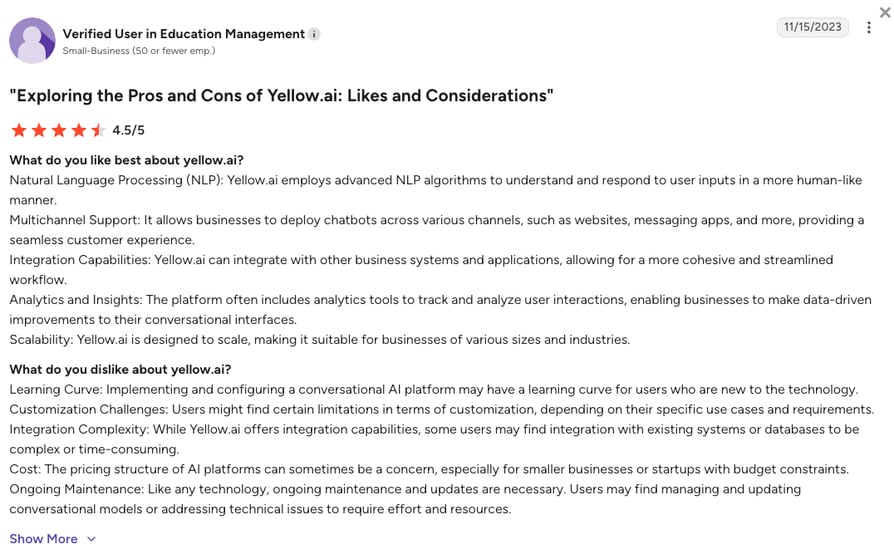
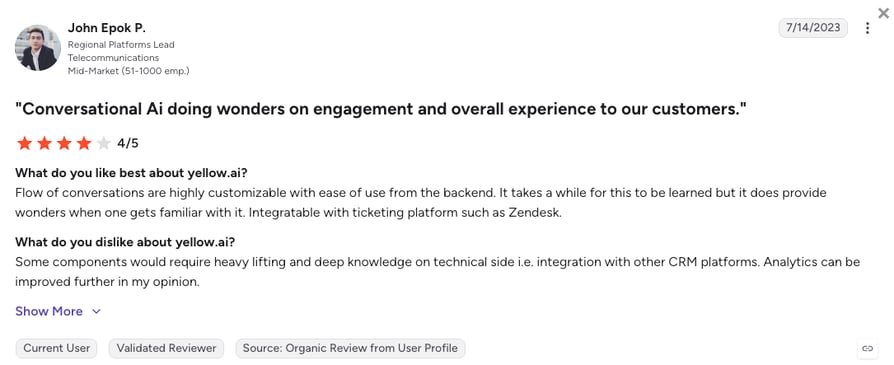
Yellow.ai's own G2 profile sits at 4.4/5 from just over 100 reviews, filed under G2's Agentic AI Software category rather than VoIP or Contact Center software, and its features page lists 35+ supported channels before voice even gets a dedicated section. Based on that review base plus current Reddit and Quora threads, here are the five structural problems that send Yellow.ai buyers looking elsewhere.
5 Main Cons of Yellow.ai That Make Businesses Look for an Alternative
- Voice is a channel bolted onto a chatbot engine, not a phone systemYellow.ai's VoiceX voice layer sits on top of the same bot orchestration core that runs WhatsApp and web chat. There's no carrier-grade telephony stack underneath it, no CRM click-to-dial, and no live softphone workspace built for a team that spends its day on the phone, not in a chat window.
- Two options: a capped Free tier, or a custom Enterprise quoteYellow.ai's live pricing page shows exactly two tiers: Free (1 AI agent, 500 chat resolutions/month included, then $0.99 per resolution, with voice, channels, and integrations all marked "Limited"), and Enterprise, quote-only with no published number. There's no mid-market self-serve plan in between, so any real usage means a sales-led procurement cycle.
- Human handoff is a channel switch, not a live transferWhen a Yellow.ai bot escalates, the conversation routes to a human agent's inbox, a different tool from the one that ran the automated exchange. On a phone system, that gap matters more: a caller stuck with a voice bot gets bounced to a new queue instead of a warm, in-call handoff to a person who can already see the call history.
- 35+ channels means paying for and configuring a lot you may not useYellow.ai's own feature page counts 35+ supported channels (WhatsApp, Slack, Teams, IVR, social, and more) under one no-code builder. G2 reviewers repeatedly flag a steep learning curve and integration complexity for teams that just wanted one channel, voice, done well.
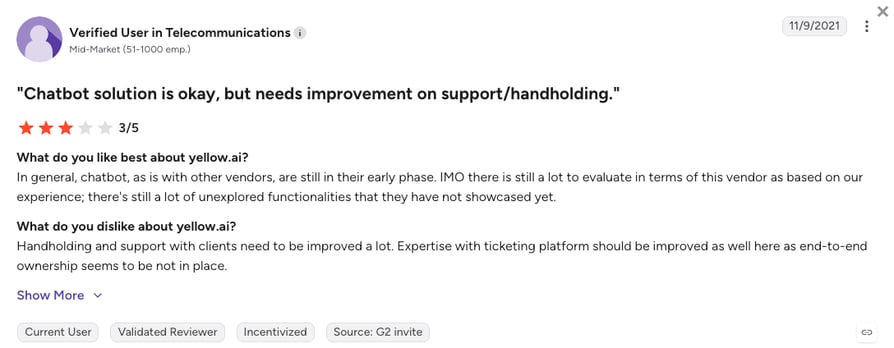
- Implementation heaviness and inconsistent support on longer rolloutsRecent G2 reviews describe multi-month implementation timelines and mixed support responsiveness on complex deployments, even with 24/7 support advertised. Yellow.ai also cut roughly 140 to 150 roles across two 2025 layoff rounds as it repositioned from "chatbot builder" to "agentic AI platform",¹ the kind of transition worth watching if you're signing a multi-year enterprise contract.
Where Yellow.ai Shines
Yellow.ai's depth in India and APAC BFSI, telecom, and utilities is real, with multilingual voice bots built to replace call center headcount at serious volume in Hindi and regional languages. That's a genuine strength, not a gap to attack. For growing teams that need calling that reaches well beyond one region without India-specific vertical tooling, CloudTalk's virtual number coverage is built for that instead.
What Is the Best Alternative to Yellow.ai?
CloudTalk is the best Yellow.ai alternative for SMB sales and support teams that need calling to be the main event, not one of 35 channels. Plans start at $25/user/mo (Starter), with unlimited inbound calling, 500 outbound minutes a month, call queues, transfers, and click-to-call, no seat minimum until Expert (3-seat minimum), backed by a 99.999% uptime SLA. Outbound calling goes unlimited from Essential.
Why Do Teams Consider CloudTalk the Best Yellow.ai Alternative?
The core difference between Yellow.ai vs CloudTalk is the architecture. Yellow.ai's voice product rides on a chat-first bot engine. CloudTalk's AI Voice Agent and human reps run on the exact same carrier-grade calling infrastructure, CRM sync, and call record, so an escalation is a warm, in-call transfer, not a ticket handed to a different tool.
Instead of a custom quote tied to conversation volume and channels, CloudTalk offers per-user pricing and a self-serve free trial, no sales-led enterprise procurement required just to get calling with an AI layer live.
5 Main Pros of CloudTalk and Why Businesses Switch from Yellow.ai
- Carrier-grade calling in 160+ countries, not voice as one channel of 35CloudTalk's calling infrastructure is telephony-native from the ground up, with international phone numbers in 160+ countries. Yellow.ai's VoiceX runs on top of the same engine that powers its chat and WhatsApp bots, a real architectural difference once call quality and uptime are what's on the line.
- Real CRM click-to-dial, not a bot logging into a helpdeskCloudTalk connects to 100+ CRM and helpdesk tools from the Essential plan, with two-way sync so reps dial straight from the CRM record and the outcome writes itself back automatically.
- A warm, in-call handoff, not a channel-to-channel handoffWhen a CloudTalk AI Voice Agent call needs a person, it escalates live, on the same call, same CRM record. Yellow.ai's bot-to-human handoff routes into a separate agent inbox instead, a colder handoff for a caller who's already mid-conversation.
- Published per-user pricing and a self-serve trial, no procurement cycleCloudTalk plans are $25, $29, and $49/user/mo, all listed publicly with a 14-day free trial. Yellow.ai's real product still sits behind a custom Enterprise quote tied to conversation volume and channels.
- No-code AI Receptionist live in minutes, not a multi-month rolloutCloudTalk's AI Receptionist deploys with no engineering sprint, 50 free minutes on every account (one-time), and 24/7 chat and email support on every plan (phone support on Expert). No bot orchestration project required to get calls answered.
Test It for 14 Days. No Sales Call Required.
How We Chose the Best Yellow.ai Alternatives and Competitors
To build this list, we worked with user experiences from Reddit, Quora, and G2, reviewed official pricing pages and technical documentation for every vendor, and evaluated three different categories of Yellow.ai alternative, omnichannel CX suites, pure AI voice specialists, and full business phone systems with AI, against the same six benchmarks.
We evaluated every platform against the criteria that matter most to teams switching away from Yellow.ai.
- Call Stability & ReliabilityWe checked whether voice runs on dedicated telephony infrastructure or as one channel inside a broader bot engine, plus uptime SLAs and real user reports of call quality.
- Total Cost of OwnershipWe compared published self-serve pricing against custom Enterprise quotes tied to conversation volume, seats, and channels, and whether AI features are bundled or gated.
- CRM & Helpdesk Integration DepthWe looked at whether call and chat data syncs both ways with click-to-dial and automation, versus one-directional logging into a separate agent inbox.
- Global Coverage & Number AvailabilityWe prioritized platforms with virtual numbers across multiple countries and continents, not just deep regional strength in a single market.
- Support Quality & AvailabilityWe checked 24/7 availability, implementation timelines, and how consistently support performs on complex, multi-channel rollouts.
- AI & Automation CapabilitiesWe assessed whether AI voice agents, call summaries, and handoffs are native to the calling layer or layered on top of a chat-first bot engine.
The Top 10 Alternatives to Yellow.ai for 2026
In this part, we'll take a detailed look at all 10 alternatives to Yellow.ai. Before that, here's how Yellow.ai stacks up against a telephony-native phone system, a chat-first CX peer, and a pure AI voice API, the three shapes most Yellow.ai searches actually take.
Yellow.ai vs. CloudTalk vs. Fin vs. Retell AI vs. Dialpad
| Feature | Yellow.ai | CloudTalk | Fin | Retell AI | Dialpad |
|---|---|---|---|---|---|
| Starting Price | Free (capped) or Enterprise custom quote | $25/user/mo | $0.99/resolution + Intercom seat | ~$0.13-0.31/min (PAYG) | $15/user/mo |
| Seats Minimum | None (per-agent limits on Free) | None (3 on Expert) | None | None | None |
| Free Trial |  (capped Free tier) (capped Free tier) | (14 days) | (90-day Fin risk-free) | ($10 free credits) | (14 days) |
| Call Recording | Limited on Free, Unlimited on Enterprise | Automatic from Starter (1-month retention; unlimited from Essential) |  (not a phone system) (not a phone system) | Add-on via telephony partner | (Standard) |
| CRM Integrations | Limited on Free, custom on Enterprise | 100+ tools from Essential, two-way sync | Any helpdesk (Zendesk, Salesforce, HubSpot) | Webhook-based, custom build | Salesforce, HubSpot (Pro plan) |
| AI Features | 35+ channel bot builder, VoiceX voice layer | Conversation Intelligence, AI Receptionist + AI Voice Agent, native to calling, all available as flat-rate add-ons | Fin AI Agent (chat/email/voice resolutions) | Low-latency voice engine (developer-built) | AI transcription and call summaries |
| Dialer Type | Not applicable (not a phone system) | Power Dialer (Expert, or $15/user/mo add-on), Parallel Dialer ($39/user/mo add-on). Smart & Preview on Expert. Click-to-call from Starter. | Not applicable (not a phone system) | Not applicable (voice API only) | Not applicable on Standard; higher tiers add outbound tools |
| Analytics & Reporting | LLM analytics, sentiment, topic tracking (Enterprise) | Conversation Intelligence for sentiment, topics, transcripts, and more + real-time call center Analytics from Expert | Reporting and workflow analytics | Call logs and latency metrics | Built-in call analytics |
| Country/Number Coverage | Global reach, deepest in India/APAC | Numbers for 160+ countries | Not a calling platform | Twilio-based SIP, US-centric | International numbers on Pro |
| Customer Support | 24/7 claimed; mixed consistency on complex rollouts | 24/7 (phone on Expert) | 24/7 (Advanced/Expert) | Community + Enterprise SLAs | 24/7 on higher tiers |
Not a Like-for-Like Grid
Yellow.ai, Fin, and Retell AI aren't full business phone systems the way CloudTalk and Dialpad are, so a few rows above read "not applicable" rather than a loss. That's the point: the right alternative depends on whether you need a phone system, a helpdesk bot, or a raw voice API.
1. CloudTalk: Best Yellow.ai Alternative for Telephony-Native Calling with AI Voice Built In
What Is CloudTalk?
CloudTalk is an AI-powered cloud phone system built for growing SMB and mid-market sales and support teams. It sits between raw voice APIs and heavyweight enterprise CX suites, giving growing teams a full contact center feature set with AI voice agents built natively into the calling layer, not layered on top of a chat engine.
Unlike Yellow.ai, CloudTalk's setup runs self-serve from a public pricing page, so a team can go from signup to a working phone system the same day, no sales-led implementation project required. Currently, more than 5,500+ growing teams around the world use CloudTalk to boost their productivity and offload the routine to AI, so their reps can stay focused on winning deals, offering great support, and ultimately, driving more revenue.
Why Is CloudTalk a Strong Yellow.AI Alternative?
- Telephony you don't have to assemble yourself: CloudTalk's carrier-grade calling runs on its own infrastructure, backed by a 99.999% uptime SLA, with local numbers in 160+ countries.
- Two-way CRM automation, not one-directional logging: CloudTalk syncs with 100+ CRM and helpdesk tools including HubSpot, Zendesk, or Pipedrive from Essential, and Salesforce from Expert. Calls, transcripts, and contact updates write back automatically, no manual cleanup.
- AI voice agents in 60+ languages, live in minutes: The AI Receptionist answers in 60+ languages with a no-code setup and 50 free minutes on every account (one-time). No engineering sprint and no bot-building project needed.
- Real outbound dialers built into the platform: CloudTalk is made for sales, offering Power Dialer (Expert or a $15/mo add-on) and Parallel Dialer ($39/user/mo add-on) that let sales teams work a list, not just receive calls.
- Transparent per-user pricing, no procurement cycle: Every CloudTalk plan and add-on is publicly listed, and each comes with a 14-day free trial. No custom quote, no conversation-volume math before you can even test it.
What Are the Pros & Cons of CloudTalk?
| Pros | Cons |
|---|---|
| AI Voice Agents, AI receptionists, and human support and sales reps share the same call record | No native video calls or omnichannel (voice-first by design) |
| 100+ CRM integrations from Essential, two-way sync | Phone support only available on the Expert plan |
| Power Dialer and Parallel Dialer for real outbound campaigns | Parallel Dialer only works as a $39/user/mo add-on (to any plan) |
| 160+ countries you can choose virtual numbers for | |
| Published per-user pricing and a 14-day free trial |
What Are CloudTalk's Plans & Pricing?
CloudTalk pricing starts at $25/user/mo (Starter, billed annually), with the following plans:
CloudTalk Pricing Plans
| Plan | Price (annual billing) | Key Features |
|---|---|---|
| Starter | $25/user/mo | Unlimited inbound calling, 500 outbound minutes/mo (regional), call queues, transfers, click-to-call, automatic call recording (1-month retention) |
| Essential | $29/user/mo | Everything in Starter + 100+ CRM integrations, IVR, skill-based routing, workflow automation, unlimited outbound (FUP applies), unlimited call recording retention |
| Expert | $49/user/mo (3-seat min) | Everything in Essential + Salesforce Ecosystem Integration, Power Dialer, 24/7 phone support |
| Conversation Intelligence (add-on) | $9/user/mo | AI call summaries, sentiment analysis, AI call scoring, topic detection, and more as an add-on to any plan |
| AI Receptionist | 50 free min/account (one-time), then $99/mo (200 min) up to $699/mo (2,500 min) | Inbound, no-code, 24/7, 60+ languages, first 50 minutes free |
| AI Voice Agent (Specialist) | From $349/mo (1,000 min) | Inbound and outbound, sales-led setup, complex workflows |
Sales Dialers at a Glance
CloudTalk bundles Power Dialer on Expert, or you can choose it as a $15/user/mo add-on to any plan. Parallel Dialer is a $39/user/mo add-on on any plan, including Expert. Both are native capabilities most chat-first CX suites don't offer at all.
What Are CloudTalk's Customers Saying?
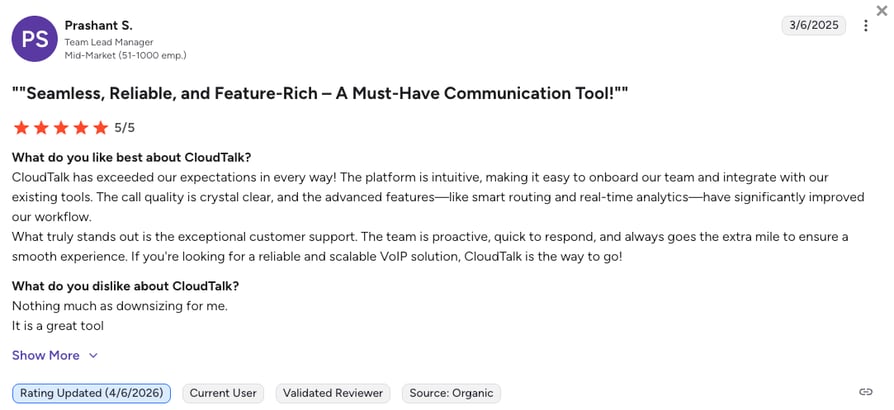
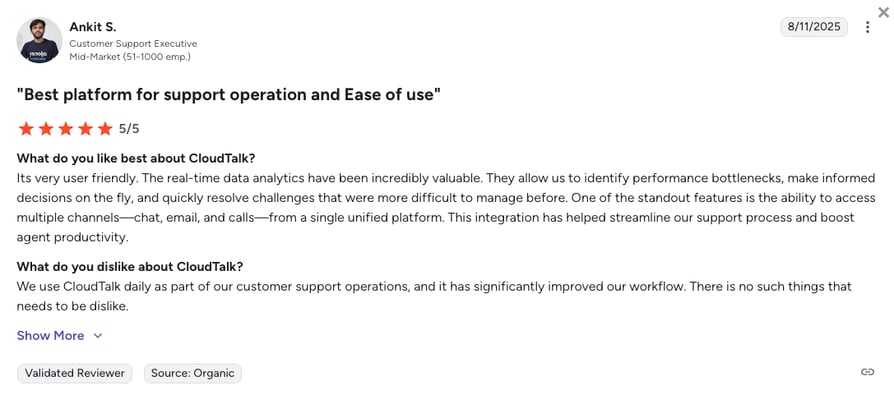
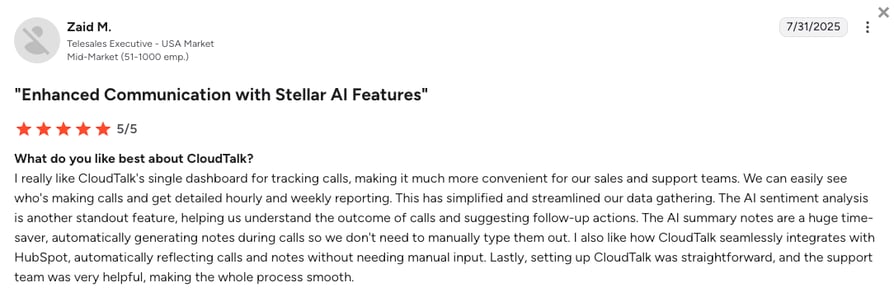
CloudTalk users consistently point to fast setup and CRM sync that actually holds up: calls, transcripts, and contact records logging automatically without the manual cleanup a bot-first tool leaves behind. Support responsiveness and ease of admin are recurring themes in verified reviews.
The most common friction point is plan structure: CRM integrations sit on Essential rather than Starter, and Salesforce deep-sync and Power Dialer are Expert-plan features, worth checking against team size before choosing a tier.
Case Study Time: CloudTalk's AI Voice Agents in Action
Circle Gym's story proves that CloudTalk's voice agents work. This Spanish fitness studio, managed remotely from Denmark, 2,000 km away, replaced its "here's a link to book your trial" flow with CloudTalk's conversational AI voice agent for appointment scheduling. Instead of a link, the agent asks callers directly what time works and locks the slot on the same call, the kind of native voice workflow a chat-first bot suite has to bolt on as a separate module.
Christian Stistrup, Circle Gym's owner, breaks down what changed:
”Originally, we sent a link for them to book online. Maybe 5% followed through. Now the AI just says: 'What time works for you?' It's so simple, but it works. People reply, the AI locks it in, and we're done.”
Owner of Circle Gym

How Do G2 Users Rate CloudTalk?
CloudTalk's current G2 rating is 4.4/5, based on 1,800+ verified reviews. Yellow.ai scores the same, but only out of 100+ reviews.
See Why 5,500+ Teams Chose CloudTalk over Yellow.ai
2. Intercom Fin: Best for Product-Led Support Teams Automating Tickets on Their Existing Helpdesk
What Is Intercom Fin?
Fin is Intercom's AI customer service agent, built to resolve support tickets end-to-end across chat, email, WhatsApp, SMS, and phone by sitting on top of a company's existing helpdesk. It serves product-led support and marketing teams already running Zendesk, Salesforce, or HubSpot. Fin AI's main differentiator is outcome-based pricing: $0.99 per resolution, billed only when Fin actually closes a ticket.
Salesforce acquisition:
Salesforce signed a definitive agreement on June 15, 2026 to acquire Fin (formerly Intercom) for approximately $3.6 billion, folding it into Agentforce, a deal expected to close around Q4 of Salesforce's fiscal 2027.²
Why Is Intercom Fin a Strong Yellow.ai Alternative?
- Works inside your existing helpdesk: Fin plugs into Zendesk, Salesforce, or HubSpot directly, so a support team doesn't have to migrate its ticket queue into a new inbox the way a full omnichannel platform switch usually requires.
- Setup in under an hour: Intercom's own claim is a same-day rollout for a working Fin agent, a much shorter runway than a multi-channel bot-building project.
- Outcome-based billing: $0.99 per resolution ties cost directly to tickets actually closed, rather than a seat or conversation-volume model that keeps climbing regardless of outcomes.
What Are the Pros & Cons of Intercom Fin?
| Pros | Cons |
|---|---|
| Works inside an existing helpdesk, no migration | Chat and ticket first, no native phone system or dialer |
| Pay-per-resolution pricing tied to outcomes | Pending Salesforce acquisition adds roadmap uncertainty |
| 90-day risk-free trial with a refund option | Resolution-based billing gets harder to forecast at high ticket volume |
What Are Intercom Fin's Plans & Pricing?
Intercom's Fin AI pricing starts at $0.99 per resolution on top of an Intercom seat, and it lets you choose from the following plans:
Intercom Fin Pricing Plans
| Plan | Price (annual billing) | Key Features |
|---|---|---|
| Essential | $29/seat/mo | Core support tools for individuals and small teams |
| Advanced | $85/seat/mo | Stronger automation, deeper reporting, more collaboration |
| Expert | $132/seat/mo | Advanced security controls, multibrand support, workflow management |
The Resolution Meter Trap
Fin's $0.99-per-resolution fee sits on top of the seat price, and it's not always clear upfront what counts as a billable outcome, resolutions, procedure handoffs, and disqualifications can all trigger a charge. At real support volume, that meter is harder to forecast than a flat per-seat rate, and none of it includes a native phone line.
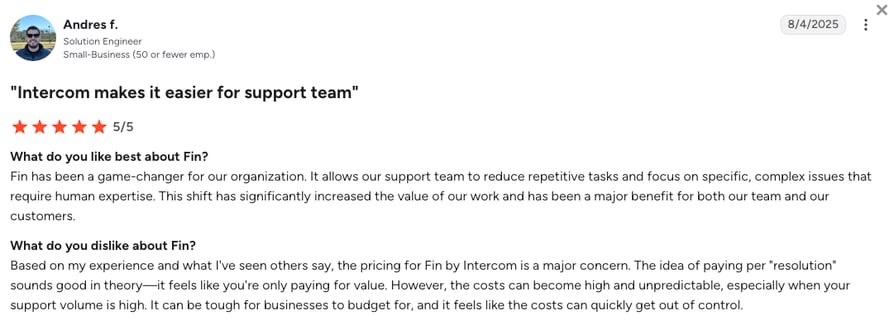
What Are Intercom Fin's Customers Saying?
Verified G2 reviewers rate Fin highly on helpfulness and ease of use, both among the most cited positives on its profile. The recurring complaints are missing features and AI limitations on more complex, multi-step support scenarios.
How Do G2 Users Rate Intercom Fin?
Fin currently holds a 4.5/5 rating on G2 across 3,800+ verified reviews, the largest review base of any tool on this list, inherited largely from Intercom's existing customer footprint.
3. Kore.ai: Best for Enterprise Teams Needing Deep NLU and Complex Backend Integrations
What Is Kore.ai?
Kore.ai is an enterprise conversational and agentic AI platform, recently rebranded around its Agent Platform Artemis, built for large organizations automating complex customer service and employee productivity workflows. It serves enterprise IT teams, with customers including Mphasis, that need deep natural language tuning and heavy backend integration work. Kore's main differentiator is NLU depth for highly customized, regulated automation, at the cost of a steep setup curve.
Why Is Kore.ai a Strong Yellow.ai Alternative?
- Deep NLU tuning for regulated workflows: Kore.ai is built for custom natural language processing on complex backend systems, a common need for banks and other regulated enterprises.
- Broad API and backend integration depth: The platform is designed to plug into complex internal systems and large enterprise IT stacks, not just consumer-facing channels.
- Enterprise support posture for regulated industries: Kore.ai targets the same large, regulated buyer Yellow.ai courts in BFSI, with a platform built around custom integration work rather than quick no-code setup.
What Are the Pros & Cons of Kore.ai?
| Pros | Cons |
|---|---|
| Deep NLU tuning for complex integrations | No public pricing; quote-only from an enterprise sales team |
| Enterprise-grade platform for regulated industries | Steep learning curve reported by reviewers |
| Broad automation across chat, voice, and process | Not a phone system; voice is one module inside a broader suite |
What Are Kore.ai's Plans & Pricing?
Kore.ai does not publish self-serve pricing, and it offers the following plan:
Kore.ai Pricing
| Plan | Price |
|---|---|
| Enterprise (custom) | Quote-only, market estimates start around $150,000+/yr |
The Kore.ai Quote Wall
There's no published starting price, no self-serve trial, and no way to estimate cost without a sales conversation. For teams that just need calling with an AI layer, that's a lot of procurement overhead before you know if the fit is even right.
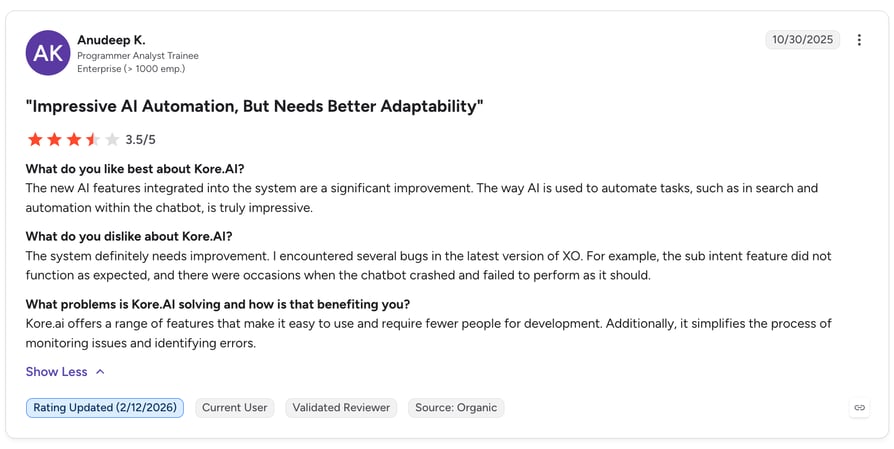
What Are Kore.ai's Customers Saying?
Reviewers consistently praise Kore.ai's integration depth and its ability to handle complex, custom automation. The most common friction point is a steep learning curve for teams without dedicated implementation resources.
How Do G2 Users Rate Kore.ai?
Kore.ai holds a 4.6/5 rating on G2 across 450+ verified reviews, filed under G2's AI Agents For Business Operations category.
4. Cognigy: Best for Enterprise Contact Centers Blending AI Automation with Human-Agent Chat and Voice
What Is Cognigy?
Cognigy, now operating as NICE Cognigy following company's acquisition by NICE CXone, is an enterprise conversational AI platform built to blend automated chat and voice with human-agent augmentation across a contact center. It serves large enterprise CX teams running omnichannel routing at scale. Cognigy's key differentiator is strong NLU quality now paired with NICE's existing contact center customer base and resources.
Why Is Cognigy One of the Best Yellow.ai Competitors?
- Omnichannel voice and chat orchestration with human-agent handoff: Cognigy is purpose-built to blend automated conversations with live agent augmentation across both voice and chat.
- Backed by NICE's contact center scale: Following the acquisition, Cognigy now sits inside NICE's broader CX portfolio and resources, a different stability profile than an independent vendor.
- Strong natural language understanding: Reviewers consistently cite Cognigy's NLU quality and drag-and-drop flow builder as standout strengths versus other enterprise bot platforms.
What Are the Pros & Cons of Cognigy?
| Pros | Cons |
|---|---|
| Strong NLU and automation quality per reviewers | Very small verified G2 review base to date |
| Backed by NICE's contact center scale post-acquisition | No public pricing; enterprise sales-led from day one |
| Blends automated voice and chat with human agents | Not a standalone phone system on its own |
What Are Cognigy's Plans & Pricing?
Cognigy does not publish self-serve pricing, and it offers the following plan:
Cognigy Pricing
| Plan | Price |
|---|---|
| Enterprise (custom) | Quote-only, sales-led |
The Cognigy Enterprise Minimum
Like several other enterprise CX suites on this list, Cognigy has no published starting price and no self-serve tier at all. Every evaluation starts with a sales conversation, even for teams that just want to test a single voice workflow.
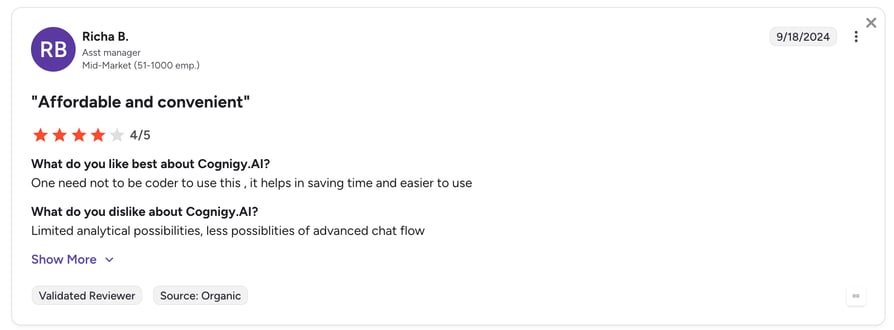
What Are Cognigy's Customers Saying?
The available reviews describe Cognigy as easy to learn with a fluid, flexible drag-and-drop flow builder that lets teams build automation logic without writing code. A frequent downside are the limited analytical capabilities. As a smaller review base, the sample size is worth keeping in mind.
How Do G2 Users Rate Cognigy?
Cognigy holds a 4.6/5 rating on G2, but only out of 10+ reviews. Cognigy's software is under the same AI Customer Support Agents Software category as Yellow.ai.
5. Ada: Best for High-Volume E-Commerce and B2C Teams Wanting Zero-Code Bot Deployment
What Is Ada?
Ada is a zero-code AI customer service agent platform built for high-volume B2C brands automating support at scale. It serves e-commerce and consumer teams that want fast, visual bot deployment without a dedicated engineering resource. Ada's differentiator is ease of administration: reviewers repeatedly point to Ada as one of the easier platforms in this category to actually run day to day.
Why Is Ada a Strong Alternative to Yellow.ai Software?
- Zero-code deployment: Ada is built around a visual, no-code builder, so a support team can launch and iterate on automation without engineering time.
- Strong automated resolution tracking: The platform is tuned for high B2C ticket volume, with resolution tracking built to scale across large consumer support queues.
- Easier day-to-day administration: Reviewers repeatedly cite Ada's ease of use and responsive support as standout strengths versus deeper, more technical NLU-first platforms.
What Are the Pros & Cons of Ada?
| Pros | Cons |
|---|---|
| Zero-code deployment and fast admin | Enterprise custom pricing with per-resolution fees on top |
| Built for high-volume B2C resolution automation | Not a calling platform or a phone system |
| Responsive support per verified reviewers | Reporting and workflow customization flagged as limited by reviewers |
What Are Ada's Plans & Pricing?
Ada does not publish self-serve pricing, and it offers the following plan:
Ada Pricing
| Plan | Price |
|---|---|
| Enterprise (custom) | Market estimates ~$30,000+/yr base, plus $1 to $3.50 per resolution |
The Per-Resolution Guessing Game
Ada's own definition of a billable "resolution" isn't fully transparent, whether a multi-message back-and-forth counts as one resolution or several can change the bill significantly. That's on top of an unpublished base platform fee.
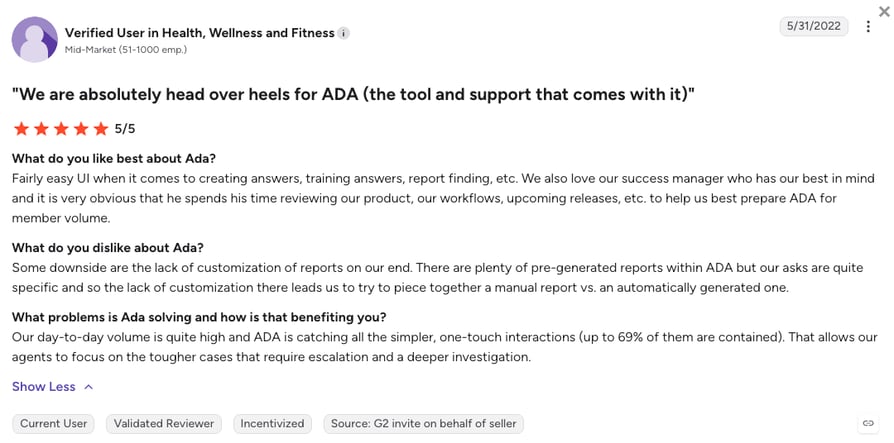
What Are Ada's Customers Saying?
Verified reviewers consistently highlight Ada's ease of use and the quality of its customer support as top strengths. The recurring criticism is that reporting could be more detailed and that dynamic, intent-based workflow customization feels limited.
How Do G2 Users Rate Ada?
Ada holds a 4.6/5 rating on G2 across 150+ verified reviews.
6. Retell AI: Best for Engineering Teams Building Custom Low-Latency Voice Agents from Scratch
What Is Retell AI?
Retell AI is a developer-first voice AI infrastructure platform focused on low-latency conversations and natural turn-taking at production scale. It serves engineering teams that want to build their own voice agents from raw APIs and SDKs, the opposite end of the spectrum from Yellow.ai's no-code, enterprise-managed bot builder. Retell's differentiator is voice quality: teams that found Yellow.ai's packaging too heavy and still too inflexible get full control here, at the cost of building it themselves.
Why Is Retell AI a Strong Yellow.ai Competitor?
- Purpose-built low-latency voice engine: Retell's engine is built specifically for real-time voice turn-taking, not a chat engine with a voice channel added on top.
- Transparent, granular usage pricing: Voice, LLM, and telephony costs are broken out separately, so teams can see exactly what drives the bill instead of a single opaque per-conversation fee.
- Self-serve start with no sales call: 20 free concurrent lines and free starting credits let a team test a real voice agent the same day, no procurement cycle required.
What Are the Pros & Cons of Retell AI?
| Pros | Cons |
|---|---|
| Purpose-built low-latency voice engine | No CRM or dialer; it's a pure voice API |
| Transparent, itemized PAYG pricing | No native human-agent workspace or handoff, still DIY |
| Self-serve start with free concurrent lines | Costs scale with usage, needs real forecasting discipline at volume |
What Are Retell AI's Plans & Pricing?
Retell AI pricing starts at roughly $0.13/min all-in (Core, pay-as-you-go), and it offers the following plans:
Retell AI Pricing
| Plan | Price (annual billing) | Key Features |
|---|---|---|
| Voice engine | ~$0.07-0.08/min | Retell's proprietary low-latency voice engine |
| LLM | ~$0.006-0.50/min | Scales with model choice (GPT-4o, Claude, and others) |
| Telephony | ~$0.015/min | Twilio-based SIP; 20 free concurrent lines included |
| Enterprise | Custom, ~$0.05/min at volume | Volume discounts, dedicated support, SLAs |
The Per-Minute Stack
Retell's pricing is transparent about each layer, but voice, LLM, and telephony fees still stack per call. There's no CRM sync or dialer bundled in either, so a sales or support team still needs a separate system for everything that isn't the voice conversation itself.
What Are Retell AI's Customers Saying?
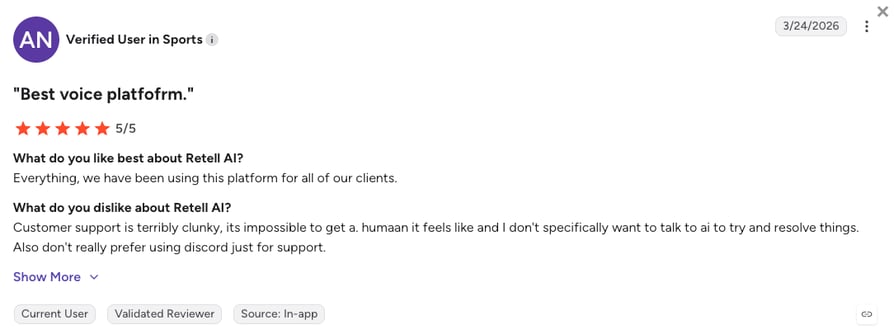
Verified G2 reviewers rate Retell AI highly on ease of use and describe it as genuinely helpful for building production voice agents. The most common complaints are missing features on more complex workflows and cost creeping up at scale.
How Do G2 Users Rate Retell AI?
Retell AI holds a 4.8/5 rating on G2 across 2,600+ verified reviews, the highest rating of any tool on this list.
7. PolyAI: Best for Enterprise Contact Centers with Six-Figure Budgets Needing Premium Voice Quality
What Is PolyAI?
PolyAI is an enterprise voice AI platform built for high-volume contact centers in banking, hospitality, insurance, and telecom. It serves large enterprises that need premium, low-latency phone conversations at heavy call volumes. PolyAI's main differentiator is voice quality purpose-built for regulated, high-stakes phone lines, at the cost of an enterprise-only contract with no self-serve tier at all.
Why Is PolyAI a Strong Alternative to Yellow.ai?
- Premium voice quality for regulated call volume: PolyAI is engineered specifically for high-volume, high-stakes phone lines like banks and insurers, a narrower but deeper focus than Yellow.ai's 35-channel spread.
- Compliance built into every contract: SOC 2 and GDPR compliance come standard with PolyAI's enterprise agreements, not an add-on tier.
- A dedicated build and support team: PolyAI's vendor team manages the agent build directly, a fully managed alternative to a self-serve no-code builder.
What Are the Pros & Cons of PolyAI?
| Pros | Cons |
|---|---|
| Premium voice quality for enterprise call volume | Contracts start around $150,000/year, out of reach below that |
| SOC 2 and GDPR compliance built into contracts | Every change needs vendor engagement, no in-house editing |
| Dedicated build and support team included | Enterprise-only, no self-serve tier at any price point |
What Are PolyAI's Plans & Pricing?
PolyAI pricing starts at roughly $150,000/year (Enterprise, annual contract), and it offers the following plan:
PolyAI Pricing
| Plan | Price |
|---|---|
| Enterprise (annual) | From ~$150,000/year, plus per-minute usage on top |
The Six-Figure Floor
PolyAI's contracts typically start around $150,000 a year before usage, with every change routed through the vendor's own team rather than an in-house editor. That's a real cost of premium voice quality at scale, and it prices out most mid-market teams entirely.
What Are PolyAI's Customers Saying?
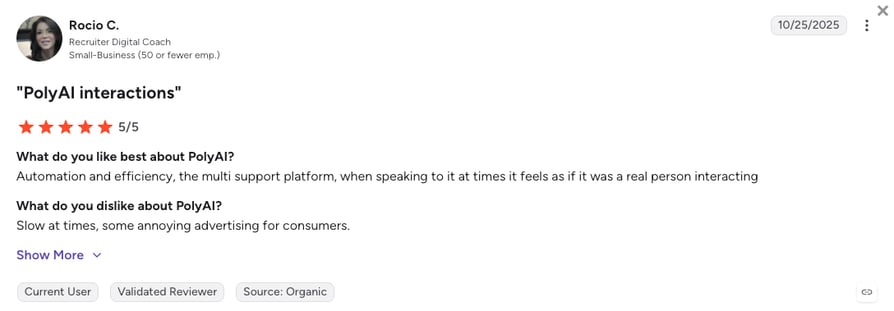
PolyAI's small G2 review base skews strongly positive on voice quality and call handling. The main friction reviewers point to isn't the product itself, it's the enterprise-only pricing and contract size, a real barrier for teams below the six-figure budget range. The sample size is small enough to treat these findings directionally rather than definitively.
How Do G2 Users Rate PolyAI?
PolyAI holds a 5/5 rating on G2, however, it's an aggregate from a small verified review base of 10+ reviews, so keep that in mind.
8. Dialpad: Best for AI-First Teams Wanting Built-In Transcription on a Real Business Phone System
What Is Dialpad?
Dialpad (Dialpad Connect) is an AI-native business phone system built for teams that want real-time transcription and call summaries bundled into their core calling plan. It serves SMB and mid-market sales and support teams. Dialpad's differentiator is that AI features live inside the calling plan itself, not a separate bot suite layered on top.
Why Is Dialpad a Strong Yellow.ai Competitor?
- AI transcription and summaries native to the calling plan: Dialpad's Standard tier bundles real-time transcription and AI call summaries directly into the phone system, not a separate add-on suite.
- A real telephony-first product: Dialpad is a business phone system first, with dialing, voicemail, and calling as the core product, not an omnichannel bot builder with voice as one option.
- CRM integrations for actual sales workflows: Salesforce and HubSpot integrations are available on the Pro tier, connecting calling directly to the CRM records reps already use.
What Are the Pros & Cons of Dialpad?
| Pros | Cons |
|---|---|
| AI transcription and summaries bundled into Standard | CRM integrations and call recording require Pro, not Standard |
| Real telephony-first business phone system | Enterprise tier is a custom quote for advanced needs |
| Salesforce and HubSpot integrations on Pro | No dedicated AI voice agent or receptionist product |
What Are Dialpad's Plans & Pricing?
Dialpad pricing starts at $15/user/mo (Standard, annual billing), with the following plans:
Dialpad Pricing Plans
| Plan | Price (annual billing) | Key Features |
|---|---|---|
| Standard | $15/user/mo | Unlimited calling, AI transcription, AI call summaries, SMS, voicemail |
| Pro | $25/user/mo | Everything in Standard + call recording, CRM integrations (Salesforce, HubSpot), international numbers |
| Enterprise | Custom | Advanced deployment and support for large organizations |
The Pro-Tier CRM Wall
Dialpad's Standard plan looks like an easy entry point, but call recording, CRM integrations, and international numbers all sit one tier up on Pro. Teams that need CRM sync from day one are really pricing a $25/user/mo plan, not $15.
What Are Dialpad's Customers Saying?
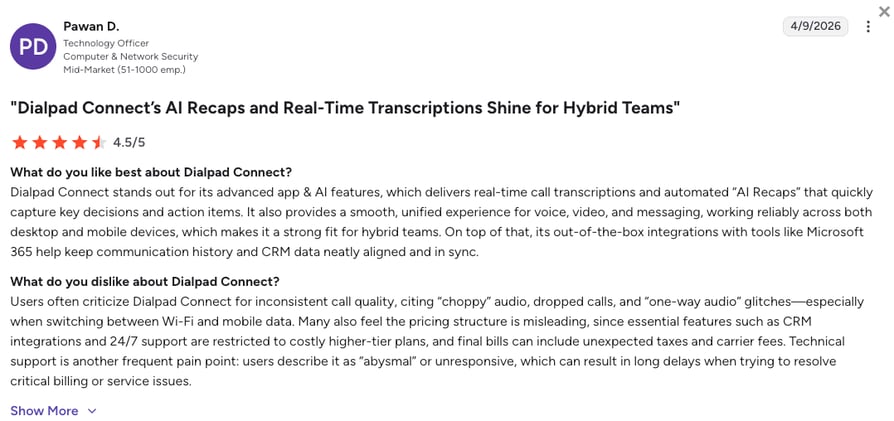
Verified reviewers frequently praise Dialpad's real-time transcription and AI call summaries as genuinely useful day to day. The recurring frustration is that CRM sync and call recording are gated to the Pro tier rather than included at the entry price.
How Do G2 Users Rate Dialpad?
Dialpad holds a 4.4/5 rating on G2 across 4,100+ verified reviews.
9. RingCentral: Best for Mid-Market Teams Needing Enterprise-Grade UCaaS with AI Layered In
What Is RingCentral?
RingCentral (marketed as RingEX) is a unified voice, video, and messaging UCaaS (Unified Communications as a Service) platform built for mid-market and enterprise teams. It serves organizations that want one platform for calling, meetings, and team chat rather than stitching several tools together. RingCentral's key differentiator against other solutions on our list is breadth: a single UCaaS suite with an AI Receptionist add-on layered on top of real telephony.
Why Is RingCentral a Strong Yellow.ai Alternative?
- Unified voice, video, and messaging in one platform: RingCentral bundles calling, video meetings, and team messaging together, broader than Yellow.ai's chat-first suite, but telephony-native from the start.
- 300+ integrations including Salesforce and HubSpot: The Advanced tier connects to a wide integration marketplace, syncing calls directly with CRM records.
- A telephony-native AI front door: RingCentral's AI Receptionist add-on answers calls on top of real carrier infrastructure, not a bot layered onto a messaging engine.
What Are the Pros & Cons of RingCentral?
| Pros | Cons |
|---|---|
| Unified voice, video, and messaging UCaaS | Call recording and deep integrations require Advanced, not Core |
| 300+ integrations including Salesforce and HubSpot | AI Receptionist is a separate paid add-on, not bundled |
| AI Receptionist add-on for RingEX customers | Advanced analytics and device analytics need the Ultra tier |
What Are RingCentral's Plans & Pricing?
RingCentral pricing starts at $20/user/mo (Core, annual billing), and you can choose from these plans:
RingCentral (RingEX) Pricing Plans
| Plan | Price (annual billing) | Key Features |
|---|---|---|
| Core | $20/user/mo | Unlimited calling, video meetings (100 participants), team messaging, IVR, AI writing assistant |
| Advanced | $25/user/mo | Everything in Core + call recording, 300+ integrations, auto call notes |
| Ultra | $35/user/mo | Everything in Advanced + unlimited storage, advanced analytics, device analytics |
The Advanced-Tier Integration Wall
RingCentral's Core plan covers calling and messaging, but call recording and the 300+ integration marketplace both require Advanced. A team evaluating RingCentral for CRM sync is really pricing a $25/user/mo plan, not the advertised $20. The same goes for CloudTalk, which also offers integrations on higher tiers, but it offers more calling features and a much stronger AI than RingCentral.
What Are RingCentral's Customers Saying?
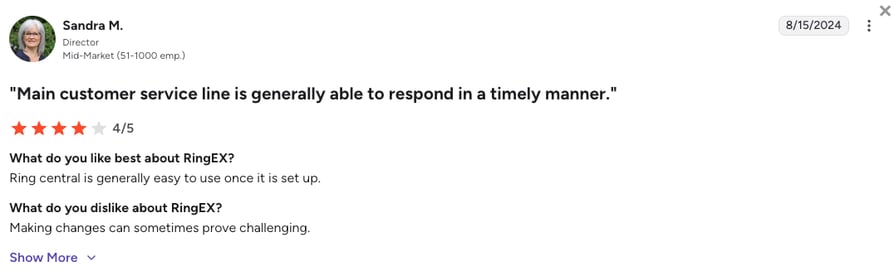
Verified reviewers generally rate RingCentral well for reliability and breadth of features across voice, video, and messaging. Some reviewers note occasional call quality issues and slower support response times on lower tiers.
How Do G2 Users Rate RingCentral?
RingCentral holds a 4.2/5 rating on G2 across 1,400+ verified reviews.
10. Genesys Cloud CX: Best for Large Enterprise Contact Centers Needing Telephony-Native Scale, Not Chatbot Orchestration
What Is Genesys Cloud CX?
Genesys Cloud CX is an enterprise CCaaS (Contact Center as a Service) platform built for large-scale routing, workforce engagement, and compliance across regulated industries. It serves the same scale of enterprise buyer Yellow.ai courts, banking, insurance, healthcare, government, but built calling-first rather than chat-first. Genesys's main differentiator is telephony-native routing at genuine enterprise volume.
Why Is Genesys Cloud CX a Strong Yellow.ai Alternative?
- Enterprise telephony-native scale: Genesys is built around routing and workforce engagement for large contact centers, the same scale ambition as Yellow.ai, reached through a voice-first platform instead of a chat-first one.
- AI-powered routing bundled into the entry suite: The Omnichannel Suite tier includes AI-driven routing alongside voice and digital channels, recording, and compliance.
- Industry-specific compliance bundles: Genesys offers dedicated bundles for banking, insurance, healthcare, and government, matching Yellow.ai's regulated-industry focus from a telephony-native starting point.
What Are the Pros & Cons of Genesys Cloud CX?
| Pros | Cons |
|---|---|
| Enterprise telephony-native routing at real scale | Entry tier has no Quality Management, that requires Essential Suite |
| AI-powered routing bundled into the entry suite | AI Copilot and automated summaries need the Ultimate Suite |
| Industry-specific compliance bundles available | Five-suite pricing ladder takes real evaluation time to compare |
What Are Genesys Cloud CX's Plans & Pricing?
Genesys Cloud CX pricing starts at $110/agent/mo (Omnichannel Suite, annual billing), with the following tiers available:
Genesys Cloud CX Pricing Plans
| Plan | Price (annual billing) | Key Features |
|---|---|---|
| Omnichannel Suite | $110/agent/mo | Voice and digital channels, routing, recording and compliance, AI routing |
| Essential Suite | $135/agent/mo | Everything in Omnichannel + screen recording, Quality Management |
| Core Suite | $169/agent/mo | Everything in Essential + workforce management, performance management |
The Quality Management Upsell
Genesys's entry Omnichannel Suite doesn't include Quality Management at all, that's Essential Suite and up. A team evaluating Genesys for QA and coaching is really pricing $135/agent/mo, not the $110 headline figure.
What Are Genesys Cloud CX's Customers Saying?
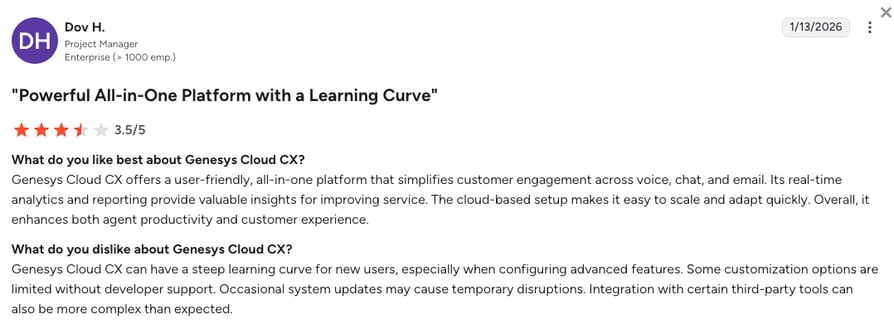
Verified reviewers describe Genesys Cloud CX as powerful and comprehensive for large-scale contact center operations. The most common criticism is implementation complexity and a real learning curve during rollout, consistent with any platform built for enterprise-scale routing.
How Do G2 Users Rate Genesys Cloud CX?
Genesys Cloud CX holds a 4.4/5 rating on G2 across 1,500+ verified reviews.
What Real Users Are Saying about Yellow.ai and Its Alternatives
A pricing page tells you what a platform claims to do. Real posts from Reddit, Quora, and G2 tell you whether it actually works that way once a real team is running it. Here's what shows up when people compare Yellow.ai and its alternatives (other AI voice agent or business phone system platforms).
What Redditors Are Saying about Yellow.ai Alternatives
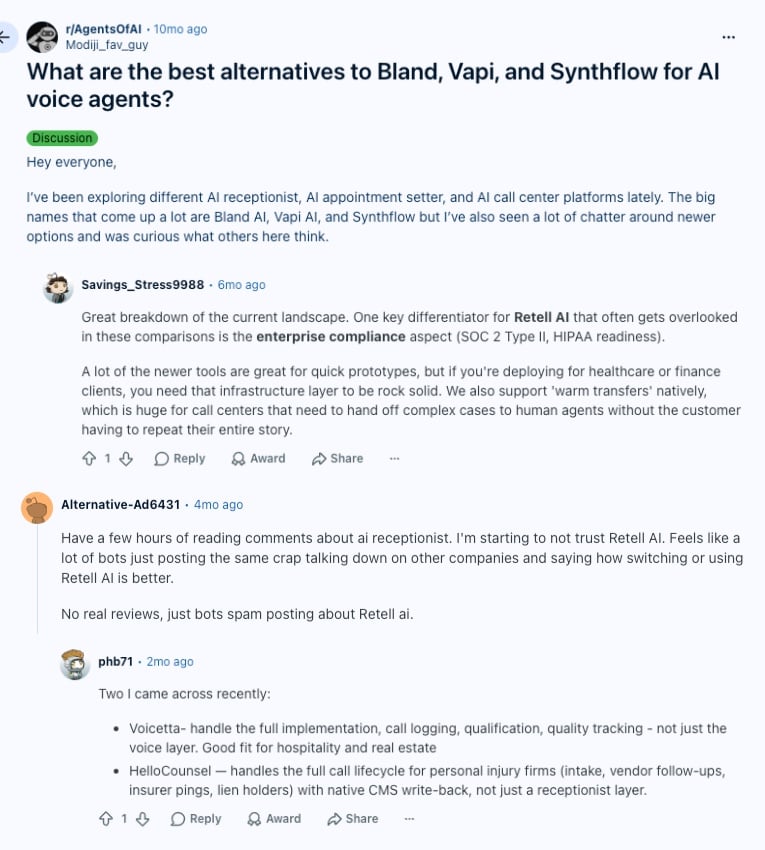
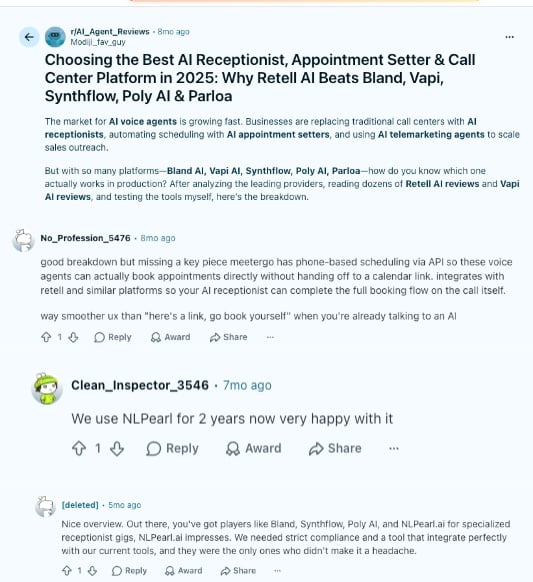
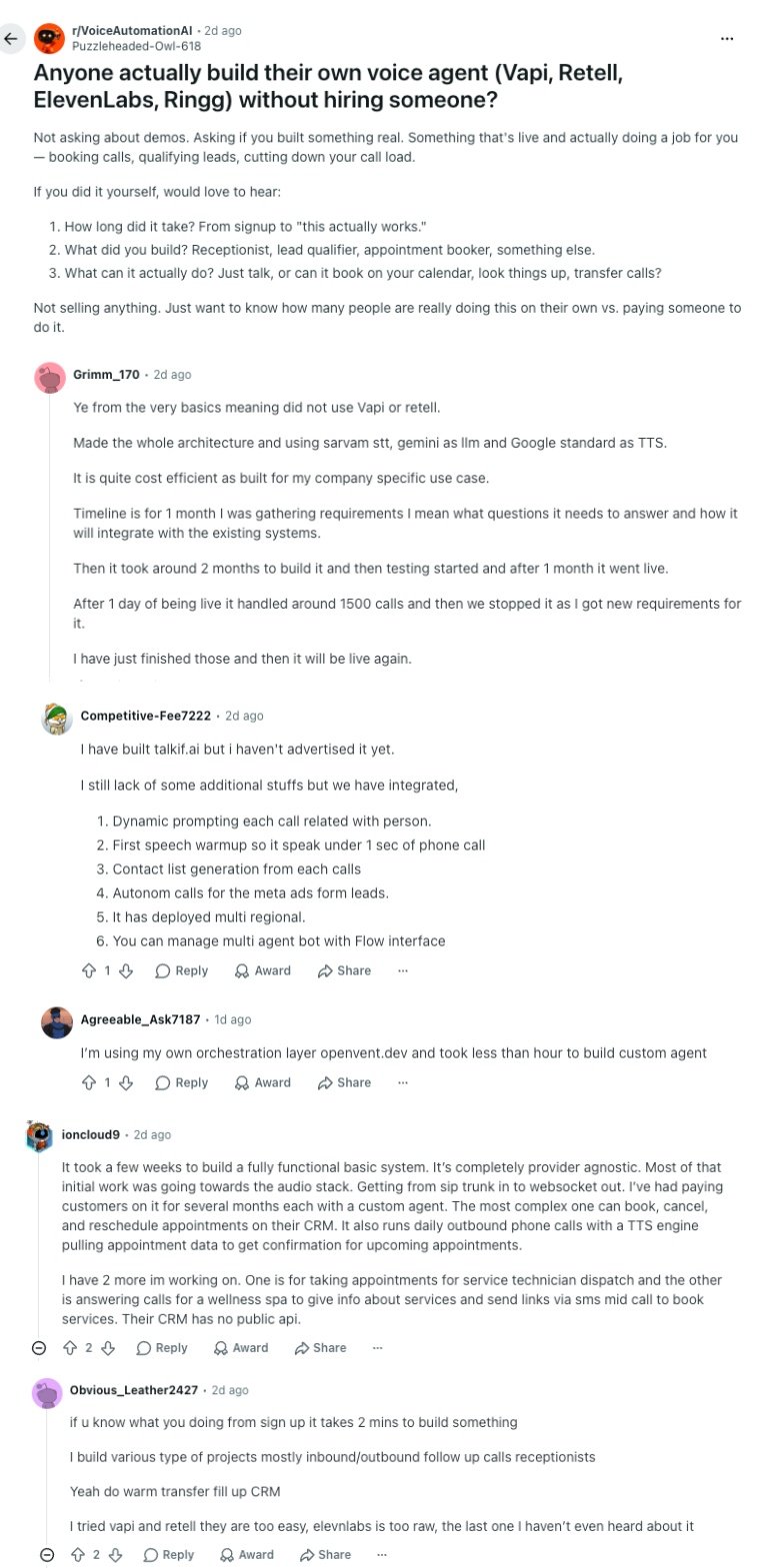
Three active threads across r/AgentsOfAI, r/AI_Agent_Reviews, and r/VoiceAutomationAI show builders and buyers comparing AI voice and receptionist platforms, even when Yellow.ai itself isn't named directly.
- Best alternatives to Bland, Vapi, and Synthflow: In an r/AgentsOfAI thread comparing Bland, Vapi, and Syntfhlow (tools that didn't make it on our list, but are also solid Yellow.ai alternatives), one reply calls out Retell AI's enterprise compliance depth (SOC 2 Type II, HIPAA readiness) and native warm transfers as a real differentiator, while another commenter pushes back that some of the praise in these threads reads like coordinated posting rather than genuine reviews. Some name smaller full-lifecycle platforms, Voicetta and HelloCounsel, for hospitality and legal intake specifically. However, nobody really mentions Yellow.ai or the likes of CloudTalk, and the whole thread stays inside standalone voice agents comparing to each other. That's the gap: these buyers are shopping for a voice agent, not a full phone system with CRM integrations and outbound dialers built in, which is exactly where CloudTalk's AI Voice Agent fits for teams moving off a broader, chat-first suite like Yellow.ai.
- AI receptionist and appointment setter platforms: A widely read r/AI_Agent_Reviews post ranking AI receptionist and call center platforms name-checks Yellow.ai's own AI-voice peers, Poly AI and Parloa, among the tools compared. Real users weigh in independently of that ranking: one notes a scheduling API that lets a voice agent book appointments end to end instead of handing off a booking link, another says they've run a competing platform for two years and are happy with it. Nobody in the thread is discussing Yellow.ai specifically, and that validation stands on its own: buyers in this category want the AI agent to close the loop, not just answer a question. For such a use case, a full business phone system with AI layered in, like CloudTalk, presents itself as a great solution.
- Building your own voice agent: In r/VoiceAutomationAI, builders describe the real cost of a DIY voice agent: one spent a month gathering requirements, two months building, and a month testing before going live; another has a custom agent handling live cancellations, rescheduling, and CRM updates in production, but is still assembling the audio stack piece by piece months in. Some admit a basic build takes minutes, with the honest caveat "if u know what you doing." That's the trade every builder in this thread is making, and it's the trade CloudTalk's AI Receptionist removes: a no-code setup live in minutes to hours, or an assisted build for more complex AI Voice Agent workflows, on top of number and language coverage that's already built.
What Quora Users Are Asking about Yellow.ai Alternatives
The Quora conversation skips feature checklists entirely and asks two practical questions: which platform actually integrates with the tools a team already runs, and which software people reach for day to day. Yellow.ai rarely comes up by name in either.
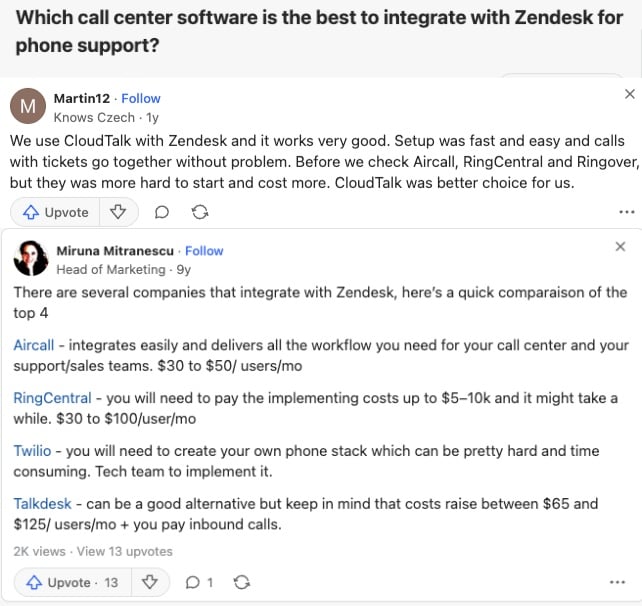
- Zendesk integration for phone support: Asked which call center software integrates best with Zendesk for phone support, one Quora user described running CloudTalk with Zendesk directly, with setup fast and calls syncing to tickets without issue. A more detailed answer further down the same thread flagged Twilio as the hardest of the group to stand up, since it means building an entire phone stack from scratch with an in-house tech team, a sharp contrast to an integration that just works out of the box.
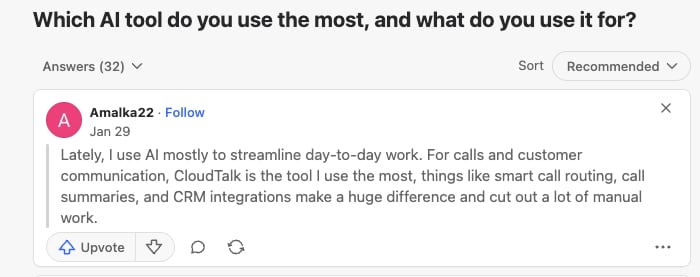
- Which AI tool do people actually use daily: In a broad thread about favorite AI tools, the top answer credits a single platform, CloudTalk, for most of the daily lift on calls and customer communication, crediting automatic call routing and CRM sync for cutting a lot of manual work out of the day. Yellow.ai isn't part of that conversation at all, and for a good reason.
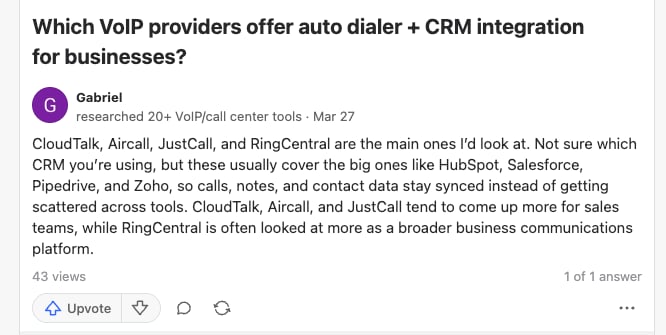
- Best auto dialer with CRM integration: A user who says they reviewed 20+ VoIP and call center tools names CloudTalk, Aircall, JustCall, and RingCentral as the main options for pairing an auto dialer with CRM sync, covering HubSpot, Salesforce, Pipedrive, and Zoho so calls and contact data stay in sync. Notably, none of the AI-first, API-based platforms show up on that shortlist at all, native dialers and two-way CRM sync simply aren't what tools like Yellow.ai or its API-based voice peers are built to do.
How CloudTalk, Yellow.ai, Fin, and Retell AI Compare on G2
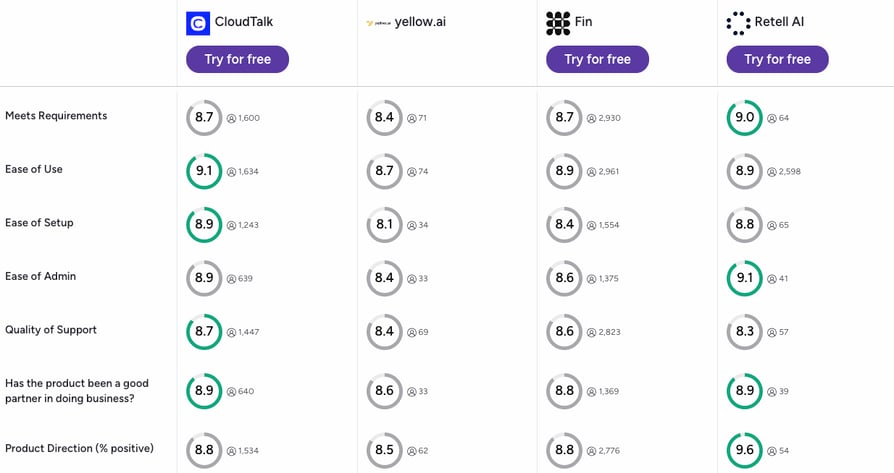
G2's side-by-side comparison of CloudTalk, Yellow.ai, Fin, and Retell AI puts real review data in one place, and it also confirms something worth knowing upfront: G2 itself notes that these four tools share no categories at all.
- Category overlap is zero: CloudTalk is categorized under VoIP Providers, Contact Center, and Outbound Call Tracking. Yellow.ai sits under Bot Platforms and AI Customer Support Agents. Fin overlaps partly with Yellow.ai on AI Customer Support Agents but also spans Shared Inbox and Conversational Support. Retell AI is filed under AI Voice Assistants and AI Agent Builders. Four different shapes of product, not four competitors in the same box.
- Meets requirements and ease of use: CloudTalk scores 8.7 on Meets Requirements (1,600 responses) and 9.1 on Ease of Use (1,634), both ahead of Yellow.ai's 8.4 (71) and 8.7 (74). Retell AI edges everyone on Meets Requirements at 9.0, though from a much smaller base of 64 responses.
- Review volume tells its own story: CloudTalk carries 1,800+ reviews and Fin sits at 3,800+, inherited largely from Intercom's existing customer base. Yellow.ai's G2 profile sits at just over 100 reviews, one of the thinnest samples in this comparison, worth factoring in alongside the rating itself.
CloudTalk vs. Yellow.ai: Final Head-to-Head Comparison
Yellow.ai automates conversations across 35+ channels for large enterprises. CloudTalk answers and makes calls as a telephony-native phone system with AI built in. The real question, though, isn't which platform has more features. What you should be asking is whether you need an omnichannel bot suite or a phone system that happens to be great at AI.
CloudTalk vs. Yellow.ai: Head-to-Head
| Feature | CloudTalk | Yellow.ai | Winner |
|---|---|---|---|
| Starting Price | $25/user/mo | Free (capped) or Enterprise custom quote | CloudTalk |
| Free Trial | 14 days, self-serve | Free tier exists, but capped at 1 agent/500 resolutions | CloudTalk |
| Minimum Agents | 1 (3 on Expert) | None published, but Free tier hard-caps usage | Tie |
| Deployment | Cloud, self-serve signup | Cloud, Free self-serve or Enterprise sales-led | CloudTalk |
| CRM Integrations | 100+ from Essential, two-way sync, click-to-dial | Limited on Free, custom on Enterprise | CloudTalk |
| Auto Call Recording | From Starter (unlimited retention from Essential) | Limited on Free, Unlimited on Enterprise | CloudTalk |
| Outbound Dialers | Power Dialer, Parallel Dialer native to the platform, connected to your CRM | Not applicable, voice is a channel, not a dialer | CloudTalk |
| Channel Breadth | Voice-first by design | 35+ channels (chat, WhatsApp, social, voice) | Yellow.ai |
| Regional/Vertical NLU Depth | General-purpose global calling | Deep India/APAC BFSI multilingual voice bots | Yellow.ai |
| Global Coverage | Numbers for 160+ countries | Global reach, deepest in India/APAC | Tie (depends on your target markets) |
| Transparent Pricing | Published per-user pricing, no quote required | Real usage sits behind a custom Enterprise quote | CloudTalk |
| Vendor Stability | Independent, steady product direction | Two 2025 layoff rounds amid a strategic repositioning | CloudTalk |
| Customer Support | 24/7 (phone on Expert) | 24/7 claimed; mixed consistency on complex rollouts | CloudTalk |
| G2 Rating | 4.4/5 (1,800+ reviews) | 4.4/5 (100+ reviews) | CloudTalk (same score, CloudTalk has 18x the volume) |
Yellow.ai's Real Structural Limit
Yellow.ai's most important limitation isn't a missing feature, it's procurement. Real usage beyond the capped Free tier sits behind a custom Enterprise quote tied to conversation volume, channels, and seats. That's a defensible model for a 1,000+ logo enterprise business, but it's a real barrier for a team that just wants calling with an AI layer, working, this quarter. If that's your team, CloudTalk is a better fit than Yellow.ai.
How to Choose the Right Yellow.ai Alternative for Your Business
The right Yellow.ai alternative depends on what you actually need replaced: the whole omnichannel bot suite, just the voice or IVR piece, or a real phone system with AI layered in. Team size, existing tools, and geographic footprint all factor in too.
Which Yellow.ai Alternative Is Best for a Pure Omnichannel Chat Swap?
If chat, WhatsApp, and ticket automation are the actual job, not voice, Intercom Fin is the fastest swap for teams already on Zendesk, Salesforce, or HubSpot, while Kore.ai and Cognigy fit larger enterprises needing deeper NLU and backend integration work. None of these three add a real phone system underneath the swap, so if calling matters at all, pair the decision with a look at a dedicated business phone system like CloudTalk.
Which Yellow.ai Alternative Is Best If You Just Need Voice or IVR Replaced?
For engineering teams that want to build a custom voice agent, Retell AI's transparent per-minute pricing and low-latency engine are the strongest fit. For enterprise contact centers with six-figure budgets and heavy call volume, PolyAI's dedicated build team is worth the price floor. For teams that want AI voice without hiring engineers or signing a six-figure contract, CloudTalk's AI Voice Agent is built to deploy without either.
What's Better Than Yellow.ai for a Real Phone System with AI Layered In?
CloudTalk is better than Yellow.ai, especially if you need a real AI-powered phone system. It's a full business phone system with an AI Receptionist and AI Voice Agent native to the same calling infrastructure human reps use, plus 100+ CRM integrations from Essential. No 35-channel suite to configure around a phone system you actually need.
What's the Best Yellow.ai Alternative for Global Outbound Sales Teams?
CloudTalk is the best Yellow.ai alternative for global outbound sales teams. If you're growing across the borders, your teams need to make calls internationally + they need local numbers across many countries and a CRM that logs every call automatically, not a bot builder configured per region. CloudTalk's Power Dialer and Parallel Dialer give outbound teams the tools to actually work a list at volume.
Case study - Revolut
When global fintech Revolut expanded its outbound sales team, their previous VoIP provider lacked the agent oversight and deep CRM syncing they needed to grow, the same gap a chat-first suite like Yellow.ai leaves for a calling-heavy sales motion.
Revolut needed a flawless HubSpot connection to prevent duplicate contacts and sync data in real time. By rolling out CloudTalk's Smart Dialer alongside local numbers in 193+ markets, Revolut automated its call logging entirely, saved its sales operations team over 40 hours a month, and onboarded 500+ sales reps.
What's the Best Yellow.ai Alternative for Regulated Enterprise Contact Centers?
For a regulated enterprise that needs chat-first automation with deep NLU, Kore.ai and Cognigy are built for that exact buyer. For one that needs the same regulated scale but reached through telephony first, Genesys Cloud CX brings industry-specific compliance bundles on a voice-native platform instead of a chat-native one.
What's the Best Self-Hosted or Open-Source Alternative to Yellow.ai?
Rasa is the answer for engineering teams that need full self-hosted control over their conversational AI stack and the compliance guarantees that come with owning the infrastructure outright. It's a real option, but it demands dedicated developer and AI expertise that most teams switching from an enterprise platform like Yellow.ai aren't staffed for.
What Is the Best Yellow.ai Alternative for Growing Teams?
CloudTalk is the strongest overall Yellow.ai alternative for growing teams that need a proper business phone system. Plans scale from basic calling on Starter to 100+ CRM integrations on Essential to Salesforce Ecosystem Integration and Power Dialer on Expert, with pricing that stays predictable at every step because it's published, not quoted.
Add AI Receptionist and AI Voice Agent coverage in 60+ languages, numbers in 160+ countries, and a 14-day free trial to test all of it, and a growing team gets a phone system that scales with headcount instead of a procurement cycle every time a new need comes up.
Ready to Make the Switch from Yellow.ai?
Yellow.ai earns its enterprise reputation honestly, especially for large, regulated organizations automating chat and voice at serious volume across India and APAC. That's a real, defensible niche, not a weakness to paper over.
For a growing team that just needs calling done well, with an AI layer native to it rather than bolted onto a chat engine, CloudTalk solves the structural gaps Yellow.ai leaves open: telephony-native reliability, real two-way CRM sync, warm in-call handoffs instead of channel-to-channel ones, and published pricing that doesn't require a sales conversation to understand. Put together, that means a phone system that scales with a team's actual growth.
Here's what you get if you replace Yellow.ai with CloudTalk:
- Telephony-native calling, not voice as one of 35 channelsCarrier-grade infrastructure with local numbers in 160+ countries.
- Real CRM click-to-dial and two-way sync100+ tools from Essential, calls and contact records update automatically.
- Warm, in-call AI-to-human handoffsAI Voice Agent and live reps share the same call record, no channel-to-channel bounce.
- Published pricing, no procurement cyclePlans and add-ons are transparently priced, no custom quote required.
- Trusted by 5,500+ businesses worldwideJoin thousands of growing teams across several industries that already run their calling (including AI) on CloudTalk.
Join 5,500+ Businesses That Already Made the Switch
Sources:
- Inc42, Exclusive: Yellow.ai Lays Off Over 100 Employees Amid Automation Push.
- Salesforce, Salesforce Signs Definitive Agreement to Acquire Fin (June 15, 2026).
Frequently Asked Questions about Yellow.ai Alternatives
Common questions about Yellow.ai, its pricing, and the best alternatives for different team sizes and use cases.
Yellow.ai is an enterprise conversational and agentic AI platform that automates customer and employee interactions across 35+ channels, including WhatsApp, web chat, social, and voice through its VoiceX layer. It serves large enterprises like Sephora, BMW, and Sony, mostly for chat-first automation, with voice as one channel among many rather than a telephony-native product like a dedicated phone system.
Yellow.ai's live pricing page shows a Free tier (1 AI agent, 500 chat resolutions/month included, then $0.99 per resolution) and an Enterprise tier that's quote-only, tied to conversation volume, channels, and seats. There's no published mid-market monthly price, market estimates for real Enterprise usage commonly start in the tens of thousands per year.
The best Yellow.ai alternative depends on what you're replacing. For a pure chat swap, Intercom Fin, Kore.ai, or Cognigy fit best. For voice or IVR specifically, Retell AI or PolyAI. For a real phone system with AI built in at published, predictable pricing, CloudTalk is the top overall pick.
It's hard to judge fairly whether Observe AI works better than Yellow.ai. Observe AI is a conversation intelligence and QA tool focused on call scoring and agent coaching, not a full CX automation platform like Yellow.ai. If you need call scoring layered onto an existing phone system, Observe.AI solves a narrower problem. However, if you need a phone system with AI call summaries and sentiment analysis built in, CloudTalk outperforms both Yellow.ai and Observe AI.
Pricing models of Yellow.ai alternatives splits into three categories: usage-based per-resolution fees (Intercom Fin at $0.99/resolution), pure per-minute AI voice pricing (Retell AI, roughly $0.13 to $0.31/min all-in), and flat per-user phone system pricing (CloudTalk from $25/user/mo). Enterprise chat-first suites like Kore.ai, Cognigy, and Yellow.ai itself publish no self-serve number at all.
The biggest risks when choosing Yellow.ai alternatives are picking a tool built for the wrong category (a chat bot when you need calling, or a voice API when you need a managed phone system), underestimating implementation time on enterprise platforms, and per-resolution or per-minute pricing that's hard to forecast until you're already committed. Checking published pricing before a sales call helps rule out the last one early.
Before making a switch from Yellow.ai, start with what's actually broken: channel needs, call volume, existing CRM, and team size. Then weigh total cost of ownership, not just the entry price, CRM integration depth, global number coverage, and whether AI features are native to the calling layer or bolted onto a separate bot engine.
Yes, CloudTalk ranks among the best Yellow.ai alternatives for AI voice calling. This is particularly true for teams that want AI voice calling native to a real phone system rather than layered on top of a chat engine. CloudTalk's AI Voice Agent and human reps share the same calling infrastructure, CRM sync, and call record, so an escalation is a warm in-call transfer rather than a handoff to a separate inbox.
CloudTalk is the strongest Yellow.ai alternative for small businesses, with published per-user pricing starting at $25/user/mo and no seat minimum until Expert. Dialpad or Quo (formerly OpenPhone) are also worth a look for very small teams or micro businesses that want simple calling with light AI features bundled in.
The best alternative to Yellow.ai for enterprises depends on the channel. For chat-first enterprise automation with deep NLU, Kore.ai or Cognigy are the closest like-for-like peers. For enterprise-scale telephony with AI layered in instead of chatbot orchestration, Genesys Cloud CX is the stronger fit.
Kore.ai and Cognigy are great Yellow.ai alternatives for insurance teams as both have real depth in regulated, complex-integration enterprise deployments that insurers often need. For insurers whose real bottleneck is inbound and outbound calling rather than chat automation, CloudTalk's AI Voice Agent for insurance is built for policy inquiries, claims intake, and renewal calls.
Ada and Intercom Fin are both strong Yellow.ai chatbot alternatives for travel brands that need fast, zero-code or product-led chat deployment for booking and support questions. If the travel business's real pain point is phone-based booking or itinerary calls instead, that's a job for a voice-first platform like CloudTalk, not a chatbot suite.
There's no automated one-click migration between Yellow.ai and most alternatives, intents, training data, and flows are generally rebuilt natively in the new platform's builder rather than imported directly. Budget real time for this if you're moving to another chat-first suite. And if you're consolidating onto a phone system like CloudTalk instead, the relevant migration is usually numbers and CRM data, not bot flows.
Yellow.ai's closest chat-first competitors are Intercom Fin, Kore.ai, Cognigy, and Ada. On the voice side, Retell AI and PolyAI compete for the AI-voice-specialist segment. For teams whose real need is a full business phone system with AI layered in, CloudTalk, Dialpad, RingCentral, and Genesys Cloud CX compete on a telephony-native footing Yellow.ai doesn't share.