Search for vapi vs bland ai and most results crown a winner, usually the vendor who wrote the page. Bland suits teams who want one bundled rate, a visual flow builder and someone else running the models. Vapi suits teams already holding provider API keys who would rather assemble the stack than inherit one.
Both platforms are well past the demo stage. Bland, founded in 2023 by Isaiah Granet and Sobhan Nejad, runs more than 3.5 million calls a week for 250-plus enterprise customers including Samsara and CNO Financial Group, per Fortune's June 2026 report on Bland.
Vapi launched in 2024 under Jordan Dearsley and Nikhil Gupta and is past a billion calls, at one to five million a day, picked by Amazon Ring over more than 40 rivals, per TechCrunch's May 2026 report on Vapi. Each raised $50 million this year.
The sections below compare features, latency, pricing, integrations, compliance and usability from each vendor's docs and pricing pages, plus an independent benchmark. Our comparison hub covers other pairings; for the short version, jump to the at-a-glance comparison table.

See what a ready-made AI voice agent looks like

Bland AI vs. Vapi AI: Core Strengths of Each Platform
Both platforms put a working AI phone agent on a real number. Bland optimizes for the shortest route to a live agent on a stack it controls; Vapi for how much of that stack you choose. It's the old DIY versus paid voice AI trade-off, narrowed to two platforms.
Where Bland AI Shines
Five strengths stand out on Bland's own pricing page and developer docs, read in August 2026.
Where Bland AI Shines
| Strength | Why It Matters |
|---|---|
| Pathways builder on every tier | Branching call logic built visually, even on the $0 platform fee plan. |
| One bundled per-minute rate | Covers the language model, speech-to-text and text-to-speech, so no token charges. |
| Native batch calling API | One request queues a campaign and sets its start time. |
| A stack Bland runs itself | Bland's own models for phone calls, with on-prem or VPC on Enterprise. |
| Norm, a prompt-to-agent builder | A plain-language brief becomes a pathway, voice and scheduling to edit. |
Where Vapi AI Shines
Vapi's pricing page and docs, read the same week, put the weight elsewhere.
Where Vapi AI Shines
| Strength | Why It Matters |
|---|---|
| Full provider choice per assistant | Transcriber, model and voice set per assistant, custom endpoints included. |
| $0.05 per minute plus BYOK | Model provider cost passed through at cost, $0 with your own keys. |
| Voice Test Suites | An AI tester calls your agent and scores the transcript on your rubric. |
| Native outbound campaigns | Recipient lists, scheduling, dynamic variables and live monitoring. |
| A wide documented surface | Composer, Workflows, Squads, SDKs, a CLI and an MCP server. |
At a Glance: Bland AI vs. Vapi AI, Key Differences
Find the dimension that decides it for your team, then read that section.
Bland AI vs. Vapi AI: Key Differences
| Dimension | Bland AI | Vapi AI | Best Suited For |
|---|---|---|---|
| Deployment model | Bland's own models, end to end | Providers you pick and wire up | Teams with a build-versus-buy call to make |
| Entry cost | $0 platform fee, $0.14/min | $0.05/min plus provider costs | Teams piloting before they commit budget |
| Pricing transparency | Three tiers priced, Enterprise quoted | Build priced, Scale quoted | Procurement-led buyers |
| Measured median latency | 1,520 ms | 1,558 ms | Teams running customer-facing conversations |
| Latency consistency | p95 is 1.48x the median | p95 is 1.29x the median | Teams sensitive to slow outlier turns |
| Call flow builder | Pathways, plus Norm for prompt-to-agent | Composer, Workflows and Squads, plus the API | Teams deciding who owns the call flow |
| Batch and outbound calling | Batch API with scheduling | Outbound Campaigns in the dashboard | Outbound campaign teams |
| Provider choice | None by design, the stack is bundled | Transcriber, model, voice and carrier swappable | Teams with a mandated model or voice vendor |
| HIPAA | BAA on Enterprise contracts | $2,000/month add-on on either plan | Regulated teams that need a BAA |
| Phone numbers | $15/month each | Up to 5 free US numbers, international imported | Teams calling outside the US |
| Concurrency entry | 10 concurrent calls on Start | 10 lines, then $10 per line per month | Teams scaling past a handful of live calls |
These figures come from each vendor's published pricing and docs, checked in August 2026, and from Openbenchmarks' voice agent latency board1, last updated 31 July 2026.
A bland vs vapi comparison is rarely the whole shortlist. Retell AI turns up in the same evaluations, usually against Bland on outbound work; see our Retell AI vs Bland AI comparison. Searches for bland ai vs vapi vs other voice agent platforms also surface Callbotics and Nedzo.
Bland AI Features vs. Vapi AI Features
Comparing bland ai features vs vapi features means comparing two philosophies of one product: Bland ships a configured pipeline, Vapi ships the wiring diagram.
Bland AI Features
Bland's agent runs on models Bland built for phone calls, driven by Conversational Pathways, its visual flow builder. Batch calling, active-call transfer and webhook triggers are API endpoints from the entry tier up.
What Bland AI Does Well
- Live data mid-call.Webhook triggers and custom API tools read and write to your systems while the call runs.
- Human handoff from Start up.Transfer Active Call is an API endpoint on every tier; warm and live transfers need Enterprise.
- Campaigns from the entry tier.Create Batch applies shared properties across a recipient list, inside Start's 100-calls-a-day cap.
- Fast first deployment.Bland's pricing FAQ puts most self-serve teams live within a day.
- One uptime promise.The same 99.9% SLA covers Start and Enterprise, per Bland's pricing page.
Where Bland AI Falls Short
- Enterprise gating.Bland's plan table gates warm and live transfers, single sign-on (SSO), appointment scheduling, custom dialing, SMS and web chat.
- No provider choice.You take Bland's language model, speech recognition and voices as designed.
- Real switching cost.Conversation logic lives inside Pathways, so moving platforms means rebuilding it.
- Carriage billed separately.The pricing page bills telephony on top, at pass-through or your own SIP, while the docs read as if the rate covers it.
Vapi AI Features
Vapi is API-first: the transcriber, language model and voice are configuration rather than defaults, each with a documented custom endpoint. Searches for vapi ai voice agent platform land on that configurability.
What Vapi AI Does Well
- A mandated provider isn't a blocker.Model, transcriber and voice are per-assistant settings, so a vendor requirement doesn't force a migration.
- Testing goes past the scripted call.Evals, Simulations and scorecards grade an agent before customers do.
- Multi-agent handoff.Squads pass a live call between assistants; Workflows and Composer cover structured flows.
- Language follows your transcriber.Auto-detection runs through Deepgram, Google STT or Gladia; other providers can pin you to one language.
- Built for coding agents.A CLI, a Model Context Protocol (MCP) server and machine-readable docs to build against.
Where Vapi AI Falls Short
- The headline rate isn't the bill.$0.05 per minute is hosting; the pricing page passes model costs to the customer.
- Several invoices unless you BYOK.Your own keys move provider cost off Vapi's invoice, not out of your budget.
- Compliance is priced separately.HIPAA is $2,000 a month, Zero Data Retention $1,000, on both plans.
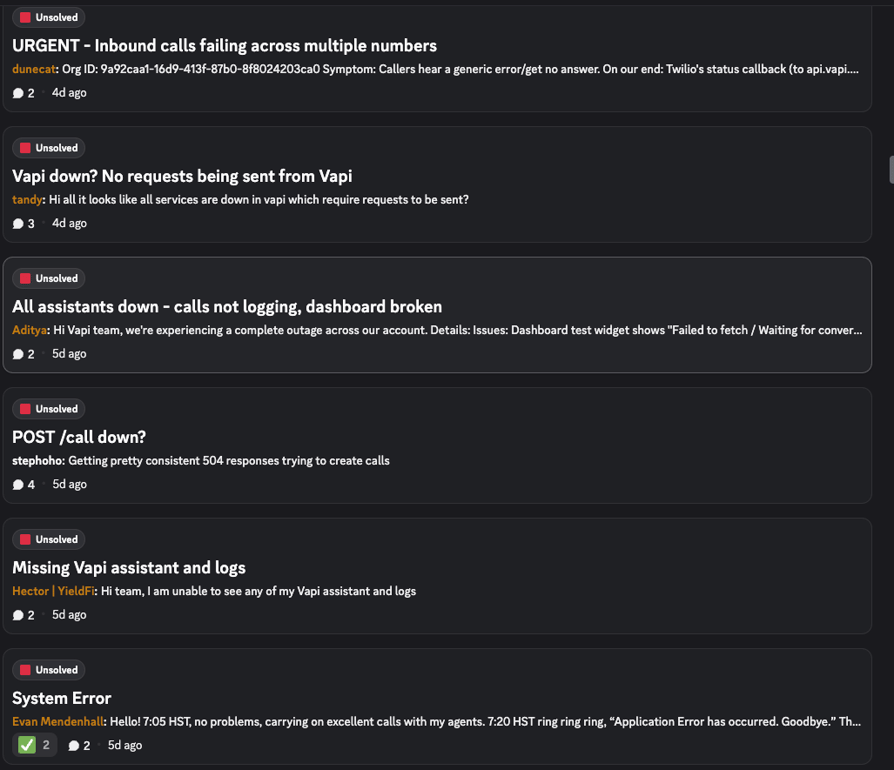
- Thin self-serve tier.Build has no SOC 2, SSO or role-based access control (RBAC), keeps call history 14 days, and offers only Discord and email support.
That last point shows up in the wild too. A Vapi user's Discord thread about a knowledge-base search regression after a backend provider was sunset is the kind of community-support signal that doesn't make it onto a pricing page:
Feature-by-Feature Comparison
Six rows carry most of the decision; pricing and compliance have their own sections.
Feature-by-Feature Comparison
| Feature | Bland AI | Vapi AI |
|---|---|---|
| Builder type | Pathways visual flows, plus Norm from a prompt | Composer, Workflows and Squads, plus the API |
| Batch and outbound calling | Create Batch API with scheduling | Outbound Campaigns in the dashboard |
| Human transfer | Transfer API on all tiers, warm and live on Enterprise | Squads handoff, transfer via assistant config |
| Webhook triggers and live data | Yes, plus custom API tools | Yes, with server events and authentication |
| Model and voice provider choice | None, bundled by design | Transcriber, model and voice all configurable |
| Testing tools | Scenario test suites before rollout | Voice Test Suites, Evals, Simulations, scorecards |
Bland and Vapi are infrastructure you build a voice agent on. CloudTalk's AI Voice Agent ships no-code and already wired into a call center, with numbers, CRM sync, routing and analytics in place; that's how Autenti put it on roughly 30% of its inbound support calls.
Latency & Voice Quality: Bland AI vs. Vapi AI
Latency decides whether a call feels like a conversation; with the accuracy and limitations of voice AI, it's where testing time goes. The number to watch is time to first audio byte, or TTFAB: the gap between the caller finishing a sentence and the agent starting.
Openbenchmarks names the failure mode: past roughly two seconds of silence, a caller assumes the line dropped and talks over the reply. So bland ai vs vapi latency shows up in testing, where the median matters less than how often a turn runs long.
Latency & Voice Quality Compared
| Dimension | Bland AI | Vapi AI |
|---|---|---|
| Vendor's stated latency | Sub-400 ms response latency | Sub-500 ms average latency |
| Measured median TTFAB | 1,520 ms | 1,558 ms |
| Measured p95 TTFAB | 2,248 ms | 2,008 ms |
| Tail ratio (p95 divided by median) | 1.48x | 1.29x |
| Turns timed to standard | 429 of 432, 3 discarded | 382 of 432, 50 discarded |
| Voice provider model | Bland's own speech models, bundled | Your choice of text-to-speech provider, including custom endpoints |
| Tuning effort for best case | Little to tune; voice count is tier-gated | Provider selection and tuning are yours to own |
Measured figures come from Openbenchmarks' Bland versus Vapi head-to-head, last updated 31 July 2026, which timed 2,078 usable turns across five platforms using a caller-side harness and an offline analyzer on dual-channel recordings of real calls.
No platform on the board reached a median caller-experienced TTFAB under one second. Openbenchmarks puts vendor self-reported latency roughly 490 ms below the measured figure, because a platform timing its own call starts the clock about 550 ms later than an external recording does.
Both vendors' numbers are real; they describe pipeline internals, not what the caller hears. At the caller's ear, Bland is a shade faster in the middle and Vapi steadier across turns.
Latency on either platform depends on the providers you configure and how you tune them. CloudTalk's AI Voice Agent runs on CloudTalk's own telephony, so there's no separate provider benchmarking before launch.
Bland AI Pricing vs Vapi AI Pricing
Comparing bland ai pricing vs vapi pricing is easy on the first line of the invoice and hard after it: the two split costs in opposite places. Bland bundles the AI and bills telephony separately; Vapi charges a thin platform fee and passes the AI through.
Bland AI Pricing
Bland publishes bland ai pricing in full for three of its four tiers. The ladder on its pricing page in August 2026:
- Start: $0.14 per minute, $0 platform fee, no card required, two credits and an inbound number included, 10 concurrent calls, 100 calls per day.
- Build: $0.12 per minute plus a $299 per month platform fee, 50 concurrent calls, 2,000 calls per day, 5 voices.
- Scale: $0.11 per minute plus a $499 per month platform fee, 100 concurrent calls, 5,000 calls per day, 15 voices.
- Enterprise: quoted on volume; adds on-prem or VPC, a forward-deployed engineer, a signed business associate agreement (BAA), data residency and higher caps.
The rate covers the model, transcription and premium voices, with no token charges. On top of it: transfer minutes at $0.03 to $0.05 by tier, $15 a month per number, and telephony at Twilio pass-through or on your own carrier, which waives the transfer fee. All four tiers carry a 99.9% uptime SLA.
Vapi AI Pricing
Vapi runs two plans: Build, self-serve and usage-based; Scale, an annual contract with a fixed fee and committed volume, quoted on request. Build charges $0.05 per minute to host, which its pricing page says excludes model provider costs, and includes 60-plus minutes and ten call lines. Past that, $10 a month per line and $0.005 per SMS or chat.
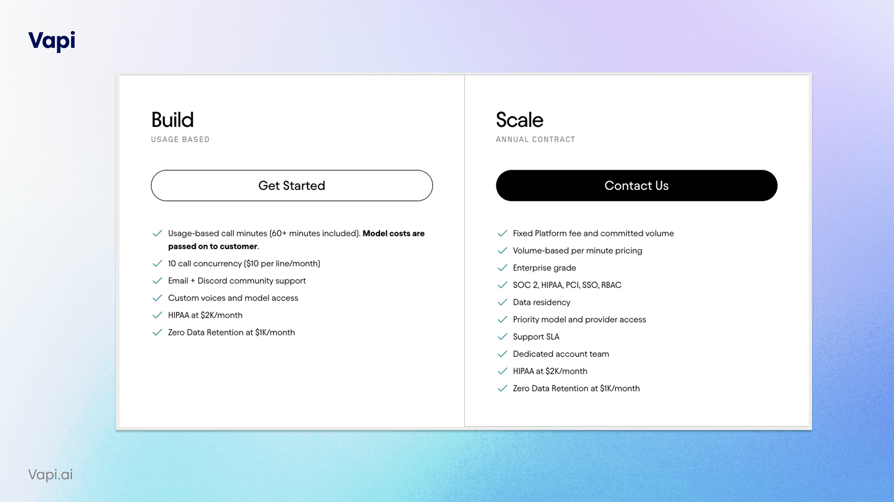
Vapi bills speech recognition, the language model and the voice at cost, or $0 on your own API keys, which moves that spend to your provider accounts instead of erasing it.
For an all-in figure, Openbenchmarks pulled both billing APIs during its July 2026 latency run and logged $0.0836 per invoiced minute for Vapi against $0.1408 for Bland, on a new signup's default stack. That's one workload on one day, not a rate card.
What to Budget for Beyond the Base Rate (Both Platforms)
Neither platform's headline rate is what you'll pay, and both stack up past it in different places.
- The AI itself. Bundled into Bland's per-minute rate; billed separately on Vapi for transcription, model and voice unless you bring your own keys.
- Carriage and numbers. Separate on both: $15 a month per Bland number plus pass-through or SIP telephony; up to five free US numbers on Vapi.
- Concurrency. Capped by tier on Bland, so scaling means a plan change; $10 per line per month on Vapi above ten.
- Compliance. An Enterprise contract on Bland for the BAA; $2,000 a month for HIPAA on Vapi, plus $1,000 for Zero Data Retention.
- Transfers. $0.03 to $0.05 a minute on Bland, waived if you bring your own telephony.
Pricing Compared Line by Line
The rows below change the invoice, not the rate card.
Pricing Compared Line by Line
| Pricing Dimension | Bland AI | Vapi AI |
|---|---|---|
| Entry per-minute rate | $0.14/min | $0.05/min platform fee |
| Platform fee | $0 on Start, $299 or $499/month above it | Included in the per-minute fee on Build |
| Measured all-in cost, one benchmark run | $0.1408 per invoiced minute | $0.0836 per invoiced minute |
| Pricing model | Bundled AI, carriage billed separately | Thin platform fee, model costs passed through or BYOK |
| Compliance add-on cost | Included in an Enterprise contract | $2,000/month HIPAA, $1,000/month Zero Data Retention |
| Concurrency cost | Raised by moving tier | $10 per line per month above 10 |
Rather test than configure?
Carriage, concurrency and compliance are where a voice AI budget lands on either platform. CloudTalk's AI Voice Agent pricing is usage-based, from $99 a month for 200 minutes as an add-on, with telephony, CRM sync and routing on one invoice.
Bland AI Integrations vs. Vapi AI Integrations
Bland publishes a named connector list and backs it with webhooks; Vapi treats the API itself as the integration layer. Either way, how easy voice AI is to integrate depends less on the first connection than on maintaining it.
Bland AI Integrations
Bland's list covers most of what a call operation already runs:
- Business apps: Salesforce, HubSpot, Slack, Notion, Zapier, Make, Calendly, Cal.com, Pipedream and Twilio.
- Contact centers: Genesys, Five9, NICE CXone, Talkdesk and Amazon Connect, plus SIP for your own carrier.
Past that list, agents reach your systems through webhook triggers and a custom API tool builder, and Bland ships an MCP server for coding agents. Named connections are configuration; branching or write-back logic is engineering work.
Vapi AI Integrations
Vapi's answer to bland ai vs vapi api maturity is that integration is the API:
- Developer surface: SDKs, a CLI, an MCP server, and webhooks with server events and authentication.
- Custom endpoints: documented for the transcriber, model and voice; telephony imported from Twilio, Telnyx, DIDWW or your own SIP trunk.
That buys a route to anything with an API, and it means most connections are built and maintained rather than switched on.
Integration Capability Compared
The difference shows up in four places.
Integration Capability Compared
| Integration Capability | Bland AI | Vapi AI |
|---|---|---|
| Connector approach | Named integrations plus custom API tools | API-first, with SDKs, a CLI and an MCP server |
| CRM connectors | Salesforce, HubSpot and others published by name | Built against the CRM's API |
| Developer requirement | Low for named connectors, real for custom logic | Real for most integrations |
| Workflow automation | Pathways nodes plus webhook triggers | Workflows, Squads and your own orchestration |
Reaching a CRM on either platform means integration work you build and then keep alive. CloudTalk's AI Voice Agent uses the same CRM sync, numbers and routing as the rest of the platform, with 100+ native integrations already in place.
Security & Compliance: Bland AI vs. Vapi AI
Security and compliance is where Bland AI and Vapi AI differ most, and the difference is how you get a certification rather than whether the vendor holds one. On both, how secure your data is on a voice AI platform depends on the tier you buy.
Bland AI Security & Compliance
- SOC 2 Type I and Type II, documentation under NDA on Enterprise contracts.
- HIPAA eligibility with a signed BAA, on Enterprise per Bland's plan table and Fortune's June 2026 reporting.
- GDPR and PCI DSS coverage, per Bland's pricing page FAQ.
- Deployment control, including on-prem and VPC options plus data residency on Enterprise.
- Enterprise-only SSO, JWT signatures and guardrails, so a self-serve team gets a narrower security surface than the certification list suggests.
Vapi AI Security & Compliance
- SOC 2, HIPAA and PCI are claimed in Vapi's enterprise capabilities, with SSO, OAuth, RBAC, guardrails and data residency.
- HIPAA is a $2,000 per month add-on on Build and Scale, with no enterprise contract required.
- Zero Data Retention is a separate $1,000 per month add-on.
- SOC 2, SSO and RBAC are not available on Build, which the pricing page marks Scale-only.
- Data retention on Build is 14 days for call history and 30 days for chat history, custom on Scale.
Security & Compliance Compared
Five rows decide whether a platform can carry a regulated workload.
Security & Compliance Compared
| Security and Compliance | Bland AI | Vapi AI |
|---|---|---|
| HIPAA, and how you get it | BAA on an Enterprise contract | $2,000/month add-on on either plan |
| SOC 2 | Type I and Type II, docs under NDA on Enterprise | Claimed; access marked Scale-only on the pricing page |
| GDPR | Stated on the pricing page FAQ | Not specified in the pricing table |
| Data retention window | Not published by tier | 14 days call history on Build, custom on Scale |
| Deployment options | Cloud, VPC or on-prem on Enterprise | Cloud |
Both sets come from each vendor's pricing page and docs, read in August 2026; claims the pricing table doesn't confirm are labelled as claims.
A compliant deployment on either platform is a stack decision you make yourself. CloudTalk carries SOC 2, GDPR and HIPAA-aligned controls with BAA support across the whole call center the AI Voice Agent runs inside, not only its AI layer.
Usability & Developer Experience: Bland AI vs. Vapi AI
The vapi vs bland for developers question has an easy answer: Vapi is the more developer-shaped platform. Whether that's what you want depends on who owns the agent six months from now.
Bland AI Usability
- Pathways lowers the floor for complex flows. Branching logic that would be code is assembled visually, on every tier.
- Norm shortens the first build. It generates a pathway, voice, calendar step, confirmation SMS and warm transfer to edit from.
- Enterprise rollout runs longer. Bland's pricing FAQ describes a roughly month-long deployment framework for enterprise customers.
- The ceiling is Bland's system. You build what Pathways and your tier allow, and the logic stays in Bland's dashboard.
Vapi AI Usability
- Code-first setup. Typed SDKs and documented endpoints mean an engineer starts the build, not an operator.
- Composer and Workflows soften the entry. Structured flows and multi-assistant handoff without writing the orchestration yourself.
- Configuration depth is the cost. You choose, price and tune the transcriber, model, voice and carrier.
- Support depends on the plan. Build gets community Discord and email; named support engineers and SLAs start at Scale.
Usability & Scalability Compared
The rows below track who can operate each platform, not how much it can do.
Usability & Scalability Compared
| Dimension | Bland AI | Vapi AI |
|---|---|---|
| Setup path | Dashboard and Pathways, or a prompt to Norm | API, SDK or Composer |
| Technical skill required | Low to start, moderate for custom logic | Moderate to high |
| Provider configuration burden | None, the stack is bundled | Yours, per assistant |
| Customization ceiling | Bounded by Pathways and tier gating | Bounded by what you're willing to build |
| Ideal team type | Operations teams with light engineering support | Teams with dedicated engineering |
Even at their most approachable, both platforms assume a real technical setup. CloudTalk's AI Voice Agent is no-code, inside an existing call center workspace, with routing built in a visual call flow designer. It's aimed at sales and support teams, not engineers.
Bland AI Reviews vs. Vapi AI Reviews on G2
Anyone researching bland ai vs vapi reviews should know the sample is thin: public volume for both platforms is a fraction of an established category, so a handful of reviews describes a handful of deployments. Our roundup of the best AI voice agents carries the same caveat; we publish ratings only where they're current and verifiable.
G2 Ratings Compared
G2 Ratings Compared
| Platform | G2 Rating | Product Hunt Score |
|---|---|---|
| Bland AI | 5.0/5 (11 reviews) | 3.0/5 (2 reviews) |
| Vapi AI | 4.2/5 (3 reviews), unclaimed profile | 4.9/5 (25 reviews) |
Both G2 samples are thin enough that a couple of new reviews would move the number, and Vapi AI's G2 listing is still unclaimed. Checked live on G2 and Product Hunt for Bland, and G2 and Product Hunt for Vapi, in August 2026.
What Real Users Say About Bland AI On G2
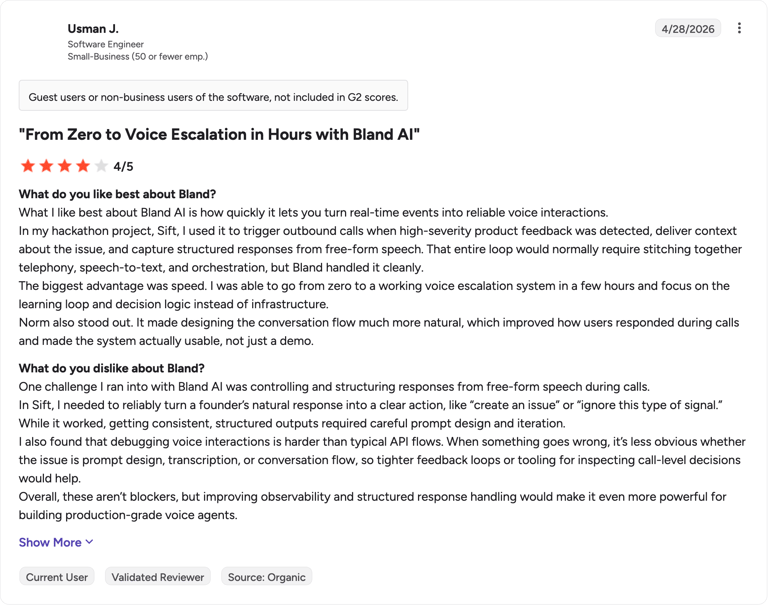
Usman J., a software engineer at a small business (G2 Validated Reviewer), on shipping a working voice escalation flow in a few hours:
What Real Users Say About Vapi AI On G2
Lalit A., an Internshala student partner at a small business (G2 Validated Reviewer, incentivized), on Vapi's biggest tradeoff:

A verified user in consulting, at a small business (G2 Validated Reviewer, incentivized), on what the API-first approach buys and where it still falls short:

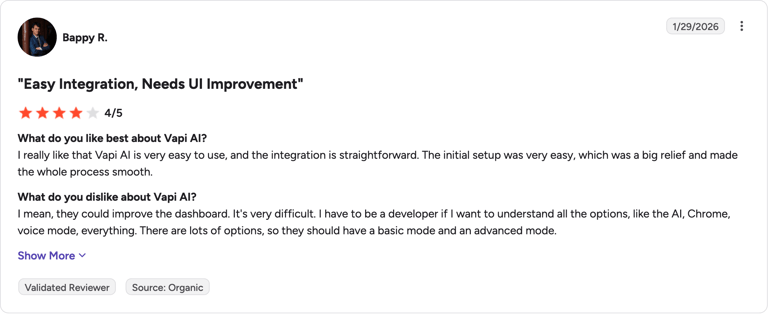
Bappy R. (G2 Validated Reviewer; role and company size not disclosed on the review), on the tradeoff between Vapi's flexibility and its dashboard:
Bland AI Reviews vs. Vapi AI Reviews on Reddit & Quora
Community threads carry what review sites miss on platforms this new: latency tuning, billing surprises, what broke in production. We read them as signals, not verdicts, the way our software review methodology treats any single rating.
What Real Users Say About Bland AI On Reddit & Quora
A two-year-old r/ArtificialIntelligence thread comparing Bland AI, Retell and Vapi is where the latency and Pathways-lock-in angle actually shows up: the original poster, atlaua-the-goddess, ties Bland's latency directly to how you build with it, asking a slower commenter whether they were "using pathways" (Bland's multi-node flow builder) rather than a single prompt. Verified live and reachable on 2026-08-14:
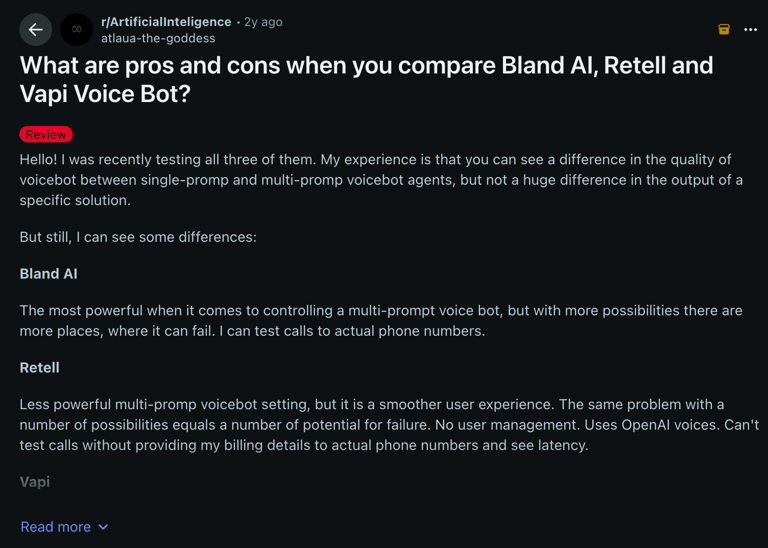
"The most powerful when it comes to controlling a multi-prompt voice bot, but with more possibilities there are more places, where it can fail." atlaua-the-goddess, in a thread comparing Bland AI, Retell, and Vapi on r/ArtificialIntelligence.
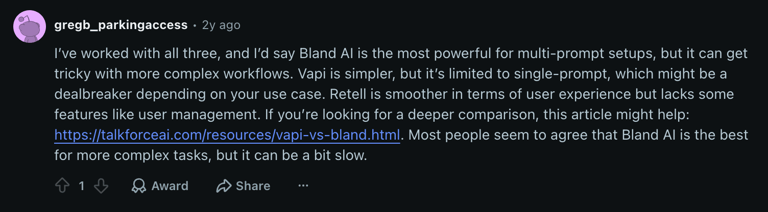
"I'd say Bland AI is the most powerful for multi-prompt setups, but it can get tricky with more complex workflows... Most people seem to agree that Bland AI is the best for more complex tasks, but it can be a bit slow." gregb_parkingaccess, same thread.
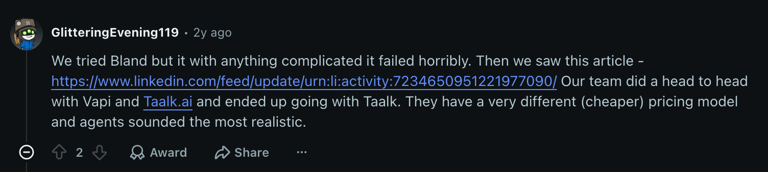
"We tried Bland but it with anything complicated it failed horribly." GlitteringEvening119, in the same thread, after which their team switched to a different vendor following a head-to-head test.
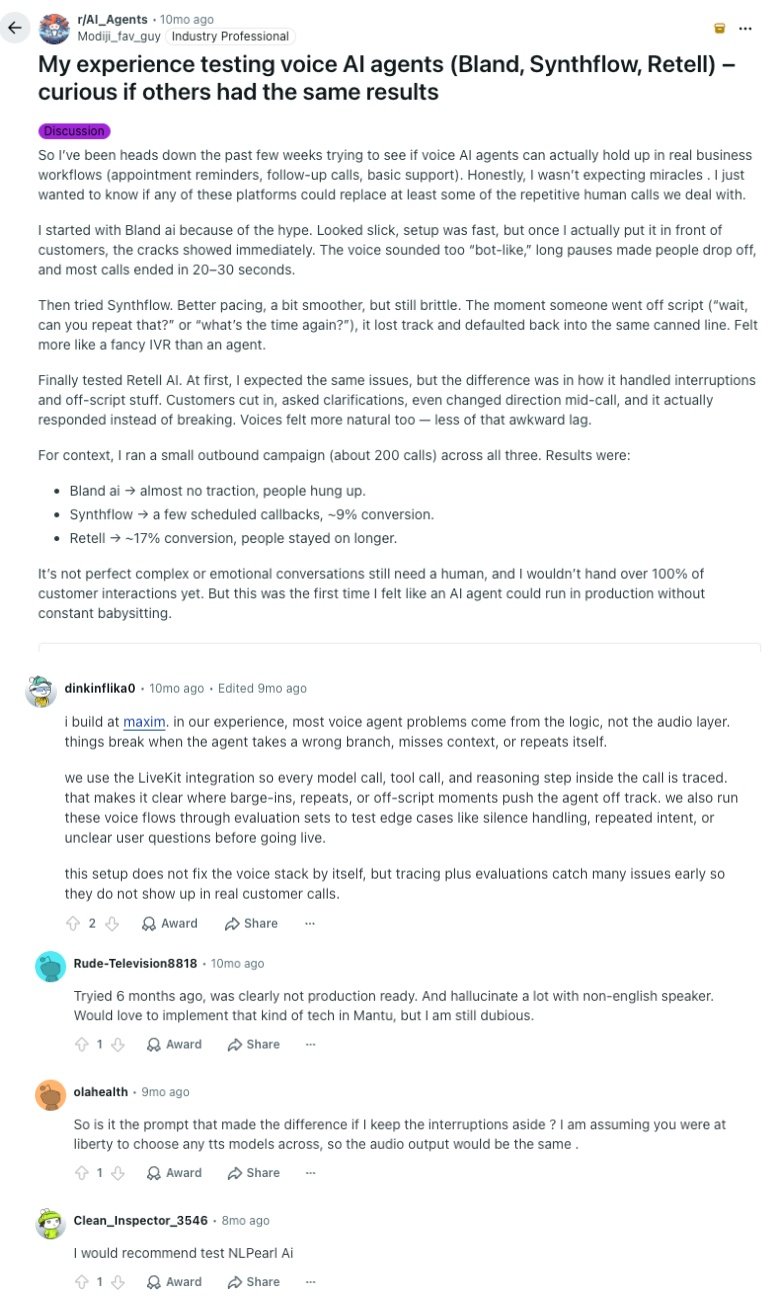
A separate, more skeptical account turns up in an r/AI_Agents thread from a builder who tested Bland, Synthflow and Retell back to back: they started with Bland for the hype, but found the voice "too 'bot-like,'" with long pauses that made people drop off, and a 200-call outbound campaign that got "almost no traction."
What Real Users Say About Vapi AI On Reddit & Quora
Bland AI Pros & Cons vs. Vapi AI Pros & Cons
Bland AI Pros & Cons
Most searches for a bland ai alternative start at a packaging wall, not a product one. The bland ai alternatives that win those evaluations tend to unbundle what Bland keeps on Enterprise.
| Pros | Cons |
|---|---|
| Pathways builder on every tier | Transfers, SSO, guardrails and omnichannel gated to Enterprise |
| One rate for model, transcription and voices | No provider choice |
| Batch calling API with scheduling | Call logic locked into Pathways |
| Norm builds a first agent from a prompt | Telephony and numbers billed on top |
| 99.9% uptime SLA on all tiers | Concurrency and daily caps fixed per tier |
Vapi AI Pros & Cons
A search for a vapi ai alternative is normally a reaction to the invoice or the setup burden, not to what the platform can do, and Vapi competitors pitch against both.
| Pros | Cons |
|---|---|
| Transcriber, model and voice per assistant | $0.05 a minute excludes model provider costs |
| BYOK drops model cost off Vapi's invoice | Multiple invoices without BYOK |
| Voice Test Suites score agents pre-launch | HIPAA $2,000/month, Zero Data Retention $1,000/month |
| Native Outbound Campaigns | No SOC 2, SSO or RBAC on Build |
| SDKs, a CLI, an MCP server, machine-readable docs | 14-day call history and Discord support on Build |
Put an AI Voice Agent on Your Own Calls This Week
Which Team Fits Which Platform?
Fit comes down to call volume, engineering capacity and how much control you'll trade for speed. Any ai voice agent platform comparison that skips those recommends whichever platform the author sells, so start from your own AI voice agent use cases.
Which Team Fits Which Platform?
| Bland AI Is the Right Fit For... | Vapi AI Is the Right Fit For... |
|---|---|
| High-volume outbound teams needing batch calling on day one | Teams with engineering capacity to own the stack |
| Regulated teams needing on-prem or VPC and a signed BAA | Teams with a mandated model, voice or carrier |
| Teams wanting one bundled rate, not provider invoices | Teams already holding provider API keys, for BYOK economics |
| Operations teams wanting a visual builder, not custom code | Teams that want agents scored against a rubric before launch |
| Teams with no machine learning or voice engineering capacity | Teams building logic beyond what a flow builder covers |
For outbound sales, Bland and Vapi both treat campaigns as native: Bland exposes batch calling as a scheduled API endpoint, Vapi runs Outbound Campaigns from the dashboard. Day-to-day ownership decides it. If a sales operations lead adjusts it, Bland's dashboard is shorter; if an engineer owns it inside a wider system, Vapi's API is.
Bland AI vs. Vapi AI: The Verdict
The bland ai vs vapi 2026 decision comes down to call volume, compliance and engineering capacity. On the one independent same-workload benchmark, the two are level on median latency and differ only in consistency, so there's no quality gap to rank. Implementing an AI voice agent after signing looks similar on both.
Choose Bland AI if you...
- Run high-volume outbound campaigns and want batch calling as a native API.
- Need on-prem or VPC, data residency and a signed BAA, and can sign an enterprise contract.
- Want one per-minute rate covering model, transcription and voices.
- Have operations people, not engineers, editing the call flows.
- Want a working agent in a day and are comfortable with Bland's models.
Choose Vapi AI if you...
- Have engineering capacity to own and tune the transcriber, model, voice and carrier.
- Are required to run a specific model or voice provider, or already hold the API keys.
- Want scored, scripted test calls before an agent touches a real customer.
- Need HIPAA or Zero Data Retention without an enterprise contract, and can absorb the cost.
- Are building conversation logic a visual flow builder cannot express.
Weighing a third option before you commit?
Frequently Asked Questions About Bland AI vs Vapi AI
Direct answers to the questions buyers ask most when comparing Bland AI and Vapi AI.
Yes, with a packaging caveat, not a quality one. Fortune reported in June 2026 that Bland AI handles over 3.5 million calls a week for 250-plus enterprise customers; its pricing page lists SOC 2 Type I and II, GDPR and PCI DSS. But a HIPAA BAA, SSO and data residency are Enterprise-only, which bites on healthcare voice agent use cases.
Vapi AI costs $0.05 per minute in platform fees plus whatever your transcriber, model and voice provider charge; its pricing page passes model costs to the customer. Openbenchmarks measured $0.0836 per invoiced minute in July 2026. Add $10 per line above ten and $2,000 a month for HIPAA, and voice AI costs resist one number.
Neither is cheaper in every case; it turns on your provider keys and compliance needs. On Openbenchmarks' July 2026 same-workload run, Vapi invoiced $0.0836 per minute against Bland's $0.1408. The gap narrows once Vapi's provider bills arrive and reverses if you need HIPAA, so model real volume in an AI voice agent ROI calculator.
No, Bland AI doesn't require coding for a basic agent. Conversational Pathways is a visual builder on every tier, and Norm generates a first agent from a plain-language description. Coding starts with live data injection, custom API tools and workflow automation reaching into your systems, all through Bland's API.
The measured difference is small on a typical turn, larger in the tail. Openbenchmarks' board, updated 31 July 2026, puts median caller-experienced TTFAB at 1,520 ms for Bland and 1,558 ms for Vapi, p95 at 2,248 ms and 2,008 ms. Both vendors publish sub-500 ms figures that time the pipeline, not what the caller hears on AI phone calls.
CloudTalk suits some teams and not others; it's a different shape of product. CloudTalk's AI Voice Agent is no-code inside a full call center, with numbers, CRM sync, routing and analytics already there, as a usage-based add-on from $99 per month for 200 minutes. Our CloudTalk vs Bland AI comparison shows where the line falls.