TL;DR
Retell AI and Bland AI both provide the infrastructure you need to build and run voice agents on phone lines. Neither is better overall—the right choice depends on your compliance needs and how much flexibility you want with third-party AI models.
- Retell AI focuses on flexibility. You can use OpenAI, Anthropic, Google, or your own LLM, with pricing starting at $0.07/minute. It also includes the first 10 knowledge bases for free and free SIP trunking.
- Bland AI focuses on control. It runs the voice, speech-to-text, language, and text-to-speech layers itself, without third-party AI in the call path. It also offers SOC 2 Type II, PCI DSS, HIPAA with a BAA, and private deployment options such as VPC, on-premise hardware, or air-gapped environments.
That makes Retell AI a better fit for agencies, mid-market teams, and product builders that want flexibility, while Bland AI is better suited to regulated enterprises and high-volume contact centers that need tighter control over data and call logic.
This comparison looks at 2026 pricing, features, latency, integrations, security, developer experience, and public reviews to help you decide which fits your needs.
Retell AI vs. Bland AI: Core Strengths of Each Platform
Retell AI focuses on flexibility and lower costs, while Bland AI focuses on control, security, and compliance. The better choice depends on what your business needs and how you plan to use your voice agents.
Where Retell AI Shines
| Strength | Why it matters |
|---|---|
| Model choice across providers | OpenAI GPT‑4.1/5.x series, Anthropic Claude 4.5/4.6/5 Sonnet and 4.5 Haiku, Google Gemini 3.x Flash variants, and a custom LLM |
| A low floor | $0.07 to $0.31 per minute published |
| Native knowledge base | The first 10 are free, then $8 per KB per month plus $0.005 per minute |
| Telephony you already own | No charge for SIP trunking, custom telephony or your own numbers; $0.015 per minute for US calls via Twilio. |
| No platform fee to start | $0 fee, $10 in credits, no contract, and 20 concurrent calls before the $8 per concurrency charge starts. |
Where Bland AI Shines
| Strength | Why it matters |
|---|---|
| No third-party AI in the call path | Bland says it owns voice, STT, LLM and TTS, so no OpenAI, Anthropic or Google sub-processor sits between you and the caller. |
| Independently audited SOC 2 Type II | A third-party auditor assesses Bland over a continuous multi-month window, with quarterly external penetration tests. |
| Deployment shaped around your data | Bland is more flexible for businesses that need to keep their data under their own control or meet strict security and compliance requirements. |
| Conversational Pathways on every tier | Pathways, integrations, automations and version lock appear on every self-serve tier, including the $0 one, not only Enterprise. |
| One rate, one SLA | The per-minute price covers model, speech-to-text and speech synthesis together, and the 99.9% uptime SLA applies to every tier. |

Book a demo of CloudTalk

Retell vs. Bland Comparison At a Glance
Retell AI prioritizes flexibility and model choice, while Bland AI focuses on control, security, and compliance. Their pricing and deployment options differ too. Here’s how they compare:
| Dimension | Retell AI | Bland AI | Best for |
|---|---|---|---|
| AI stack | Uses third-party models and voices | Owns the full AI stack | Retell for model choice; Bland for one provider |
| Model choice | OpenAI, Anthropic, Google, or custom LLM | Bland Speech v3 | Retell for flexibility; Bland for control |
| Pricing | Pay as you go, from $0.07/min | From $0.11/min + monthly fee; $0.14 /min (no monthly fee) | Retell for variable usage; Bland for predictable volume |
| Getting started | $0 platform fee + $10 credits | $0 fee + 2 credits + free inbound number | Both are easy to test |
| Compliance | HIPAA, SOC 2 Type I & II, and GDPR; more options on Enterprise | SOC 2 Type I and Type II, HIPAA-eligible with a signed BAA, GDPR, and PCI DSS | Both support key compliance standards |
| Deployment | Cloud; dedicated servers on Enterprise | Cloud, VPC, On-Premise | Bland for data control |
| Voice & latency | Depends on your TTS provider | Proprietary Bland Speech v3 | Depends on your voice needs |
| Concurrency | 20 free; paid plans scale higher | 10–100 or custom, depending on plan | Retell for spikes; Bland for planned volume |
| Best for | Agencies, mid-market teams, product builders | Regulated enterprises, high-volume contact centers | Depends on your needs |
Retell AI vs. Bland Features
The main difference between Retell AI vs. Bland AI features is how they handle the AI behind the agent. Retell AI lets you choose and combine different models, while Bland AI uses its own AI stack.
What Are Retell AI's Key Features?
Retell AI assembles an agent from parts you pick: a language model, a voice, a knowledge base, a telephony path. Pricing is per component, which makes the stack legible and the bill harder to predict.
What Retell AI does well
- Test your agent before going live. You can use templates and run test calls with different scenarios to see how your agent handles conversations before real customers call.
- Useful tools for outbound campaigns. You can add branded calls or run bulk calls without upgrading to a higher plan. You just pay for what you use.
- Extra tools to improve call quality. Retell offers features like noise removal, safety controls, PII removal, and AI quality checks. These come at an extra cost.
Where Retell AI falls short
- You rely on other AI providers. Retell uses models and voices from providers like OpenAI, Anthropic, Google, and ElevenLabs. This gives you more choice, but also means more third parties are involved in your call setup.
- The advertised price isn't the final cost. The advertised rate only covers part of the setup. You also need to add the voice, AI model, and phone connection, so the final cost can be higher.
- You pay while callers are waiting. Retell charges for silence and hold time. It doesn't charge for calls that never connect, and AI charges stop once a call is transferred.
What Are Bland AI's Key Features?
Bland AI takes a different approach. It controls the whole AI stack and bundles everything into one per-minute rate. You build your call flows in Conversational Pathways, and you can run the agent in Bland’s cloud, your own VPC, your own GPUs, or isolated hardware.
What Bland AI does well
- Simpler security setup. Bland controls the whole AI stack, so you don't have to manage multiple AI providers and their data agreements.
- Knowledge bases and voices are included. Your plan includes a set number of knowledge bases and voices, so you don't pay separately for each one.
- Advanced call logic is available from the start. You can use Conversational Pathways, integrations, automations, and version control without upgrading to Enterprise.
Where Bland AI falls short
- You can't choose your AI models. You're limited to Bland's own models, so you can't switch to a third-party model if you prefer its performance or pricing.
- Some important features require Enterprise. Features like warm transfers, SMS, web chat, appointment scheduling, and custom dialing are only available on Enterprise.
- The Start plan is mainly for testing. With limited calls, concurrency, voices, and knowledge bases, it's not designed for larger production setups.
Feature-by-Feature Comparison
| Feature | Retell AI | Bland AI |
|---|---|---|
| AI stack | Uses third-party models, voices, and telephony | Uses its own AI stack |
| Model choice | OpenAI, Anthropic, Google, or custom LLM | Bland’s own models |
| Knowledge bases | 10 free, then paid | 10–unlimited depending on plan |
| Flow building | Templates and simulation testing | Conversational Pathways for multi-step flows |
| Telephony | Retell-managed numbers, SIP trunking, BYOC via Twilio/Telnyx/Vonage | Built-in phone numbers, SIP, and PBX |
| Transfers | AI charges stop after transfer | Paid per minute; free with your own telephony |
| Concurrency | 20 free; more available on paid plans | 10–100 depending on plan; more on Enterprise |
| Deployment | Cloud; dedicated servers on Enterprise | Cloud, your VPC, on-premises, or air-gapped |
| Voices | Multiple providers, including ElevenLabs | 1–15 depending on plan; unlimited on Enterprise |
Retell AI vs Bland Latency & Voice Call Quality
Latency matters because the faster an agent responds, the more natural the conversation feels. Bland AI claims around 400 ms of latency, while Retell AI reports around 600 ms, giving Bland the edge on paper.
| Dimension | Retell AI | Bland AI |
|---|---|---|
| Reported latency | ~600 ms | ~400 ms |
| Voice models | Choose from multiple third-party models and providers | Proprietary Bland Speech v3 |
| Audio path | Depends on the providers you choose | Controlled by Bland |
| Uptime | Status page and dedicated servers on Enterprise | 99.9% SLA on all plans |
| Concurrency | 20 free; more available on paid plans | 10, 50, or 100 depending on plan |
| Independent benchmark | None found | None found |
Retell AI vs Bland AI Pricing
Retell AI starts at $0.07/min with no platform fee, while Bland AI starts at $0.14/min with its AI stack included. Here’s how their pricing compares.
How Much Does Retell AI Cost?
Retell AI pricing offers a single pay-as-you-go plan with a $0 platform fee, $10 in credits, full platform access, no contract, and a custom Enterprise tier. Its published headline is $0.07 to $0.31 per minute, but that range depends on the components you pick.
| Component | Published rate |
|---|---|
| Platform fee | $0 |
| Voice agent headline | $0.07 to $0.31 per minute |
| Retell voice infrastructure | $0.055 per minute |
| Text-to-speech | $0.015 per minute for platform, Minimax, Fish, Cartesia and OpenAI voices; $0.040 for ElevenLabs |
| Language model | $0.003 per minute for GPT 5 nano up to $0.16 for GPT 5.5 on the standard tier, and up to $0.32 on the fast tier |
| Speech-to-speech | $0.07 per minute for Realtime mini; $0.345 for GPT Realtime |
| Telephony | $0.015 per minute for US calls via Twilio or Telnyx; no charge for SIP trunking or custom telephony |
| Phone numbers | $2.00 per month; free if you bring your own; verified numbers $10 per month plus a one-time $10 fee |
| Knowledge base | First 10 free, then $8 per KB per month plus $0.005 per minute of use |
| Concurrency | 20 concurrent calls free, then $8 per concurrency per month |
| Notable add-ons | Branded Call $0.10 per outbound call; Batch Call $0.005 per dial; PII removal $0.01 per minute; AI Quality Assurance $0.10 per minute |
| Billing behavior | Per-second tracking with no round-up; billed only for connected calls; billed during silence and hold |
How Much Does Bland AI Cost?
Bland AI pricing has three self-serve plans plus Enterprise, starting at $0.14/minute. The per-minute price includes the AI model, speech-to-text, and voice, with no extra token or model fees. Telephony is charged separately, either through your own Twilio or SIP setup, or through Bland’s Twilio connection at cost.
| Tier | Per minute | Platform fee | Transfer | Concurrent calls | Calls per day | Knowledge bases | Voices |
|---|---|---|---|---|---|---|---|
| Start | $0.14 | $0 | $0.05/min | 10 | 100 | 10 | 1 |
| Build | $0.12 | $299/mo | $0.04/min | 50 | 2,000 | 50 | 5 |
| Scale | $0.11 | $499/mo | $0.03/min | 100 | 5,000 | 100 | 15 |
| Enterprise | Custom | Contracted to volume | Custom | Sized to volume | Unlimited | Unlimited | Unlimited |
Pricing Compared Line by Line
| Pricing dimension | Retell AI | Bland AI |
|---|---|---|
| Pricing model | Modular pay-as-you-go, per component | Three tiered plans plus contracted Enterprise |
| Headline rate | $0.07 to $0.31 per minute | $0.14, $0.12 or $0.11 per minute by tier |
| Platform fee | $0 | $0, $299 or $499 per month |
| What the per-minute rate covers | Nothing alone; model, voice and telephony bill separately | Model, speech-to-text and speech synthesis |
| Phone numbers | $2.00 per month, or free if you bring your own | Inbound number valued at $15/mo included on Start |
| Knowledge base cost | First 10 free, then $8 per KB per month plus $0.005 per minute | Included by tier, 10 up to unlimited |
| Transfers | AI fee stops at transfer; telephony continues | $0.05 to $0.03 per minute by tier; free with your own telephony |
| Typical all-in | $0.11 per minute for a mainstream build, per Retell's calculator | The tier rate plus telephony |
| Contract to start | None; $0 fee and $10 credits | None on Start; no card required |
Retell AI Integrations vs. Bland AI Integrations
The main difference is how much integration work they handle for you. Retell AI offers more flexibility, while Bland AI focuses on built-in tools and structured workflows.
What Does Retell AI Integrate With?
Retell AI offers built-in integrations with tools like Make, Twilio, HubSpot, n8n, and GoHighLevel. For other tools, you can connect them through its API and webhooks. You can also use your own phone provider through SIP or custom telephony.
What Does Bland AI Integrate With?
Bland AI also supports integrations and automations through its API and webhooks. You can bring your own Twilio account or SIP provider, or use Bland’s built-in Twilio connection. Enterprise adds more advanced options, such as custom code and dedicated infrastructure.
Integration Capability Compared
| Integration capability | Retell AI | Bland AI |
|---|---|---|
| Native CRM and automation connectors | Make, Twilio, Vonage, GoHighLevel, n8n and HubSpot listed natively | API and webhook-driven, with integrations on all tiers |
| Telephony and SIP support | SIP trunking and custom telephony at no charge; $0.015/min US via Twilio or Telnyx | Your own Twilio or any SIP trunk, or built-in Twilio at pass-through cost |
| Developer requirement | Engineering for the initial build, dashboard configuration afterward | Engineering to design Pathways and wire integrations |
| Webhook and API access | Full API and webhooks | Full API and webhooks |
| Plan gating | Integrations on pay-as-you-go; compliance controls on Enterprise | Integrations on every tier; custom code extraction and custom dialing on Enterprise |
Security & Compliance: Retell AI vs. Bland AI
Retell AI uses third-party AI models and voice providers, while Bland AI keeps the AI stack in-house. Both offer security and compliance measures, but their approaches to data handling are different. Here’s how they compare:
| Security | Retell AI | Bland AI |
|---|---|---|
| SOC 2 | Type I & Type II, independently audited | Type II, independently audited |
| HIPAA | Compliant with a signed BAA | HIPAA with a signed BAA |
| GDPR | GDPR-compliant DPA | GDPR with DPA |
| PCI DSS | Not listed | PCI DSS v4.0 |
| BAA / DPA | Available online | Available through Trust Portal |
| Data retention | Configurable per agent | Configurable |
| Encryption | At rest and in transit | At rest and in transit |
Usability & Developer Experience: Retell AI vs. Bland AI
Retell AI is generally easier to navigate and get started with, with a cleaner interface for building agents, testing calls, and managing prompts and knowledge bases. Bland AI offers more powerful visual controls through Conversational Pathways, but its interface can feel more complex for beginners. Here's how they compare:
| Feature | Retell AI | Bland AI |
|---|---|---|
| Visual builder | Drag-and-drop builder and no-code sandbox | Visual flow builder with Conversational Pathways |
| API | Full API for agents, calls, voices, phone numbers, and more | API for calls, pathways, voices, knowledge bases, tools, and more |
| AI tools | Official MCP server for AI-assisted development | llms.txt docs for AI agents |
| Flow control | Prompt-based agent flows | Visual flows with different node types and conditions |
| Variables | API parameters and agent settings | Built-in variables and {{variable}} syntax |
| Templates | Demo projects and examples | Prebuilt pathway templates |
| Support | Documentation, dashboard, and Enterprise support | Discord support and dedicated Enterprise engineers |
| Onboarding | Production agent in under 30 minutes, deployment takes 1-2 weeks | Within a day on the self-serve plans; enterprise deployments follow a 28-day deployment framework |
Retell AI vs Bland Reviews on G2
G2 users rate both platforms highly, but the size of their review bases is very different. Retell AI scores 4.8/5 from 2,638+ reviews, while Bland AI scores 5.0/5 from just 11+ reviews. That makes Bland’s higher score look impressive, but Retell’s much larger review pool gives its rating more weight.
Retell AI users most often praise its ease of use, intuitive interface, integrations, and natural conversations. The main complaints are a learning curve for advanced workflows, missing features, and concerns about costs as usage grows.
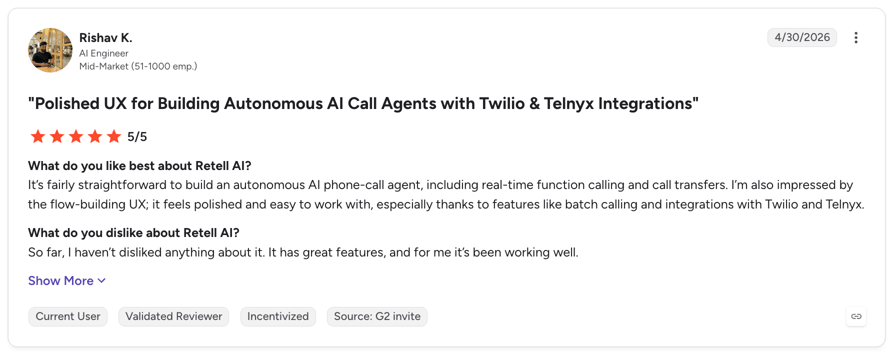
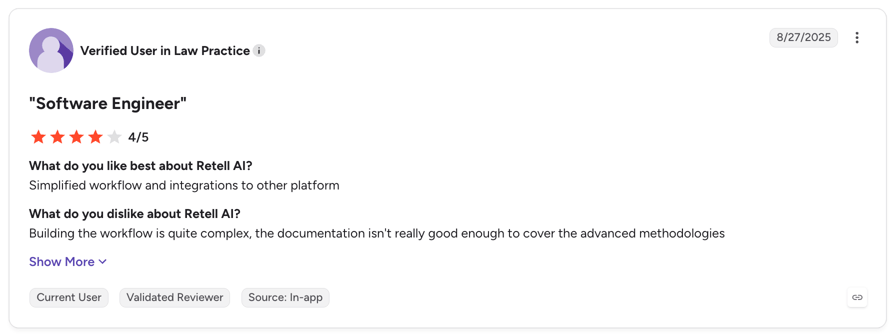
Bland AI gets similar praise for powerful voice agents, easy integrations, fast setup, and responsive support. Its main weakness is also usability: some reviewers say the platform takes time to learn, especially when building more complex agents.
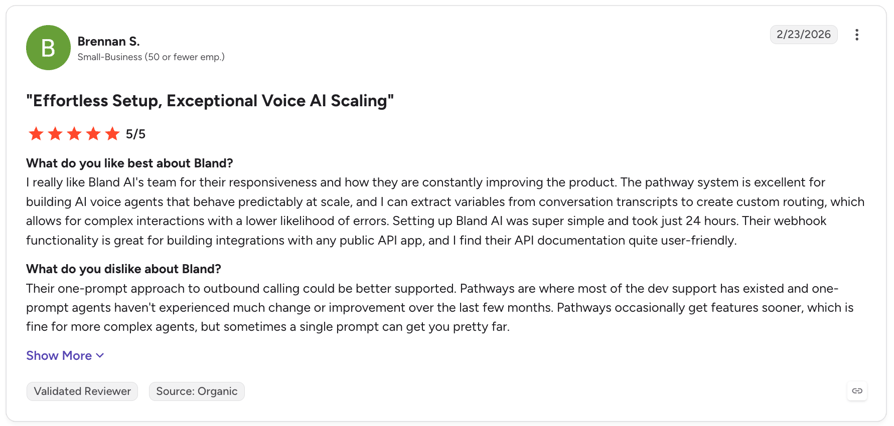
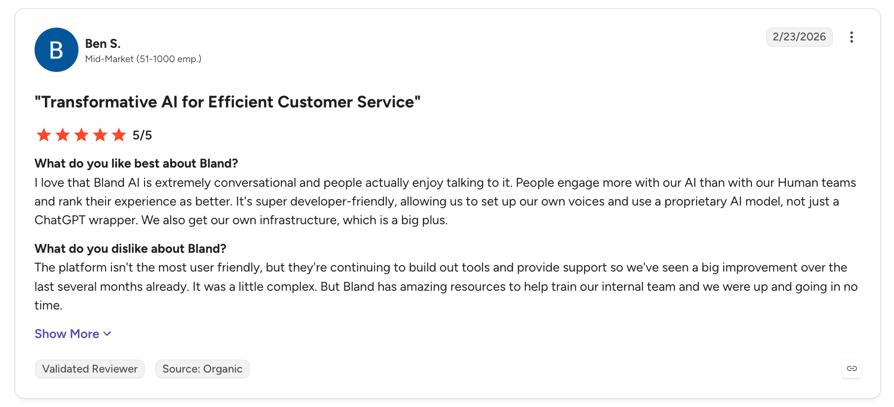
So while Bland AI has the higher G2 score, Retell AI has far more user feedback behind its rating. The reviews point to a similar trade-off: Retell feels easier to pick up, while Bland gives users more control but can take longer to master.
Retell AI Reviews vs. Bland AI Reviews on Reddit
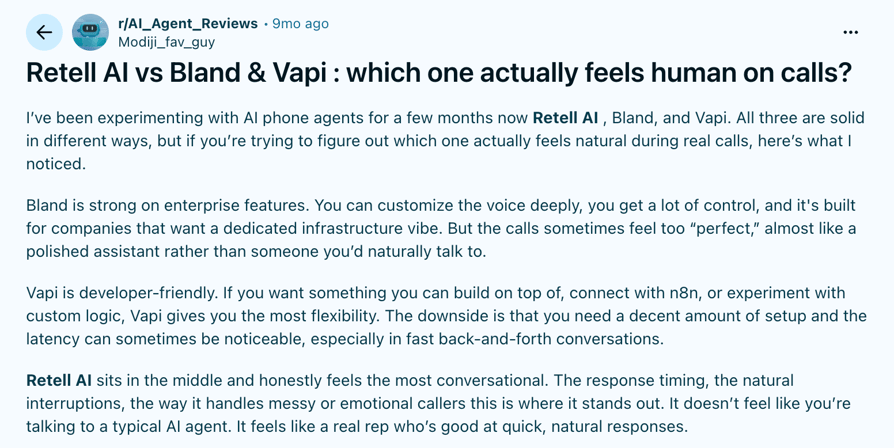
Reddit users note that Bland offers more enterprise-level control and voice customization, while Retell AI stands out for its more natural response timing, interruptions, and handling of messy or emotional conversations, making it feel more like talking to a real rep than an AI agent
Retell AI vs. Bland AI: Pros and Cons
Retell AI and Bland AI take different approaches to voice AI. Retell gives you more freedom to choose your models, voices, and telephony setup, while Bland keeps more of the stack in-house and focuses on control and deployment options.
Retell AI Pros & Cons
| Pros | Cons |
|---|---|
| More flexibility: Choose from OpenAI, Anthropic, Google, or a custom LLM, plus multiple voice providers. | More moving parts: Your agent can rely on several third-party AI and voice providers. |
| Easy to start: $0 platform fee, $10 in credits, no contract, and 20 concurrent calls included. | The headline price isn’t the full cost: The $0.07/min rate can increase once you add the model, voice, and telephony you need. |
| Built-in knowledge retrieval: The first 10 knowledge bases are free. | Extra knowledge bases cost more: Beyond the first 10, you pay $8/month per knowledge base plus usage. |
| Flexible telephony: Free SIP trunking and custom telephony, so you can keep your existing setup. | Some enterprise controls are gated: Features such as HIPAA with a BAA, SSO, and RBAC require Enterprise. |
| Precise usage billing: Per-second billing with no round-up, and calls that never connect aren’t charged. | Silence still costs: Usage continues while callers are on hold or there’s silence. |
Bland AI Pros & Cons
| Pros | Cons |
|---|---|
| More control over the AI stack: Bland handles the voice, STT, LLM, and TTS layers itself. | No model choice: You can’t swap in OpenAI, Anthropic, Google, or another third-party LLM. |
| Strong security options: SOC 2 Type II, PCI DSS, and private deployment options such as VPC and on-premise. | Some features are Enterprise-only: Warm transfers, SMS, appointment scheduling, and other advanced capabilities require Enterprise. |
| Simpler pricing: One per-minute rate covers the model, transcription, and speech synthesis. | Monthly fees at higher tiers: Build and Scale add $299 or $499/month on top of usage. |
| Advanced call logic: Conversational Pathways, integrations, automations, and version control are available across self-serve plans. | Start is limited: The entry tier is capped at 1 voice, 10 concurrent calls, and 100 calls per day. |
| 99.9% SLA on every tier: Even the Start plan includes the published uptime SLA. | Less flexibility for teams that want to customize the stack: You’re tied to Bland’s proprietary AI infrastructure. |
The short version:
Retell AI is the more flexible option if you want control over the models and components behind your agent. Bland AI makes more sense if you prioritize a self-contained AI stack, security controls, and private deployment.
Retell AI vs. Bland AI: The Verdict
The better choice depends less on which platform has more features and more on what you’re trying to build. Retell AI gives you more freedom to choose the models and components behind your agent, while Bland AI is better suited to teams that need tighter control over the infrastructure.
Choose Retell AI if you…
- Build AI agents for different clients or use cases and need the flexibility to choose different models and voices for each one.
- Want to experiment with new LLMs or voice providers without rebuilding your agent on another platform.
- Run variable or unpredictable call volumes and prefer pay-as-you-go pricing without a monthly platform fee.
- Already have your own telephony setup and want to connect it through SIP or custom telephony.
- Need natural, flexible conversations and want more control over the components that shape the caller experience.
Choose Bland AI if you…
- Build voice agents for regulated industries where security, compliance, and data control are key requirements.
- Need private infrastructure such as VPC, on-premise, or air-gapped deployment.
- Run high-volume contact center operations where predictable usage makes Bland’s tiered pricing worthwhile.
- Need complex, structured call flows and want to build them with Conversational Pathways.
- Prefer a more self-contained setup rather than managing several AI and voice providers.
The bottom line:
Retell AI is the stronger choice for flexible, developer-led builds and teams experimenting across models and use cases. Bland AI is better suited to enterprise deployments where infrastructure control, compliance, and predictable operations matter more. Neither is universally better—the right one depends on what your voice agent actually needs to do.
Weighing infrastructure against a packaged agent?
FAQs About Retell AI vs. Bland AI
Neither is better overall. Retell AI is stronger on third-party model choice and modular pricing; Bland AI is stronger on audited compliance and private deployment. In the conversational AI platform category, compliance load usually decides.
Retell AI is usually cheaper at low volume. Retell publishes $0.07 to $0.31 per minute, and its own calculator puts a mainstream build at $0.11. Bland AI charges $0.14 per minute at no platform fee, $0.12 at $299 a month, or $0.11 at $499.
Bland AI reports lower latency at around 400 ms, compared with roughly 600 ms for Retell AI. However, neither figure comes from an independent benchmark, and real-world latency can vary depending on the models, voices, and telephony providers you use.
Retell AI lets you choose the voice provider, at $0.015 per minute for platform voices and $0.040 for ElevenLabs. Bland AI uses its own Bland Speech v3, included in the rate, with 1 to 15 voices by tier. Test both on your own script.
Both require some technical work, but they take different approaches. Retell AI is easier to get started with, with a drag-and-drop builder, templates, testing tools, and a no-code sandbox. Bland AI gives you more control through Conversational Pathways, but building more complex flows can require more engineering.
Bland AI is the stronger fit for regulated industries, with HIPAA, PCI DSS, SOC 2 Type II, and private deployment options. Retell AI also supports HIPAA and SOC 2, but some features are Enterprise-only.
Yes, both do. Retell AI supports batch dialing at $0.005 per dial and branded outbound at $0.10 per call, covering most of what an AI voice agent for outbound sales calls needs. Bland AI runs both through one per-minute rate.
CloudTalk is a different category. Retell AI and Bland AI are infrastructure platforms, while CloudTalk offers a no-code AI Voice Agent built into a business phone system. It’s a strong fit for SMBs and sales or support teams that want to automate calls without the technical setup. Pricing starts at $99/month for 200 minutes.