Bland's advantage is real. It runs its own phone-tuned models instead of routing calls through outside language, speech, and voice vendors, and on Enterprise it deploys inside your infrastructure or a virtual private cloud (VPC). It holds SOC 2 Type I and Type II, HIPAA with a signed business associate agreement (BAA), PCI DSS, and GDPR.
So the split is clean. Sales, support, and customer experience (CX) teams that want an agent on the phones this quarter pick CloudTalk. Engineering-led teams automating high volume, under a mandate that data never touches an outside model provider, pick Bland.
Salesforce's 2025 State of Service report, a survey of 6,500 service professionals, found AI already handles 30% of service cases, heading for 50% by 20271. Most teams are deciding this now.
This CloudTalk and Bland AI comparison covers setup, handoff, data privacy, cost, integrations, security, and reviews. Skip to the at-a-glance table if one dimension decides it. If Bland sits next to Retell on your shortlist, we run those numbers in our Retell AI vs Bland AI comparison.
See CloudTalk's AI Voice Agent Take a Real Call
Why CloudTalk Is Better Than Bland AI
Both products build competent agents. What separates them is everything that has to exist around the agent before it can take a real customer call, and who builds it.
CloudTalk's Core Advantages Over Bland AI
CloudTalk's Core Advantages Over Bland AI
| Advantage | Why It Matters |
|---|---|
| Lands in a working call center | Numbers in 160+ countries, IVR and routing from Starter, seats, supervision. With Bland, you source it. |
| Handoff on every plan | Core CloudTalk features on every plan. Bland does cold transfer on any plan; warm needs Enterprise. |
| 60+ languages and accents | Bland covers 40+ natively, translation in 23. Narrower across many markets. |
| Bundled AI pricing, not an open meter | CloudTalk: $99 for 200 minutes, $349 for 1,000. Bland: $0.14 to $0.11 a minute plus a fee, no upper bound. |
| Compliance without an enterprise contract | CloudTalk: SOC 2, ISO 27001, GDPR, CCPA, HIPAA, PCI-DSS. Bland gates BAA, SSO, and residency behind Enterprise. |
Customer story: Oxford Royale Academy, an education provider, replaced its dependency on seasonal hiring with multilingual AI calls. Read the story.
At a Glance: CloudTalk vs. Bland AI, Key Differences
Here is how CloudTalk and Bland AI compare in 2026 on the nine dimensions buyers ask about most. Find your row, then jump to that section. Still deciding which calls to automate first? That is answered in our guide to the best use cases for AI voice agents.
CloudTalk vs Bland AI: Key Differences
| Dimension | CloudTalk | Bland AI | Winner |
|---|---|---|---|
| Setup path | No-code wizard, under 10 minutes | Pathways or Norm; 2 to 6 weeks to production | CloudTalk |
| Bundled call center | Numbers, routing, seats, analytics | Not included; telephony separate | CloudTalk |
| Live-agent handoff | Warm and cold, every plan | Cold on all plans; warm on Enterprise | CloudTalk |
| Underlying AI stack | Providers you pick: GPT-4o or Claude, Deepgram, ElevenLabs | Its own phone-tuned models, no pass-through | Bland AI |
| On-premise or VPC | Not offered | Enterprise only, residency on request | Bland AI |
| Pricing model | $25 to $49 per user/month, plus a fixed minute bundle | $0.14 to $0.11 a minute plus a $0 to $499 platform fee | CloudTalk |
| Compliance breadth | SOC 2, ISO 27001, GDPR, CCPA, HIPAA, PCI-DSS | SOC 2, HIPAA with BAA, GDPR, PCI DSS; BAA on Enterprise | Tie |
| Language coverage | 60+ languages, sub-800ms response | 40+ native, translation in 23 | CloudTalk |
| Ideal team | Sales, support, and CX on a live phone line | Engineering-led, regulated, high volume | Depends |
Two rows go Bland's way, and both are about where your data lives.
CloudTalk Features vs. Bland AI Features
Comparing CloudTalk vs Bland AI features means holding two product shapes side by side. CloudTalk ships an AI Voice Agent as one capability inside a call center. Bland ships a voice-AI platform and expects the surrounding stack from you.
CloudTalk AI Voice Agent Features
The CloudTalk AI Voice Agent vs Bland AI comparison turns on what each agent inherits. CloudTalk's agent, branded CeTe internally, runs on the same telephony as your human team. A call it answers and then transfers becomes one continuous CRM record, notes and recording attached.
What CloudTalk's AI Voice Agent Does Well
- No-code build in under 10 minutes.A four-step wizard, no engineering ticket.
- It inherits a real phone system.Numbers in 160+ countries, IVR and routing from Starter, recording, analytics.
- Escalation is a first-class skill.Warm and cold transfer are core platform features, with their own reporting dashboard.
- 60+ languages at sub-800ms.Plus neural voices meant to be hard to tell from a person.
- Pricing you can budget.AI Receptionist is $99 a month for 200 minutes, first 50 free. AI Specialist is $349 for 1,000.
Where CloudTalk's AI Voice Agent Falls Short
- It's always an add-on.Never included in a plan, so it sits on top of your seat cost on every tier.
- Adjacent AI sits elsewhere.Power Dialer is included only on Expert. AI Conversation Intelligence is always an add-on at $9 per user/month.
- No on-premise or VPC option.If calls must run on infrastructure you control, CloudTalk can't do it today.
- The AI stack is third-party.You pick the model, speech-to-text, and voice vendors, which means call data reaches them.
- A fast first build still needs tuning.The 10-minute figure holds for basic intake. Teams building branching logic want more presets than the wizard offers.
Customer story: Circle Gym got 150% more trial bookings with AI Voice Agents. Read the story.
Bland AI Features
Bland AI is an enterprise platform for building and monitoring AI phone agents at scale, on its own models. Can Bland AI make outbound calls? Yes, alongside inbound: lead qualification, appointment confirmation, and follow-up, with batch calling inside per-tier caps.
What Bland AI Does Well
- Its own models, end to end.Every model is custom-made for phone calls, and no third party touches a call. It ships Bland Speech v3.
- Deployment where data has to stay.On-premise and VPC on Enterprise, with US, EU, and APAC options on request.
- Credentials built for procurement.SOC 2 Type I and Type II, HIPAA with a BAA, GDPR, PCI DSS, AES-256 at rest, TLS 1.3 in transit.
- A visual builder plus a prompt-to-agent assistant.Pathways is a drag-to-connect node canvas. Norm builds and debugs agents from plain English.
- Volume it can prove.596 million calls resolved, 1M+ concurrent in production, 250+ enterprise customers, 99.9% uptime service level agreement (SLA).
Where Bland AI Falls Short
- The operational features are Enterprise-gated.Warm transfer, BAA, SSO, residency, on-premise, SMS and web chat all mean a quote.
- There's no call center around the agent.No seats, no agent desktop, no supervision, and telephony billed separately.
- Cost has no ceiling.Per talk minute, transfer minutes extra at $0.05 to $0.03, and 100 to 5,000 calls a day by tier.
- Narrower breadth.40+ languages against 60+, and 19 integrations against the 95+ CloudTalk includes from Essential.
Feature-by-Feature Comparison
Feature-by-Feature Comparison
| Feature | CloudTalk | Bland AI |
|---|---|---|
| Setup type | No-code 4-step wizard | Pathways builder, or Norm from a prompt |
| Bundled telephony | Included, 160+ countries | Provisions and ports numbers; billed separately |
| Native CRM sync | 95+ integrations from Essential, two-way | Salesforce and HubSpot inside 19 connectors |
| Live-agent handoff | Warm and cold, every plan | Cold on all plans; warm on Enterprise |
| Underlying AI stack | Providers you choose | Proprietary, phone-tuned |
| Outbound and batch | AI agent, plus the AI Sales Dialer add-on | Yes, inside per-tier daily and concurrency caps |
| Analytics | Real-time analytics and wallboards | Real-time watching; alarms on Enterprise |
| Testing and QA | Recording, transcript search, AI call scoring | Scenario testbed, environment versioning |
| Omnichannel | Voice, SMS, MMS, WhatsApp | Voice, SMS, iMessage, web chat; last two on Enterprise |
Handoff is the row that decides most deals, so it gets more than a table cell.
Live-Agent Handoff & Operational Readiness: CloudTalk vs. Bland AI
Handoff is where AI voice deployments fail. An agent that answers 80% of a call and then drops the caller into a dial tone has moved the frustration, not removed it. Done properly, the AI reaches a named human on a routed line and passes the transcript and CRM record with the call.
On a platform whose product is the agent alone, you build each piece yourself. There are no seats to route to and no desktop for the context to land in. On a platform that was a phone system first, the routing and the call transfers already exist.
PwC's 2025 AI Agent Survey of 308 US executives found customer service leads AI agent adoption at 57%, while trust drops to 20% for financial transactions2. Teams will let AI take the routine call and want a person on the one carrying money.
Handoff and Operational Readiness Compared
| Dimension | CloudTalk | Bland AI |
|---|---|---|
| Native handoff | Warm and cold, every plan, with reporting | Cold via the Transfer Call node and API; warm on Enterprise |
| Context at handoff | One continuous CRM record, notes and recording attached | Briefing prompt, then a three-way call; CRM context via your connectors |
| Custom integration work | None. The agent inherits routing and analytics | Yes, beyond the 19 connectors and for the desktop layer |
| Routing after handoff | IVR and skill-based routing from Starter, ring groups, queues | Not included; lives in your contact center stack |
Customer story: Autenti, a SaaS and IT services company, had AI voice agents handle approximately 30% of its inbound support calls. Read the story.
Teams who specify handoff want more than a transfer. They want the call to reach the right group, to arrive labeled so whoever picks up knows why, and to carry a summary so nobody re-asks what the AI already covered. They also ask what happens when no agent is free.
Behind that list sits the question that stalls these projects: what if the agent says something it shouldn't? Buyers want an exit to a human the moment a conversation leaves known ground. That requirement decides more deals than voice quality does.
Bland can hand a call to a person. The real questions are which tier it costs you, and how much of the receiving end you build.
Data Privacy & Deployment Model: CloudTalk vs. Bland AI
Most AI voice platforms are assembled from other companies' parts: one vendor's language model, another's speech recognition, a third's voice synthesis. That is why they ship fast, and why call audio crosses several trust boundaries on the way through.
A proprietary, self-hosted stack means one company trains and runs every model, and nothing leaves the perimeter. Plenty of buyers don't need that. If you handle health or card data you may have no choice, and the bar is what a HIPAA-compliant call center must clear. This is where Bland is ahead.
A September 2025 Pew Research Center survey found 61% of Americans want more control over how AI is used in their lives, up six points from 20243. The instinct isn't limited to compliance officers.
Data Privacy and Deployment Model Compared
| Dimension | CloudTalk | Bland AI |
|---|---|---|
| AI provider model | Third-party: GPT-4o or Claude, Deepgram, ElevenLabs | Built in-house, no third party on the call |
| On-premise or VPC | Not offered | Enterprise only, on your own infrastructure |
| Data residency | 9 AWS and Google Cloud locations, each SOC 2 and ISO 27001 certified | US, EU, APAC on request, Enterprise |
| Encryption | End-to-end, automatic on WebRTC, TLS for SIP | AES-256 at rest, TLS 1.3 in transit, HSM-backed keys |
| Certifications | SOC 2 Type 2, ISO/IEC 27001, GDPR, CCPA, HIPAA, PCI-DSS | SOC 2 Type I and II, HIPAA with BAA, GDPR, PCI DSS |
If on-premise is a hard line in your security questionnaire, the comparison ends here and Bland is your answer. If it isn't, the next section usually decides it.
Total Cost of Ownership: CloudTalk vs. Bland AI
Both headline prices understate the real bill. Anyone researching CloudTalk vs Bland AI pricing sees $25 per user/month against $0.14 a minute and concludes the meter is cheaper. That holds for the AI minutes and misleads on the total.
Gartner predicts agentic AI will autonomously resolve 80% of common customer service issues by 2029, cutting operational costs 30%5. Neither vendor is there yet, but it's the direction the cost argument is heading, and it's part of why the shape of your bill today matters more than the sticker price.
How much does CloudTalk cost? Starter is $25, Essential $29, Expert $49 per user/month billed annually. The agent is a separate add-on with published AI Voice Agent pricing from $99 a month for 200 minutes.
Bland's rate covers the model, transcription, and voice synthesis, with no token charges or provider pass-throughs. Telephony, transfer minutes, and the platform fee bill on top, and the operating layer is yours.
Cost Components Compared
| Cost Component | CloudTalk | Bland AI |
|---|---|---|
| Base or entry cost | $25 to $49 per user/month, annual | $0 on Start, $299 on Build, $499 on Scale |
| AI agent cost | Fixed bundles: 50 free minutes, then $99 for 200, $349 for 1,000 | Per talk minute: $0.14, $0.12, or $0.11 |
| Telephony and transfers | Included, with a per-plan minute bundle | Separate; transfers $0.05 to $0.03, waived if you bring telephony |
| Notable add-ons | Power Dialer $15 (free on Expert), Parallel Dialer $39, AI Conversation Intelligence $9 | Voices capped at 1, 5, or 15; knowledge bases at 10, 50, or 100 |
| Volume ceiling | No daily call cap | 100, 2,000, or 5,000 calls a day |
| Needs a sales call | Custom plan, AI volume above 10,000 minutes | Warm transfer, BAA, SSO, residency, on-premise, SMS |
| Uptime | 99.999% | 99.9% on all four tiers |
A Worked Estimate: A Small Team at ~1,000 AI Minutes a Month
Run the Bland AI vs CloudTalk pricing math for a team using ~1,000 AI minutes a month with three human agents. These are estimates at published list prices, annual billing on CloudTalk, excluding Bland's telephony. Per-minute billing is the norm for agent-only platforms, so Retell AI pricing behaves the same way.
Worked Estimate: ~1,000 AI Minutes a Month
| Component | CloudTalk | Bland AI |
|---|---|---|
| Platform and seats | 3 Starter seats, ~$75, including IVR and routing | $0 on Start, no seats; $299 on Build |
| AI agent minutes | AI Specialist, $349 for 1,000 minutes | $140 on Start, or $120 on Build |
| Telephony and transfers | Included | Billed separately |
| Live-agent handoff | Included, warm and cold | Cold only; warm needs Enterprise |
| Volume ceiling | No daily cap | 100 calls a day on Start; 2,000 on Build |
| Estimated all-in | ~$424, fixed | ~$140 on Start, plus telephony, or ~$419 on Build |
At 1,000 minutes Bland's Start plan is cheaper on paper, by a wide margin. What differs is what the money buys and how the curve behaves. CloudTalk's $424 includes a phone system, three seats, routing, warm handoff, and supervision, with the AI cost capped.
Bland's $140 buys AI minutes only. It excludes telephony, caps you at 100 calls a day, and scales linearly with nothing capping the total. Add the operating layer and the Enterprise tier you need for warm transfer or a BAA, and the comparison inverts.
Ask either vendor two questions before comparing rates. Are you billed for connect time or dial attempts, because on outbound that gap gets expensive? And can you watch the allowance drain before the invoice lands? Teams who forecast their minutes stay happy on a meter. If you want a number you can budget and forget, take the bundle.
CloudTalk pricing starts at $25/user/month with the minute bundle published beside it. See all plans.
CloudTalk Integrations vs. Bland AI Integrations
The CloudTalk vs Bland AI integrations picture is less lopsided than the headline counts suggest. Bland AI does have native CRM connectors. What differs is breadth and who maintains the connection, so compare CloudTalk's integrations catalog against Bland's actual list.
CloudTalk Integrations
CloudTalk's AI Voice Agent inherits the platform's integrations, so it needs no integration project of its own. The catalog of 95+ customer relationship management (CRM), helpdesk, and applicant tracking system (ATS) connectors starts on Essential and covers HubSpot, Salesforce, Pipedrive, Zoho, Zendesk, Freshdesk, and Intercom.
Native integrations bring two-way sync of contacts, calls, recordings, AI summaries, and tags, plus click-to-call inside the partner UI, screen-pops on inbound, and triggers in the Workflow Automation designer. Across the wider ecosystem CloudTalk maintains 100+ native integrations, a public API, webhooks, and Zapier.
Bland AI Integrations
Bland lists 19 integrations, and the mix tells you who it sells to: native Salesforce and HubSpot beside Genesys, Five9, NICE CXone, Talkdesk, and Amazon Connect, telephony via Twilio and SIP, scheduling via Calendly and Cal.com, automation via Zapier, Make, and Pipedream.
Beyond the catalog sits an open REST API with webhooks, plus an MCP server that plugs Bland into coding agents. If your stack is a regulated enterprise contact center, that list is aimed at you. If your process needs a tool outside those 19, the connector is yours to build and maintain.
Integration Capability Compared
Integration Capability Compared
| Capability | CloudTalk | Bland AI |
|---|---|---|
| Native CRM integrations | 95+ from Essential, two-way sync | Salesforce and HubSpot inside 19 |
| Telephony included | Yes, 160+ countries | Numbers and porting, or your own trunk; billed separately |
| Developer requirement | None for the native catalog | None for listed connectors; API work beyond them |
| Workflow automation | Workflow Automation Designer, Zapier, webhooks | Zapier, Make, Pipedream, webhooks, MCP |
| Enterprise contact center fit | Replaces the contact center | Connects into Genesys, Five9, NICE CXone, Talkdesk |
Integrations decide how fast the agent becomes useful. Your security review decides whether it ships at all.
Security & Compliance: CloudTalk vs. Bland AI
Both platforms clear the certifications an enterprise review asks for. They diverge on two things: where call data gets processed, and which tier the paperwork sits on.
CloudTalk Security & Compliance
CloudTalk's AI Voice Agent inherits the platform's posture rather than having one of its own:
- Certifications.CloudTalk's security documentation states SOC 2 Type 2 and ISO/IEC 27001, full GDPR, CCPA, and HIPAA compliance, PCI-DSS, and EU-US Data Privacy Framework participation.
- Encryption.End-to-end call encryption, automatic on WebRTC and available via TLS for SIP, with secure recording and STIR/SHAKEN signing outbound.
- Identity.Connects your existing identity provider, with Google SSO as the supported option.
- Infrastructure.AWS and Google Cloud across 9 locations, each SOC 2 Type II and ISO 27001 certified, with annual third-party penetration testing.
- Operational controls.Recording consent, pause and resume, retention controls, DNC management, blacklisting.
Bland AI Security & Compliance
Is Bland AI safe? For regulated deployments, yes, and this is its strongest area. Bland publishes SOC 2 Type I and Type II, HIPAA eligibility with a signed BAA, GDPR, and PCI DSS, with documentation under NDA. Data is AES-256 at rest and TLS 1.3 in transit, keys are HSM-backed, and MFA is enforced on production.
Because the models are Bland's own and self-hosted, call data never passes through outside providers. Enterprise customers can run the platform on their own infrastructure or in a VPC.
The caveat is the tier. The signed BAA, SSO, JWT signatures, residency, and on-premise deployment are all Enterprise-only, so a smaller team on Start or Build gets the certifications without the contractual instruments that usually accompany them.
Security & Compliance Compared
Security and Compliance Compared
| Security and Compliance | CloudTalk | Bland AI |
|---|---|---|
| GDPR | Yes, with a DPA, plus CCPA and EU-US DPF | Yes |
| SOC 2 | Type 2 | Type I and Type II |
| ISO/IEC 27001 | Yes | Not published |
| HIPAA | Compliant, no enterprise contract needed | Eligible with a BAA, Enterprise only |
| PCI DSS | Yes | Yes |
| On-premise or VPC | Not offered | Enterprise only |
| Encryption | End-to-end, automatic on WebRTC | AES-256 at rest, TLS 1.3 in transit |
| SSO | Yes, Google SSO | Enterprise only |
| Data residency | 9 AWS and Google Cloud locations | US, EU, APAC, Enterprise only |
Once the security review passes, the question is how long the thing takes to build.
Usability & Developer Experience: CloudTalk vs. Bland AI
Neither platform needs an engineer to build a first agent. What differs is what happens after that agent works.
Put three things in your pilot script before you judge either builder. Lag comes up more than any other complaint, and CloudTalk publishes a sub-800ms response target. Barge-in matters as much: what the agent does when a caller talks over it, or pauses.
Then voice, where specialist vendors remain the benchmark for naturalness and speech control. Teams comparing platforms concede that point and buy on the operation built around the voice. Both companies measure latency differently, so test on your own calls.
CloudTalk Usability
Building CloudTalk's AI Voice Agent is a configuration exercise, not a development project. The no-code wizard has four steps:
- Profile. Name the agent, pick its language and voice.
- Skills. Attach the actions it can take, such as taking a message or transferring.
- Knowledge base. Upload the documents it answers from.
- Guardrails. Set the limits on what it can say and do.
CloudTalk's guidance is under 10 minutes for basic intake, 1 to 2 weeks with custom integrations. Because the agent lives beside your human team, whoever owns the call flows owns the agent. What you can point it at is a longer list than most teams expect, covered in our breakdown of the capabilities and use cases of AI voice agents.
Bland AI Usability
Bland's builder is better than its reputation suggests. Pathways is a visual drag-to-connect canvas with per-edge conditions, nodes for transfer, knowledge base, wait, and webhook, in-dashboard testing, and draft to production versioning. Code isn't required; the Custom Code node is an Enterprise extra.
Norm goes further, building and debugging agents from a plain-English description. Bland's own headline is that you can build production-ready agents with no experience.
What Bland asks for is project ownership rather than coding skill. It says most teams deploy a first agent within a day, while production agents take 2 to 6 weeks, and its enterprise motion is a 28 to 30-day framework led by forward-deployed engineers.
That is a serious implementation program, and it exists because everything around the agent, from routing after handoff to the supervisor desktop, gets scoped per customer.
Deloitte's 2025 TMT Predictions forecast 25% of companies using generative AI would launch agentic pilots in 2025, reaching 50% by 20274. For most, the bottleneck is not builder depth; it is how fast the pilot answers real calls.
Usability & Scalability Compared
Usability and Scalability Compared
| Dimension | CloudTalk | Bland AI |
|---|---|---|
| Setup time | Under 10 minutes, or 1 to 2 weeks with integrations | A day for a first agent, 2 to 6 weeks to production |
| Technical skill | None. A wizard an ops or CX person runs | None for the builder; engineering beyond 19 connectors |
| Builder depth | 4-step wizard plus Call Flow Designer, 19 actions | Pathways canvas, scenario testbed, versioning |
| Maintenance owner | The ops or CX team that owns the call flows | Your engineers, or Bland's on Enterprise |
| Support model | 24/7 chat and email on all plans | Account and billing on all tiers; Slack on Enterprise |
CloudTalk Reviews vs. Bland AI Reviews on G2
G2 and Trustpilot are the review platforms most B2B buyers check first, and anyone researching CloudTalk vs Bland AI reviews should know the two aren't on comparable footing. CloudTalk has years of feedback from a broad base. Bland's public volume is much smaller, so a single new review moves its average a long way.
We take the same line in our Retell AI review: report what's verifiable, say plainly what isn't.
G2 Ratings Compared
Here is the CloudTalk vs Bland AI G2 picture as it stands. CloudTalk's figures come from our own tracked rating; Bland's below are pulled directly from its G2 page, checked August 2026. Check the current numbers on Bland AI's G2 profile.
G2 Ratings Compared
| Review Dimension | CloudTalk | Bland AI |
|---|---|---|
| G2 rating | 4.4/5 | 5.0/5 |
| G2 review count | 1851+ reviews | 11 reviews |
| Trustpilot | Rating tracked separately | 2.9/5 (2 reviews) |
| Sample size | Large, long-running | Small enough that single reviews move the average |
G2 also ranked CloudTalk among the Top 50 Customer Service Products for 2026.
What Real Users Say About CloudTalk On G2
Three reviews, verified directly on G2:
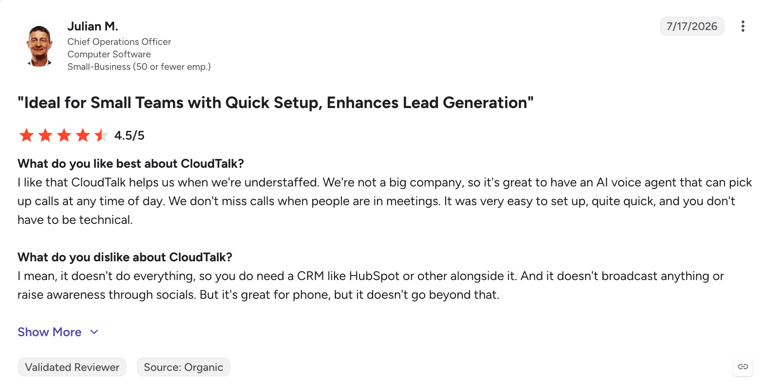
Julian M., Chief Operations Officer at a small computer-software company, on the AI Voice Agent covering the phones when the team is stretched thin:
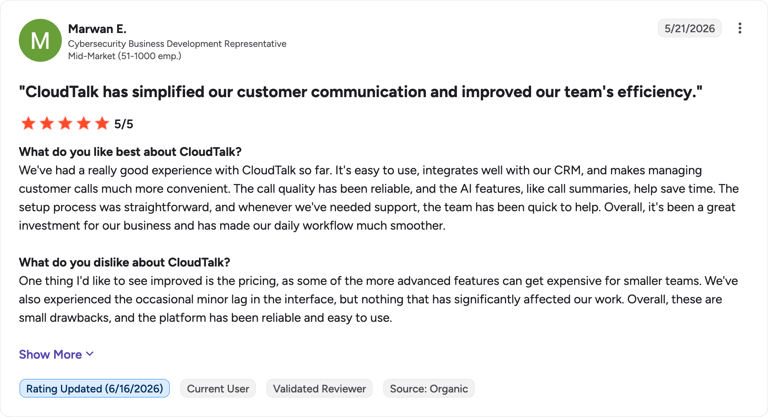
Marwan E., a Cybersecurity Business Development Representative at a mid-market company, on reliability, CRM integration, and support response time:
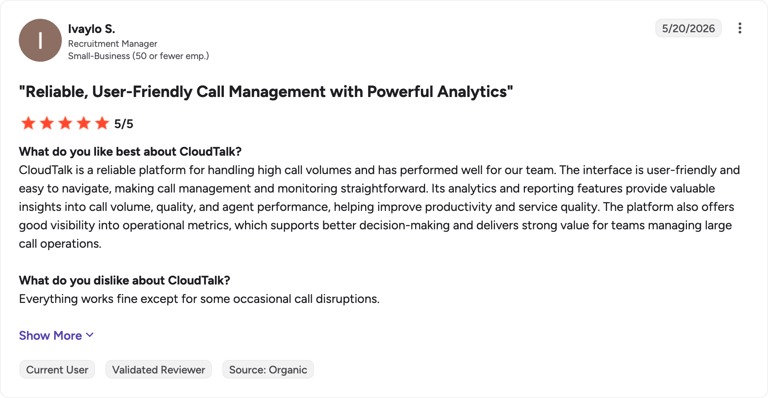
Ivaylo S., a Recruitment Manager at a small business, on handling high call volume with clear analytics:
What Real Users Say About Bland AI On G2
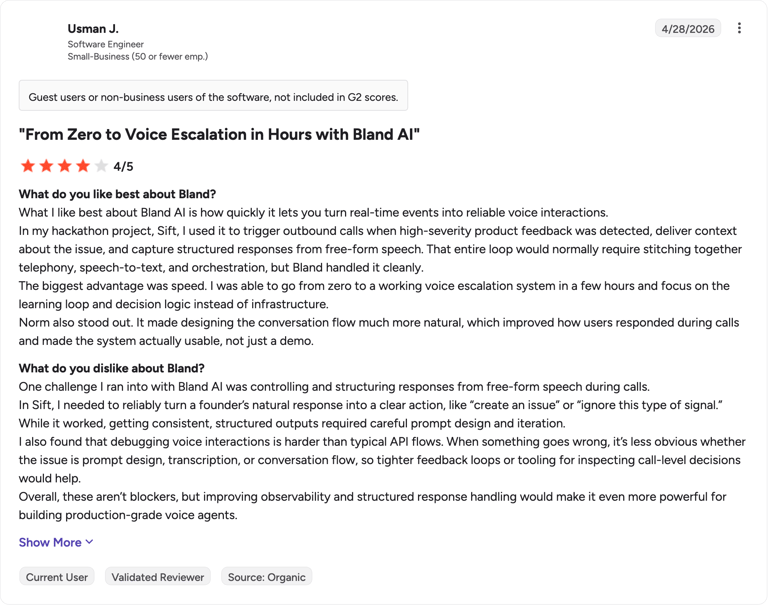
Bland AI's G2 review volume is thin enough that this is the one verified match available right now. Usman J., a software engineer who built a voice-escalation prototype on Bland during a hackathon, on how fast it was to get a working call flow running:
What CloudTalk Customers Report In Case Studies
These are attributed case-study quotes rather than review-platform feedback, which is why the numbers are specific. Dozens more sit in our customer stories.
"The transition to CloudTalk was super smooth. Actually, agent productivity grew by 10% just as a direct result of the switch. We thought our sales team couldn't handle more than 15 daily leads, but this year, on some days, they took care of 30 and even won more deals." Franco Viale Leyva, Head of Commercial Performance at Poliglota.
"Our call volume tripled in only two years. Today, our agents receive around 100,000 calls per quarter. With CloudTalk, we can handle all of this communication easily." Frederico Lopes, Head of Customer Service at DiscoverCars.
"CloudTalk has grown on us from the very first moment. It's a part of our daily workflow. Everyone in the company finds uses for it, from sales to support or onboarding. Without CloudTalk, we wouldn't provide such outstanding service." Pavel Pribis, CEO of Boataround.
CloudTalk Reviews vs. Bland AI Reviews on Reddit & Quora
Practitioner threads surface what review forms don't: day-to-day operation, how fast support answers, and what implementing an AI voice agent actually involves once the demo is over.
What Real Users Say About CloudTalk On Reddit & Quora
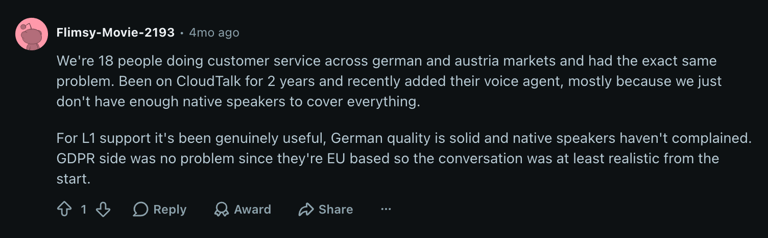
Flimsy-Movie-2193, running customer service across German and Austrian markets, on CloudTalk's AI Voice Agent handling German-language calls:
What Real Users Say About Bland AI On Reddit & Quora
From a two-year-old thread comparing Bland AI, Retell, and Vapi on r/ArtificialIntelligence, reachable and verified directly on 2026-08-14:
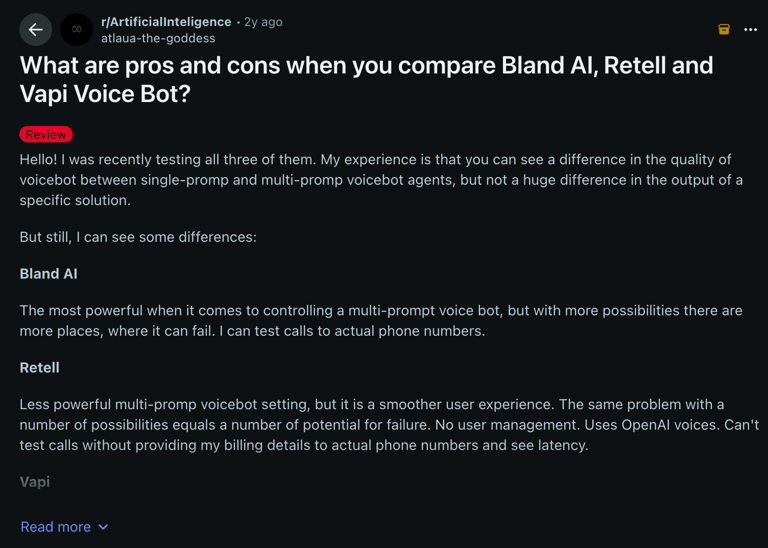
"The most powerful when it comes to controlling a multi-prompt voice bot, but with more possibilities there are more places, where it can fail." atlaua-the-goddess, in a thread comparing Bland AI, Retell, and Vapi on r/ArtificialIntelligence.
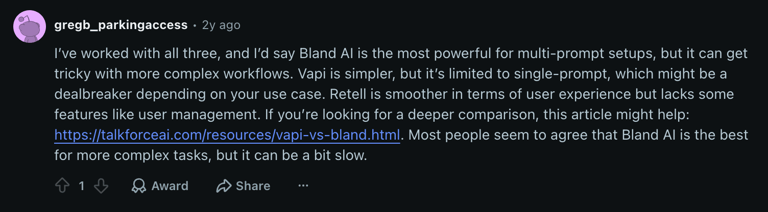
"I'd say Bland AI is the most powerful for multi-prompt setups, but it can get tricky with more complex workflows... Most people seem to agree that Bland AI is the best for more complex tasks, but it can be a bit slow." gregb_parkingaccess, same thread.
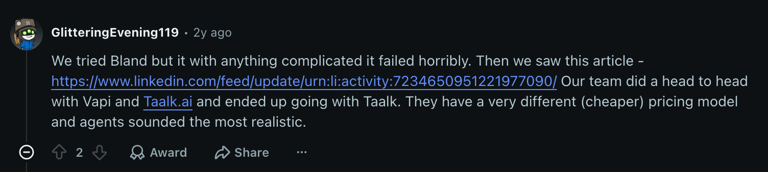
"We tried Bland but it with anything complicated it failed horribly." GlitteringEvening119, in the same thread, after which their team switched to a different vendor following a head-to-head test.
CloudTalk Pros & Cons vs. Bland AI Pros & Cons
Pros and cons only mean something against the job you're hiring the agent for, so be specific about the benefits of AI voice agents for sales and support before weighing either column.
CloudTalk Pros & Cons
| Pros | Cons |
|---|---|
| No-code AI agent live in under 10 minutes | Always an add-on, never included in a plan |
| Inherits numbers in 160+ countries, IVR, routing, recording | Power Dialer on Expert only; AI Conversation Intelligence always an add-on |
| Warm and cold transfer on every plan, with reporting | No on-premise or VPC for full data sovereignty |
| 60+ languages at sub-800ms response | Runs on third-party AI providers |
| 95+ CRM, helpdesk, and ATS integrations from Essential | |
| Published pricing, plus a 14-day trial, no card | |
| SOC 2 Type 2, ISO 27001, GDPR, HIPAA, PCI-DSS, 24/7 support |
Bland AI Pros & Cons
| Pros | Cons |
|---|---|
| Proprietary phone-tuned models, so calls skip third parties | Warm transfer, BAA, SSO, residency, on-premise all Enterprise-only |
| On-premise and VPC with US, EU, APAC residency on Enterprise | No bundled call center: no seats, no desktop, no supervision |
| SOC 2 Type I and II, HIPAA with a BAA, GDPR, PCI DSS | Usage-based cost scaling linearly; telephony and transfers extra |
| Pathways builder plus Norm, testbed, versioning | Caps of 100, 2,000, or 5,000 calls a day |
| 596M calls resolved, 1M+ concurrent, 250+ enterprise customers | 40+ languages and 19 integrations, both narrower |
| 99.9% uptime SLA on all four tiers | Small public review volume, so peer validation is thin |
Put the Agent on Your Own Call Flow Before You Decide
Which Team Fits Which Platform?
Fit comes down to one question: a production-ready agent inside a call center you already run, or self-hosted infrastructure for a regulated deployment? Anyone evaluating CloudTalk vs Bland AI for a small business answers fast, because the second arrives with an implementation program attached. Our page on the AI voice agent for small business goes deeper.
CloudTalk vs Bland AI: Which Fits Your Team
| CloudTalk Is the Right Call For… | Bland AI Still Works If… |
|---|---|
| Teams wanting an AI agent live without an engineering project | You're regulated and need on-premise or VPC deployment |
| Teams needing handoff to a named human with full context | Policy says data must never reach a third-party AI provider |
| Teams already on CloudTalk, wanting the agent on the same numbers | You have engineering resource to own Pathways |
| Teams wanting published pricing they can forecast | You're at very high volume and can negotiate Enterprise |
| Teams needing seats, supervision, and analytics beside the AI | You need a signed BAA, SSO, and residency |
| Small teams serving 60+ languages | Genesys, Five9, NICE CXone, or Talkdesk covers your stack |
Customer story: MadRent, in real estate and property management, put AI on lead qualification and freed the team for sales. Read the story.
A third option belongs here, since plenty of teams price it out first: build the agent yourself on raw infrastructure. Per minute, it costs less. The wiring is what teams underestimate, meaning the telephony and SIP connection, the outbound triggering, and call reporting a manager will use.
Teams who have tried it call the result brittle and the maintenance permanent. Bland sits on the same spectrum, further along: buy infrastructure instead of an operation, and the operation becomes yours to build and keep running.
CloudTalk vs. Bland AI: The Verdict
The pattern holds across setup, handoff, integrations, cost, and compliance. CloudTalk sells the agent plus the call center it needs to be useful. Bland sells a more private agent and leaves the call center to you.
Bland wins on data sovereignty and self-hosted infrastructure, and it's cheaper per AI minute at low volume. CloudTalk wins on time to value, operational completeness, and a predictable bill. For the math on your own numbers, the AI voice agent ROI calculator runs it on your call counts.
Choose CloudTalk If You…
- Want an agent answering real calls within the week, configured by an ops or CX person
- Need to transfer a live caller to a human on any plan, not only on an enterprise contract
- Run sales or support on a phone line and need seats, routing, recording, and supervision
- Want your AI cost capped by a bundle instead of a meter that runs with volume
- Serve many markets and need 60+ languages from one agent
- Need write-back into HubSpot, Salesforce, Pipedrive, or Zendesk via two-way sync
- Want SOC 2, ISO 27001, GDPR, HIPAA, and PCI-DSS without an enterprise tier
Choose Bland AI If You…
- Operate under a policy that conversations must never pass through a third-party AI provider
- Need on-premise or VPC deployment, or US, EU, or APAC residency, and can contract at Enterprise
- Have engineering resource to build the routing, desktop, and supervision layer
- Automate very high volume, where 1M+ concurrent calls is a relevant proof point
- Already run Genesys, Five9, NICE CXone, Talkdesk, or Amazon Connect
- Need a signed BAA because compliance, not productivity, is driving the purchase
The Bottom Line
CloudTalk wins for businesses that want a working AI voice agent inside an operational call center without an engineering project attached. Bland AI wins for engineering-led teams in regulated industries building something fully custom on infrastructure they control.
Bring Your Call Flow, We'll Bring the Agent
Sources:
- Salesforce, State of Service report, 2025
- PwC, 2025 AI Agent Survey
- Pew Research Center, AI in Americans' Lives, September 2025
- Deloitte, 2025 TMT Predictions
- Gartner, Agentic AI press release, March 2025
Frequently Asked Questions About CloudTalk vs Bland AI
Direct answers to the questions buyers ask most when comparing CloudTalk and Bland AI.
CloudTalk is better than Bland AI for most businesses; Bland AI is better for a narrow case. CloudTalk gives you an agent live in under 10 minutes inside a phone system with numbers, routing, and humans to escalate to. Bland wins when policy forbids third-party providers or demands on-premise. Your constraint decides it, the same lens we use on the best AI voice agents.
Bland AI costs $0.14 a minute on Start, $0.12 on Build, and $0.11 on Scale, with Enterprise priced to volume. Build adds a $299 platform fee and Scale $499, and transfers bill separately at $0.05 to $0.03. Telephony isn't included either, so the per-minute rate is a floor, not your bill, as our Bland AI pricing breakdown shows.
No. Bland AI runs its own phone-tuned stack, ships Bland Speech v3, and states that customer data never goes through third parties. CloudTalk does the opposite, letting you pick the model, speech-to-text, and voice vendors. More flexible, and call data reaches them. Your preference usually tracks whether you want a standalone voice agent or one built into an existing system.
Bland AI is HIPAA compliant in the way procurement cares about: HIPAA-eligible and willing to sign a BAA, alongside SOC 2 Type I and II, GDPR, and PCI DSS. The catch is the tier. That signed BAA sits on Enterprise, so teams on Start or Build get the certifications without the contract that makes them enforceable. It is one line in the wider HIPAA call center requirements.
Yes. CloudTalk's AI Voice Agent inherits the platform's connectors instead of needing its own. The 95+ CRM, helpdesk, and ATS catalog starts on Essential and covers HubSpot, Pipedrive, and Zendesk, with two-way sync of calls, recordings, and AI summaries. A call the agent handles lands in the same record a human would have written, in Salesforce or your helpdesk.
Yes, with a tier caveat. Cold transfer works on any plan via the Pathways Transfer Call node and the Transfer Active Call API. Warm transfer, where the agent briefs the human then merges into a three-way call, needs an enterprise account. Whether cold is enough depends on the context your team needs, the difference between transferring a call effectively and handing over a stranger.
The best Bland AI alternative depends on what you're replacing. If it's the operation around the agent, CloudTalk fits closest: an AI Voice Agent live in minutes inside a call center with numbers, routing, seats, and warm transfer. If you only want cheaper minutes for an agent your engineers build, per-minute platforms like Retell AI compare better.