TL;DR:
CloudTalk and Retell AI take different approaches to AI voice agents. CloudTalk is a production-ready call center platform, while Retell AI is developer-focused infrastructure for building custom voice agents.
- CloudTalk offers a complete AI calling platform. Its no-code AI Voice Agent can go live in under 10 minutes, with a full phone system, built-in CRM integrations, call routing, IVR, and live-agent handoff—all with more predictable pricing.
- Retell AI offers more flexibility and developer control. You can choose from different language models and voice providers, with pay-as-you-go pricing starting at $0.07/minute.
The best choice depends on your team. Choose CloudTalk if you want a working AI voice agent without developers; choose Retell AI if you have engineers who want full control over the AI and telephony stack.
This CloudTalk vs. Retell AI comparison looks at 2026 pricing, features, integrations, call handling, security, and ease of use to help you choose the right AI voice platform.
We compare both tools across real-world use cases, from no-code deployment and live-agent handoffs to custom AI models, telephony, and total cost of ownership.

See CloudTalk's AI Voice Agent take a real call

CloudTalk vs. Retell AI Comparison at a Glance
CloudTalk focuses on ready-to-use AI voice agents and built-in call center capabilities, while Retell AI prioritizes flexibility and developer control. Their pricing, integrations, and deployment models differ too. Here’s how they compare:
| Dimension | CloudTalk | Retell AI | Best for |
|---|---|---|---|
| AI voice agent | Production-ready agent built into the call center | Voice AI infrastructure for building custom agents | CloudTalk for ready-to-use agents; Retell AI for custom builds |
| Setup | No-code setup, with basic agents live in under 10 minutes | Visual flow builder with APIs and SDKs | CloudTalk for faster deployment |
| Call center | Built-in numbers, IVR, routing, queues, and recording | Voice infrastructure; contact center layer is up to you | CloudTalk for all-in-one calling |
| Live-agent handoff | Skills-based queues with transcript and CRM context | Cold, warm, and agentic-warm transfers | CloudTalk for integrated handoffs; Retell AI for transfer flexibility |
| Telephony | Local numbers in 160+ countries | US and Canada numbers, 15 dialable countries, or your own SIP | CloudTalk for international coverage |
| Language support | 60+ languages and accents | 55+ | CloudTalk for multilingual coverage |
| CRM integrations | 100+ native integrations | Limited native integrations; APIs and middleware for others | CloudTalk for plug-and-play integrations |
| Pricing | From $99/month (200 min) | Pay as you go, from $0.07/minute | CloudTalk for predictable costs; Retell AI for usage-based pricing |
| Model & voice choice | CloudTalk-managed AI and voice stack | Different models and voice providers to choose from | Retell AI for flexibility; CloudTalk for simplicity |
| Latency | Under 800ms, vendor-stated | Around 600ms, vendor-stated | Tie based on vendor-stated figures |
| Compliance | SOC 2 Type 2, ISO 27001, GDPR, CCPA, HIPAA, PCI-DSS, and EU-US DPF | HIPAA, SOC 2 Type I & II, and GDPR; more options on Enterprise | Both support key compliance standards |
| Getting started | 14-day trial for the phone system; 50 free AI minutes in your first month | $0 platform fee + $10 credits | Retell AI for free entry; CloudTalk for a full platform trial |
| Best for | Ops, CX, and sales teams without spare engineering resources | Engineering teams building custom voice experiences | Depends on your team and use case |
CloudTalk vs. Retell AI Features
CloudTalk and Retell AI take different approaches to AI voice agents. CloudTalk combines AI calling with a complete call center, while Retell AI gives developers more control over the voice stack.
CloudTalk AI Voice Agent Features
CeTe, CloudTalk’s AI Voice Agent, is built directly into the call center platform. That means the agent can use the same numbers, CRM integrations, routing, recording, and analytics as your human agents.
Where CloudTalk Stands Out
- No-code setup. Teams can configure an agent without developer support, including its skills, knowledge base, voice, and call-handling rules.
- Context-aware handoffs. When a call moves from the AI agent to a human, the transcript, notes, recording, and CRM context can stay attached to the same interaction.
- Built-in call center workflows. AI Receptionist can handle FAQs, take messages, route calls, and screen spam and robocalls using the same phone system as your human agents.
- Natural-sounding voices. CloudTalk’s AI Voice Agent uses natural-sounding AI voices designed to keep conversations fluid and engaging, with support for 60+ languages and accents.
- Multi-step workflows. Build agents that go beyond answering calls. Configure prompts, knowledge bases, skills, conditional logic, CRM actions, and call-flow branches to handle tasks such as lead qualification, appointment booking, and human transfers.
What to Consider
- The AI Voice Agent is an add-on. Teams pay separately for AI usage alongside their CloudTalk seats.
- Limited model and voice-provider flexibility. CloudTalk manages the underlying AI stack, so you don't get the same freedom to choose your own LLM or voice provider
- Built for streamlined deployments. CloudTalk is a strong fit for teams that value speed and simplicity, while enterprises looking for maximum customization and granular control over the AI stack may benefit more from a developer-first platform.
See how CloudTalk’s AI Voice Agent, call center features, integrations, and pricing work in our CloudTalk review.
Retell AI Features
Retell AI is an API-first platform for building custom voice agents. It combines a visual flow builder with developer tools, allowing teams to choose the models, voices, and speech providers for their agents.
Where Retell AI Stands Out
- Flexible AI stack. Choose from different language models and voice providers (Retell Platform, MiniMax, Fish Audio, ElevenLabs, Cartesia, OpenAI).
- A visual builder on top of the API. The flow canvas has nodes for dialogue, tools, transfers, and code, and Conductor edits agents from plain-English instructions.
- Advanced call transfers. Retell AI supports cold, warm, and agentic-warm transfers, including workflows where an AI agent briefs the receiving agent before handing over the call.
- Observability engineers will like. Dashboards for success rate, latency, cost, and concurrency, per-call P50/P90/P99, and live takeover.
- Custom integrations. APIs, webhooks, SDKs, and other developer tools allow you to connect Retell AI to a wide tech stack.
What to Consider
- Not a full phone system. Retell AI provides the infrastructure to build and run voice agents, while features such as queues, IVR, routing, and broader contact center management require a separate phone or contact center platform.
- CRM coverage is more developer-led. Salesforce and HubSpot sync natively, but most other systems rely on APIs, webhooks, or middleware to connect.
- Telephony coverage is more limited. Retell-managed numbers are available in the US and Canada, with managed telephony supporting 15 dialable countries. Teams operating elsewhere may need their own SIP setup.
- More control also means more configuration. Retell AI gives developers more ways to tune models, voices, prompts, and call behavior, but that flexibility can require more technical expertise to manage reliably.
Our Retell AI review covers the platform, features, pricing, and build experience in more detail.
How Do CloudTalk and Retell AI Compare Feature by Feature?
| Feature | CloudTalk | Retell AI |
|---|---|---|
| Live-agent handoff | Into skills-based queues, context attached | Cold, warm, and agentic-warm transfers to an external destination |
| Custom language model choice | Not available | Different models and voice providers |
| IVR and skills-based routing | Included in the phone system | Not included, build it yourself |
| Supervisor tooling | Wallboards, call monitoring, rep performance | Live monitoring and takeover, no queue view |
| Knowledge-base retrieval | Included during agent setup | Per-minute, plus a monthly fee beyond 10 bases |
| Outbound campaigns | Smart Dialer, Power Dialer, and Parallel Dialer | Batch calling, per dial |
| Analytics and reporting | Dashboards, call tagging, rep performance, transcripts feeding AI Conversation Intelligence | Success rate, latency, cost, concurrency, P50/P90/P99, live takeover |
| Compliance tooling | SOC 2 Type 2, ISO 27001, GDPR, HIPAA + BAA, PCI-DSS, STIR/SHAKEN | HIPAA, SOC 2 Type I & II, and GDPR; more options on Enterprise |
Live-Agent Handoff & Call Handling: CloudTalk vs. Retell AI
Both CloudTalk and Retell AI support live-agent transfers, but they handle the handoff differently. CloudTalk connects the AI agent to your existing call center workflows, while Retell AI gives you the transfer tools but leaves the receiving setup to your team.
| Dimension | CloudTalk | Retell AI |
|---|---|---|
| Live-agent handoff | Warm transfers and context shared with the receiving agent | Cold, warm, and agentic-warm transfers, plus AI-to-AI handoff |
| Context at handoff | Transcript, recording, and AI notes stay connected to the call | Live context needs to be passed through your setup; post-call data can sync with Salesforce or HubSpot |
| Call routing after handoff | Built-in IVR, skills- and condition-based routing, and ring groups | Transfers go to a number you manage |
| Custom integration work | Minimal—uses your existing call center, routing, and CRM setup | More setup required for queues, routing, and agent-facing workflows |
CloudTalk vs. Retell AI Pricing
Retell AI pricing starts from $0.07/minute. CloudTalk’s AI Voice Agents start at $99/month (200 min included), with telephony plans starting at $25/user/month. The key difference is the pricing model: Retell AI gives you granular, usage-based pricing, while CloudTalk bundles AI minutes into defined plans for more predictable monthly costs.
How Much Does Retell AI Cost?
Retell AI uses a pay-as-you-go model with no platform fee, but its $0.07–$0.31/minute headline rate depends on the models, voices, and other components you choose. Some features also carry separate usage or monthly fees.
| Component | Published rate |
|---|---|
| Platform fee | $0 |
| AI voice agent | $0.07–$0.31/minute |
| Voice infrastructure | $0.055/minute |
| Text-to-speech | $0.015–$0.040/minute |
| Language model | $0.003–$0.34/minute, depending on model and tier |
| Phone numbers | $2/month; free with your own number |
| Knowledge base | $8/KB/month + usage; First 10 free for Enterprise |
| Concurrency | 20 calls free, then $8 per additional concurrency/month |
| Other usage fees | Additional charges for features such as Batch Call, PII removal, and AI Quality Assurance |
How Much Does CloudTalk Cost?
CloudTalk's pricing has two options: AI Receptionist (designed for inbound calls), starting at $99/month for 200 minutes, and AI Specialist, starting at $349/month for 1,000 minutes. Higher-volume bundles are available, with custom pricing above 10,000 minutes. The first 50 minutes are free in the first month. The phone system is priced separately, with plans starting at $25/user/month.
| Component | Published rate |
|---|---|
| AI Receptionist | $99/month, including 200 AI minutes |
| AI Specialist | $349/month, including 1,000 AI minutes |
| Phone system plans | Starter $25/user/month, Essential $29/user/month, Expert $49/user/month |
| Additional features | Some features, such as Power Dialer and AI Conversation Intelligence, are separate add-ons depending on the plan |
| Billing model | Monthly plan + defined AI minute allowance, making costs easier to forecast |
Pricing Compared Line by Line
| Pricing dimension | CloudTalk | Retell AI |
|---|---|---|
| Pricing model | Monthly AI bundles + phone system seats | Modular pay-as-you-go |
| Starting AI price | $99/month for 200 minutes | From $0.07/minute |
| AI pricing tiers | $99–$699 for AI Receptionist; $349–$1,249 for AI Specialist | $0.07–$0.31/minute depending on configuration |
| Phone system | From $25/user/month | Not a full phone system; depends on the provider |
| What affects your bill | AI tier + human seats | Model, voice, telephony, concurrency, knowledge bases, and other usage-based features |
| Cost predictability | Higher—defined monthly bundles | Lower—final cost varies with usage and configuration |
| Pricing flexibility | Choose a bundle based on monthly volume | Pay for the components and minutes you actually use |
| Best suited to | Teams that want a managed AI calling platform and predictable monthly costs | Teams that want granular control over their AI stack and usage |
The key difference:
CloudTalk is designed around predictable monthly plans, while Retell AI gives you a more usage-based model with greater flexibility in how you build and scale your agent.
CloudTalk vs. Retell AI Integrations
CloudTalk and Retell AI take different approaches to integrations. CloudTalk offers a broad library of ready-made CRM and helpdesk integrations, while Retell AI focuses on APIs, webhooks, and developer tools for teams building custom connections.
CloudTalk Integrations
CloudTalk’s AI Voice Agents work with the platform’s existing integrations, so teams can connect their agent to the same tools they already use for sales and support. 100+ native integrations include HubSpot, Salesforce, Pipedrive, Zendesk, Zoho, and Intercom, with additional integrations available through APIs, webhooks, Workflow Automation, and Zapier.
That makes CloudTalk a good fit for teams that want to connect an AI agent without building the integration layer themselves. You still configure fields and workflows, but the underlying connection is already there.
Retell AI Integrations
Retell AI takes a more developer-focused approach. Salesforce and HubSpot have native integrations, while other connections can be built through APIs, webhooks, SDKs, and tools such as Make, n8n, and GoHighLevel.
This gives engineering teams more flexibility to connect Retell AI to custom systems and workflows. The trade-off is that more of the integration work and ongoing maintenance sits with your team.
Which Platform Has Better Integrations?
| Integration capability | CloudTalk | Retell AI |
|---|---|---|
| Native CRM and helpdesk integrations | 100+ native integrations, including HubSpot, Salesforce, Pipedrive, Zendesk, Zoho, and Intercom | Native integrations for Salesforce and HubSpot; most rely on APIs, webhooks, or middleware |
| Developer tools | API, webhooks, Workflow Automation, and Zapier | API, webhooks, SDKs, CLI, and MCP |
| Standard connections | Ready to configure with no development required | More likely to require custom development |
| Call and contact data | Calls, recordings, transcripts, and AI notes can sync with connected systems | Post-call data syncs natively with limited integrations; other systems require custom setup |
| Best for | Teams that want ready-made integrations and minimal development | Engineering teams that need deeper customization and control |
Security & Compliance: CloudTalk vs. Retell AI
Both CloudTalk and Retell AI meet common enterprise security and compliance requirements, including SOC 2, GDPR, and HIPAA. The main difference is their approach to the AI stack: CloudTalk manages the underlying infrastructure, while Retell AI lets you choose third-party models and voice providers.
| Security & compliance | CloudTalk | Retell AI |
|---|---|---|
| SOC 2 | Type 2 | Type 1 and Type 2 |
| GDPR | Yes, with DPA and EU-US Data Privacy Framework participation | Yes, with DPA; do not currently operate within the EU |
| HIPAA | Yes, with a signed BAA for healthcare customers | Yes, with a signed BAA |
| ISO 27001 | Yes | Yes |
| Data retention | Managed within CloudTalk’s security framework | Configurable per agent, from 1 day to 2 years |
| Access control | Google SSO | Custom SSO on Enterprise |
| AI provider exposure | CloudTalk manages the underlying AI stack | Depends on the models, voice, and speech providers you select |
Usability & Developer Experience: CloudTalk vs. Retell AI
CloudTalk and Retell AI are both relatively easy to get started with, but they target different users. CloudTalk is built for teams that want to configure and manage AI agents without developers, while Retell AI gives technical teams more flexibility to customize and build around the agent.
| Dimension | CloudTalk | Retell AI |
|---|---|---|
| Initial setup | Under 10 minutes for a basic agent | Visual builder and quick-start tools for a first agent |
| Technical skill required | No coding for standard setup | No coding to build an agent; technical skills become more useful for advanced setups |
| Customization | Templates, skills, prompts, knowledge bases, and call flows | More control through APIs, prompts, tools, providers, and custom workflows |
| Ongoing management | Ops and CX teams can manage agents themselves | Engineering teams are better suited to ongoing customization and maintenance |
| Support | CSM included; 24/7 support for the phone system | Documentation, email support, and 24/7 omnichannel support on Enterprise plan |
| Best for | Ops, CX, and sales teams that want to manage AI without developers | Product and engineering teams building highly customized voice experiences |
Cloudtalk vs Retell AI Reviews on G2
Both platforms receive strong ratings on G2, but they have different review volumes. CloudTalk scores 4.4/5 from 1,702+ reviews, while Retell AI scores 4.8/5 from 2,638+ reviews.
What Do Real Users Say About CloudTalk on G2?
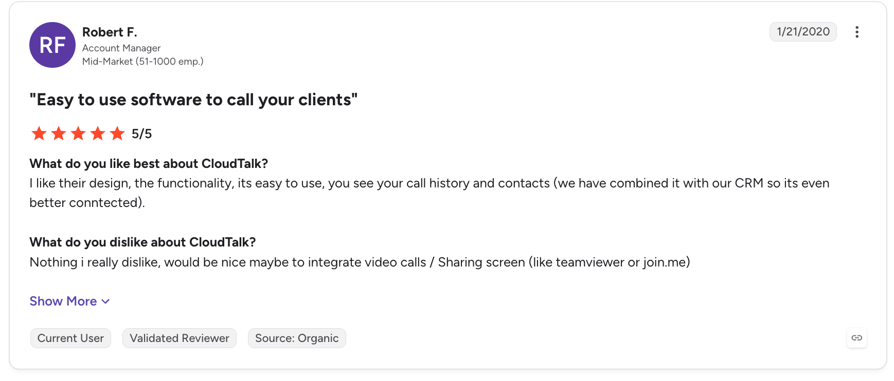
CloudTalk users often highlight its ease of use, call quality, CRM integrations, and call-management features. The most common positive feedback is around how quickly teams can get started and manage calls without a steep learning curve.
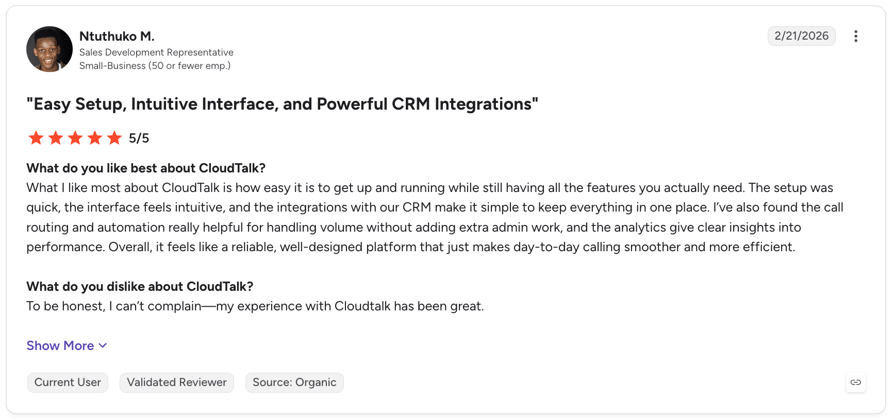
However, there are some areas users would like to see improved. For example, users have asked for capabilities such as native video conferencing, which means teams looking for an all-in-one communications platform may still need another tool for video calls.
What Do Real Users Say About Retell AI on G2?
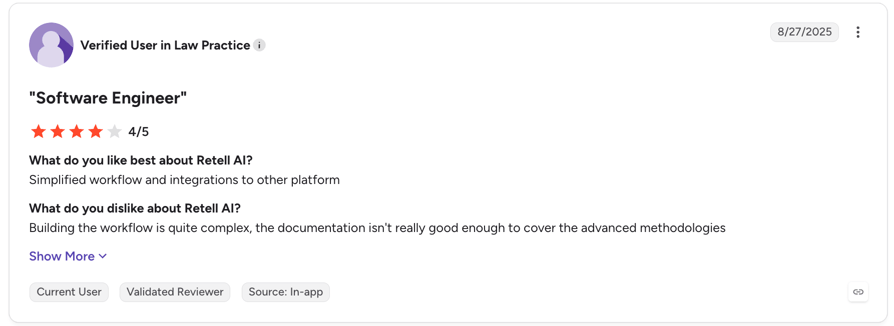
Retell AI users frequently praise its intuitive interface, easy agent setup, natural-sounding voices, workflow builder, and integrations. Recent reviewers also highlight how quickly they can connect agents to phone calls and customize them for specific use cases.
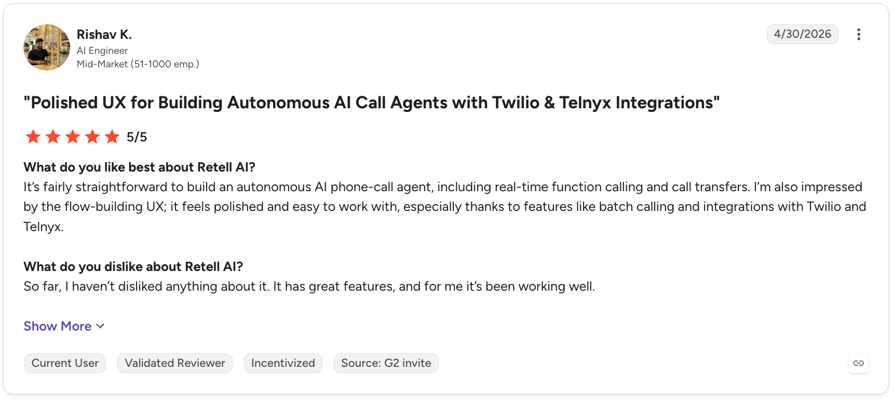
The trade-off is that Retell AI is built for more customizable voice-agent development, so more advanced workflows can require more configuration and technical expertise than a ready-to-use calling platform.
CloudTalk Pros & Cons vs. Retell AI Pros & Cons
Retell AI and Bland AI take different approaches to voice AI. Retell gives you more freedom to choose your models, voices, and telephony setup, while Bland keeps more of the stack in-house and focuses on control and deployment options.
CloudTalk Pros & Cons
| Pros | Cons |
|---|---|
| No-code setup: Ops and CX teams can build and manage the agent without developers. | AI Voice Agents are an add-on: AI usage is priced separately from CloudTalk seats. |
| Built-in phone system: Numbers, IVR, call routing, queues, and live-agent handoff are part of the same platform. | Less control over the AI stack: You can’t choose the underlying language model or voice provider. |
| 160+ countries: Local numbers and international calling are built into the platform. | More controlled customization: Teams looking for deep, developer-level control over every part of the voice stack may prefer an API-first platform. |
| Predictable pricing: Seats plus an AI minute package make costs easier to forecast. | No native video conferencing: Teams need a separate tool for video calls. |
Retell AI Pros & Cons
| Pros | Cons |
|---|---|
| More control over the AI stack: Choose from multiple LLMs, voice providers, and speech engines. | More infrastructure to manage: Telephony, routing, queues, and the receiving contact center sit outside the platform. |
| Easy to start: $0 platform fee, $10 in credits, and no annual contract. | Limited native CRM integrations: Salesforce and HubSpot are supported natively; other connections require additional setup. |
| Flexible call transfers: Supports cold, warm, agentic-warm, and AI-to-AI handoffs. | More moving parts: Different models, voice providers, and telephony options can make the setup more complex. |
| Strong developer tooling: Visual flows, Conductor, APIs, SDKs, and webhooks support highly customized builds. | Usage-based pricing: Costs vary depending on the model, voice provider, and telephony setup you choose. |
| Detailed observability: Track metrics such as cost, latency, concurrency, and call outcomes. | Some enterprise controls are gated: Advanced access controls such as RBAC and custom SSO are available on Enterprise. |
Bring AI and your phone system together
Which Team Fits Which Platform?
The right choice depends on how much of the voice stack you want to own. CloudTalk is built for teams that want a production-ready AI agent inside a complete phone system. Retell AI is better suited to teams that want to build and control more of the underlying voice experience.
| CloudTalk is the right call for... | Retell AI still works if... |
|---|---|
| Teams that need an AI agent live without an engineering ticket | You have engineers to own the build and the upkeep |
| Anyone drowning in spam calls and repetitive inbound like order-status checks, which AI Receptionist handles | You need a specific model, voice provider, or speech engine |
| Teams that expect most conversations to end in a human transfer that carries context | You're building a custom conversational product, not operating a contact center |
| Businesses calling outside the US and Canada, where 160+ countries of local numbers matter | Your calling stays inside Retell AI's geography, or you run your own SIP |
| Small businesses with no spare developer time | You want to tune latency, prompts, and providers past a packaged platform's limits |
| Companies already on CloudTalk, where the agent slots into existing numbers and routing | Your compliance needs are met without EU-based service operation |
CloudTalk vs. Retell AI: The Verdict
There’s no universal winner between CloudTalk and Retell AI. They’re built for different types of teams and different ways of deploying AI voice agents. CloudTalk combines AI voice agents with a complete business phone system, while Retell AI gives technical teams more flexibility to build and control the voice layer themselves.
The better choice depends on what the team needs around the AI agent, not just how well the agent handles a conversation. Consider the phone system, integrations, handoff experience, customization, and who will own the setup and maintenance.
Choose CloudTalk if you…
- Want an agent answering calls this month, with no developer on the project
- Expect many calls to transfer, with the human seeing the full context
- Need local numbers, IVR, and routing in the same product as the AI
- Call or receive calls outside the US and Canada
- Want CRM and helpdesk sync that already exists, not a connector you maintain
- Need ISO/IEC 27001, PCI-DSS, or GDPR backed by a signed DPA
Choose Retell AI if you…
- Have engineers to own the agent, the telephony, and the integrations long-term
- Need a specific language model, voice provider, or speech recognition engine
- Are building a custom conversational product, not running a contact center
- Want true pay-as-you-go billing with no seats and no contract
- Value latency percentiles and provider-level tuning over packaged operations
- Already have a contact center to receive transfers, and only need the voice layer
The bottom line:
Buy CloudTalk if the agent has to work in a call center from day one and no one on staff writes code. Buy Retell AI if your engineers want the parts, and the control, to assemble something of their own.
Still deciding between buying and building?
FAQs About CloudTalk vs. Retell AI
For most teams looking for a ready-to-deploy AI calling solution, CloudTalk is the better fit. Its AI Voice Agent works within a complete calling platform, so teams can set up, route, and manage calls without building the surrounding infrastructure. Retell AI is a stronger choice for engineering-led teams that need deeper customization and control over the AI stack.
Not to build an agent. Retell AI has a visual flow canvas and Conductor, an AI co-builder that edits agents from plain English. Coding starts at go-live: telephony, CRM wiring, and the transfer destination are engineering work.
Yes. CloudTalk's agent uses the same 100+ native integrations as the rest of the platform, so calls, recordings, transcripts, and AI notes land on the contact record. Salesforce, HubSpot, Pipedrive, Zendesk, and Zoho are native.
Yes: cold, warm, and agentic warm transfer, plus AI-to-AI handoff. What Retell AI doesn't supply is what receives the call. On CloudTalk, the transfer lands in a skills-based queue with the transcript attached, even after hours.
CloudTalk, in almost every case. Small teams rarely have a developer to own telephony and prompt tuning, and CloudTalk's AI voice agent for small business setup is no-code and transcribes conversations and pushes smart notes directly into popular tools like HubSpot or Salesforce instantly.
Both CloudTalk and Retell AI offer robust, enterprise-grade security and compliance frameworks. CloudTalk includes SOC 2 Type 2, ISO/IEC 27001, GDPR, CCPA, HIPAA, PCI-DSS, and 256-bit encryption. Retell AI holds SOC 2 Type 1 and 2 and is HIPAA compliant, but its docs state it runs no EU services.
It depends on what you need. Retell AI can have a lower per-minute cost, but its usage-based pricing can add up as you layer in telephony, concurrency, knowledge bases, and other features. For SMBs, CloudTalk can offer more predictable costs by bringing AI calling, phone system features, and usage into one platform and invoice. Our AI Voice Agent ROI calculator can help you estimate your potential savings.
CloudTalk, for teams that want a finished product rather than infrastructure: no-code setup, native CRM sync, and handoff into staffed queues. If you'd rather stay developer-first, Retell AI vs Bland AI covers that end of the market.