Qu'est-ce qu'un bridge call ? Définition, avantages et usages
Résumé de ce que couvre ce guide sur le bridge call
| Section | Réponse rapide |
|---|---|
| Qu'est-ce qu'un bridge call ? | Un appel téléphonique qui réunit trois personnes ou plus sur une même ligne partagée via un numéro d'appel et un code d'accès. |
| Comment fonctionne un bridge call ? | Chaque participant compose le même numéro, saisit un code PIN et rejoint un salon audio partagé doté de commandes d'animation. |
| Bridge call vs conférence téléphonique | Le pont (« bridge ») est la ligne partagée (la technologie) ; la conférence téléphonique est la réunion qui s'y déroule. |
| Pourquoi utiliser un bridge call ? | Participez depuis n'importe quel appareil, réduisez les coûts de réunion, sécurisez vos appels et boostez la productivité. |
| Usages fréquents en centre d'appels | Support client, démos de vente, formation et suivi de la qualité en direct. |
En bref : qu'est-ce qu'un pont d'appel ?
Un bridge call (ou pont d'appel) est un appel téléphonique qui connecte trois personnes ou plus sur une seule ligne partagée, peu importe où elles se trouvent ou l'appareil utilisé. En résumé, c'est une salle de réunion virtuelle que vous rejoignez en composant un numéro de téléphone et un code d'accès.
Alors que les équipes se répartissent désormais entre plusieurs villes et pays, les bridge calls sont devenus un moyen simple de maintenir le dialogue. Et la demande est bien réelle : 79 % des professionnels estiment que les réunions virtuelles sont tout aussi productives, voire plus, que les réunions en présentiel, d'après l'étude de Passport Photo Online sur les réunions virtuelles.1
La technologie derrière cela s'appelle le pontage d'appels (ou call bridging). Elle fusionne plusieurs correspondants sur une même ligne sécurisée, permettant aux équipes à distance et aux clients internationaux de collaborer sans avoir à réserver de salle ni à jongler entre différentes applications. Pour les centres d'appels, cela se traduit par une résolution plus rapide des problèmes et moins de contraintes de planification.
Découvrez ci-dessous la définition d'un bridge call, son fonctionnement étape par étape, sa différence avec une conférence téléphonique classique et sa place au sein d'un centre d'appels performant.
Points clés à retenir :
- Qu'est-ce qu'un pont d'appel ?Un pont d'appel est une technologie qui fusionne plusieurs appels dans un espace virtuel unique, permettant à des personnes utilisant différents appareils de rejoindre la même conversation.
- Pourquoi les entreprises ont-elles besoin du pontage d'appels ?Le pontage d'appels offre la flexibilité que 95 % des travailleurs recherchent dans le travail à distance, tout en aidant les entreprises à économiser jusqu'à €10,600 par employé en télétravail, ce qui en fait un outil ultra-rentable pour collaborer efficacement.
- Pourquoi les réunions professionnelles virtuelles sont-elles essentielles ?Avec la mondialisation des entreprises, les réunions virtuelles sont devenues la norme. Et cela fonctionne : 79 % des professionnels affirment qu'elles sont tout aussi productives, voire plus, que les rencontres physiques.
- Pourquoi le pontage téléphonique est-il important ?La technologie de pont téléphonique synchronise parfaitement l'audio entre les appareils pour garantir des appels de haute qualité, tout en offrant des commandes de modération et des sessions de groupe pour des discussions structurées.
Découvrez le bridge call en action
Quelle est la signification d'un bridge call ?
Un bridge call est une fonctionnalité de téléphonie qui connecte plusieurs participants au sein d'un même appel partagé, permettant à des personnes situées dans des lieux différents ou utilisant des appareils distincts de rejoindre la même conversation. C'est la façon la plus simple de définir le bridge call dans les systèmes de communication modernes.
Contrairement à un simple appel à trois, un système de pont d'appel peut accueillir un nombre bien plus important de participants, selon la capacité de votre ligne de pont. Pour bien comprendre le concept : il s'agit d'un numéro de téléphone hébergé dans le cloud qui sert d'espace de réunion permanent et sécurisé pour vos équipes internes et vos clients externes.
Un pont téléphonique est particulièrement utile pour les centres d'appels, car les membres de l'équipe, les clients et les partenaires peuvent tous échanger sans avoir besoin d'une salle de réunion physique. C'est un élément central de nombreuses configurations de pontage de conférence, utilisé quotidiennement pour le support client, les ventes et le travail d'équipe à distance.
Comment fonctionne un bridge call ?
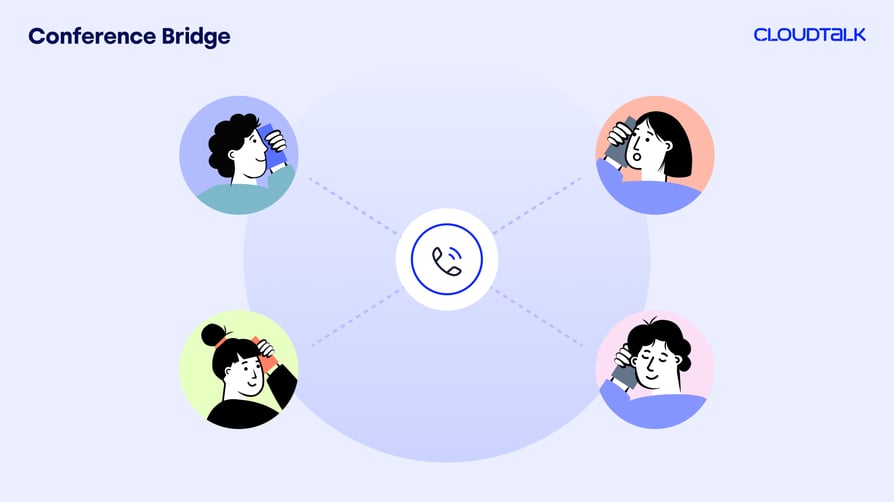
Un bridge call fonctionne en créant un espace virtuel unique que tous les participants rejoignent en composant un numéro partagé et un code d'accès. Une fois connectés, le système fusionne leurs flux audio dans un salon unique où chacun peut parler et écouter en temps réel. Voici comment se déroule un bridge call classique, étape par étape :
- Composer le numéro : tout le monde appelle le même numéro de téléphone, souvent appelé ligne de pont.
- Saisir un code : chaque participant tape un code PIN ou d'accès, garantissant que seules les personnes invitées puissent rejoindre l'appel. C'est essentiel pour les sujets confidentiels.
- Rejoindre l'espace partagé : le pont réunit tout le monde dans un seul espace audio et synchronise les voix, même pour les grands groupes.
- Utiliser les commandes d'animation : les modérateurs peuvent couper les micros, distribuer la parole ou diviser le groupe en sous-sessions.
- Conclure et analyser : grâce à l'activation de l'enregistrement d'appel, vous pouvez réécouter les points clés plus tard ou les partager avec les absents.
Puisqu'il s'agit d'une fonctionnalité purement téléphonique, le type d'appareil importe peu. Téléphone fixe, mobile ou ordinateur, chacun se connecte comme il le souhaite. Dans un outil comme CloudTalk, cela repose sur des fonctions de conférence téléphonique et d'appel à trois intégrées, permettant à un agent d'ajouter un spécialiste à un appel client en cours sans avoir à raccrocher.
Configurez votre premier bridge call gratuitement
Pourquoi les bridge calls sont-ils plus populaires que jamais ?
Alors que les entreprises collaborent de plus en plus avec des clients et des équipes répartis partout dans le monde, les ponts pour conférences téléphoniques s'imposent rapidement.
Ils sont simples, économiques et sécurisés. Voici cinq raisons évidentes qui expliquent le succès croissant des bridge calls.
Rejoignez un bridge call de n'importe où, sur n'importe quel appareil
Le principal atout d'un bridge call est sa flexibilité. Les participants peuvent se connecter de n'importe où, sur n'importe quel appareil, ce qui est indispensable pour les équipes à distance, les clients internationaux ou les collaborateurs sur différents fuseaux horaires.
Une entreprise ayant des bureaux à New York, Londres et Tokyo peut réunir ses équipes sans que personne n'ait à se déplacer. Les collaborateurs appellent depuis un poste fixe, un mobile ou un ordinateur, même en déplacement. CloudTalk facilite cela grâce à des numéros locaux dans plus de 160 pays, offrant à une équipe distribuée la même portée qu'une multinationale.
Les bridge calls réduisent vos coûts de réunion
La flexibilité géographique s'accompagne d'économies substantielles. Les réunions physiques engendrent des frais de déplacement, d'espace de bureau, d'énergie, et bien plus encore. Un pont téléphonique fiable élimine le besoin de matériel de conférence sur site coûteux et réduit les frais de télécommunication liés aux appels d'équipe longue distance.
Les équipes peuvent organiser des sessions stratégiques régulières, où qu'elles se trouvent. Le travail à distance peut faire économiser aux entreprises jusqu'à €10,600 par employé en télétravail, selon le rapport 2024 sur le travail à distance du US Career Institute.2 De nombreux services de bridge call proposent également des forfaits abordables basés sur le volume d'appels ou l'utilisation, ce qui en fait un choix très économique pour les entreprises de toutes tailles.
Les bridge calls sécurisent vos conversations privées
Vous craignez qu'un appel confidentiel ne soit intercepté ? Un pont de conférence téléphonique vous offre un niveau élevé de sécurité pour garantir que seules les personnes autorisées puissent y participer. La plupart des services utilisent des codes d'accès, des codes PIN et le chiffrement pour protéger vos échanges.
C'est un aspect crucial dans les secteurs de la finance, de la santé et du droit, où la confidentialité est primordiale. Un cabinet d'avocats discutant d'un dossier via un bridge call peut s'appuyer sur ces contrôles pour protéger les données de ses clients. CloudTalk, par exemple, est conforme aux normes SOC 2, RGPD et HIPAA, avec des options de consentement à l'enregistrement intégrées.
Les bridge calls boostent la productivité de l'équipe
Avec une configuration adaptée, un pont d'appel vous fait gagner un temps précieux, à vous, à vos clients et à vos équipes. Au lieu de coordonner une réunion physique complexe, vous invitez tout le monde à une conférence audio à une heure précise.
Imaginez : votre équipe projet travaille à distance et un problème urgent survient. Plutôt que de faire revenir tout le monde au bureau ou d'envoyer des e-mails interminables, vous envoyez une invitation rapide pour un bridge call. En quelques minutes, tout le monde est en ligne depuis son bureau, son domicile ou en déplacement, prêt à résoudre le problème. Cette réactivité maintient la productivité au plus haut et permet de gérer les urgences en temps réel.
Les services de bridge call proposent des fonctionnalités avancées
La plupart des services de bridge call incluent des outils pour assurer le bon déroulement des échanges, comme la coupure des micros, les ateliers en sous-groupes et des commandes d'animation.
Des fonctionnalités comme l'enregistrement d'appel s'avèrent particulièrement utiles. Elles vous permettent de réécouter les points importants ou de partager la conversation avec les collaborateurs absents, ce qui reste difficile à réaliser proprement dans une salle de réunion classique. Les superviseurs peuvent également écouter, chuchoter des conseils à un agent ou intervenir directement si nécessaire.
Optez pour un système téléphonique simple et efficace
Bridge call vs conférence téléphonique : quelle est la différence ?
On utilise souvent les termes de bridge call et de conférence téléphonique de manière interchangeable, mais ils désignent des concepts légèrement différents. Le pont (« bridge ») désigne la technologie qui réunit les correspondants sur une même ligne. La conférence téléphonique désigne quant à elle la réunion qui s'y déroule. En clair : le pont est le « comment », et la conférence est le « quoi ».
Bridge call vs conférence téléphonique
| Bridge call | Conférence téléphonique | |
|---|---|---|
| Définition | La ligne partagée (le « pont ») qui connecte les participants | La réunion où les personnes échangent ensemble |
| Objectif principal | La méthode de connexion | L'événement et son ordre du jour |
| Format type | Audio, appel via un numéro et un code PIN | Audio, souvent accompagné de vidéo ou de partage d'écran |
| Configuration | Une ligne ou un numéro de pont réutilisable | Planifiée pour chaque réunion spécifique |
| Idéal pour | Des appels d'équipe ou clients réguliers sur un numéro unique | Des réunions ponctuelles, webinaires, présentations |
En résumé, la plupart des conférences téléphoniques s'appuient sur un pont en arrière-plan. Que l'on parle de pont de conférence ou de pont téléphonique, cela désigne la même idée : une ligne partagée unique qui réunit un groupe.
Comparez avant de choisir :
Vous souhaitez comparer des plateformes complètes, et pas seulement des concepts ? Découvrez notre sélection des meilleures solutions de conférence téléphonique, avec fonctionnalités et tarifs détaillés.
Quels sont les usages fréquents des bridge calls dans les centres d'appels ?
Un pont de conférence téléphonique est utile dans de nombreux aspects du travail en centre d'appels, notamment :
- Le support client : un pont de conférence permet aux équipes d'assistance de faire intervenir des agents spécialisés pour traiter les questions complexes, afin de résoudre les problèmes plus rapidement.
- La vente : les équipes commerciales utilisent le pont de conférence pour des consultations et des démonstrations à distance, impliquant plusieurs parties prenantes sans nécessiter de réunion en personne.
- La formation et le développement : les centres d'appels utilisent les ponts de conférence pour la formation, afin que les employés à distance bénéficient des mêmes instructions.
- L'assurance qualité et le suivi : les superviseurs rejoignent les appels en direct pour les surveiller en temps réel et effectuer des évaluations de performance. Cela permet de maintenir une qualité de service élevée et de créer des opportunités de coaching sur le vif.
Boostez la participation grâce aux appels adaptés au travail à distance.
Simplifiez vos prochains appels de conférence
Un pont de conférence fait une chose à la perfection : il rassemble une équipe dispersée au sein d'une seule conversation, depuis n'importe quel appareil et sur une ligne sécurisée. C'est pourquoi les réunions virtuelles sont désormais la norme, et non plus un plan de secours. Les chiffres le prouvent : 7 travailleurs sur 10 trouvent les réunions virtuelles moins stressantes que celles en personne, et 6 sur 10 affirment qu'il est plus facile d'y participer en ligne.
Mais un pont de conférence ne vaut que par la plateforme qui le soutient. CloudTalk gère les conférences téléphoniques sur la ligne que votre équipe utilise déjà au quotidien, avec l'enregistrement des appels, la double écoute en direct, la synchronisation CRM intégrée et des numéros virtuels fiables dans plus de 160 pays. Pas d'outil de conférence distinct, pas de matériel sur site à acheter.
Alors, si vous configurez votre premier pont de conférence ou si vous remplacez un système qui coupe sans cesse, le moyen le plus rapide de constater la différence est de l'essayer vous-même.
Découvrez ce que sont de vraies réunions de qualité.
Sources :
- Passport Photo Online
- US Career Institute
Foire aux questions sur les ponts de conférence
Réponses aux questions les plus fréquentes sur les ponts de conférence, leur fonctionnement et leur utilité dans un centre d'appels.
Un appel ponté est un appel téléphonique qui réunit trois personnes ou plus sur une seule ligne partagée, permettant ainsi à des correspondants utilisant différents appareils et situés dans des lieux distincts de participer à la même conversation. Ce nom fait référence au « pont », la ligne virtuelle qui connecte tout le monde via un numéro d'appel et un code d'accès uniques.
La différence réside dans ce que chaque terme désigne. Le pont de conférence est la ligne partagée, c'est-à-dire la technologie qui connecte les correspondants, tandis que la conférence téléphonique est la réunion elle-même. La plupart des conférences téléphoniques utilisent un pont en arrière-plan, c'est pourquoi les deux termes sont souvent utilisés de manière interchangeable.
Pour rejoindre un pont de conférence, composez le numéro de la ligne de conférence qui vous a été communiqué, puis saisissez le code PIN ou le code d'accès lorsque vous y êtes invité. Une fois le code validé, vous êtes connecté à l'espace audio partagé avec les autres participants, que vous appeliez depuis un poste fixe, un mobile ou un ordinateur.
Pour ponter un appel téléphonique, utilisez un outil de conférence pour créer une ligne de pont, puis partagez le numéro d'appel et le code d'accès afin que d'autres puissent s'y joindre. Dans CloudTalk, le pontage repose sur les fonctionnalités intégrées de conférence téléphonique et d'appel à trois, permettant à un agent d'intégrer un collègue ou un spécialiste à un appel en direct sans avoir à raccrocher.
Un pont audio est la version uniquement vocale d'un pont de conférence. Il connecte plusieurs correspondants sur une seule ligne partagée pour une conversation téléphonique, sans vidéo ni partage d'écran, ce qui garantit sa fiabilité même avec des connexions lentes ou depuis un téléphone classique.
Un appel de pont dans Microsoft Teams est une réunion que les utilisateurs rejoignent en composant un numéro d'audioconférence et un ID de conférence, plutôt que via l'application Teams. Cela permet aux participants de se joindre par téléphone lorsqu'ils n'ont pas accès à Internet, selon le même principe de ligne partagée que n'importe quel pont de conférence.
Dans la gestion des incidents, un pont de conférence (souvent appelé pont d'incident) est une ligne partagée qui rassemble rapidement les intervenants lors d'une panne ou d'une urgence. Il maintient les ingénieurs, les responsables et le personnel d'assistance sur un même appel afin qu'ils puissent résoudre les problèmes en temps réel, d'où qu'ils soient, quelle que soit l'urgence.
« Rejoindre le pont » signifie appeler la ligne de conférence partagée pour participer à une réunion. Lorsque quelqu'un dit « nous sommes sur le pont », cela signifie que l'appel de groupe a déjà commencé et que les participants s'y connectent via le numéro de pont et le code d'accès.
Un numéro de téléphone de pont est le numéro d'appel que les participants composent pour accéder à un appel de conférence. Il reste généralement le même au fil du temps, de sorte qu'une équipe peut réutiliser la même ligne de pont pour des réunions récurrentes sans devoir configurer un nouveau numéro à chaque fois.
Pour configurer un pont de conférence, choisissez un service de pont de conférence, créez un numéro d'appel et un code d'accès, puis partagez ces informations avec les participants pour l'heure prévue. Avec CloudTalk, la conférence téléphonique est intégrée aux forfaits, ce qui vous permet d'héberger un appel de pont, de l'enregistrer et de le suivre en direct sans acheter de matériel supplémentaire.
Pour passer un appel de pont, configurez une ligne de pont virtuelle dans votre outil d'appel, puis envoyez aux participants le numéro d'appel et le code d'accès. Les équipes utilisant CloudTalk le font depuis la plateforme qu'elles utilisent pour leurs appels quotidiens, avec l'enregistrement et la synchronisation CRM en arrière-plan pour ne perdre aucun détail.
Une ligne téléphonique pontée est une ligne partagée qui permet à plusieurs correspondants de rejoindre le même appel en même temps. Au lieu d'appels individuels séparés, tout le monde se connecte via cette ligne unique, ce qui rend possibles les discussions de groupe par téléphone.
Le pontage d'appels sert à connecter plusieurs participants au sein d'un même appel, ce qui est idéal pour les réunions d'équipe, les sessions de formation, les démonstrations de vente et les appels clients sans déplacement. Dans les centres d'appels, le pontage permet également à un superviseur ou à un spécialiste d'intervenir dans un appel en direct lorsqu'un client a besoin d'une aide supplémentaire.
Une ligne de pont est la ligne téléphonique partagée qui permet à plusieurs personnes de rejoindre un seul appel. Elle fonctionne comme un espace de réunion au sein d'un système de téléphonie cloud, accessible via un numéro d'appel unique, et constitue le pilier des conférences téléphoniques et des réunions d'équipe récurrentes.
Un appel de ligne de pont connecte plusieurs participants via une ligne virtuelle partagée unique, permettant à un groupe d'échanger sans passer d'appels individuels distincts. C'est l'équivalent d'un appel de pont, le terme désignant simplement la ligne de pont qui achemine l'audio de chacun.
Le but d'un pont d'appels est de permettre à plusieurs personnes de rejoindre la même ligne, facilitant ainsi l'organisation de réunions et de discussions de groupe entre différents sites. Pour les centres d'appels, cela accélère également la résolution des problèmes, car les agents peuvent intégrer instantanément un spécialiste ou un responsable au lieu de planifier un nouvel appel.
On appelle ces réunions des « ponts » parce qu'elles se déroulent sur un système d'appel de pont qui relie tout le monde au sein d'une même réunion virtuelle sur une ligne partagée. Le « pont » est le point de connexion qui unit les différents correspondants, la réunion tirant donc son nom de la technologie qui la rend possible.
Un pont d'appels est généralement sécurisé, utilisant des connexions cryptées et des codes d'accès uniques pour que seules les personnes invitées puissent s'y joindre. Les fournisseurs professionnels vont encore plus loin : CloudTalk, par exemple, est conforme aux normes SOC 2, RGPD et HIPAA, avec des contrôles de consentement à l'enregistrement essentiels pour les appels des secteurs financier, médical et juridique.