Comcast Business Phone Pricing 2026: $24.95 to $64.95 per Line
TL;DR
Comcast Business voice pricing is public, just not where you would look for it. Comcast files a Business Pricing List per state, most recently effective 1 May 2026. Seat and line rates are identical across California, Illinois, Washington, Florida and Michigan. Only fees and surcharges change by region.
Four things the quote will not tell you:
- Not bundling costs you about $20 per line per month. A Business Voice Mobility line is $44.95 bundled with Comcast internet and $64.95 standalone.
- Comcast can raise your voice price during your contract. Its Customer Terms state Comcast "may increase the monthly recurring charges for Voice and/or Video Services" with 30 days' notice, while internet charges "shall not increase during the initial Service Term." Voice is carved out of the price protection.
- Early termination is 75% of everything remaining, plus 100% of any custom installation Comcast paid for. One business owner reported an $1,050 fee 14 months into a 36-month phone and internet contract.
- Equipment and install are separate. $14.95 per month equipment fee on VoiceEdge, $27.95 on Business Voice, and standard installation up to $199.95 depending on your state.
Here is the whole rate card at a glance:
| Plan | Price per month | Billing unit | Best for |
|---|---|---|---|
| VoiceEdge Basic Seat | $24.95 | Per seat | Simple extensions that need calling and voicemail only |
| Business Voice, Basic Line | $24.95 | Per line, bundled only | Fax lines, alarm lines, back-of-house phones |
| Business Voice, Full Featured | $34.45 to $64.45 | Per line | Traditional lines. $34.45 only from the 4th line, bundled |
| Business Voice Mobility | $29.95 to $64.95 | Per line | Lines that ring to a mobile. $29.95 only from the 4th line, bundled |
| VoiceEdge Webex Standard Seat | $34.95 | Per seat | Teams that want calling plus Webex meetings |
| VoiceEdge Select | $39.95 | Per seat, 1 to 8 seats | Small offices under 8 people |
| VoiceEdge UC Seat | $34.95 to $44.95 | Per seat, volume tiered | Full cloud PBX. $34.95 only at 20+ seats |
| PRI Trunking | $349 per 6-channel port | Per port | On-premise PBX that still needs trunks |
| SIP Trunking | $10 to $35 per session | Per concurrent call | Existing PBX, priced down at volume |
| Comcast Business Mobile | $30 to $40 | Per line, promo | Cell lines. Requires Comcast Business Internet |
Add to every row above: an equipment fee, installation, taxes and regulatory surcharges of roughly 10% to 20%, and a term contract. Full breakdown in the hidden costs section.
Comcast Business phone pricing runs from $24.95 per seat per month for a VoiceEdge Basic Seat to $64.95 per line for a standalone Business Voice Mobility line. VoiceEdge Select costs $39.95 per seat for 1 to 8 seats, and Unified Communication seats run $34.95 to $44.95 depending on volume.
Comcast publishes none of these prices on its own website. Every voice page on business.comcast.com shows "Request a Quote" instead of a rate. The figures in this guide come from Comcast's state regulatory pricing lists, which are binding, dated, and public, but buried on xfinity.com rather than the sales site.
Compare It Against Pricing You Can Actually See
What Are Comcast Business Phone Plans and Pricing?
Comcast Business sells voice in three shapes: Business Voice (individual lines), Business VoiceEdge (cloud PBX sold per seat), and trunking (PRI and SIP, for businesses keeping an on-premise PBX). Comcast Business Mobile is a separate cellular product.
All prices below are list rates from Comcast's Business Pricing Lists effective 1 May 2026. We checked California, Illinois, Washington, Florida and Michigan. The seat and line rates are identical in all five. What changes by state is installation, truck rolls, jack charges and surcharges.
What Is the Comcast Business Voice Mobility Plan?
Business Voice Mobility is a phone line that can ring to a mobile device, with unlimited nationwide calling included. It costs $44.95 per line per month bundled with another Comcast service, or $64.95 standalone. From the fourth line onward, bundled pricing drops to $29.95.
- Line 1 to 3, bundled: $44.95 each
- Line 4 and above, bundled: $29.95 each
- Standalone, any quantity: $64.95 each
- Equipment fee: $27.95 per month
- Voicemail: $5.00 per line per month
What to watch: the $20 gap between bundled and standalone. If you ever drop Comcast internet, every voice line reprices upward automatically.
What Is the Comcast Business VoiceEdge Plan?
Business VoiceEdge is Comcast's cloud PBX, sold per seat rather than per line. Voice lines themselves are listed at no charge, because the seat is the billable unit. Seats run $24.95 to $44.95 per month depending on tier and volume.
- Basic Seat: $24.95
- Webex Standard Seat: $34.95
- Comcast Seat for Microsoft Teams: $34.95
- Webex Premium Seat: $44.95
- Unified Communication seat, 1 to 9: $44.95
- Unified Communication seat, 10 to 19: $39.95
- Unified Communication seat, 20 or more: $34.95
- VoiceEdge equipment fee: $14.95 per month
- Additional telephone number: $0.20
Included at no extra charge: auto attendant, additional hunt groups, readable voicemail transcription and audio conferencing for up to 100 participants. Those are genuinely free on current plans, which is worth knowing because on grandfathered VoiceEdge accounts the auto attendant is billed at $24.95 per licence.
What to watch: the $34.95 UC rate needs 20 seats. A 10-person team pays $39.95 each, so $399.50 a month before the equipment fee, install and tax.
What Is VoiceEdge Select?
VoiceEdge Select is the small-business tier of VoiceEdge, priced at $39.95 per seat per month for 1 to 8 seats. Above 8 seats you move to full VoiceEdge.
What to watch: at 8 seats you are paying $319.60 a month, and a 9th seat moves you onto a different product and a new quote.
What Are Comcast PRI Trunks?
PRI trunking connects an existing on-premise PBX to the phone network over a T1 circuit. Comcast prices it per port rather than per user.
- Port, 6 channels: $349.00 per month
- Additional channels: $14.00 each per month
- Full 23 or 24 channel capacity: $489.00 per month
- PRI equipment fee: $24.95 per month
- Initial port installation: $500.00 one-time
- Integrated Access Device: $890.00
- Numbers: first 20 free, then $4.00 per block of 20
What to watch: a single PRI carries roughly $1,390 in one-off costs before the first monthly bill.
What Is Comcast SIP Trunking?
SIP trunking is the modern replacement for PRI, billed per concurrent call session rather than per channel. It gets meaningfully cheaper at volume.
| Concurrent call sessions | Price per session per month |
|---|---|
| 6 to 9 | $35.00 |
| 10 to 14 | $30.00 |
| 15 to 24 | $21.00 |
| 25 to 49 | $14.00 |
| 50 to 99 | $13.00 |
| 100 to 249 | $11.00 |
| 250 or more | $10.00 |
Add to that: a $24.95 monthly equipment fee and $500 installation per site. Numbers cost $0.45 individually, $5.00 per block of 20, or $20.00 per block of 100.
How Much Does Comcast Business Mobile Cost?
Comcast Business Mobile is cellular, not VoIP, but it appears on the same bill and affects your bundle. Standard is $30 per line per month and Pro is $40, both promotional rates reduced by $10 for 36 months.
The condition that matters: it requires Comcast Business Internet. Comcast's own terms note a $25 per line per month charge if you do not maintain Comcast TV, Internet or Voice service, which pushes a Standard line to $55. There is a $10 one-time activation fee per line.
What Are Comcast Business Phone's Hidden Costs?
The seat price is roughly half the story. Between contract terms, installation, equipment and surcharges, a Comcast Business voice bill routinely lands 30% to 50% above the quoted rate. Every figure below is from Comcast's own published documents.
What Are Comcast Business's Contract Terms and Early Termination Fees?
Comcast Business voice is sold on a term contract, typically 12 to 36 months. Early termination costs 75% of all remaining monthly fees, plus 100% of any custom installation Comcast paid for.
That is quoted verbatim from Comcast's Business Services Customer Terms and Conditions: the termination charge is "seventy-five percent (75%) of the remaining monthly fees that would have been payable... and one hundred percent (100%) of any amount paid by Comcast in connection with Custom Installation."
Contracts auto-renew for successive one-year terms unless you give 30 days' written notice before expiry.
the clause that should decide your contract length
What Does Comcast Business Installation Cost?
| Fee | Amount | Note |
|---|---|---|
| Standard service installation | Up to $199.95 (CA, WA) or $129.95 (IL, MI, FL) | Varies by state |
| PRI initial port installation | $500.00 | One-time |
| SIP installation, per site | $500.00 | One-time, per location |
| UCaaS service activation | $199.00 | One-time |
| VoiceEdge premises equipment install | $199.00 per event | |
| VoiceEdge truck roll | $100.00 | |
| VoiceEdge expedited order | $500.00 | If you need it live sooner |
| Repair visit or truck roll | $99.95 (CA) or $129.95 (IL) | After install |
| Technician labour | $74.95 to $75.00 per hour, or $200.00 per hour on SIP and UCaaS | 2-hour minimum on PRI |
| Jack charge or jack change | $49.95 (CA) or $99.95 (IL) each |
What Are Comcast Business's Equipment Fees?
- Business Voice equipment fee: $27.95 per month
- VoiceEdge equipment fee: $14.95 per month
- PRI and SIP equipment fee: $24.95 per month each
- Unreturned equipment: $27.95, plus hardware replacement from $70 for a 2-line modem to $890 for an Integrated Access Device
Desk phones are leased, and Comcast publishes no price for them. Poly VVX 250, 350 and 450, CCX 600, Rove cordless and Trio conference units are all listed as available for lease at "an additional monthly fee" with no figure attached. Get the per-model lease cost in writing before you sign, because it is one of the few numbers Comcast keeps entirely off the record.
What Add-Ons Does Comcast Business Charge For?
| Add-on | Price |
|---|---|
| Auto attendant, additional hunt groups, voicemail transcription | No charge on current plans |
| Voicemail on a Business Voice line | $5.00 per line per month |
| Additional voicemail box (VoiceEdge) | $7.00 per month plus $7.00 setup |
| Call Queue Agent | $9.95 per month plus $12.00 setup |
| Reception Console | $29.95 per month plus $12.00 setup |
| Toll-free number | $20.00 per number per month plus $9.95 activation |
| Auto attendant recording edit | $35.00 one-time |
| Remote call forwarding | $4.95 per number per month plus $19.95 setup |
| Additional directory listing | $4.50 per listing |
| Directory listing management | $11.00 per service per month |
| Microsoft Teams connector | $5.00 per month |
| SIP bursting | $2.00 per session |
| Long distance on Basic Lines | $0.05 per minute |
| Directory assistance | $2.49 per call, $2.99 with call completion |
Number porting: no port-in or port-out fee appears in any of the five state rate cards we checked. That is an absence of a listed fee rather than a confirmed $0, so ask for it in writing.
What Taxes and Surcharges Does Comcast Add?
Every Comcast rate card carries the same line: "Prices shown does not include federal, state or local regulatory fees, taxes or surcharges." Realistically that adds 10% to 20% to a voice bill, and the variation between states is large.
| Charge | California | Illinois | Washington | Florida |
|---|---|---|---|---|
| Voice Network Investment | $11.00 | $11.00 | Not listed | $11.00 |
| State commission surcharge | 1.8% | 0.145% | 0.2004% | 0.1603% |
| State Universal Service Fund | Not listed | 3.3271% | Not listed | Not listed |
| City utility tax | Not listed | Not listed | Up to 9.0% | Not listed |
| State per-line charge | Public Purpose Fund $0.90 per line | Telecom Relay $0.004 per line | Lifeline and TRS $0.00 | TRS $0.08 per line |
| Paper statement fee | $3.95 | $3.95 | Not listed | Not listed |
| Late payment fee | Not listed | $10.00 | Not listed | Not listed |
| Payment convenience fee | Not listed | Up to $5.99 | Not listed | Not listed |
An Illinois business pays 3.33% in state USF alone. A Seattle business can pay up to 9% in city utility tax. On top of federal USF, 911 fees, franchise fees and sales tax, the gap between quote and invoice is not marginal.

One published rate. No install fee, no equipment fee, no early termination formula, no surprise line items.

What Do Real Users Say About Comcast Business Phone?
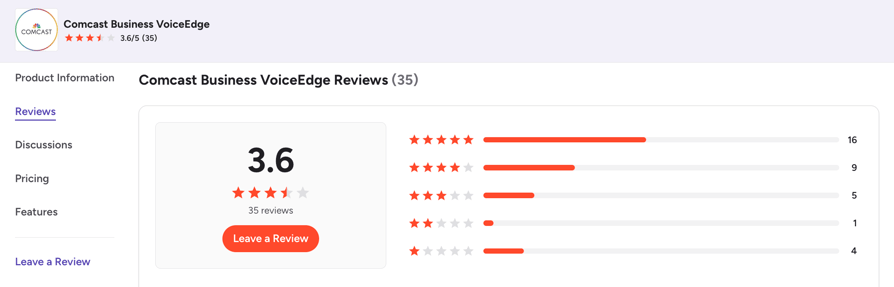
Comcast Business voice reviews are unusually polarised, and the gap between platforms is worth understanding before you read any single score.
| Platform | Rating | Reviews | What it covers |
|---|---|---|---|
| G2 | 3.6 / 5 | 35 | Business VoiceEdge specifically |
| Capterra | 2.8 / 5 | 52 | Business VoiceEdge, the larger of two duplicate listings |
| Software Advice | 2.8 / 5 | 52 | Business VoiceEdge, same review pool as Capterra |
| TrustRadius | 5.2 / 10 | 16 | Comcast Business VoIP |
| Trustpilot | 1.2 / 5 | 140 | comcastbusiness.com as a whole, 95% one-star |
| BBB | A+ rating, 1.06 / 5 customer reviews | 3,029 | Comcast Corporation, includes residential |
how to read those numbers honestly
What Do Negative Comcast Business Reviews Say?
Four themes recur across platforms, and all four are about the commercial relationship rather than call quality.
- Bills rising without explanation. A Trustpilot reviewer in May 2026 wrote that their bill "went from 189$ to 275$ in less than 3months." On Comcast's own support forum, a customer reported a jump to $644.17, "a staggering increase of $297.85," and a past-due demand over $1,700 after cancelling.
- Early termination fees applied to businesses closing or shrinking. A construction firm that cut staff from 18 to 7 was told there was "a $1,050 termination fee" in month 14 of a 36-month phone and internet contract. Another owner closing their business reported being quoted $800 with 11 months to run.
- Cancellation and porting friction. "5 months later, we are still dealing with incomplete cancellations," one Trustpilot reviewer wrote in August. Another described spending "hours on hold, often 45 to 90 minutes per call." A forum thread documents a port-out request where one of 13 numbers was released and the receiving carrier had to resubmit 15 times.
- Outages tied to hardware. A construction customer on Software Advice reported being "left without service multiple times," including "over 1 week" without phone service "due to comcast sending us faulty equipment."
Sub-scores tell the same story. Across the 52-review Software Advice sample: Ease of Use 2.8, Functionality 2.8, Value for Money 2.6, Customer Support 2.5. Overall sentiment splits 42% positive and 50% negative.
What Do Positive Comcast Business Reviews Say?
The praise is consistent and worth taking seriously, because it points at genuine strengths.
- Same-day field service. A cosmetics business owner on Software Advice: "My top compliment is the customer service and how the agents are able to get a tech out normally the same day." Having an engineer who can physically attend is something no cloud-only provider offers.
- Reliability once installed. A dental practice with two years of use on Capterra: "It worked without any hiccups. Reliable service."
- Bundle economics. A Technology Director on G2 cited "the possibility to have a lower cost, due to bundling," which is real: the bundled rate saves about $20 per line per month.
Has Comcast Faced Regulatory Action Over Billing?
Yes, twice on the public record, and both cases concerned charges customers had not agreed to.
- FCC, October 2016: Comcast paid a $2.3 million settlement over negative-option billing, then a record for a cable operator, for charging customers for services and equipment they never authorised.
- Washington State, June 2019: a judge found 445,848 Consumer Protection Act violations and imposed a $9.1 million penalty. 240,588 violations were for enrolling customers in a Service Protection Plan without consent, including 30,946 accounts signed up "without their knowledge."
Neither case is about voice quality, and neither is recent. They are included because they establish that the billing complaints above fit a documented pattern rather than being isolated bad luck.
What Will Comcast Business Phone Actually Cost?
Three scenarios using Comcast's published list rates. Each adds the equipment fee, amortises installation over 12 months, and applies a conservative 12% for taxes and surcharges. Your negotiated rate may be lower and your surcharges may be higher.
Scenario 1: 4-Person Office on VoiceEdge Select
Profile: a small professional services firm, 4 seats, bundled with Comcast internet, one toll-free number.
| Cost item | Monthly |
|---|---|
| VoiceEdge Select, 4 seats at $39.95 | $159.80 |
| VoiceEdge equipment fee | $14.95 |
| Toll-free number | $20.00 |
| Installation ($129.95, spread over 12 months) | $10.83 |
| Taxes and surcharges at 12% | $24.67 |
| Estimated total | ~$230 per month |
| Effective cost per seat | ~$57.50 |
The gap: the quoted rate is $39.95 per seat. The real number is closer to $57.50, a 44% uplift before anyone negotiates anything.
Scenario 2: 10-Person Team on VoiceEdge Unified Communications
Profile: a growing sales team, 10 UC seats, one reception console, two call queue agents.
| Cost item | Monthly |
|---|---|
| UC seats, 10 at $39.95 (10 to 19 tier) | $399.50 |
| VoiceEdge equipment fee | $14.95 |
| Reception Console | $29.95 |
| Call Queue Agents, 2 at $9.95 | $19.90 |
| Installation ($199.95, spread over 12 months) | $16.66 |
| Taxes and surcharges at 12% | $57.72 |
| Estimated total | ~$539 per month |
| 36-month commitment | ~$19,400, with 75% due on early exit |
The gap: at 10 seats you are one seat short of nothing and 10 short of the $34.95 tier. The pricing rewards 20-seat teams and penalises 10-seat ones. Ask specifically what happens to your rate at seat 20.
Scenario 3: 25-Line Business Still on Analog Lines
Profile: a multi-site operation running Business Voice Full Featured lines, bundled, with voicemail on each.
| Cost item | Monthly |
|---|---|
| Lines 1 to 3 at $44.45 | $133.35 |
| Lines 4 to 25 at $34.45 | $757.90 |
| Voicemail, 25 lines at $5.00 | $125.00 |
| Business Voice equipment fee | $27.95 |
| Taxes and surcharges at 12% | $125.30 |
| Estimated total | ~$1,170 per month |
The gap: voicemail alone is $1,500 a year here, and it is included at no charge on VoiceEdge. If you are running analog lines with paid voicemail, that is the first thing to price against a cloud alternative.
the number to model before you sign anything
Get a Phone System With One Number on the Invoice
What Are the Cheaper Alternatives to Comcast Business Phone?
Comcast's seat rates are not wildly out of line on paper. The difference is what sits around them: the term contract, the installation, the equipment fee, the bundle dependency and the mid-contract repricing clause. Here is how the same 10-seat team prices elsewhere.
| Provider | Entry price per user | 10 seats per month | Contract | Setup and equipment fees |
|---|---|---|---|---|
| Comcast VoiceEdge UC | $39.95 (10 to 19 tier) | $399.50 plus fees | 12 to 36 months, 75% ETF | Install up to $199.95, equipment $14.95 per month |
| CloudTalk | $25/per user per month annual | $250 per user per month | Month to month | None |
| Nextiva | $15 annual, $23 monthly | $150 | Annual for best rate | None published |
| Dialpad | $15 annual, $20 monthly | $150 | Annual on Pro and above | None published |
| Ooma Office | $19.95 | $199.50 | No contract | $29.95 one-time activation |
| RingCentral | $20 annual, $30 monthly | $200 | No term required | None published |
The comparison that matters is not the seat rate. It is that none of the alternatives above carries a 75% early termination formula, a contractual right to raise your rate mid-term, or a $20 per line penalty for changing internet provider.
How Does CloudTalk Compare to Comcast Business Phone?
Comcast Business is a cable company that sells phone lines alongside internet. CloudTalk is a calling platform built for teams whose revenue depends on the phone. That difference shows up in what each is good at.
Where CloudTalk Wins
- Published pricing, no quote required. Starter $25, Essential $29, Expert $49 per user per month. You can compare us before speaking to anyone.
- Month-to-month plans and no early termination formula. No 75% of remaining months, no 100% of custom install.
- No installation fee, no equipment fee, no truck roll. Reps work from a desktop and mobile app. Desk phones are optional, not leased.
- No bundle dependency. Your rate does not change because you switched internet provider.
- Built for sales and support work, not just dial tone. Power, Smart and Parallel dialers, call flow designer, call recording and conversation intelligence.
- 100+ native integrations including HubSpot, Salesforce, Pipedrive and Zendesk, so calls log themselves.
- Local numbers in 160+ countries if you sell outside the US.
- 14-day free trial, no credit card.
Where Comcast Business Wins
- Physical field service. A Comcast engineer can come to your building, often same day. If you have analog lines, alarm panels, elevator phones or fax machines that must stay on copper, that matters.
- One vendor for internet, phone and mobile. If simplifying your supplier list is worth more than the price difference, the bundle has real value.
- PRI and SIP trunking if you are keeping an on-premise PBX and are not ready to replace it.
The honest summary: if your phone is infrastructure, Comcast is a reasonable choice and the bundle discount is real. If your phone is how your team sells or supports customers, you are paying for a cable contract and getting a dial tone. CloudTalk holds 4.4/5 on G2 from 1,852 reviews against Comcast Business VoiceEdge's 3.6 from 35.
“We just copy the agents, update the scripts, and we're live. No need to hire and train a completely new team from scratch.”
Owner of Circle Gym

What Are Comcast Business Phone's Best Features?
Comcast Business VoiceEdge includes several things competitors charge extra for, and those are worth naming before the criticism.
- Auto attendant at no charge. Included on current plans. On grandfathered VoiceEdge accounts it is $24.95 per licence, so this is a genuine improvement.
- Readable voicemail transcription, included. Voicemail-to-email with transcription costs nothing extra on VoiceEdge, while Business Voice lines pay $5.00 per line for plain voicemail.
- Audio conferencing for up to 100 participants, included in the seat price.
- Unlimited hunt groups. Additional hunt groups are listed at no charge.
- Microsoft Teams and Webex integration. A Comcast Seat for Teams is $34.95, the same as a Webex Standard Seat.
- Same-day field engineers. Reviewers consistently name this as the strongest thing about the service.
What Are the Pros and Cons of Comcast Business Phone?
| Pros | Cons |
|---|---|
| Real field service: an engineer can attend your site, often same day. No cloud provider offers this. | No published pricing: every voice page shows "Request a Quote," so you cannot compare before a sales call. |
| Bundle savings are genuine: about $20 per line per month against standalone rates. | Voice prices can rise mid-contract: the Customer Terms permit it with 30 days' notice, while internet prices are protected. |
| Auto attendant, hunt groups and voicemail transcription included on VoiceEdge at no extra charge. | 75% early termination fee plus 100% of custom install, applied even when businesses close or shrink. |
| Full trunking range: PRI and SIP for businesses keeping an on-premise PBX. | Fees stack fast: install to $199.95, equipment $14.95 to $27.95 per month, plus 10% to 20% in taxes and surcharges. |
| Reliable once installed: long-tenure reviewers report stable service with few outages. | Support and value score lowest: 2.5 and 2.6 out of 5 across a 52-review sample, with 50% negative sentiment overall. |
Every rate published. No contract. No install fee. Port your numbers and keep them.
Is Comcast Business Phone Worth the Cost?
Comcast Business phone is worth it for a specific business: one that already buys Comcast internet, needs physical lines or on-site support, and values one supplier over the lowest price. For that business the bundle discount is real and the field service is genuinely differentiated.
It is a poor fit for almost everyone else, and the reason is structural rather than technical.
Comcast Business Makes Sense If:
- You already buy Comcast internet, so the bundled rate applies and the $20 per line penalty does not
- You have analog dependencies that must stay on copper: alarm panels, elevator phones, fax lines, card terminals
- On-site engineer support matters more to you than price, and you will use it
- You are keeping an on-premise PBX and need PRI or SIP trunking rather than a cloud phone system
- You are at 20+ seats, where the $34.95 UC tier finally becomes competitive
Comcast Business Is Probably Not the Right Fit If:
- Your team sells or supports customers by phone and needs dialers, recording, routing and CRM logging
- You want to compare prices before speaking to a salesperson
- You might change internet provider during the contract, which reprices every voice line upward
- You need to be able to leave, because 75% of remaining months plus 100% of custom install is a real barrier
- You are under 10 seats, where the per-seat rate is at its least competitive
- You have any chance of downsizing, which is exactly when the early termination fee bites
The one question to settle before you sign: ask your rep, in writing, what your per-seat rate becomes if you drop Comcast internet, and what the early termination figure is at month 12. If both answers are acceptable, the bundle is a fair deal. If either makes you hesitate, price a month-to-month alternative first. CloudTalk publishes every rate, and you can test it free for 14 days before committing to anything.
Switch to a Phone System You Can Actually Price
Sources:
- Comcast Business Voice Service Business Pricing Lists, by state, effective 1 May 2026
- Comcast Business Services Customer Terms and Conditions, v.30
- Comcast Business, Understand Your Bill
- Comcast Business VoiceEdge product page
- Comcast Business Mobile plans and pricing
- G2, Comcast Business VoiceEdge reviews
- Software Advice, Business VoiceEdge profile and sub-scores
- Trustpilot, comcastbusiness.com
- FCC negative-option billing settlement, October 2016
- Washington State Attorney General, Comcast Consumer Protection Act ruling, June 2019
FAQs: Comcast Business Phone Pricing
Comcast Business phone costs $24.95 to $64.95 per line or seat per month, depending on product:
- VoiceEdge Basic Seat: $24.95
- VoiceEdge Webex Standard or Teams Seat: $34.95
- VoiceEdge Select: $39.95 (1 to 8 seats)
- VoiceEdge UC Seat: $34.95 to $44.95 by volume
- Business Voice line: $44.95 bundled, $64.95 standalone
Add an equipment fee of $14.95 to $27.95 per month, installation up to $199.95, and 10% to 20% in taxes and surcharges.
No. Every voice page on business.comcast.com shows "Request a Quote" rather than a price.
However, Comcast files a Business Pricing List for each state with full rates, effective 1 May 2026. These are public but hosted on xfinity.com rather than the business site. Seat and line rates are identical across states. Only installation, truck rolls and surcharges vary by region.
Yes. Comcast Business voice is sold on a term contract, typically 12 to 36 months, and it auto-renews for successive one-year terms unless you give 30 days' written notice before expiry.
Early termination costs 75% of all remaining monthly fees plus 100% of any custom installation Comcast paid for.
Yes. Comcast's Customer Terms and Conditions state that Comcast "may increase the monthly recurring charges for Voice and/or Video Services subject to thirty (30) days prior notice."
The same document says internet charges "shall not increase during the initial Service Term." Voice is explicitly excluded from the price protection that covers internet. A term contract locks you in without locking your voice rate.
The main ones, all from Comcast's published rate cards:
- Installation: up to $199.95, varying by state
- Equipment fee: $14.95 per month on VoiceEdge, $27.95 on Business Voice
- Standalone penalty: about $20 more per line if you do not bundle with Comcast internet
- Toll-free number: $20.00 per month plus $9.95 activation
- Taxes and surcharges: 10% to 20%, including 3.33% state USF in Illinois and up to 9% city utility tax in Washington
- Paper statement fee: $3.95 in several states
Generally no, once fees are included. A 10-seat team pays around $399.50 a month for Comcast VoiceEdge UC seats before the equipment fee, installation and tax, against $200 on RingCentral Core, $150 on Nextiva Core and $199.50 on Ooma Office.
None of those alternatives carries a 75% early termination formula or a contractual right to raise your rate mid-term.
No port-in or port-out fee appears in any of the state rate cards we checked. That is an absence of a listed fee rather than a confirmed $0, so get it in writing.
Note that porting out has drawn complaints on Comcast's own support forum, including one case where 1 of 13 numbers was released and the receiving carrier resubmitted the request 15 times.
Business VoiceEdge is Comcast's cloud PBX, sold per seat rather than per line. Voice lines are listed at no charge because the seat is the billable unit.
Seats run $24.95 (Basic) to $44.95 (Webex Premium or UC at low volume). Auto attendant, additional hunt groups, voicemail transcription and 100-participant audio conferencing are all included at no extra charge on current plans.
Business Voice is individual phone lines, billed per line at $24.95 to $64.95, suited to traditional handsets, fax and alarm lines. Voicemail costs an extra $5.00 per line.
VoiceEdge is a cloud phone system billed per seat, with auto attendant, hunt groups and voicemail transcription included. If you want a phone system rather than phone lines, VoiceEdge is the product.
Four levers, in order of impact:
- Bundle with Comcast internet if you have not, worth about $20 per line per month
- Move analog lines to VoiceEdge, which removes the $5.00 per line voicemail charge
- Get to 20 seats if you are close, which drops UC seats to $34.95
- Price a month-to-month alternative at renewal, since your leverage is highest 30 to 60 days before auto-renewal