Phonely AI Review: The TL;DR Verdict
| Field | Verdict |
|---|---|
| One-line verdict | A fast, well-funded AI voice agent platform with real infrastructure behind it and marketing numbers you should check before you budget against them. |
| Overall rating | 3.8/5. Strong product signals, thin independent evidence. |
| Best for | High-volume SMB and mid-market call operations |
| Not good for | Buyers who need audited performance data |
| Starting price | Free plan with 100 minutes; Starter $50/mo ($33 billed annually); Pro $150/mo ($100 billed annually); Enterprise "as low as 5¢/min" |
| Free tier? | Yes. A permanent free plan with 100 minutes and one phone number. |
| Setup time | Phonely says 70% of businesses get started in under five minutes. No independent timing exists. |
| Standout pro | Published pricing plus a full plan-by-plan feature matrix, which is rare among AI voice startups |
| Standout con | Every headline performance number is self-reported, and several conflict with each other |
| User sentiment | Not measurable from independent sources at the time of writing. |
| CloudTalk verdict | Choose CloudTalk if you want an AI voice agent that sits on a phone system you already trust, with a published per-seat price list and a review base you can count. |
Why Phonely AI's Numbers Need Checking
According to SurveyMonkey's 2025 CX-focused study of 2,017 US adults1, only 54% of consumers say they can confidently tell when they're interacting with an AI chatbot. Phonely's marketing site says 90% of callers can't tell its agents are AI. Only one of those numbers has a published methodology behind it, and it isn't Phonely's.
That gap matters if you're the person who signs the contract. An agent that fools nobody costs you the calls it handles badly. One that fools everybody costs you the trust of the 89% of Americans who, in the same SurveyMonkey research, say companies should always offer the option to speak to a human.
The usual fix is to read reviews. That doesn't work here: of the ten results ranking for this term, two are review articles with zero backlinks and zero citations, one is a Trustpilot page for a completely different company, and three are Reddit threads.
So we did the checking instead, across the published benchmark, the pricing page, the Series A announcement, the Y Combinator record and the VentureBeat reporting. You'll get what Phonely costs per minute, which of its numbers hold up, where its own figures disagree, and which alternatives fit which buyer. One clarification first: this is Phonely AI at phonely.ai, not phonely.co.uk, an unrelated UK landline provider whose Trustpilot page ranks on page one for this search.
If you're still working out what AI voice agents actually do, start there. This page assumes you know the category and goes straight to whether the numbers hold.
See an AI Voice Agent Whose Numbers You Can Check
How We Reviewed Phonely AI
For nearly a decade, we've helped over 30,000 professionals find and implement smarter business communication tools. We've reviewed 200+ software tools across industries, analyzed 5,500+ verified customer reviews from platforms like G2, Capterra, and Trustpilot, and drawn insights from real user discussions on Reddit and Quora.
In the past year alone, we published 1,000+ articles, each one written by humans for humans. Learn how we keep our content integrity and our software review methodology.
For this review we read every figure below at its primary source in August 2026 and labelled it as independently verifiable or as a vendor claim. Where we couldn't confirm something, the article says so.
Phonely AI Scorecard: Our Honest Ratings
We scored these dimensions from published documentation and primary-source verification. Phonely's independent review base is too thin to score against, which is itself part of the picture.
Phonely AI Scorecard
| Dimension | Rating | Why |
|---|---|---|
| Ease of setup | 4/5 | Self-serve free plan, no-code AI Builder, and direct website import to build the knowledge base. The "under five minutes" claim is Phonely's own and has never been independently timed. |
| Call quality and latency | 4/5 | Real engineering behind it: fine-tuned models on Groq's LPU hardware plus Maitai's optimization layer, with a published benchmark table. Every figure in that table is self-reported. |
| Pricing clarity | 4/5 | Four published tiers and a full feature matrix, which most AI voice startups don't offer. Two numbers on the page contradict each other, and Enterprise terms stay behind a sales call. |
| Features and capabilities | 4.5/5 | Voice, SMS, chat and API in one platform, with A/B testing on scripts, escalation detection, warm transfers and unlimited concurrency on every tier. |
| Integrations | 3/5 | 22 named partners plus Zapier, REST APIs and webhooks. Phonely doesn't document which are native and which are brokered. |
| Support and reputation | 3/5 | A $16M Series A and named enterprise customers who also invested. Against that, an independent review base we couldn't measure at all. |
Phonely AI overall rating: 3.8/5. Best for teams whose high call volume justifies testing it properly, and who have the time to verify the claims on their own traffic.
What Is Phonely AI?
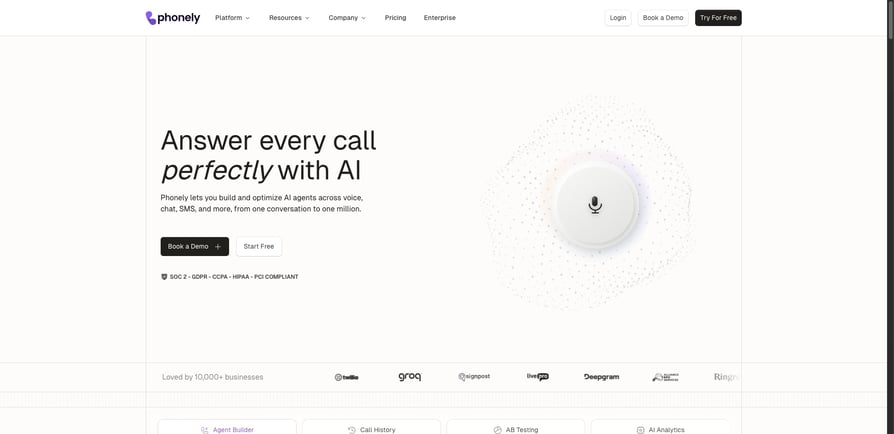
Phonely AI is an AI voice agent platform that answers and places business calls without a human on the line. Phonely handles FAQs, books appointments, qualifies leads, transfers callers and runs outbound campaigns, which covers most of the use cases businesses hand to AI voice agents first. Phonely was founded in Melbourne, Australia, in 2023 by Will Bodewes (CEO) and Nisal Ranasinghe (CTO), and went through Y Combinator's Summer 2024 batch.
The credibility signals are checkable. Phonely announced in April 2026 that it had closed a $16M Series A led by Base10 Partners, bringing total funding to $19M, with Y Combinator, Etech Global Services, TSA Group and Engage CX participating. Three of those participants are enterprise customers who invested while renewing their contracts, which says more than a logo on a homepage.
Founders Will Bodewes and Nisal Ranasinghe came out of AI research at the University of Melbourne, and the technical bet reflects that. Rather than calling a general-purpose model over an API, Phonely runs fine-tuned models on Groq's inference hardware, with Maitai handling model optimization and hot-swapping.
A year ago, the answer to what is Phonely AI would have been "an AI receptionist." That framing is out of date. Phonely's product pages now position it as an omnichannel agent platform across voice, SMS, chat and API, with an optimization layer that A/B tests call scripts.
Who Is Phonely AI Best Suited For?
- High-volume inbound operationsEvery paid tier includes unlimited concurrent calls, so a spike doesn't queue behind a seat count.
- Outbound teams that measure their scriptsPhonely reports that changing one question in a script produced a 5% conversion lift for one customer.
- BPOs and outsourced contact centersPhonely's three named enterprise customers all sit in that category, and TSA Group runs 4,500 human agents alongside it.
- Teams comfortable running their own evaluationThe free plan gives you 100 minutes to test, and given the state of the evidence, you'll want them.
Phonely's 100 free minutes are the right instinct: test an agent on your own calls before you commit to anything. If you'd rather run that test on an agent that comes with the phone system attached, start your 14-day free trial, no credit card required.
How Does Phonely AI Work?
Phonely AI works in three steps:
- You describe the job. Point the no-code AI Builder at your website and it imports pages to build the agent's knowledge base.
- You set the voice and the rules. Choose the voice and language, then define routing, including when the agent hands a caller to a human.
- The agent takes calls on a Phonely number. Numbers come with every plan, and every tier allows unlimited concurrent calls.
What makes the platform interesting sits underneath: the inference stack, the setup path, and the telephony layer Phonely doesn't fully document.
How Do Groq and Maitai Make Phonely Fast?
Most voice agents feel slow because the language model takes a second or more to start speaking. Phonely's answer was to stop using a general-purpose model and run fine-tuned models on Groq's language processing unit (LPU) chips, built for inference rather than training, with Maitai managing model selection and per-customer fine-tuning on top.
Phonely's own published benchmark with Groq and Maitai reports time to first token dropping from 661ms to 176ms at the 90th percentile, and completion time falling from 1,446ms to 339ms. Phonely summarizes those as reductions of 73.4% and 74.6%; the first matches its own table, the second works out to 76.6%. The engineering deserves to be taken seriously. It is also entirely vendor-reported: no published methodology, no shared test set, no third-party audit. VentureBeat's June 2025 reporting on the same figures came from interviews with Phonely, Groq and Maitai, and ran no independent test.
How Fast Can You Set Up a Phonely Agent?
Phonely's build surface is a web dashboard rather than a mobile app, worth knowing if you came here looking for a Phonely AI app review. Website import is where the plan starts to matter: the AI Builder pulls 3 pages into the knowledge base on Free, 30 a month on Starter, and unlimited above.
Phonely's FAQ says 70% of businesses get started in less than five minutes, and the Y Combinator launch post makes the same claim. Nobody has independently timed it, and "started" is doing a lot of work there. A first agent answering is not a production agent that handles your edge cases, so budget for iteration; our guide to implementing an AI voice agent covers what that usually involves.
What Phonely Doesn't Publish About Telephony Costs
A common claim about Phonely, repeated on several competing review pages, is that it runs on Twilio and bills you separately for it. We found no public evidence for that. The word "Twilio" appears exactly once across every Phonely page we read, in a comparison table describing a competitor's limitation ("Restricted to Twilio").
Phonely does publish that numbers are included in every plan (1 on Free, 3 on Starter, 5 on Pro), with SIP trunking, custom telephony and branded caller ID as Enterprise-tier rows. The open question is whether per-minute carrier costs come out of your plan minutes or bill on top. That's a real budgeting problem, just not a Twilio-shaped one. Ask sales and get the answer in writing.
Phonely AI Accuracy and Latency: What the Numbers Actually Mean
Phonely AI accuracy is the claim the rest of the product rests on, so start with the benchmark table itself.
The 81.5% to 99.2% Arc Has a Missing Baseline
Phonely's Published Benchmark
| Checkpoint | Model | TTFT (P90) | Completion time (P90) | Accuracy |
|---|---|---|---|---|
| Legacy | GPT-4o | 661 ms | 1,446 ms | 94.7% |
| Switch to Maitai | Maitai m0 | 186 ms | 316 ms | 81.5% |
| 1st iteration | Maitai m1 | 189 ms | 378 ms | 91.8% |
| 2nd iteration | Maitai m2 | 176 ms | 342 ms | 95.2% |
| 3rd iteration | Maitai m3 | 179 ms | 339 ms | 99.2% |
The headline everywhere is "81.5% to 99.2%." Read the top row and you'll see what that leaves out. The system Phonely replaced, GPT-4o, was already at 94.7%. Switching to the custom stack made accuracy worse at first, and it took four fine-tuning iterations to beat the baseline it started from.
The honest version is "94.7% to 99.2% after four rounds of fine-tuning," still a good result and straight from Phonely's own table. The 17.7-point jump everyone quotes measures the custom stack against its own worst day. Neither version tells you how the agent behaves on your calls, which is the part of voice AI accuracy and its limitations that only your own traffic answers.
"Sub-400ms" Is Not What the Caller Hears
Phonely AI latency figures all trace back to one number, and it measures less than it sounds like. The 339ms figure is P90 model completion time, which covers the model's part of the job. Speech-to-text, text-to-speech and telephony transport sit on top of it, and none of those appear in the published number. That doesn't make the claim false, and Phonely never says otherwise on the benchmark post. It does mean that comparing "sub-400ms" against another vendor's end-to-end latency compares two different measurements, so time the full round trip yourself.
Where Phonely's Own Numbers Disagree
All of these come from Phonely or its CEO, and they don't line up:
Where Phonely's Figures Disagree
| Claim | Figures published | Where |
|---|---|---|
| Accuracy | 99%, 99.2%, 99.7% | Comparison page (live), benchmark post (June 2025), Series A post (April 2026) |
| Callers who can't tell it's AI | "about 70%+", then 90% | CEO Will Bodewes to VentureBeat (June 2025); Series A post (April 2026) |
| Calls handled per day | 100,000+, 120,000+ | About page, homepage |
| Cost reduction | 63%, 70%+, 74%, 80% | Site-wide CTA, homepage, customer case, Series A post |
| Voices available | 100+, 1,000+, "thousands" | Three separate blocks on the product page |
| Minutes on Starter | 200, then 250 | Plan card and comparison matrix on the same pricing page |
The detectability shift is the one to watch. Phonely CEO Will Bodewes told VentureBeat in June 2025 that "about 70%+ of people who call into our AI" can't tell it isn't a person. By April 2026 the marketing site says 90%, with no study published behind either.
Call it a fast-moving company writing marketing copy faster than it publishes methodology, which is common and also exactly why you shouldn't budget against these numbers. SurveyMonkey's Q4 2025 AI-sentiment study found that 14% of consumers would lose trust in a business that used an AI agent without clearly explaining it's AI, so the stakes go past accuracy.
What Are the Key Features of Phonely AI?
Low-Latency Voice With Per-Customer Fine-Tuning
What it is: fine-tuned models on Groq LPU hardware, with Maitai hot-swapping model versions and tuning to your call patterns.
Why it matters: the agent starts talking sooner, and it gets better at your calls rather than staying at a generic baseline.
The catch: fine-tuning needs volume. On 250 minutes a month you get the speed, not much of the tuning.
AI Receptionist, Warm Transfers and Escalation Detection
What it is: the agent answers, handles the FAQ, books or reschedules, and hands off to a human with context attached. Escalation Detection is a named feature, as is AI Talk Block.
Why it matters: the handoff is where most voice agents fail. Passing context instead of making the caller repeat themselves is what separates a clean escalation to a human from an annoyed caller.
The catch: Phonely doesn't publish how escalation is triggered or how tunable the threshold is. Test it with a deliberately awkward caller.
Voice Cloning and Language Coverage
What it is: neural voices with voice cloning (Phonely calls it a "vocal twin") across a claimed 100+ languages for voice, SMS and chat.
Why it matters: multilingual customer support without staffing a multilingual team.
The catch: the voice count is a mess. Phonely's product page says 100+ in one block, 1,000+ in another, and "thousands of voices in hundreds of languages" in a third. Ask which languages are production-ready for your markets.
Omnichannel: Voice, SMS, Chat and API
What it is: one agent across voice, conversational AI SMS, chat and outbound AI email, with SMS metered by plan (1 per 5 minutes on Starter, 1 per 10 on Pro).
Why it matters: a caller who doesn't want to wait can get a text instead, from the same agent with the same context, which is the whole point of omnichannel customer service.
The catch: conversational SMS starts on Pro, so the omnichannel story costs $150 a month to test properly.
AI Workflow Builder, REST APIs and Webhooks
What it is: a visual workflow builder for non-developers, plus REST APIs and webhooks. Advanced API integrations are a Pro-tier line item.
Why it matters: you're not stuck with whatever the no-code builder can express, which bites as soon as the agent needs to read from or write to something custom.
The catch: Phonely doesn't publish API documentation depth, SDK availability or rate limits. Ask for docs access before signing.
Analytics, Call History and Script A/B Testing
What it is: a call analytics dashboard, full call history and monitoring, transcripts, and A/B testing on call scripts.
Why it matters: script A/B testing is uncommon here, and paired with call analytics it turns the agent into something you optimize rather than set and forget.
The catch: the 5% conversion lift Phonely reports is one data point from the vendor, not a benchmark you should plan against.
Phonely AI Pricing Breakdown
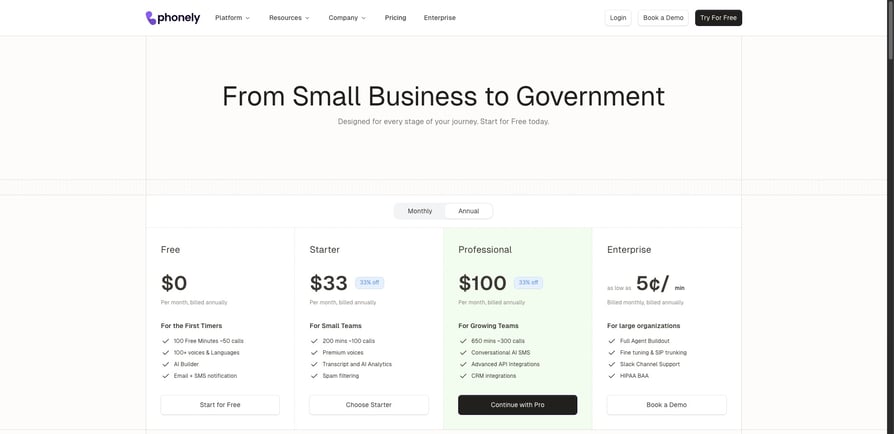
How much does Phonely AI cost? Phonely AI pricing starts with a permanent free plan that includes 100 minutes and one phone number. Starter is $50 a month ($33 billed annually) for 250 minutes and 3 numbers. Pro is $150 a month ($100 billed annually) for 750 minutes and 5 numbers. Enterprise is quoted, starting "as low as 5¢/min."
Every other review of Phonely we read gets this wrong: one quotes usage-based pricing at about 5 cents a minute, another lists plan names and prices that appear nowhere on Phonely's page. Phonely publishes four tiers and a full cost-and-features matrix.
Phonely AI Pricing
| Plan | Monthly | Annual | Minutes | Numbers | Overage | Support |
|---|---|---|---|---|---|---|
| Free | $0 | $0 | 100 | 1 | n/a | Community |
| Starter | $50/mo | $33/mo | 250 | 3 | $0.25/min | Email only |
| Pro | $150/mo | $100/mo | 750 | 5 | $0.30/min | Priority email |
| Enterprise | Quoted | Quoted | Talk to sales | Custom | $0.25/min | Slack, Teams and phone |
Two inconsistencies sit on that page as of August 2026. The plan cards say Starter includes 200 minutes and Pro 650, while the matrix directly below says 250 and 750. And Starter's overage reads $0.25/min in the monthly view, $0.35/min in the annual view of the same table.
What Does Phonely AI Actually Cost Per Minute?
Run the arithmetic and the pricing reads differently. Starter is $50 for 250 minutes, or $0.20 per minute of committed spend. Pro is $150 for 750 minutes, also $0.20 per minute. The "as low as 5¢/min" headline on the Enterprise card is roughly a quarter of what the self-serve tiers cost you.
Phonely's Real Cost Per Minute
| Monthly usage | Published route | Monthly cost | Effective per minute |
|---|---|---|---|
| 250 minutes | Starter, billed monthly | $50 | $0.20 |
| 250 minutes | Starter, billed annually | $33 | $0.13 |
| 1,000 minutes | Pro monthly + 250 overage at $0.30 | $225 | $0.23 |
| 10,000 minutes | Pro monthly + 9,250 overage at $0.30 | $2,925 | $0.29 |
| 10,000 minutes | Enterprise at the published 5¢ floor | $500 | $0.05 |
Annual billing is the biggest lever on the self-serve tiers, taking committed cost to about $0.13 a minute. Past roughly 1,500 minutes a month, staying on Pro and paying overage gets expensive fast, which is presumably the point: the pricing is built to push volume buyers into a sales conversation. For a like-for-like frame, our breakdown of how much voice AI costs sets the per-minute and per-seat models side by side.
Phonely AI Enterprise Features Pricing Review: What's Still Unpublished
The top tier is where the transparency stops. Enterprise buys full agent buildout, fine tuning, SIP trunking, a HIPAA business associate agreement (BAA), and Slack, Teams and phone support. What a Phonely AI enterprise features pricing review can't tell you is the commercial terms, because Phonely doesn't publish:
- Minimum commitmentNo stated floor for volume or contract value.
- What triggers Enterprise pricingNo volume threshold where 5¢/min becomes available.
- Contract length and setup feesNeither appears on the pricing page.
- SLA termsThe enterprise page claims 99.999% uptime; the contractual remedy behind it isn't published.
- Telephony treatmentWhether carrier minutes come out of plan minutes or bill separately.
Get all five in writing before you model a budget.
Is Phonely AI Free? Trial and Demo Details
Yes, and it's a permanent free plan rather than a countdown trial. You get 100 minutes (roughly 50 calls by Phonely's own estimate), one phone number, the AI Builder, voices and languages, and email plus SMS notifications. Community support only, and website import is capped at 3 pages.
We didn't run the signup flow, so we can't confirm whether card details are required. Either way, 100 minutes is enough to test whether the agent handles your five hardest call types.
CloudTalk prices the way it publishes: per-seat plans from $25/user/month, with AI Voice Agents as a usage-based add-on from $99/month for 200 minutes. See all plans.
Phonely AI Review on 6 Must-Have Business Requirements
How Good Is Phonely's Call Quality and Latency?
Strong on paper, unverified in the field. 339ms P90 model completion time is fast by any standard, but it's a component measurement, and the accuracy figure behind it has no published methodology. Ask for a live demo using your own difficult caller scenario, not the vendor's script.
How Usable Is Phonely in Practice?
The no-code AI Builder plus website import is a sensible on-ramp, and the free plan means you can try it without a sales call. Treat Phonely's "under five minutes" as time to first agent, not time to production, and plan a couple of weeks of iteration on real traffic.
Can Phonely Handle High Call Volume?
Unlimited concurrent calls on every plan, including Free, which is unusual and useful. Phonely reports 100,000+ calls a day on its About page and 120,000+ on its homepage. All vendor figures, and nobody has published peak-hour data, so load-test your worst hour.
How Good Is Phonely's Language Support?
100+ languages claimed across voice, SMS and chat, with voice cloning. The voice count contradicts itself three ways on Phonely's own product page, and there's no published list of which languages are production-grade. If you operate in a non-English market, get the specific language and accent tested on a real call.
How Well Does Phonely Integrate With Your Stack?
22 named partner integrations plus Zapier, REST APIs and webhooks. Most entries are dated July 2024; Salesforce is dated November 2025. The page doesn't say whether each connector is native or brokered through Zapier, which matters for two-way sync and field mapping, and usually decides how easy a voice AI is to integrate at all.
Phonely AI Integrations
| Category | Named on phonely.ai | Notes |
|---|---|---|
| CRM | HubSpot, Salesforce, Close, Copper, Airtable | Salesforce added November 2025; native vs Zapier depth undocumented |
| Calendars | Google Calendar, Microsoft Outlook | Both listed since July 2024 |
| Email and messaging | Mailchimp, ActiveCampaign, AWeber, ConvertKit, Drip, ClickSend SMS | The deepest category |
| Work management | Asana, ClickUp, Slack | Slack doubles as the Enterprise support channel |
| Marketing and data | Able CDP, Aritic, Autoklose | Depth undocumented |
| Automation and custom | Zapier, REST APIs, webhooks, Chrome extension | The practical route for anything not natively listed |
| Telephony | Numbers included (1/3/5 by plan); SIP trunking and custom telephony on Enterprise | Underlying carrier not publicly documented |
| AI infrastructure | Groq (LPU inference), Maitai (model optimization) | Confirmed by Phonely and by VentureBeat |
What Support Does Phonely Offer, and Is the Company Stable?
Support is tiered sharply: community on Free, email only on Starter, priority email on Pro, and Slack, Teams and phone on Enterprise. If you're on Starter and something breaks mid-campaign, email is your only channel. Stability is the better story, since a $16M Series A in April 2026 and three enterprise customers who invested rather than churned is a real runway signal for a company founded in 2023.
What We Could and Couldn't Verify About User Sentiment
Phonely's independent review base is either very thin or not publicly measurable, and we won't invent one.
Phonely AI Ratings Across Platforms
| Platform | Rating | Notes |
|---|---|---|
| G2 | Not yet confirmed | A G2 seller profile exists and ranks for this term |
| Capterra | Listed (product ID 1071675) as of August 2026; rating not yet confirmed | Confirmed to exist, not N/A, but the rating still needs manual confirmation |
| Trustpilot | Not applicable | The Trustpilot page ranking for this keyword belongs to phonely.co.uk, a different company |
With no independent rating to lean on, the practical move is to model the economics on your own numbers rather than a vendor's percentage; an AI voice agent ROI calculator gets you a defensible figure in a few minutes.
Press coverage we can verify: VentureBeat's Michael Nuñez published original reporting in June 2025 with interviews from Phonely's CEO, Groq's CMO and Maitai's founder. Real coverage in a real publication, and also the only substantial independent article about the company we found.
What Does Reddit Say About Phonely AI?
Searching Reddit for a read on Phonely AI is a dead end. A few threads mention the company in passing, but none turn into an actual discussion of the product, its accuracy claims, or what it's like to run calls through it. No reviewer thread, no complaint thread, no "has anyone used this" conversation with any substance behind it.
If you were hoping Reddit would settle whether Phonely's numbers hold up, it won't. That conversation just hasn't happened yet. It fits the pattern of everything else in this section: not necessarily bad, just too new and too thin to have generated real independent discussion anywhere.
Is Phonely AI Legit? Reputation and Trust
Yes. Asking is Phonely AI legit usually means "is this a real company or a wrapper that'll disappear," and the answer is clear. Phonely is a Y Combinator Summer 2024 company, founded in Melbourne, Australia in 2023, with $19M raised including a $16M Series A led by Base10 Partners in April 2026. Three of its enterprise customers put money in. That's not a wrapper. If build-versus-buy is the real question underneath, our comparison of DIY versus paid voice AI is the better place to start.
Keep the legitimacy question and the accuracy question separate. The business is well-supported. The specific performance figures are self-reported, internally inconsistent, and untested by anyone outside the company. You can believe both of those at once, and you should.
Phonely AI vs phonely.co.uk
They're unrelated companies. Phonely AI (phonely.ai) is the Melbourne-founded, Y Combinator-backed AI voice agent company described here. Phonely (phonely.co.uk) is a UK landline and VoIP provider. A Trustpilot page for the UK company currently ranks on page one for "phonely ai review," so people are reading reviews of a completely different business and forming an opinion about this one. Don't let those ratings, good or bad, affect your evaluation.
Who Should (and Should Not) Use Phonely AI
Best Fit: Buyer Profiles Where Phonely Works
- BPOs and outsourced contact centersEtech Global Services reports a 72% cost reduction and a 34% increase in first call resolution.
- Insurance and financial services outbound teamsEngage CX runs high call volumes and, per Phonely's Series A post, drove over $10M in policy sales in the first four months of 2026.
- Local service businesses losing calls to voicemailSignpost reports 100% of calls answered and a 3x lead capture rate, and Free plus Starter make that cheap to test.
- Teams that want to optimize scripts, not just automate themA/B testing and per-customer fine-tuning give you something to iterate on.
- Buyers who'll do their own testingSpend the 100 free minutes on the calls your team handles worst, and the unverified claims matter much less.
Poor Fit: When to Look Elsewhere
- Buyers who need audited performance dataIf procurement wants a third-party benchmark, Phonely doesn't have one.
- Regulated buyers who need an inspected SOC 2 report on day onePhonely claims the certifications; see the compliance section below for why we'd double down on inspecting rather than trusting the badge.
- Teams that want a large independent review base to checkThere isn't one yet.
- Buyers who need the phone system tooPhonely is a voice agent, not a business phone system with seats, queues, wallboards and supervisor tooling for human agents.
Which Industries Is Phonely a Fit For?
Phonely AI Industry Fit
| Industry / use case | Fit assessment |
|---|---|
| BPO and outsourced contact centers | Good. Etech Global Services and TSA Group are named customers, both reporting 72-74% cost reduction (vendor-published). |
| Insurance and financial services outbound | Good. Engage CX reports high daily call volume and $10M+ in policy sales in four months (vendor-published). |
| Healthcare intake and scheduling | Good with diligence. Lifelike Health is a named HIPAA customer; a BAA is an Enterprise inclusion, so request it early. |
| Local services and SMB missed-call capture | Good. Free and Starter tiers make it cheap to test. |
| Regulated industries needing inspected attestations | Caution. Compliance is claimed publicly; the reports weren't available to inspect, and the underlying attestation vendor's credibility is itself in question (see below). |
| Buyers who need an independent review history | Caution. Not measurable at the time of writing. |
| Deep CRM-embedded workflows | Caution. 22 named integrations, none documented as native or brokered. |
Is Phonely AI Secure? Compliance and Data Privacy
Compliance: What's Claimed vs What's Attested
Phonely's homepage carries a compliance strip reading "SOC 2 - GDPR - CCPA - HIPAA - PCI Compliant." The pricing matrix has a security block with rows for SOC 2 and GDPR, HIPAA BAA signature and PCI compliance, and the homepage FAQ repeats the SOC 2, HIPAA and GDPR claims. Phonely also links a trust center from its footer, hosted at trust.delve.co/phonely.
That trust center is itself a reason for caution. Delve, the compliance-attestation vendor behind it, has been accused of issuing SOC 2 reports with pre-written, templated findings before customers submitted any evidence.2 Y Combinator removed Delve from the program over the allegations.
That doesn't make Phonely's own SOC 2 status false. It does mean the badge on Phonely's trust center isn't the independent proof it looks like. Ask for the actual SOC 2 report, confirm who performed the audit, and get its type, date and scope in writing before any healthcare or financial services deployment.
What Does Phonely Publish About Data Handling?
Phonely's enterprise page describes automatic redaction of names, credit card details and other sensitive data, and claims dedicated infrastructure scaling to millions of calls at 99.999% uptime. Beyond that the picture thins out. Data residency, retention periods for recordings and transcripts, and whether call data feeds the per-customer fine-tuning that Maitai performs are not addressed anywhere public we could find. That last one deserves a direct question, since fine-tuning on your call data is central to how the product improves and it is the biggest single variable in how secure your data is when using voice AI.
What Are the Pros and Cons of Phonely AI?
Phonely's per-tier inclusions are unusually generous, right down to unlimited concurrent calls on the free plan. What's missing is outside verification.
Phonely AI Pros
- Four published pricing tiers with a full feature matrixMost AI voice startups don't publish this level of detail.
- Real infrastructure behind itFine-tuned models on Groq LPUs with Maitai optimization, backed by a published benchmark table.
- Verifiable credibilityYC S24, a $16M Series A led by Base10 in April 2026, $19M total raised.
- Named enterprise customers who put money inEtech Global Services, TSA Group and Engage CX all invested while renewing their contracts.
- Generous free tier100 free minutes plus unlimited concurrent calls on every tier, including Free.
Phonely AI Cons
- Every headline number is self-reportedNo published methodology or third-party audit behind any of them.
- Its own figures don't agree with each otherAccuracy shows up as 99%, 99.2% and 99.7%; detectability as 70%+ and 90%, depending on the page.
- The headline per-minute price isn't what you paySelf-serve tiers work out to about $0.20 a minute committed, roughly four times the "as low as 5¢/min" Enterprise figure.
- Almost no independent review baseToo thin to measure, and the trust-center's attestation vendor (Delve) has its own credibility questions.
- Enterprise terms stay behind a sales callMinimums, contract length, setup fees, SLA remedies and data residency are all unpublished.
The Best 4 Phonely AI Alternatives in 2026
The useful Phonely AI alternatives split by what you're optimizing for: a proven platform, an enterprise no-code build, transparent per-minute billing, or developer control. We read every competitor figure below on the vendor's own published pricing page in August 2026. For a wider field than these four, our roundup of the best AI voice agents covers more of the category.
Phonely AI Alternatives Compared
| Capability | CloudTalk | Synthflow | Retell AI | Vapi |
|---|---|---|---|---|
| Best for | AI voice agents on top of a full business phone system | Enterprise no-code voice agents | Transparent per-minute pricing, no contract | Developer-first custom agents |
| Pricing model | Per-seat plans plus a usage-based AI Voice Agents add-on | Annual enterprise contract | Pay as you go | Platform fee plus components at cost |
| Published entry price | $25/user/month; AI Voice Agents add-on from $99/month for 200 minutes | From $30,000 annually | $0 to start; $0.07 to $0.31/min | $0.05/min platform fee |
| Free tier | 14-day free trial; first 50 AI Voice Agent minutes free in month one | Not listed on the pricing page | $10 in free credits | Not published |
| Contract required | No | Yes, annual | No | No; enterprise is volume-based |
| Compliance | SOC 2 Type 1 and Type 2, GDPR, HIPAA | SOC 2, HIPAA, GDPR and ISO 27001 badges published on its pricing page, plus EU/US hosting options | SOC 2 certified; HIPAA available via a custom BAA on enterprise plans, not blanket-certified | HIPAA $2,000/month and Zero Data Retention $1,000/month as paid add-ons; the base plan ships without SOC 2 by default |
| Telephony | Included: virtual numbers in 160+ countries on a multi-carrier network | Native telephony or SIP trunking | Bundled in its published per-minute calculator | Assembled from your own providers and API keys |
| No-code friendliness | High: an agent configured in under 10 minutes | High | Medium | Low, built for developers |
| Independent review base | 4.4/5 on G2 from 1,702+ reviews | 4.5/5 on G2 from 1,000+ reviews (checked August 2026) | 4.8/5 on G2 from 2,600+ reviews (checked August 2026) | G2 lists the developer platform under two separate product slugs, each with only 3 reviews as of August 2026, too thin a sample to cite as a rating |
| Where it beats Phonely | Published per-seat pricing, a countable review base, and the phone system underneath the agent | Enterprise implementation and launch support scoped into the contract | Per-minute cost you can model line by line before signing | Total control of the stack and the model choices |
Related Reading
- Best voice AI agents for call deflection
- Benefits of AI voice agents for sales and support
- How to improve cold calling with AI voice agents
- The AI voice agent use case library
Why CloudTalk AIVA Is Worth Considering
The trade-off is straightforward. Phonely built a fast inference stack and fine-tunes a model per customer, which is real engineering CloudTalk doesn't claim to match. CloudTalk built an AI voice agent on top of a business phone system that already handles the humans, the numbers, the routing and the reporting, with a price list and a review base you can check today.
Phonely AI vs CloudTalk: Feature and Capability Comparison
Phonely AI vs CloudTalk
| Capability | Phonely AI | CloudTalk |
|---|---|---|
| Company stage | Founded 2023, YC S24, $19M raised | Established, 5,500+ customers |
| Pricing model | Published tiers plus per-minute overage | Per-seat plans from $25/user/month, with AI Voice Agents as a usage-based add-on |
| Entry AI cost | Free plan with 100 minutes; Starter $50/month for 250 | AI Voice Agents add-on from $99/month for 200 minutes, first 50 minutes free in month one |
| Latency claim | Sub-400ms P90 model completion time (self-reported) | Sub-800ms response latency |
| Accuracy claim | 99% to 99.7% depending on the page (self-reported) | No headline accuracy percentage published |
| Telephony | Numbers included; underlying carrier undocumented | Virtual numbers in 160+ countries on a decentralized SIP architecture with multiple backup carriers |
| Integrations | 22 named partners plus Zapier and webhooks | 100+ native integrations with two-way sync |
| Languages | 100+ claimed | 60+ languages and accents |
| Compliance | SOC 2, HIPAA, GDPR, CCPA and PCI claimed; attestations not inspected, and the trust-center vendor's audits are themselves disputed | SOC 2 Type 1 and Type 2, GDPR, HIPAA |
| Independent review base | Not measurable at the time of writing | 4.4/5 on G2 from 1,702+ reviews |
| Time to first agent | "Under five minutes" claimed | Self-service configuration in under 10 minutes |
Phonely AI vs CloudTalk: Pricing and Track Record
CloudTalk's AI Voice Agent is an add-on, never bundled into a plan, and it's priced by usage rather than per seat. The add-on starts at $99 a month for 200 minutes, with the first 50 minutes free in your first month and volume discounts at scale. The platform underneath starts at $25/user/month on Starter, $29 on Essential and $49 on Expert, with a 14-day free trial.
The difference from Phonely comes down to what you can verify before you spend. CloudTalk publishes a per-seat list price, a 99.999% uptime figure, and a G2 profile with 1,702+ reviews behind a 4.4/5 rating. Phonely publishes prices too, to its credit, but the performance numbers you'd be buying on have no outside check.
What that looks like in practice: MadRent in property management put AI on lead qualification and freed its team for sales, and Autenti has AI voice agents handling roughly 30% of inbound support calls. Trevo reached 20x more customers per campaign, and CloudTalk's own AI prequalification agent unlocked 17x ROI on long-tail leads. Every one of those is a named company with a published outcome.
Where Does CloudTalk Fit Better?
- You need the phone system, not just the agentCloudTalk's AI Voice Agent sits on the same infrastructure as your human agents: the same numbers, routing, recording, transcription and analytics. A call the AI answers and transfers lands as one continuous record in the CRM.
- Your CRM workflow is the point100+ native integrations bring two-way sync of contacts, calls, recordings, AI summaries and tags, plus embedded click-to-call and CTI screen-pops inside the partner UI.
- Procurement wants evidenceA published price list, 5,500+ customers across 100+ countries and a countable review base survive a diligence review in a way a self-reported benchmark doesn't.
- You want to start without a sales callA 14-day free trial, plus the first 50 AI Voice Agent minutes free in month one, gets you testing on your own traffic.
To be fair to Phonely: if raw model latency and per-customer fine-tuning are your deciding factors and you'll validate the claims yourself, its stack is the more specialized one.
The fair test is your own traffic, on both. CloudTalk's AI Voice Agent is configured in under 10 minutes, and your first 50 minutes are free in month one.
Final Verdict: Is Phonely AI Worth It?
Is Phonely AI worth it? For most buyers with real call volume and a willingness to test, yes, with conditions. The company is real, the pricing is public, the infrastructure work is genuine, and the free plan costs you nothing but an afternoon. What you shouldn't do is build a business case on the headline numbers, because Phonely's own pages can't agree on what they are.
Who Is Phonely a Good Fit For?
- High-volume inbound or outbound operationsTeams that can use unlimited concurrency on every tier.
- BPOs, insurance outbound teams and local service businessesThese match Phonely's named customer profiles.
- Teams that will test before committingUse the 100 free minutes to run your own evaluation.
- Buyers who prioritize model performanceLatency and fine-tuning matter more to you than vendor track record.
Who Should Skip Phonely AI?
- Procurement needing third-party verified dataPhonely has no audited performance benchmark to hand over.
- Regulated buyers needing an inspected SOC 2 reportAlong with a documented data-residency policy, neither of which Phonely makes inspectable today.
- Teams that want an independent review baseTo sanity-check the vendor's claims against real customer feedback.
- Buyers who also need a full phone system for human agentsWhere CloudTalk is the more direct fit alongside the AI agent. See the business phone system comparison.
Put an AI Voice Agent on Your Own Calls Before You Budget for One
Sources:
1. SurveyMonkey, Customer Service Statistics
2. Captain Compliance, The Delve Scandal: Fake SOC 2 Audits, Open-Source Code Theft, and Exit from Y Combinator
Frequently Asked Questions about Phonely AI
Direct answers to the questions buyers ask most when weighing Phonely AI for business use.
Phonely AI is a Melbourne-founded AI voice agent company at phonely.ai, backed by Y Combinator's Summer 2024 batch. It sells the kind of conversational AI receptionist that answers and routes calls. It is not phonely.co.uk, an unrelated UK landline provider.
No. The 99.2% figure comes from Phonely's own benchmark post with Groq and Maitai, which publishes no methodology, test set or third-party audit. The same table shows the GPT-4o system Phonely replaced was already at 94.7%. Your only real check is scoring your own calls.
Phonely AI costs $0 for 100 minutes a month on its free plan, $50 on Starter (250 minutes) and $150 on Pro (750 minutes). Annual billing cuts those to $33 and $100, and Enterprise is quoted from 5¢/min. Both self-serve tiers work out to about $0.20 per committed minute of AI voice agent time.
Phonely doesn't publish that. Numbers are included in every plan (1 on Free, 3 on Starter, 5 on Pro) and SIP trunking is an Enterprise row, but the page never says whether per-minute carrier costs come out of your plan minutes. Ask sales in writing.
Phonely claims SOC 2, HIPAA, GDPR, CCPA and PCI compliance and lists a HIPAA BAA as an Enterprise inclusion. We couldn't inspect a single attestation directly, and the trust-center vendor behind Phonely's badge (Delve) has itself been reported for issuing templated SOC 2 findings before evidence was submitted. Request the actual report and the signed BAA before any deployment with HIPAA call center requirements.
Phonely AI has a permanent free plan rather than a countdown trial: 100 minutes (about 50 calls, by Phonely's estimate), one phone number, the AI Builder and community support. That is enough for smaller teams evaluating AI voice agents to run a real test before paying.
Yes, on track record. CloudTalk publishes per-seat pricing from $25/user/month with AI Voice Agents as a usage-based add-on, carries a 4.4/5 rating on G2 from 1,702+ reviews, and documents SOC 2 Type 1 and Type 2. Phonely's review base isn't measurable yet, though its inference stack is the more specialized one.