TL;DR: Plivo vs Twilio
Plivo and Twilio both give developers programmable voice and messaging, but they don't sell it the same way.
- 01Plivo is now voice-AI-first: self-serve covers SIP trunking, audio streaming, AI agents and numbers in the US and India only, capped at $2,500 of monthly usage. Telephony starts at $0.0010/min outbound.
- 02Twilio is the broadest CPaaS catalog on one pay-as-you-go account: voice at $0.0140/min outbound, SMS at $0.0083, plus Verify, WhatsApp, RCS, video, SendGrid email and Segment with no contract floor.
- 03Plivo's cheaper reputation now has a gate. SMS, WhatsApp, Verify and coverage beyond the US and India sit behind an Enterprise plan starting at $1,000/month.
- 04A third option: both platforms are parts, not a product. CloudTalk is a finished call center with numbers, routing, CRM sync and AI Voice Agents from $25/user/month, no developers required.
Neither platform wins this comparison outright:
Plivo and Twilio are both strong CPaaS providers. They fit different budgets, different coverage needs and different amounts of engineering appetite. The right pick depends entirely on your use case.
Plivo, founded in 2011 and rebuilt around voice AI in 2026, is the leaner platform: a clean REST API, telephony from $0.0010/min, and a self-serve tier you can start on with $10 in credits and no card. It holds 4.5 out of 5 on G2 across 747 reviews, with 78% of those reviews coming from small businesses.
Twilio, founded in 2008 and publicly traded on the NYSE, is the widest ecosystem in the category: voice, SMS, RCS, WhatsApp, Apple Messages, video, Verify for 2FA, SendGrid for email, Segment for customer data, Flex for contact centers and the Studio low-code builder, all billed on one pay-as-you-go account. It holds 4.1 out of 5 on G2 across 504 reviews.
The split is cleaner than it looks.
- Plivo fits teams building voice AI or SIP-based calling in the US and India who want the lowest per-minute rate and can live inside a self-serve usage cap.
- Twilio fits teams that need more than core voice: global coverage, verification, omnichannel messaging or email in the same account, with no commitment to unlock any of it.
Below, we work through the Plivo vs Twilio 2026 decision layer by layer: core strengths, features, pricing, compliance, developer experience, reviews, and buyer fit. Or jump straight to the key differences table.

Need a working phone system, not an API to build one with?

Plivo vs. Twilio: Core Strengths of Each Platform
Each platform solves the same core problem, programmable voice and messaging, but they optimize for different things.
- Plivo optimizes for per-unit cost and a fast path to a working voice agent.
- Twilio optimizes for breadth, reach, and having every channel on one bill. Neither approach is wrong; they serve different teams.
Where Plivo Shines
- Lowest published telephony rates:SIP trunking and audio streaming start at $0.0010/min outbound and $0.0028/min inbound, against Twilio's $0.0140/min outbound on local numbers.
- Cheaper SMS at volume:US long-code SMS lists at $0.0077 versus Twilio's $0.0083. Plivo's own calculator puts 100,000 messages/month at $528 against $790 on Twilio.
- Cheaper phone numbers:US long codes rent at $0.50/month and toll-free at $1.00/month, less than half Twilio's $1.15 and $2.15.
- Bundled voice AI agent pricing:$0.03/min covers voice models, transcription and orchestration in one line, with the agent builder, simulation testing, knowledge base and human transfer included free.
- Publicly listed certificationsSOC 2, GDPR, HIPAA/HITECH, PCI DSS Level 1, CSA STAR Level 1 and EU-US DPF are all named on Plivo's security page, no sales call needed to see them.
Where Twilio Shines
- No contract floor on anything:Every product, including Verify, WhatsApp and global routes, is available pay-as-you-go from a free trial account with no minimum spend.
- Widest channel catalog:SMS, MMS, RCS, WhatsApp, Facebook Messenger, Apple Messages for Business, voice, video and email through SendGrid, all on one account.
- Verify as a finished product:OTP and 2FA start at $0.05/verification with channel fallback handled for you, and Lookup validates numbers from $0.01/request.
- Super Network carrier reach:Redundant global interconnects with backup zones for disaster recovery, plus full STIR/SHAKEN authentication on outbound calls.
- Deepest tooling and community:Studio low-code builder, Functions, CodeExchange samples, SDKs across more languages, and by far the larger body of third-party tutorials and Stack Overflow answers.
At a Glance: Plivo vs. Twilio, Key Differences
Every Plivo vs. Twilio comparison eventually reduces to the dimensions below. Use this table to identify what matters most for your use case, then jump to the relevant section for detail.
| Dimension | Plivo | Twilio | Best suited for |
|---|---|---|---|
| Pricing model | Pay-as-you-go capped at $2,500 monthly usage, then Enterprise from $1,000/month | Pay-as-you-go with automatic volume tiers, no cap and no plan gate | Plivo for predictable low-volume voice; Twilio for anything that might scale past a cap |
| Self-serve coverage | United States and India only; 190+ countries on Enterprise | Global from the free trial account, numbers in 100+ locales | Twilio for international traffic without a sales cycle |
| US outbound SMS | $0.0077/segment, long code (Enterprise plan only) | $0.0083/segment, long code | Plivo at high volume if you clear the Enterprise floor; Twilio below it |
| Voice per minute | $0.0010 out / $0.0028 in via SIP trunking | $0.0140 out / $0.0085 in on local numbers; $0.0040 both ways on BYOC or SIP | Plivo for outbound-heavy dialing; Twilio if you need PSTN numbers, not trunks |
| Local number cost | $0.50/month long code, $1.00 toll-free | $1.15/month local, $2.15 toll-free, $0.50 if you bring your own | Plivo for large number inventories |
| Omnichannel breadth | SMS, RCS, MMS, WhatsApp; no video or email products | Adds Facebook Messenger, Apple Messages, video and SendGrid email | Twilio for teams consolidating every channel on one vendor |
| Verification / 2FA | Verify API exists but is Enterprise-gated | Verify from $0.05/verification, self-serve | Twilio for OTP and fraud prevention without a contract |
| Voice AI approach | Managed agent at $0.03/min plus telephony, with a builder and simulation testing included | Conversation Relay at $0.07/min; you supply and pay for the model layer | Plivo for a faster managed agent; Twilio for full control of the model stack |
| Compliance visibility | Certifications listed publicly; HIPAA BAA and SSO on Enterprise | ISO/IEC 27001 and audit reports available through a request portal | Plivo for fast vendor review; Twilio for enterprise procurement depth |
| G2 standing | 4.5/5 from 747 reviews, 78% small business | 4.1/5 from 504 reviews, 51% small business | Plivo scores higher on ease and support; Twilio wins on roadmap direction |
Plivo vs. Twilio: Features Comparison
Plivo Features
Plivo's 2026 platform is narrower and more opinionated than it used to be. The self-serve product is SIP trunking, audio streaming, phone numbers and a managed voice AI agent, with SMS, WhatsApp and Verify moved up to the Enterprise plan. If you are evaluating Plivo as a general-purpose messaging API, that reshaping matters more than any single rate.
| What Plivo Does Well | Where Plivo Falls Short |
|---|---|
| Lowest telephony floor in the category. Outbound SIP trunking at $0.0010/min and inbound at $0.0028/min, with secure trunking, noise cancellation and call recording bundled as add-on services. | The $1,000/month Enterprise gate. SMS, WhatsApp, Verify, short codes, custom sender IDs, HIPAA BAAs and SSO are all Enterprise-only, which changes the calculation for anyone who came to Plivo purely for cheap messaging. |
| A managed voice agent with the extras included. $0.03/min covers voice models, transcription and orchestration, and concurrency, CPS, the Vibe Agent builder, simulation testing, knowledge base and transfer-to-human are free. | Self-serve is US and India only. The 190+ country footprint is real, but it lives on the Enterprise plan. European or APAC traffic means a sales conversation before you can send anything. |
| Clean, well-documented REST API. G2 reviewers consistently rate Plivo higher than Twilio on ease of use, ease of setup and API call speed, and Plivo advertises a first agent deployed in under ten minutes. | A hard usage ceiling. Pay-as-you-go caps at $2,500 of monthly usage with 2 RPS and 50 concurrent calls, so growth forces a plan migration rather than just a higher bill. |
| Standards-based integration. Documented support for LiveKit and Pipecat means you can plug Plivo's trunks into an existing voice AI stack instead of adopting a proprietary orchestration layer. | No self-serve 2FA path. Plivo does have a Verify API, but because it is Enterprise-only, teams below that threshold still have to build verification themselves or bolt on a third party. |
| Cheap number inventory. At $0.50/month per US long code, running hundreds of numbers for local presence or A/B testing costs less than half what the equivalent costs on Twilio. | No video, email or CDP. If your roadmap needs channels beyond voice and messaging, Plivo is not the platform that consolidates them. |
Twilio Features
Twilio's product catalog is the widest in CPaaS and keeps expanding: alongside Programmable Voice and Messaging sit Verify, Lookup, Video, SendGrid, Segment, Flex and the newer Conversations family covering memory, orchestration, intelligence and Relay. The strength and the weakness are the same fact, which is that there is a lot of it.
| What Twilio Does Well | Where Twilio Falls Short |
|---|---|
| Verify as a shipped product. OTP and 2FA from $0.05/verification with multi-channel fallback built in, so you are not assembling a verification flow out of raw SMS sends. | Higher per-unit rates almost everywhere. SMS at $0.0083 against $0.0077, outbound voice at $0.0140 against $0.0010, local numbers at $1.15 against $0.50. The gap compounds at volume. |
| Every channel on one account. SMS, MMS, RCS, WhatsApp, Facebook Messenger, Apple Messages for Business, voice, video and email, with one set of credentials and one invoice. | The real bill is rarely the headline rate. Recording at $0.0025/min, storage, transcription at $0.05/min, answering machine detection at $0.0075/call, Voice Insights, Conversation Relay at $0.07/min and carrier surcharges each add a line. |
| Studio and Functions for low-code flows. Non-specialists can assemble IVR and messaging logic visually, which shortens the path from idea to a testable flow. | Genuine learning curve. Twilio scores meaningfully below Plivo on G2 for ease of use and ease of setup, and the size of the catalog is a common reason cited. |
| Trust and deliverability tooling. Trust Hub, A2P 10DLC registration, CNAM, STIR/SHAKEN authentication and Branded Calling at $0.12/call all help answer rates on outbound. | Compliance documents sit behind a request portal. Security and privacy reports come through security.twilio.com rather than a public page, which slows down a quick vendor assessment. |
| No gate on scale or geography. Volume discounts apply automatically as you grow, and committed-use pricing is an option rather than a prerequisite. |
Feature-by-Feature Comparison
| Feature | Plivo | Twilio |
|---|---|---|
| SMS and MMS | Yes, Enterprise plan only. Long code, toll-free and short code routes | Yes, self-serve. Long code, toll-free, short code and FTEU short code |
| RCS | Yes, Rich at $0.0077 and Rich Media at $0.018 | Yes, Rich at $0.0083 and Rich Media at $0.022 |
| Yes, from $0.0037/message, Enterprise plan | Yes, self-serve | |
| Verify / 2FA | Yes, Verify API on Enterprise | Yes, Verify from $0.05/verification plus Lookup from $0.01/request |
| Video API | No | Yes, from $0.004 per participant per minute |
| Email API | No | Yes, SendGrid Email API and Marketing Campaigns |
| Low-code builder | Vibe Agent builder for voice agents, included free | Studio for call and messaging flows, plus Functions for serverless logic |
| Customer data platform | No | Yes, Segment from $120/month for up to 10k visitors |
| Number types | Long code, toll-free, short code (regular and vanity) | Local, toll-free, short code (random and vanity), plus bring-your-own-number at $0.50/month |
| Contact center product | No | Yes, Flex. See our Twilio Flex pricing breakdown |
The CloudTalk Angle:
Both platforms are infrastructure you build a communications system on top of. CloudTalk is the finished system: numbers, CRM sync, call routing, coaching, and AI, already assembled. The fuller build-versus-buy math sits in the pricing section below.
Try CloudTalk; you have nothing to lose.
Plivo vs. Twilio: Pricing Compared
This is where the Plivo vs Twilio pricing question gets more interesting than it used to be, because the two platforms no longer package the same things the same way.
Plivo Pricing
- Pay-as-you-go: $10 in free credits, no credit card. Covers the US and India, includes SIP trunking, audio streaming, AI agents and phone numbers, with 2 RPS and 50 call concurrency, up to $2,500 of monthly usage.
- Enterprise: from $1,000/month. Adds 190+ country coverage, SMS, WhatsApp and Verify, short codes and custom sender IDs, custom volume pricing, and BAA, HIPAA and SSO.
- Telephony: calls from $0.0010/min outbound and $0.0028/min inbound.
- Voice AI agent: $0.03/min excluding telephony, covering voice models, transcription and orchestration.
- SMS: $0.0077/segment on US long codes and short codes, $0.0079 toll-free, plus carrier surcharges of $0.0035 to $0.0050 per outbound message.
- Phone numbers: long codes $0.50/month, toll-free $1.00/month, short codes $500/month regular or $1,000/month vanity with a $1,500 one-time fee. Full detail in our Plivo pricing guide.
Twilio Pricing
- Pay-as-you-go throughout: no plan tiers, no monthly minimum. The free trial provides about $15 in credit to buy a number and test.
- Voice: $0.0140/min to make local calls, $0.0085/min to receive on local numbers, $0.0220/min inbound toll-free. Browser, SIP interface and BYOC trunking all run $0.0040/min.
- SMS: $0.0083/segment outbound and inbound across long code, toll-free and short code, plus carrier surcharges of $0.0035 to $0.0050 outbound.
- Verify: from $0.05/verification. Lookup from $0.01/request.
- Phone numbers: local $1.15/month, toll-free $2.15/month, bring-your-own $0.50/month, random short code $1,000/month, vanity $1,500/month.
- Free allowances worth knowing: basic text-to-speech is free, the first 1,000 link-shortening events each month are free, TaskRouter's first 100 tasks per month are free, and CPS provisioning is free on pay-as-you-go. For very small usage, Twilio's real entry cost is lower than the rate card suggests.
Pricing Compared Line by Line
| Pricing dimension | Plivo | Twilio | CloudTalk |
|---|---|---|---|
| US outbound SMS | $0.0077/segment, Enterprise plan | $0.0083/segment, self-serve | Included in plan, no per-segment API billing |
| Outbound voice per minute | $0.0010 via SIP trunking | $0.0140 local, $0.0040 via BYOC | Calling credit on the plan, rates by destination |
| Local number, monthly | $0.50 | $1.15 | International numbers in 160+ countries |
| 2FA / verification | Verify API, Enterprise plan only | From $0.05/verification, self-serve | Not applicable, CloudTalk is not a verification platform |
| Entry commitment | None to start, $1,000/month to unlock messaging and global reach | None at any tier | $25/user/month, 14-day free trial, no card |
| AI voice agent | $0.03/min plus telephony | Conversation Relay $0.07/min plus your own model costs | $9/month add-on, no-code, already wired to the phone system |
| Estimated cost, 200,000 US SMS/month | ~$1,540 base + ~$800 carrier surcharges = ~$2,340, and only on the $1,000/month Enterprise plan | ~$1,660 base + ~$800 carrier surcharges = ~$2,460, no plan required | Not comparable: messaging is not billed per segment on a per-seat plan |
| Total cost of a working call center | Raw API cost plus engineering time to build routing, recording, dashboards and CRM sync, then maintain them | Same, or Flex licensing if you buy the assembled version | $25/user/month all-in, live the same day, zero engineering |
Plivo vs. Twilio: Compliance & Reliability
Plivo Compliance & Reliability
- SOC 2 certified with an annual independent audit, GDPR aligned, and PCI DSS Level 1 certified.
- HIPAA and HITECH: Plivo will sign a Business Associate Agreement for customers handling PHI, though BAA and HIPAA sit on the Enterprise plan.
- CSA STAR Level 1 self-assessment completed, and participation in the EU-US Data Privacy Framework.
- Redundancy: at least two local carriers per country, backup routing that reroutes in under two seconds, annual external penetration tests, AES-256 at rest and TLS 1.2 or greater in transit.
- No public uptime SLA percentage is published on the security page. Live incident history is on status.plivo.com, and priority 1 incidents are covered around the clock.
Twilio Compliance & Reliability
- ISO/IEC 27001 certified with regular external audits, and dedicated GDPR and CCPA products in the Privacy Portal.
- HIPAA-eligible products are supported, and PHI and PII handling rules can be enforced through the Privacy Portal's risk-based classification.
- The Super Network provides redundant global interconnects and multiple backup zones for disaster recovery, with SLA compliance managed centrally.
- 100% of Twilio calls are STIR/SHAKEN authenticated, which matters for answer rates on US outbound.
- Security and privacy documentation is available on request through security.twilio.com rather than published openly, so budget time for it in a procurement cycle.
Compliance & Reliability Compared
| Dimension | Plivo | Twilio |
|---|---|---|
| SOC 2 | Certified, audited annually, stated publicly | Reports available via request portal |
| ISO/IEC 27001 | Not listed | Certified |
| GDPR | Compliant, plus EU-US DPF participation | Compliant, with a dedicated GDPR product |
| HIPAA | HIPAA/HITECH with BAA, Enterprise plan | HIPAA-eligible products, BAA available |
| PCI DSS | Level 1 certified | In scope for payment products |
| Published uptime SLA | No public figure; status page and 24/7 P1 response | No public figure; SLA terms are contractual, status page available |
| Documented outage/downtime reports | Live incident history published on status.plivo.com, with 24/7 priority 1 response | Public status pages for Super Network, SendGrid and Segment; historical incidents visible |
| Redundancy model | Two or more carriers per country, sub-two-second failover, AWS-hosted | Super Network with backup zones and STIR/SHAKEN on all calls |
The CloudTalk Angle:
On both platforms, compliance is something you inherit and then have to configure yourself correctly. CloudTalk ships GDPR, SOC 2 and HIPAA tooling as part of an already-supported platform with a 99.999% uptime SLA, so there is no stack to certify.
Plivo vs. Twilio: Developer Experience & Learning Curve
Developer experience is where the Plivo vs. Twilio choice usually gets decided, because on a well-configured route both platforms sound fine. What differs is how long it takes to get to that route.
Plivo Developer Experience
- Smaller API surface means less to learn. G2 reviewers rate Plivo above Twilio on ease of use, ease of setup and ease of administration.
- Plivo advertises a deployed voice agent in five steps and under ten minutes, with a CLI-first flow.
- Documented quickstarts for LiveKit and Pipecat, so an existing voice AI stack can adopt Plivo's trunks without rearchitecting.
- The trade-off: fewer worked examples in the wild, so when you hit an edge case there is less community material to lean on.
Twilio Developer Experience
- Documentation depth is the category benchmark, with helper libraries across more languages and a CodeExchange library of working samples.
- Studio gives non-specialists a visual path to IVR and messaging flows, and Functions covers serverless glue code without extra hosting.
- Nearly any integration question has already been answered somewhere public, which shortens debugging more than documentation alone does.
- The trade-off: a real learning curve. Reviewers repeatedly flag configuration complexity, and the size of the catalog is usually the reason.
Developer Experience Compared
| Dimension | Plivo | Twilio |
|---|---|---|
| SDK language coverage | Core languages covered, narrower list | Broader official helper library coverage |
| Documentation depth | Focused and current, less sprawling | The most comprehensive in CPaaS |
| Low-code tooling | Vibe Agent builder for voice agents | Studio plus Functions across voice and messaging |
| Time to first successful call | Advertised at under ten minutes on the voice agent path | Fast on a single API, longer once you wire several products together |
| Community and support | Higher G2 support scores, smaller community | Largest community; paid support plans for faster response |
The CloudTalk Angle:
Both platforms assume a development team either way. CloudTalk requires none: the phone system, call flow designer, and CRM integrations are configured in a UI by the team that will actually use them.
Easy setup, no IT department needed. Go live within minutes.
Plivo vs. Twilio: User Reviews
G2 and Capterra are the most widely used peer review platforms for B2B software, but one caveat applies here. Both Plivo and Twilio are developer infrastructure rather than end-user software, so review volume is lower than a typical SaaS category and the reviewer base skews toward the engineers who integrated the API rather than the teams living in it daily. Read the scores as directional, not decisive.
| Review dimension | Plivo | Twilio |
|---|---|---|
| G2 user rating | 4.5 / 5 | 4.1 / 5 |
| G2 user count | 747 | 504 |
| Capterra user rating | 4.3 | 4.4 |
| Capterra user review count | 83 | 508 |
| Meets requirements | 9.1 | Below Plivo on this dimension |
| Ease of use | 9.0 | 8.4 |
| Ease of setup | 8.8 | 7.9 |
| Quality of support | 8.5 | Reviewers preferred Plivo |
| Product direction (% positive) | 7.7 | Reviewers preferred Twilio's roadmap |
| Segment mix | 78% small business | 51% small business |
The pattern is consistent across G2's own head-to-head data: reviewers find Plivo easier to use, set up and administer, and rate its support higher, while preferring Twilio's product direction. That is exactly what you would expect from a focused platform versus an expanding one, and it is the clearest answer G2 gives to the question of whether Plivo is better than Twilio, which is that it depends on whether you value simplicity now or optionality later.
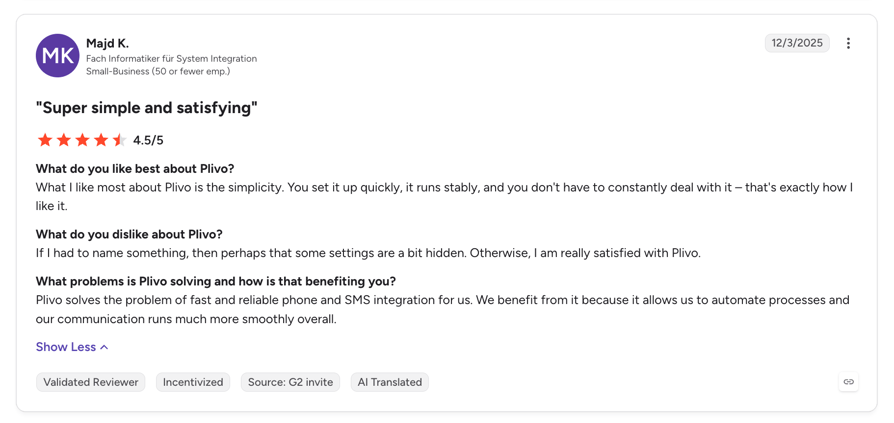
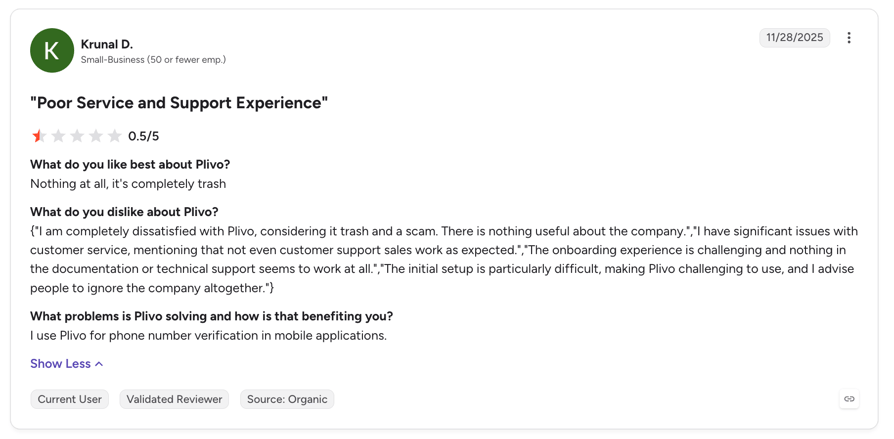
What Real Users Say About Plivo On G2
Positive Plivo user review:
Negative Plivo user review:
What Real Users Say About Twilio On G2
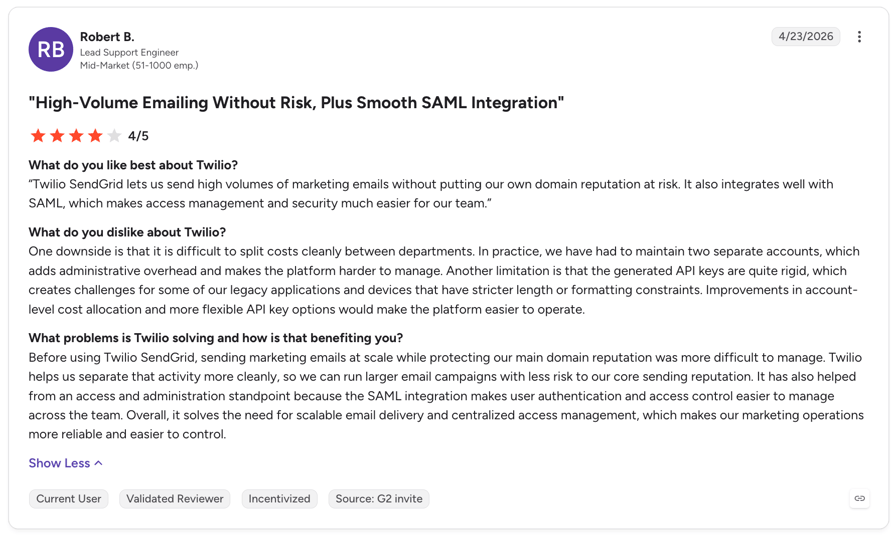
Positive Twilio user review:
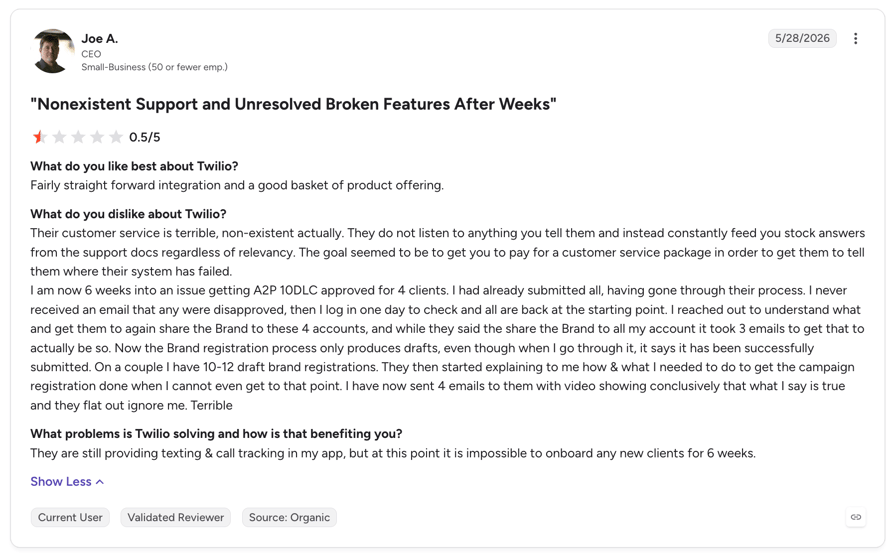
Negative Twilio user review:
Plivo vs. Twilio: Reddit & Quora
What Real Users Say About Plivo On Reddit & Quora
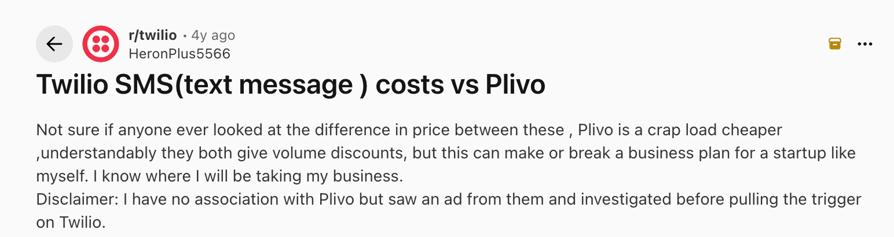
Reddit thread about Plivo:
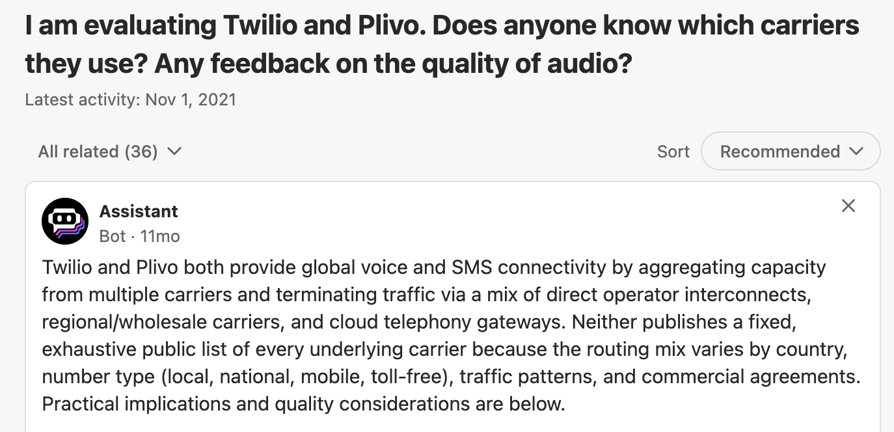
Quora discussion about Plivo:
What Real Users Say About Twilio On Reddit & Quora
Reddit thread about Twilio:
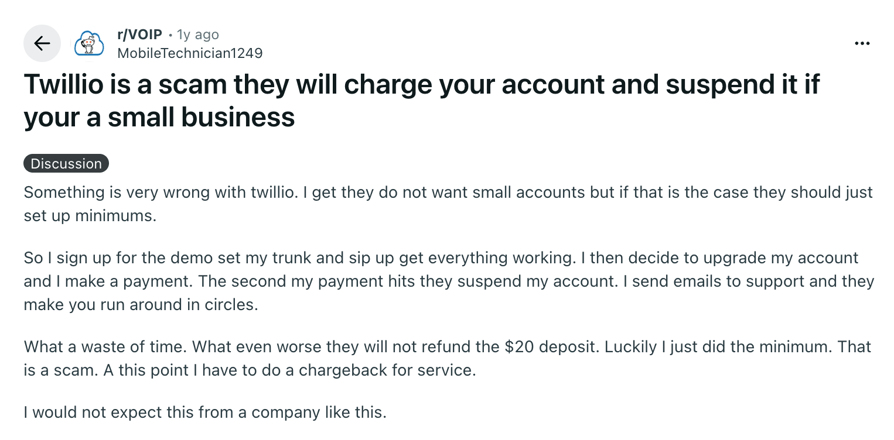
Quora discussion about Twilio:
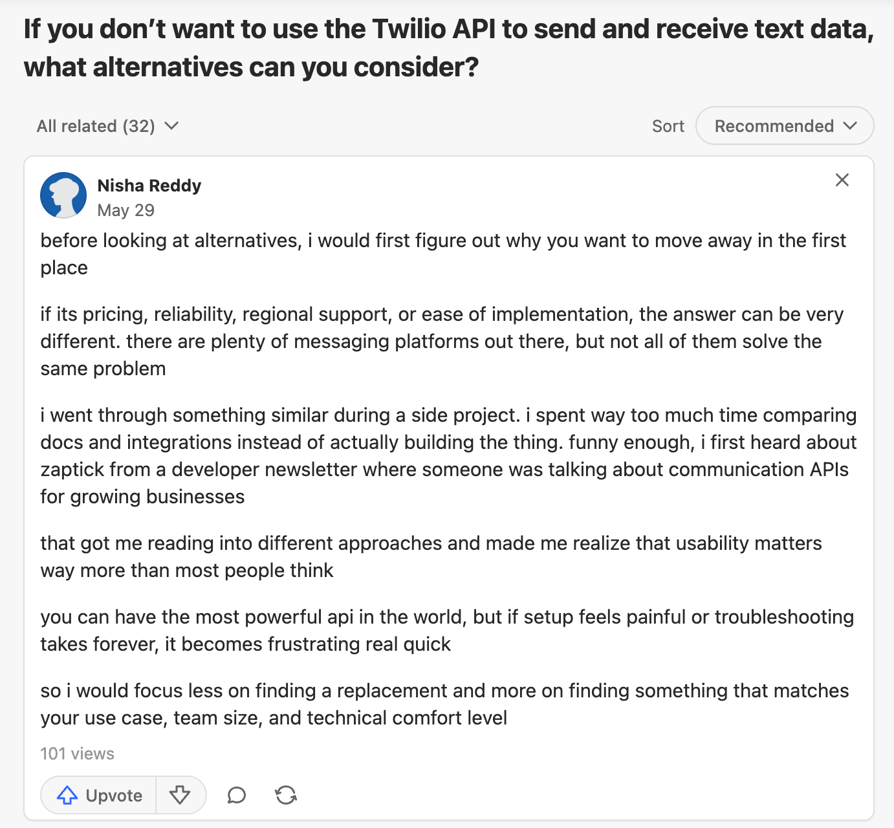
Plivo Pros & Cons vs. Twilio Pros & Cons
Plivo Pros & Cons
| Pros | Cons |
|---|---|
| Telephony from $0.0010/min outbound, the lowest published rate of the two | SMS, WhatsApp and Verify require the $1,000/month Enterprise plan |
| US long codes at $0.50/month, less than half Twilio's price | Self-serve coverage is limited to the US and India |
| Managed voice AI agent at $0.03/min with builder and testing included | Pay-as-you-go caps at $2,500 monthly usage, 2 RPS and 50 concurrent calls |
| 4.5/5 on G2 from 747 reviews, ahead of Twilio on ease and support | No video, email or customer data products if the roadmap needs them |
| Certifications listed publicly: SOC 2, GDPR, HIPAA, PCI DSS Level 1, CSA STAR | Smaller community, so fewer public answers for edge cases |
Twilio Pros & Cons
| Pros | Cons |
|---|---|
| Every product available pay-as-you-go with no plan gate or minimum spend | Higher per-unit rates on SMS, voice and numbers across the board |
| Widest channel catalog: RCS, WhatsApp, Apple Messages, video, SendGrid email | Add-ons stack: recording, storage, transcription, AMD and Voice Insights each bill separately |
| Verify from $0.05/verification and Lookup from $0.01/request as finished products | Lowest G2 scores of the two on ease of use and ease of setup |
| Global reach and numbers in 100+ locales from a trial account | Compliance documentation only via a request portal, which slows procurement |
| Deepest documentation, SDK coverage and public community in the category | Faster support requires a paid support plan |
...or solve your dilemma with CloudTalk.
Which Team Fits Which Platform?
Fit here depends on three things: your budget, how much of the ecosystem beyond core voice you actually need, and whether you want to build or buy. It does not depend on which platform is better, because on any given route both work.
| Plivo is the right fit for... | Twilio is the right fit for... |
|---|---|
| Cost-conscious teams building voice AI or SIP calling in the US or India | Teams that need international coverage today, without a sales cycle |
| High-volume messaging senders who clear the Enterprise threshold anyway | Teams that need Verify, 2FA or omnichannel messaging out of the box |
| Small dev teams that want a shorter ramp-up and a smaller API surface | Teams with engineering capacity to absorb the learning curve |
| Anyone running a large number inventory for local presence | Enterprises consolidating voice, messaging, email and customer data on one vendor |
| Vendor reviews that need certifications visible without a sales call | Products whose usage could spike unpredictably past any plan cap |
Plivo vs. Twilio: The Verdict
The Twilio vs. Plivo comparison comes down to budget and ecosystem breadth, not platform quality. Plivo is cheaper per unit and easier to learn, but its 2026 packaging puts messaging, verification and global coverage behind a $1,000/month floor. Twilio costs more per unit and takes longer to learn, but nothing is gated and nothing caps out.
Choose Plivo if you…
- Are building voice AI or SIP-based calling and want the lowest per-minute rate available
- Operate in the US or India and have no near-term plans beyond those markets
- Send enough US SMS volume that a $1,000/month plan pays for itself in unit savings
- Run hundreds of numbers and care about the $0.50 versus $1.15 monthly difference
- Have a small dev team and want a smaller API surface to learn and maintain
- Need certifications visible up front for a fast vendor security review
Choose Twilio if you…
- Need to send or call outside the US and India without negotiating a contract first
- Want Verify, 2FA or Lookup as products rather than something to build
- Need channels Plivo does not sell: video, email, Facebook Messenger, Apple Messages
- Cannot predict volume and refuse to hit a $2,500 monthly usage ceiling
- Value the deepest documentation and the largest public body of worked examples
- Are consolidating communications and customer data with a single vendor
Book a demo to see exactly how CloudTalk can elevate your business.
Frequently Asked Questions About Plivo vs Twilio
Per unit, yes: US SMS at $0.0077 against $0.0083, outbound SIP telephony at $0.0010/min against Twilio's $0.0140/min local rate, and numbers at $0.50 against $1.15. The catch is that Plivo's SMS sits on a $1,000/month Enterprise plan, so below that threshold Twilio is usually cheaper in total. See our full plivo vs twilio pricing 2026 breakdown for the line-by-line math.
Neither is universally better. Plivo wins on price and on ease of setup, and it is the stronger pick for US or India voice AI work. Twilio wins on coverage, channel breadth and the absence of any plan gate. If you want a working phone system rather than an API, a business phone system is a different purchase entirely.
Both run redundant carrier networks and neither publishes a headline uptime percentage. Plivo connects to at least two carriers per country with failover under two seconds; Twilio's Super Network adds backup zones and STIR/SHAKEN on 100% of calls. Test both on your own routes, and compare against a Twilio alternative that publishes a 99.999% uptime SLA.
Twilio has broader SDK language coverage, more worked samples and by far the larger community. Plivo has the smaller API surface, and G2 reviewers rate it higher on ease of use and ease of setup. Broad documentation helps at the edges; a smaller surface helps on day one. Neither removes the need for developers, unlike a no-code call flow designer.
Close, with two gaps. Plivo now offers SMS, WhatsApp and a Verify API for 2FA, but all three are Enterprise-plan features, whereas Twilio sells them self-serve. Plivo has no video or email product at all. For everything else, the two platforms overlap heavily. Our Plivo alternative guide covers what to do when a feature you need is gated.
Yes, and high volume is arguably the only case where Plivo's messaging pricing makes sense in 2026, since you need the Enterprise plan to send SMS at all. Plivo's own calculator puts 100,000 US messages per month at $528 against $790 on Twilio. Add carrier surcharges of $0.0035 to $0.0050 per message to both figures, and check how other providers compare at your volume.
Yes, and plenty of teams do: Plivo for cheap outbound telephony or high-volume SMS, Twilio for Verify, WhatsApp and international routes. Both support SIP trunking, and Twilio's BYOC lets you keep an existing carrier. The cost is two integrations, two bills and two failure modes to monitor. Number porting between them is possible but takes planning.
For a sales or support team that needs a working phone system, yes, because it is a different category. Plivo and Twilio are parts you assemble; CloudTalk arrives assembled, with numbers in 160+ countries, routing, 100+ integrations and AI Voice Agents from $25/user/month. If you are building voice into your own product, stay with a CPaaS.
Not universally. On the evidence here, Plivo is better on price, on ease of setup and for US or India voice AI work, while Twilio is better on coverage, channel breadth and the absence of any plan gate. G2 reviewers split the same way, rating Plivo higher on ease and support but preferring Twilio's roadmap. Whether Plivo is better than Twilio for you comes down to whether you value simplicity now or optionality later.
In raw CPaaS terms, the closest competitors are Plivo, Vonage, Sinch, Infobip, Bandwidth, MessageBird and Telnyx, all selling programmable voice and messaging APIs. But most teams searching for a Twilio competitor do not want another API, they want a working phone system. In that case the comparison set is contact center platforms instead, which is why the Twilio alternative shortlist usually looks nothing like the CPaaS one.
It depends what you are optimizing for. Plivo is cheaper per unit if you can live inside its plan structure, Telnyx and Bandwidth compete on messaging rates, and Vonage competes on video depth. If what you actually need is calling for a sales or support team rather than building blocks, a finished platform beats any CPaaS on time to value: see how CloudTalk compares as a Twilio alternative for business calling.
Yes by the usual enterprise measures. Plivo is SOC 2 certified with annual independent audits, PCI DSS Level 1 certified, GDPR compliant, an EU-US Data Privacy Framework participant, and CSA STAR Level 1 self-assessed. It encrypts data with AES-256 at rest and TLS 1.2 or greater in transit, and runs annual external penetration tests. HIPAA and HITECH coverage with a signed BAA is available, though only on the Enterprise plan, which matters if you need a HIPAA compliant call center.