8 Best Parallel Dialers for Outbound Sales Teams in 2026
SUMMARY:
CloudTalk is the best parallel dialer for teams that want multi-line dialing inside a full call center platform, while Orum and Nooks are the stronger picks for pure high-volume SDR floors.
The 8 best parallel dialers:
- 01CloudTalk: best overall parallel dialer with a full call center suite
- 02Nooks: best for a collaborative virtual sales floor
- 03Orum: best for maximizing live conversations at scale
- 04Apollo: best for combining prospecting data and parallel dialing
- 05Koncert: best for multi-mode AI dialing across a sales floor
- 06Klenty: best for multichannel outreach with a built-in dialer
- 07Salesfinity: best for anti-spam and contact enrichment
- 08Elto: best for fast human-pickup detection and Apollo users
For each one you'll find the real price, the line ceiling per agent, and where it falls short.

See what 10-line parallel dialing does to a real cold list
Book a walkthrough of CloudTalk's Parallel Dialer, voicemail detection and caller-ID tooling with someone who does this daily.

Best Parallel Dialer Software: Comparison Table
| Provider | Key Features | Best For | Max Lines | Starting Price | G2 Rating |
|---|---|---|---|---|---|
| CloudTalk | Parallel, power and smart dialers; AI voicemail detection; Branded Caller ID; 100+ integrations | Parallel dialing inside a full call center platform | 10 | $25/user/mo (Starter) + $39/user/mo Parallel Dialer add-on = $64/user/mo | 4.4/5 |
| Nooks | AI Dialer; Virtual Salesfloor; AI Sequencing; enrichment; AI coaching | Collaborative SDR floors with coaching built in | Not published | Quote-based | 4.8/5 |
| Orum | Parallel and power dialing; AI Detection; voicemail sequencer | High-volume teams of nine seats or more | 10 | Quote-based (nine-seat minimum) | 4.6/5 |
| Apollo (Apollo.io) | Parallel dialer sold as a separate add-on; 230M+ contacts; sequencing; enrichment | Prospecting data and dialing in one tool | Not published | $49/user/mo (Basic) + $119/team/mo Advanced Dialer add-on, billed annually | 4.7/5 |
| Koncert | Five dialer modes; Remote Salesfloor; DataGenie enrichment | Several dialing modes from one vendor | 4 (Symphony) / 5 (Symphony+) | Quote-based | 4.6/5 |
| Klenty | Parallel and power dialer add-on; multichannel sequencing; AI coaching | Email and calls from a single cadence | 5 | $70/user/mo (Growth) + $45/user/mo dialer add-on = $115/user/mo | 4.6/5 |
| Salesfinity | AI Parallel Dialer; Virtual Salesfloor; waterfall enrichment; open API | Layering AI dialing onto an existing stack | Not published | Quote-based | 4.8/5 |
| Elto | AI parallel dialing; millisecond pickup detection; Apollo.io sync | Small teams wanting a flat published price | 6 | $179/seat/mo | 4.9/5 |
Every price and line count above is the vendor's own published figure; where a cell carries a note instead of a number, the vendor doesn't disclose it. If you're still weighing dialing modes rather than vendors, our roundup of the best dialers for call centers covers the wider field.
Why Your Reps Are Already Out of Dialing Hours
According to Salesforce's 2026 State of Sales research1, a survey of more than 4,000 sales professionals, 48% of reps say they lack the bandwidth to do adequate cold outreach, even though they already spend close to a full day of every workweek prospecting.
That gap has a price tag. Every hour a rep spends listening to ring tones, voicemail greetings and dead numbers is an hour they're not talking to a buyer. The same Salesforce research found that nearly half of reps name cold calling as the worst part of their job, and that the average seller now spends only 40% of the week actually selling, dropping to 35% for Gen Z reps, who lose roughly two hours a week to manual data entry alone.
Most teams reach for headcount, or for one of the many dialers for cold calling that still ring one number at a time. Neither helps much. The constraint isn't how fast a rep can press dial; it's how many numbers ring out before anyone picks up. Buying a bolt-on dialer solves that arithmetic and creates a new problem when your numbers start getting flagged as spam.
A parallel dialer attacks the right variable: it rings several prospects at once per agent and hands the rep only the calls a human answered. Below are the 8 best parallel dialers, with the real cost and the line ceiling for each one.
Why Trust Our Software Reviews?
For nearly a decade, we've helped over 30,000+ professionals find and implement smarter business communication tools. We've reviewed 200+ software tools across industries, analyzed 5,500+ verified customer reviews from platforms like G2, Capterra, Trustpilot and TrustRadius, and drawn insights from real user discussions on Reddit and Quora.
In the past year alone, we published 1,000+ articles, each one written by humans for humans. Learn how we keep our content integrity and our software review methodology.
How We Chose the Best Parallel Dialer Software
We built this list from verified user reviews, vendor product documentation, live pricing pages and feature-by-feature comparisons, then cross-referenced what we found against user discussions on Reddit and Quora that formal reviews tend to miss.
The criteria that decided the ranking: maximum simultaneous lines per agent, answer-detection speed, caller-ID reputation tooling, onboarding speed, CRM integrations, pricing transparency including add-ons, support quality, and how the platform holds up as a team grows. Where a vendor wouldn't publish a number, we say so instead of guessing. We apply the same criteria across our dialer coverage, whether we're ranking power dialer providers or predictive dialers.
The 8 Best Parallel Dialers in 2026
The sales dialer market is wide, and narrowing it to parallel dialers still leaves plenty to choose from. These eight are the ones worth shortlisting.
1. CloudTalk: Best Overall Parallel Dialer with a Full Call Center Suite
What Is CloudTalk?
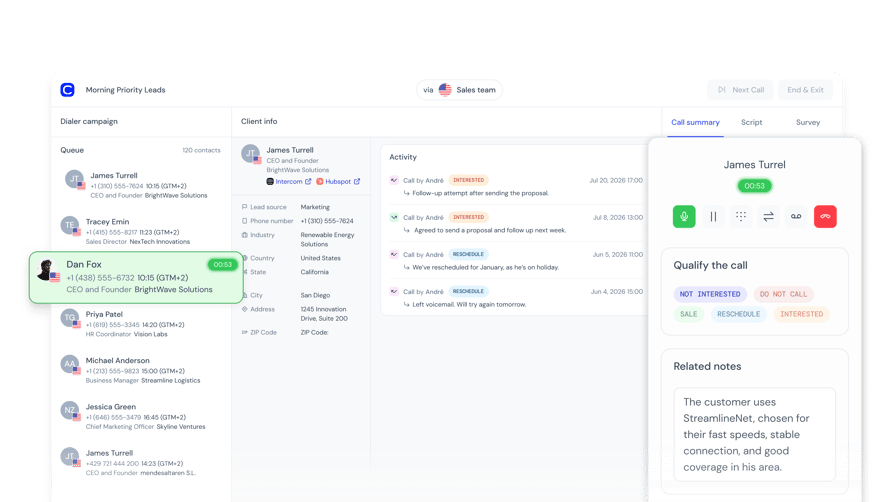
CloudTalk is the global AI business calling software built for SMB growth, combining a hosted VoIP call center software platform with an AI Sales Dialer that runs every outbound dialing mode. Unlike the standalone dialers in this list, parallel dialing sits alongside workflow automation, conversation intelligence and real-time analytics in one system. That means one contract and one pool of numbers instead of a dialer bolted onto someone else's phone system.
Key Features of CloudTalk
- Parallel Dialing with up to 10 lines per agent, connecting the first live answer with no delay
- AI voicemail detection at roughly 1.5s, which drops a pre-recorded voicemail or ends the call so agents only speak to humans
- Power Dialer and Smart Dialer for sequential and CRM-view-built call lists
- Branded Caller ID with carrier-verified registration via Hiya and Numeracle, plus Spam Remediation
- Workflow Automation and Conversation Intelligence AI, always a paid add-on rather than a plan inclusion
- Coverage in 160+ countries, a 99.999% uptime SLA and 24/7 support
What Is the Pricing of CloudTalk?
CloudTalk pricing starts at $25/user/month on Starter, with Essential at $29/user/month and Expert at $49/user/month. The Parallel Dialer is a $39/user/month add-on on every plan, including Expert, so a Starter seat with parallel dialing comes to $64/user/month. AI Conversation Intelligence is a separate add-on at $9/user/month, AI Voice Agents start at $99/month for 200 minutes, and Branded Caller ID is billed from $0.07 per call. CloudTalk offers a 14-day free trial, and no credit card is needed to start one.
What Are the Pros and Cons of CloudTalk?
| Pros | Cons |
|---|---|
| Parallel, power, smart and preview dialing in one platform, so the dialer is not a separate vendor | The Parallel Dialer is a paid add-on on every plan, including Expert, so the sticker price understates the real cost |
| 160+ international, local and toll-free numbers, with coverage in 160+ countries | AI Conversation Intelligence and AI Voice Agents are never bundled into a subscription plan |
| Caller-ID reputation tooling (Branded Caller ID via Hiya and Numeracle, plus Spam Remediation) that standalone dialers do not ship | Standard integrations and the API start on Essential, not Starter |
What Do Customers Say About CloudTalk?
CloudTalk holds a 4.4/5 rating on G2 from 1853+ verified reviews. There's no verbatim quote here yet, because we don't publish reviewer wording we haven't read in full. The score is the claim, not a hand-picked testimonial.
G2 rating: 4.4/5 (1853+ reviews)
2. Nooks: Best for a Collaborative Virtual Sales Floor
What Is Nooks?
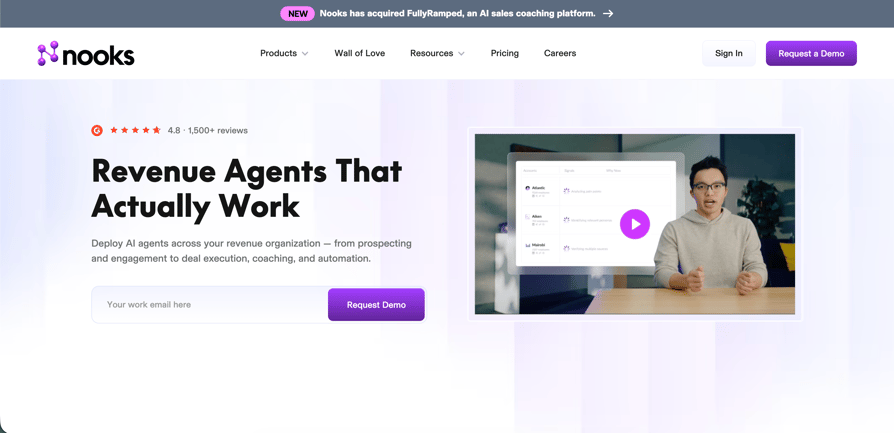
Nooks is an AI sales platform that sells itself on giving go-to-market teams an unfair pipeline advantage. Its AI Dialer handles parallel, multi-line and power dialing, while a Virtual Salesfloor keeps the whole team audible to each other during a calling block. It suits SDR floors that want coaching and momentum built into the dialing tool rather than bolted on afterwards.
Key Features of Nooks
- AI Dialer covering parallel, multi-line and power dialing
- AI Answer Detection, which Nooks describes as zero latency
- Virtual Salesfloor for live team listening
- AI Sequencing and Contact Data Enrichment with automatic number verification
- AI coaching, following Nooks' acquisition of the coaching platform FullyRamped
What Is the Pricing of Nooks?
Nooks pricing is quote-based. The pricing page is a lead form ("Get in touch with the team to get a custom quote") with no plan names, no published rates and no advertised free plan, so every evaluation starts with a sales conversation. If you need a figure before you book that call, a tool with published rates is the faster comparison; our roundup of AI cold calling software is a reasonable place to start.
What Are the Pros and Cons of Nooks?
| Pros | Cons |
|---|---|
| Parallel dialing, sequencing, enrichment and coaching in one platform rather than four | No public pricing at all |
| Virtual Salesfloor gives managers live visibility across the whole floor | Maximum parallel lines per agent are not published |
What Do Customers Say About Nooks?
Nooks carries one of the higher scores in this category, at 4.8/5 on G2 from 1,700+ reviews as published. That score is all we can verify independently, so treat it as a signal and ask a current Nooks customer what the Virtual Salesfloor is like on a slow day.
G2 rating: 4.8/5 (1,700+ reviews)
3. Orum: Best for Maximizing Live Conversations at Scale
What Is Orum?
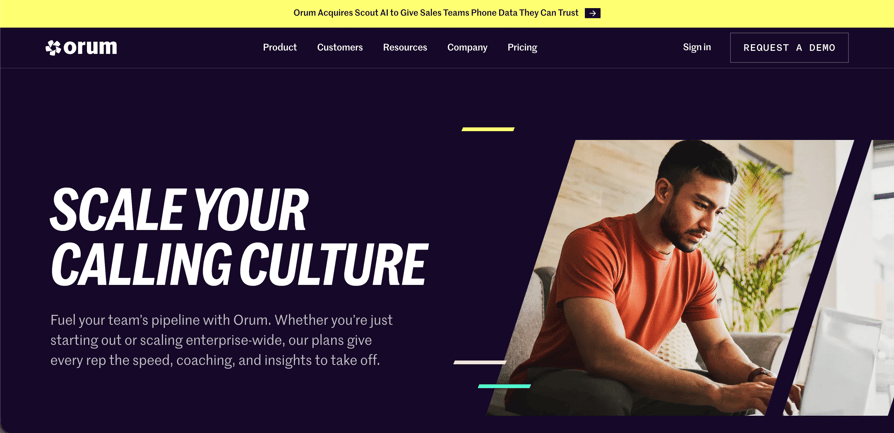
Orum is an AI dialing platform built around a single promise: scale your calling culture. Its parallel dialer runs up to 10 lines and uses AI detection to filter out voicemail, busy signals and disconnected numbers before a rep ever hears them. Orum is aimed squarely at established outbound teams, and its own pricing page sets a nine-seat minimum.
Key Features of Orum
- Parallel Dialer with up to 10 lines, plus power dialing and click-to-call included
- AI Detection for voicemail, busy signals and disconnected numbers
- Voicemail Drop and a Voicemail Sequencer, both included
- Up to 10 caller IDs per month for local presence, and international calling
- AI scorecards and on-demand AI roleplay for coaching
What Is the Pricing of Orum?
Orum pricing is quote-based; the pricing page shows a feature matrix and a "Request a demo" button with no numbers. Two details matter more than the missing price: Orum requires a minimum of nine seats, and the free trial is capped at 500 dials, which a busy SDR can burn through in a couple of days. Paid plans carry no dial limits.
What Are the Pros and Cons of Orum?
| Pros | Cons |
|---|---|
| Ten-line parallel dialing, power dialing, voicemail drop and international calling are included rather than sold as add-ons | The nine-seat minimum rules out small teams entirely |
| No dial caps on paid plans | No published pricing on any tier |
| AI detection filters voicemail and busy signals before the rep hears them | The free trial stops at 500 dials, under a week of real parallel dialing |
What Do Customers Say About Orum?
Orum's published score is 4.6/5 on G2 from 1,000+ reviews. We hold no verified reviewer quote, so the two things worth raising with a current customer are the ones Orum's own pricing page already concedes: the seat floor and the capped trial.
G2 rating: 4.6/5 (1,000+ reviews)
4. Apollo: Best for Combining Prospecting and Parallel Dialing
What Is Apollo?
Apollo.io is a sales intelligence and engagement platform whose pitch is to let you prospect with the data that actually connects. It pairs a contact database of 230M+ contacts and 30M+ companies with a parallel dialer, email sequencing and analytics, so reps can build a list and call it without an export step. The dialer itself splits in two: a base, credit-metered dialer on every paid plan, and parallel dialing behind a separate add-on. Apollo fits teams whose bottleneck is data quality as much as dial volume.
Key Features of Apollo
- Parallel dialer inside the same platform as the contact database, sold as a separate add-on rather than bundled into a plan
- Contact database of 230M+ contacts and 30M+ companies
- Email sequencing and multichannel engagement
- CRM integrations and data enrichment
- Lead scoring and an analytics dashboard
What Is the Pricing of Apollo?
Apollo pricing runs from a credit-limited Free plan at $0, to Basic at $49 per seat/month, Professional at $79 per seat/month, and Organization at $119 per seat/month (three-seat minimum). All three paid tiers are billed annually at those rates. Paid plans unlock unlimited sequences, CRM integrations and fuller access to the contact database, but none of them include parallel dialing: that sits behind a separate Advanced Dialer add-on at $119 per team/month, billed annually (or $149/month billed monthly), which also covers the Power Dialer, international dialing and local presence.
What Are the Pros and Cons of Apollo?
| Pros | Cons |
|---|---|
| Prospecting data and the dialer live in one tool, so there is no list export step | The dialer is one module in a broad platform rather than a specialist product |
| A genuine free tier, which almost nothing else in this line-up offers | Line counts and answer-detection specifics are not published, and parallel dialing isn't bundled into any plan (it's a separate per-team add-on) |
| Published per-seat pricing across all three paid tiers | Apollo describes its own parallel-dialer results as early access and self-reported |
What Do Customers Say About Apollo?
Apollo's published score is 4.7/5 on G2 from 9,800+ reviews, by far the largest base here, and it reflects the breadth of the platform rather than the dialer. Read it as a verdict on Apollo.io overall, then ask specifically about parallel dialing on a demo.
G2 rating: 4.7/5 (9,800+ reviews)
5. Koncert: Best for Multi-Mode AI Dialing Across a Sales Floor
What Is Koncert?
Koncert is a sales engagement platform whose pricing page leads with "pricing built for your AI dialing strategy". Rather than one dialing product, it ships five modes, from an AI Parallel Dialer to an agent-assisted dialer, plus a Remote Salesfloor that recreates a physical floor for distributed reps. It suits teams whose call lists vary enough that a single dialing mode would not cover them.
Key Features of Koncert
- Five dialer modes: AI Parallel Dialer, AI Flow Dialer, Agent-Assisted Dialer, Workflow Dialer and Click-to-Call
- Symphony (1 to 4 lines) and Symphony+ (1 to 5 lines) parallel-dialing tiers
- Remote Salesfloor, a virtual recreation of a physical sales floor
- Koncert Cadence for multichannel sequencing, plus Koncert Phone and an AI Voice Agent
- DataGenie waterfall enrichment that replaces bad records and fills missing details
What Is the Pricing of Koncert?
Koncert pricing is quote-based. Every tier shows a "Get Pricing" button and the page carries a "Contact us for pricing" section, so there is no published rate for Symphony, Symphony+ or the add-ons. With nothing to compare on price, most buyers line Koncert up against Koncert dialer alternatives while they wait for the quote.
What Are the Pros and Cons of Koncert?
| Pros | Cons |
|---|---|
| Five dialing modes let one vendor cover parallel, flow, agent-assisted and click-to-call use cases | A ceiling of four to five lines is the lowest here; CloudTalk and Orum both reach 10 |
| Built-in DataGenie enrichment tackles list quality at the source | No public pricing on any tier |
What Do Customers Say About Koncert?
Koncert appears in most parallel-dialer round-ups and in Google's AI Overview for the term. It now carries a published G2 score of 4.6/5 from roughly 420 reviews, though we hold nothing verified yet to quote on the five-dialing-modes question specifically.
G2 rating: 4.6/5 (420+ reviews)
6. Klenty: Best for Multichannel Outreach with a Built-In Dialer
What Is Klenty?
Klenty is a sales engagement platform that runs email, calls, LinkedIn and SMS from one cadence, with its dialer sold under the name Dial IQ. Reps can run parallel dials alongside automated email and follow-up steps without leaving the sequence. It works best for teams whose calls are one channel among several rather than the whole motion.
Key Features of Klenty
- Parallel and power dialing, sold together as a single add-on, published at up to 5 lines
- Multichannel sequencing across email, calls and follow-up cadences
- Cold-calling minute bundles per plan: 200 minutes on Growth, 1,000 on Plus
- An AI coaching stack with AI Battlecards, live transcription, objection detection and call scorecards
What Is the Pricing of Klenty?
Klenty pricing starts with Starter at $50 per month billed annually (note: per month, not per user), then Growth at $70 per user/month with 200 calling minutes, and Plus at $99 per user/month with 1,000 minutes. Parallel dialing is not included in any of them. The Parallel and Power Dialer is a $45 per user/month add-on, so parallel dialing on Growth actually costs $115 per user/month. Klenty offers a 14-day free trial with no credit card.
What Are the Pros and Cons of Klenty?
| Pros | Cons |
|---|---|
| A fully published price ladder across three tiers plus the dialer add-on, which is rare in this field | Parallel dialing costs an extra $45/user/month on top of any plan, taking the real entry price to $115/user/month |
| Calling minutes are bundled into the plan rather than metered separately | Starter does not include cold calling at all; calling starts on Growth |
| Calls sit inside the same cadence as email and LinkedIn steps | The published 5-line ceiling is lower than CloudTalk's or Orum's 10 |
What Do Customers Say About Klenty?
Klenty's published score is 4.6/5 on G2 from 390+ reviews, a modest base for a platform of its age. We have no verified reviewer wording for Klenty, so nothing here is presented as a customer voice.
G2 rating: 4.6/5 (390+ reviews)
7. Salesfinity: Best for Anti-Spam and Contact Enrichment
What Is Salesfinity?
Salesfinity calls itself the calling platform built for your revenue stack, and it means that literally: it's built to sit on top of the CRM and sequencer you already run rather than replace them. Its AI Parallel Dialer works alongside waterfall phone enrichment and number-health management, so the dialing and the data quality get handled together. It fits teams that like their current stack and only want the dialing layer fixed. If the CRM is the center of that stack, our roundup of the best CRM with dialer options is the better place to start.
Key Features of Salesfinity
- AI Parallel Dialer for live human conversations
- Virtual Salesfloor for team momentum and live listening
- Waterfall phone enrichment across 7+ data providers
- Nurture AI, which surfaces buying signals such as hiring and funding
- Anti-spam number registration, contact validation, an open API and an MCP server
What Is the Pricing of Salesfinity?
Salesfinity pricing is quote-based, and there is no pricing page at all; the /pricing URL redirects to the homepage. Salesfinity describes the commercial model as "start with a pod, prove it in 60 days, expand on your terms", and it offers a free trial.
What Are the Pros and Cons of Salesfinity?
| Pros | Cons |
|---|---|
| Built to layer onto an existing stack rather than replace it | No public pricing and no pricing page |
| Waterfall phone enrichment across 7+ providers addresses list quality at the source | Maximum parallel lines per agent are not published |
| Enterprise security posture: SOC 2 Type II, ISO 27001, GDPR and SSO | Smaller and newer than most of this field, so the review base is thin |
What Do Customers Say About Salesfinity?
Salesfinity's published score is 4.8/5 on G2 from 120+ reviews, a small enough sample that the average moves with a handful of new entries. The satisfaction figures on Salesfinity's own homepage are self-reported and we haven't verified them, and we have no verified reviewer wording to quote.
G2 rating: 4.8/5 (120+ reviews)
8. Elto: Best for Fast Human-Pickup Detection and Apollo Users
What Is Elto?
Elto is an AI parallel dialer that dials up to six prospects at once and detects a human pickup in milliseconds, patching the rep into the conversation before the prospect gives up. When it hits a voicemail it leaves the message after the beep, otherwise it disconnects. Elto is the natural pick for small teams and agencies running Apollo.io, thanks to a native two-way sync. Set against the broader field of best AI sales dialer software, it trades breadth for one job done fast.
Key Features of Elto
- AI parallel dialing with up to 6 simultaneous calls and human-pickup detection in milliseconds
- Automatic voicemail handling: leaves the voicemail after the beep, otherwise disconnects
- Native integrations with Apollo.io, Salesforce, Salesloft, Outreach, HubSpot and Gong
- Up to 10 outbound numbers (US and UK), with extras at $1/month each
- Call recording and transcription, time-zone filtering and dial-tree detection
What Is the Pricing of Elto?
Elto publishes its price openly, which is unusual in this category. The single "All-you-can-call" plan is $179 per seat/month with unlimited dials and up to six concurrent calls, billed monthly or yearly (yearly is advertised as 40% off). Elto offers 7 days free to start, and additional outbound numbers cost $1/month each.
What Are the Pros and Cons of Elto?
| Pros | Cons |
|---|---|
| The only provider here with a flat, fully published seat price and unlimited dials | Six concurrent calls is one of the lowest ceilings in this line-up |
| Native Apollo.io integration that syncs dispositions, analytics, sequences and lists | Outbound numbers are limited to the US and UK |
| A real 7-day free trial rather than a dial-capped demo | $179 per seat is a high flat rate for a single-function tool, with no lower tier |
What Do Customers Say About Elto?
Elto's published score is 4.9/5 on G2 from just 24 reviews. That's a genuinely thin sample, so read the near-perfect average as a signal about early adopters rather than a settled verdict. We have no verified reviewer wording to quote alongside it.
G2 rating: 4.9/5 (24 reviews)
Put a parallel dialer in front of your own cold list
Run 10 lines per agent against a list you already have and count the live conversations that come back. No credit card required.
What Is a Parallel Dialer?
A parallel dialer is outbound calling software that rings several numbers at the same time for each agent and connects that agent to whoever answers first, canceling the remaining attempts. It exists to strip the waiting out of cold calling, so a rep's headset only opens when someone actually picks up. For the mechanics in full, including how it differs from other auto-dialers, read our explainer on what a parallel dialer is.
How Does a Parallel Dialer Work?
Three things happen on every parallel dial, fast enough that the rep experiences one continuous stream of conversations.
Step 1: The Dialer Places Several Calls at Once
The system takes the next batch of contacts and dials them simultaneously for one agent, anywhere from three to 10 numbers depending on the platform and configuration. That is why the category is also sold as a multi-line dialer. The agent hears none of it.
Step 2: AI Answer Detection Screens Out Voicemail, IVR and Busy Signals
CloudTalk checks every ringing line for what actually picked up, so voicemail greetings, IVR trees, busy signals and disconnected numbers never reach the rep. CloudTalk's voicemail detection lands at roughly 1.5 seconds and either drops a pre-recorded voicemail or ends the call and reschedules the contact.
Step 3: The First Live Answer Reaches the Rep, and the Rest Are Re-Queued
The first human answer is patched straight to the agent. In CloudTalk, the canceled calls are dropped, logged as missed against those prospects and automatically redialed at the end of the queue, so nobody falls off the list. If two prospects pick up at the same moment, the second call is ended and rescheduled rather than dumped into silence.
How Many Lines Can a Parallel Dialer Run at Once?
Line ceilings are the most under-published spec in this market, and they matter more than the price. CloudTalk and Orum both run up to 10 lines per agent, Elto caps at six, Klenty publishes up to five, and Koncert runs one to four lines on Symphony and one to five on Symphony+. Nooks, Apollo and Salesfinity don't publish a figure, so ask for it in writing before you sign.
More lines aren't automatically better. Every extra line raises the odds of two simultaneous pickups and of your numbers attracting carrier attention, so the detection quality behind the lines matters as much as the count.
Parallel Dialer vs Power Dialer vs Predictive Dialer
The three modes get used interchangeably in sales copy, and they behave nothing alike.
| Dialer type | How it dials | Best for | Watch out for |
|---|---|---|---|
| Parallel dialer | Rings several numbers at once for one agent and connects the first live answer | Cold lists with low pickup rates, where waiting is the bottleneck | Caller-ID reputation and the answer delay when detection is slow |
| Power dialer | Dials one number at a time per agent and starts the next call when the previous one ends | Warm lists, smaller teams, and calls that need preparation | Reps still absorb every ring-out and voicemail themselves |
| Predictive dialer | Paces dialing across the whole team using answer-rate forecasts and agent availability | Large floors with consistent staffing and steady volume | Abandoned calls when the algorithm over-dials the available agents |
If you are choosing between the first two, our parallel dialer vs power dialer breakdown goes deeper on the trade-off, and parallel dialer vs predictive dialer covers the pacing question.
Benefits of Using Parallel Dialer Software
Parallel dialing changes what a calling block feels like for a rep, and it changes what a manager can plan around. Five effects show up on the floor within the first month.
Increased Agent Talk Time
Talk time is the number every outbound manager watches, and parallel dialing moves it by removing the waiting rather than by pushing reps harder. With 10 lines running per agent and voicemail screened out before it reaches anyone, a rep spends the shift talking instead of listening to ring-outs. The dead time between conversations shrinks to whatever the wrap-up takes.
More Live Conversations per Shift Without Adding Headcount
The same roster covers more of the list, because the constraint moves from dial capacity to conversation capacity. That matters most when hiring is frozen or a territory needs coverage before the next headcount cycle.
Faster Ramp Time for New Reps
New hires get to their tenth real conversation in hours instead of days, so objection handling gets practiced while the training is fresh. Managers listening in on a virtual floor can correct a bad opener the same morning it appears.
Lower Infrastructure Cost Than an On-Premise PBX
Traditional PBX hardware is expensive to buy and maintain, and it ties calling capacity to a building. A cloud-based dialer for sales teams shifts that to the provider, which makes 10 concurrent lines per agent a configuration setting rather than a procurement project.
Cleaner CRM Data and Less Manual Call Logging
Every attempt, disposition and outcome writes back automatically, including the calls canceled mid-ring. Reps stop retyping notes, and the pipeline reflects what happened on the phones rather than what someone remembered to log.
What Are the Risks and Drawbacks of Parallel Dialing?
Vendors rarely publish this part. Parallel dialing multiplies whatever you point it at, and that includes your mistakes.
Dead Air: Why Prospects Hang Up Before the Rep Says Hello
The gap between a prospect saying "hello" and a rep being connected is where parallel dialing loses deals. Slow answer detection creates a second or two of silence, and to the person holding the phone that silence reads as a robocall. They hang up before your rep speaks.
Detection speed is the fix. CloudTalk's detection resolves in roughly 1.5 seconds and hands the rep a live line rather than a decision to make, which is why that spec deserves more scrutiny than the line count.
How Parallel Dialing Puts Your Numbers on Carrier Spam Lists
Dial 10 numbers at once from one caller ID and carriers see a pattern that looks exactly like the traffic they're paid to block. Once a number gets labeled, answer rates fall for every rep using it, and the damage follows the number rather than the campaign.
Number rotation helps, but it isn't a strategy on its own. CloudTalk registers outbound identities through Branded Caller ID with carrier verification via Hiya and Numeracle, from $0.07 per call, plus spam protection and remediation for numbers already flagged. Salesfinity and Koncert take a data-side approach instead, validating numbers before they get dialed.
Can More Dials Fix a Bad Contact List?
No. A parallel dialer pointed at stale data burns through that data faster and produces the same nothing, only sooner. Wrong-number rates climb with list age, and each dead record still costs a dial and a fraction of your number's reputation.
Enrichment is the counterweight. Salesfinity runs waterfall phone enrichment before the dial, Koncert's DataGenie replaces bad records outright, and Apollo keeps the dialer next to a 230M+ contact database, so lists get rebuilt rather than recycled.
What TCPA, DNC and Consent Rules Still Require of You
Automating the dialing doesn't automate the compliance. According to the Federal Trade Commission's National Do Not Call Registry Data Book for Fiscal Year 20252, the registry held about 258.5 million active registrations as of 30 September 2025, after more than 4.7 million numbers were added during the year. That's the list your dialer has to respect on every attempt.
The same FTC data book reports that unwanted-call complaints remain roughly 48% below their FY 2021 peak of about five million, though they rose again in FY 2025. So scrutiny isn't going away. Whatever tool you pick needs DNC scrubbing, consent tracking, GDPR handling for EU contacts and call-recording consent built in rather than bolted on. Our guide to autodialer laws covers what applies where.
How Do I Choose the Right Parallel Dialer for My Business?
Price is the easiest thing to compare and the least useful. These five questions separate the tools that will still fit in a year from the ones that won't.
Which Parallel Dialer Scales Best for High-Volume Outbound Campaigns?
For a floor of 10 or more reps running cold lists all day, Orum and CloudTalk scale best, because both run up to 10 lines per agent and neither caps dials on paid plans. Orum's nine-seat minimum is a non-issue at that size and becomes a hard blocker below it. CloudTalk scales the same dialing capacity without a seat floor, so a five-rep team can run the identical configuration.
Below five seats, Elto's flat $179 per seat with unlimited dials is simpler to reason about, and its six-line ceiling is rarely the binding constraint at that volume. Koncert's four to five lines sits at the wrong end of this spectrum for genuinely high-volume work.
Scaling isn't only about lines. According to Salesforce's 2026 State of Sales research1, 55% of sales professionals already use AI for prospecting and another 38% plan to. The same research found top performers are 1.7x more likely than underperformers to use prospecting AI agents. The dialer that scales is the one whose AI features your reps will actually turn on.
Do You Need a Standalone Dialer or a Full Phone System?
If your team only makes outbound cold calls and someone else owns the phone system, a specialist dialer is the cleaner buy. If that same team also takes inbound calls and needs IVR and routing, a standalone dialer leaves you managing two telephony contracts and two sets of numbers.
How Does It Protect Your Caller ID Reputation?
Ask what happens after a number gets flagged, not only how the tool avoids it. Number rotation, carrier registration, STIR/SHAKEN signing and a remediation path are four separate things, and most dialers here ship one or two. A local presence dialer on its own gives you no route back from a number that's already flagged, so make each vendor say which of the four they actually own. CloudTalk ships all four, including Spam Remediation for numbers that are already labeled.
What Will It Actually Cost per Rep per Month?
Run the add-on math before you compare anything. CloudTalk's Starter seat is $25/user/month and the Parallel Dialer add-on is $39/user/month on every plan, so parallel dialing costs $64/user/month. Klenty's Growth seat is $70/user/month and its Parallel and Power Dialer add-on is $45/user/month, so the real figure is $115/user/month. Apollo's Basic seat is $49/user/month, but parallel dialing isn't included at all; it needs a separate, team-billed Advanced Dialer add-on, currently $119/month. Elto is $179 per seat flat. Nooks, Orum, Koncert and Salesfinity won't tell you until you talk to sales, and Orum won't talk below nine seats. Run the same arithmetic for your own seat count against CloudTalk's sales dialer pricing before you shortlist anyone.
Which CRM and Sales-Stack Integrations Do You Need?
The dialer has to write back to wherever your pipeline lives, or your reps keep logging calls by hand and you've bought a faster way to create data debt. Check that dispositions, recordings and outcomes sync both ways, not just that a logo appears on an integrations page. If HubSpot is your system of record, our guide to running a parallel dialer with HubSpot covers what a real two-way sync needs.
What Are the Key Features to Look for in Parallel Dialer Software?
Parallel dialing on its own is a dialing mode. These are the features that decide whether it produces conversations or just noise:
- AI answer detection: the speed and accuracy with which the platform separates a human "hello" from a voicemail greeting, an IVR tree or a busy tone. Sub-two-second detection is the bar.
- Local presence and caller-ID management: rotating outbound identities, carrier registration and a documented path for numbers that get flagged.
- Call Recording: automatically record and access your agents' calls directly from your browser.
- Call Transcription: automatically transcribe calls in multiple languages and get insights on what was said.
- Campaigns: create custom campaigns to help agents structure their calls with notes, scripts and questionnaires.
- Topic Extraction: extract recurring topics from calls and adjust your scripts on the fly.
- Sentiment Analysis: follow a prospect's sentiment shifts during a call and get immediate feedback.
- Analytics: get a full view of what happens across your team and keep control of its performance.
- CRM disposition sync: two-way writeback of dispositions, recordings and outcomes, including the attempts the dialer canceled.
CloudTalk: An Unparalleled Dialing Experience
The best parallel dialer for you depends on your list, your team size and who owns your phone system. But the pattern across this comparison is hard to miss: the vendors that do nothing but dialing tend to have holes elsewhere, whether that's a nine-seat floor or no answer for a number that's already been flagged.
CloudTalk's parallel dialer runs 10 lines per agent and screens out voicemail in roughly 1.5 seconds, and it sits inside a platform that also handles your inbound calls, your numbers in 160+ countries and your analytics. Point it at sales or at support; either way it's one vendor and one bill.
Customer story: Integrity360 tripled SDR pickup rates with CloudTalk.
One vendor for your outbound dialing and your inbound calls
Bring your line-count and caller-ID questions. We'll show you how CloudTalk's Parallel Dialer handles both.
Sources
Frequently asked questions
A parallel dialer places several calls at once for one agent, then drops the rep into whichever call a human answers. The rest are canceled and re-queued. It's the highest-volume mode of outbound dialer for cold lists.
CloudTalk is the best parallel dialer software for this, at 10 lines per agent with voicemail detection in about 1.5 seconds. It also runs your inbound calls as a call center dialer. Orum matches 10 lines but needs nine seats.
Most cap between four and 10 lines per agent: CloudTalk and Orum reach 10, Elto six, Klenty five, Koncert four to five. Your plan's concurrent calls limit matters too, and Nooks, Apollo and Salesfinity publish no figure.
A power dialer dials one number at a time per agent; a parallel dialer rings several at once and connects the first answer. Cold lists suit parallel, warm lists suit a power dialer.
Auto-dialers are legal in the US but heavily regulated. TCPA rules, consent requirements and the national Do Not Call list apply to every attempt, so pick a TCPA-compliant dialer with DNC scrubbing built in.
Parallel dialers can. Ten simultaneous calls from one caller ID look like the traffic carriers block, and a phone number showing as spam drags answer rates down for every rep. Carrier registration is the fix.
Elto is the best parallel dialer for Apollo.io users, with a native two-way sync at $179 per seat/month. Apollo's own dialer is the fallback, and CloudTalk fits teams that want dialing wired into the rest of their integrations.