TL;DR
- What it is: Ruby is a human-only virtual receptionist service, founded in 2003 in Portland, Oregon. US-based receptionists answer your phone, and you're billed by the minute.
- Overall rating: 4/5: a genuinely strong human answering service; whether it's worth it comes down to the per-minute math at your call volume.
- Pricing: From $250/month for 50 minutes to $1,725/month for 500, verified on ruby.com on 24 August 2026. No free tier and no trial: a money-back guarantee that ends at 21 days or 500 receptionist minutes, whichever comes sooner.
- Best for: Law firms, healthcare practices, and high-touch services that need human judgment on sensitive calls and will pay a premium for it.
- Not good for: High-volume or budget-conscious teams: per-minute human pricing with 60-second rounding and an unpublished overage rate scales against you.
- Standout pro: Genuine human warmth and judgment on complex, high-stakes calls: the thing AI still can't fully replicate.
- Standout con: The cost trajectory: premium per-minute rates, overage charges, and documented rate changes.
- User sentiment: Positive, with an average rating of 4.6/5 on Trustpilot from 800+ reviews.
- Verdict: If what you're actually replacing is voicemail and missed calls, an AI receptionist covers the same volume at a flat, predictable cost: that's where CloudTalk's AI Voice Agents fit.
Introduction
According to the U.S. Bureau of Labor Statistics' May 2025 Occupational Employment and Wage Statistics, the mean annual wage for receptionists and information clerks in the United States is $39,460. The same agency's Employer Costs for Employee Compensation series puts benefits at 31.6% of total compensation as of the first quarter of 2026, landing a full-time hire near $57,700 all in.
So most small businesses skip the hire. Then calls go to voicemail at 5:01pm, on Saturdays, and whenever two lines ring at once, and each one is a prospect who dialled a competitor before you played the message back.
Voicemail doesn't fix that, because people stopped leaving messages, and an IVR menu just puts a maze in front of the caller you wanted to catch. Ruby answers with a trained person and charges per minute. AI call answering takes the same calls at a flat rate, which is the other half of this decision.
This Ruby receptionist review is built on what Ruby publishes, and on where its own documentation stops agreeing with itself. Over the last decade, we helped 30,000+ professionals find and implement smarter business communication tools, under a published content integrity statement.

See what happens to the calls nobody picks up

Ruby Receptionist Scorecard: Our Honest Ratings
The ratings below are based on Ruby's own documentation and pricing pages. Review-platform sentiment (Trustpilot, ConsumerAffairs, G2, Capterra) is reported separately in the reviews sections.
| Dimension | Rating | Why |
|---|---|---|
| Ease of setup | 4/5 | No-code onboarding with a dedicated specialist; most businesses are live within days. The real investment is training humans on your business, not configuring software. |
| Call quality & human judgment | 4.5/5 | Trained receptionists handle nuance, tone, and judgment calls that AI still can't fully match. Quality tracks the context you provide during onboarding. |
| Pricing clarity | 3/5 | The tier card is published, but 60-second rounding, an unpublished overage rate, and documented rate changes complicate long-term budgeting. |
| Features & capabilities | 4/5 | Scheduling, payments, routing, screening, and transcripts come with every plan, with no per-feature fees. |
| Integrations | 3.5/5 | Deep legal practice-management coverage (Clio, MyCase, Filevine) plus Salesforce and HubSpot; thinner outside those categories. |
| Support & reputation | 4.5/5 | In business since 2003, Portland-based, with brand recognition most answering services never reach. |
See what an AI phone agent costs before you talk to a salesperson.
What Is Ruby Receptionist?
Ruby is a virtual receptionist service that started in 2003 as a four-person business in Portland, Oregon, and now runs on remote employees across 13 states, trading as Ruby Receptionists, Inc. Its receptionists are US-based and complete 120 hours of training in empathetic service, conflict resolution, and active listening before handling a customer call. The positioning is deliberately human-first: Ruby says openly that it won't use AI to replace human connections.
One limit to know upfront: coverage
Ruby serves the United States, Canada, and the US Caribbean only, and extra fees may apply for transfers outside North America.
Is Ruby an AI Receptionist?
No. Ruby is a human receptionist service with AI assisting the humans, the reverse of how AI receptionist products work. If you searched "ruby ai receptionist" expecting an AI voice agent, this is what Ruby ships. All of it is included in every plan at no extra cost, and all of it is opt-in.
| Ruby AI feature | What it does |
|---|---|
| Call Nav | An LLM assistant for the receptionist, not the caller. It pulls answers from a database built for your business in real time, "built from only data you provide and used exclusively by our receptionists." |
| Call and voicemail transcripts | Verbatim AI-generated transcripts of every call and voicemail. |
| Sentiment analysis | AI-quantified caller sentiment in the Ruby app and portal. |
| Advanced robocall filtering | AI spam and robocall filters. |
Who Ruby Receptionist Is Best Suited For
Ruby fits businesses where the person answering has to exercise judgment and a missed call costs more than a minute of receptionist time. That means healthcare practices needing HIPAA-compliant virtual reception, law firms qualifying sensitive inquiries, and small businesses with no reception staff.
It also fits anyone whose callers dislike automation. Pew Research Center's September 2025 study of AI in Americans' lives found 62% of US adults interact with AI at least several times a week, yet 27% would not let AI assist with their daily activities at all. If your clients sit in that 27%, a human voice isn't a preference.
Covered by a person during the day. Covered, full stop, after hours.
How Does Ruby Receptionist Work?
Ruby's virtual receptionist service works like an outsourced front desk: your calls are forwarded to Ruby, a trained person answers with your greeting, and you're billed for the minutes they spend.
Live Human Receptionists, Not AI
A call reaches your Ruby number or forwards from your existing line. Ruby documents the flow in its own FAQ:
- 01A US-based receptionist answers with your custom greeting.
- 02The receptionist screens the caller against your criteria.
- 03The caller waits on a brief hold while Ruby reaches you.
- 04You accept the transfer, or Ruby takes a voicemail or a written message.
- 05Messages land in the Ruby app and the my.call-ruby.com portal, with email and text delivery optional.
Onboarding & Training
- A Ruby account specialist learns your business, call types, and customers; Ruby then assigns and trains receptionists and configures routing. You take a Ruby number in the area code of your choice, subject to availability, or Ruby hosts or ports your existing number at no charge. Plan for real hours of briefing, because quality tracks the context you hand over. The contract runs in 30-day terms that renew automatically, so there's no annual lock-in.
Escalation for Specialized Inquiries: What Happens at the Handoff?
- Ruby has no handoff gap on ordinary questions, because a person answered first. Nobody repeats themselves to a second party, and once the call transfers to you or your voicemail, the meter stops. The wall is specialist knowledge: a receptionist briefed on your greeting and FAQ list won't diagnose a fault or argue a point of law, so those calls come through to your team on whatever call routing rules you set.
What Are the Key Features of Ruby Receptionist?
Ruby receptionist services put the same core feature set in every plan, from bilingual answering and screening to payments, scheduling, and transcripts.
Highly-Trained Human Receptionists (Core Differentiator)
- The training is the product. Ruby's receptionists handle tone, hesitation, and the caller who is upset before explaining why, and they make small judgment calls on your behalf.
Bilingual Support: Is Ruby's Spanish Service 24/7?
- Optional Spanish bilingual service comes with every receptionist account at no extra cost, which isn't a given among bilingual virtual receptionist providers. The hours are the problem, because Ruby states them two ways on its own site. Its pricing page and its Spanish-service FAQ both promise "24/7 Spanish and bilingual call handling." Two other FAQ answers say bilingual service and outbound call assists are "only available Monday to Friday, 5am to 6pm Pacific / 8am to 9pm Eastern."
Smart Call Routing & Screening
- Calls are screened against your criteria before reaching you, so you decide who gets put through, who gets a message taken, and who gets filtered. Ruby's AI robocall filtering runs underneath, keeping solicitation calls off your desk and out of your minute allowance.
Payment Processing & Lead Qualification
- Ruby offers PCI-compliant service on request for customers who want receptionists to collect sensitive information during intake or take payment. Receptionists enter card details into your existing payment system or payment link, which Ruby reviews first, so Ruby never holds your payment stack.
Appointment Scheduling with Calendar Integration
- Ruby books into Calendly and Google Calendar and supports 20+ other scheduling tools, with receptionists checking real availability during the call. That's the same job AI virtual receptionists for appointment scheduling do, minus the person. One conflict nobody else reports: with HIPAA-compliant service, Ruby can't schedule through Calendly, because Calendly isn't HIPAA compliant.
Call Logging, Transcription & HIPAA Compliance
- Every call and voicemail is transcribed, and messages and call details land in the app and portal with notifications. That searchable trail is what buyers are really probing when they ask about call quality: proof that every message was captured and actioned. HIPAA-compliant service is opt-in, needs a signed Business Associate Agreement, and carries no extra charge.
Integrations Ecosystem
- Ruby names native integrations with Clio and Grasshopper plus a Zapier layer it markets as 5,000+ integrations.
| Category | Named integrations |
|---|---|
| Legal / practice management | Clio, MyCase, Filevine, Law Ruler, Lawmatics, Rocket Matter |
| CRM | Salesforce, HubSpot, Keap, Zoho, Follow Up Boss, JobNimbus |
| Scheduling / calendar | Calendly, Google Calendar, plus 20+ other scheduling tools |
| Field service | FieldPulse, JobNimbus |
| Communication / collaboration | Microsoft Teams, Slack, Monday.com |
| Customer service | Zendesk |
| Telephony | Google Voice (port or forward at no extra cost), Grasshopper, Nextiva |
| Forms | Google Forms |
| Automation | Zapier |
Ruby Receptionist Pricing Breakdown
Ruby receptionist pricing runs from $250/month for 50 minutes to $1,725/month for 500 minutes, as of August 2026. The date stamp matters: most published reviews still quote the older $235 / $375 / $680 / $1,640 card, so if a figure looks familiar and cheap, check when it was written. Against the wider range of how much a virtual receptionist costs, Ruby sits at the premium end.
How Much Does Ruby Receptionist Cost? Plans and What's Included
| Minutes per month | Price | Ruby's own label |
|---|---|---|
| 50 | $250 / month | Great for startups |
| 100 | $395 / month | Great for one-person businesses |
| 200 | $720 / month | Most popular, small businesses of all kinds |
| 500 | $1,725 / month | Great for larger and growing businesses |
All four tiers include the same core service, with no activation, onboarding, setup, or customization fees.
How Ruby Counts a Receptionist Minute
This determines your bill, and Ruby documents it in its own FAQ:
- Minutes bill in 60-second increments, rounded up. Ruby's example: "if a call is ten seconds long, it will be billed as 60 seconds."
- Inbound time starts when the receptionist receives the call and includes hold time.
- Billed time includes any time a receptionist spends completing information on your call after the caller has hung up.
- Once the call transfers to you or your voicemail the meter stops, so your own talk time is free.
- Outbound minutes cover the specialist's call plus the time spent emailing you the result.
The Real Cost: Overages, Surcharges, and Rate Changes
- Ruby's answer on overage is that "additional minutes are billed according to the overage rate associated with your plan," and the rate is published nowhere. Third-party estimates circulate, but none traces back to Ruby, so ask for your tier's rate in writing.
- Three more items sit in the terms rather than the price card. Credit-card payments carry a 3.0% surcharge that debit, ACH, and check payments avoid, roughly $22 a month on the 200-minute plan. Base fees bill in advance and are non-refundable, with no credit for partially used periods, and overage bills in arrears, around the first business day after each billing period.
- On rate changes, stick to what's knowable. Ruby's Terms of Use reserve the right to "adjust pricing for our Services or any components thereof in any manner and at any time." And the card has demonstrably moved. The $235 / $375 / $680 / $1,640 tiers most articles still quote are now $250 / $395 / $720 / $1,725. Budget on the assumption the number can change, and re-check before renewal.
Estimate Your Minutes Before You Pick a Tier
- Almost nobody knows their call volume when they start shopping, which is why the entry tier so often turns out to be the wrong buy. Pull two numbers from your carrier logs first: how many calls went unanswered last month, and how many arrived outside business hours. Then convert calls into billing units rather than talk time, at one minute minimum per call plus hold and wrap-up. A business fielding 80 short after-hours calls sits closer to the 100-minute tier than the 50, even if talk time totals 25 minutes.
What to Ask Ruby Before You Sign
Six questions, all of them things Ruby's public documentation leaves open:
- 01What's the overage rate on my plan, in writing?
- 02Is bilingual service 24/7 on my account, or Monday to Friday, 5am to 6pm Pacific?
- 03How long are transcripts and recordings retained, and can transcription be switched off?
- 04Does HIPAA service break my scheduling tool or stop messages being emailed to me?
- 05Does my money-back window end at 21 days or at 500 minutes?
- 06Which payment methods avoid the 3.0% credit-card surcharge?
Is Ruby Receptionist Free? Trial Details
- No. There's no free tier and no trial. Ruby offers a money-back guarantee instead, and the wording matters: cancel for a full refund by notifying Ruby either within 21 days of purchase or before usage exceeds 500 receptionist minutes or 50 billable chats, "whichever occurs sooner."
Know exactly how much you'll pay before committing.
What Do Real Users Say About Ruby Receptionist?
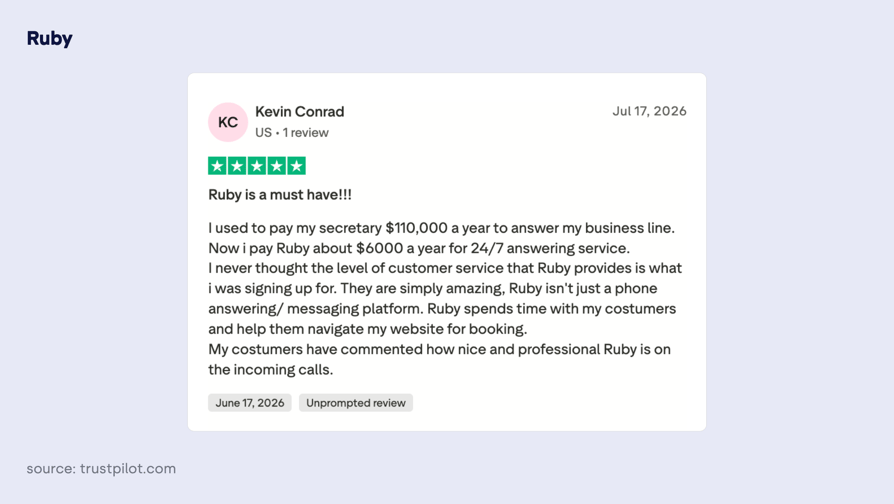
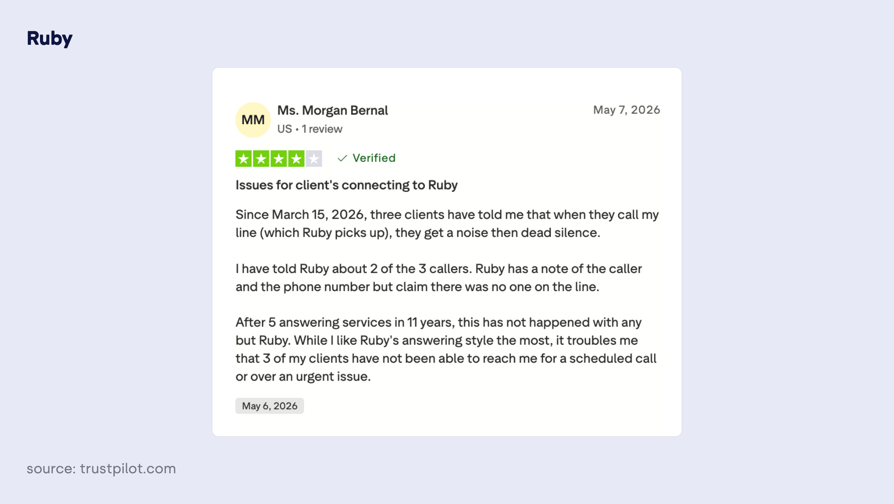
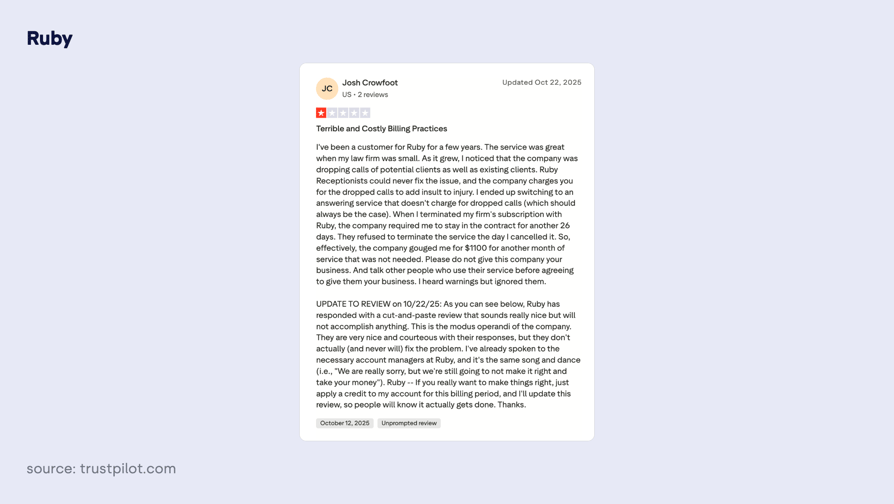
Here are some of the latest Ruby reviews on Trustpilot, so you can see multiple opinions from multiple people:
A 5-Star Review:
A 4-Star Review:
A 1-Star Review:
Ruby Receptionist User Ratings & Reviews
| Platform | Rating (votes) |
|---|---|
| Trustpilot | 4.6 rating / 800+ reviews |
| ConsumerAffairs | 2.0 rating / 20+ reviews |
| G2 | 3.8 rating / 10+ reviews |
| Capterra | 3.9 rating / 10+ reviews |
Measure a month of your real call volume first.
Ruby Receptionist Review on 6 Must-Have Business Requirements
Feature lists don't decide whether an answering service works for you; these six requirements do. Here's how Ruby measures up on each.
Call Quality & Human Judgment
- This is Ruby's strongest ground. A trained person reads frustration, adjusts tone, and makes judgment calls mid-conversation, and that's exactly what buyers pay the premium for. The fairer test, though, is traceability: whether every message is captured, logged, and visibly actioned. Ruby's call recordings and transcripts cover that trail, with the caveat that quality depends on the context your team provides during onboarding.
Usability & Setup
- Onboarding is no-code and guided by a dedicated specialist, and most businesses are answering within days. Just budget honestly for the ramp: you're training a human team to represent your business, which takes real back-and-forth, not a settings page.
Scalability & Volume Fit
- Per-minute pricing with 60-second rounding and an unpublished overage rate means costs climb with volume rather than flattening. Before picking a tier, pull your carrier's unanswered and after-hours minutes and price the bundle against measured volume, not a guess. High-volume teams will feel this line item first.
Language Support
- English and Spanish bilingual receptionists are a real differentiator, and human bilingual handling avoids the misheard-names problem that trips up AI agents configured in one language. The caveat stands: bilingual coverage is reportedly not 24/7, so confirm current hours if Spanish-speaking callers are a large share of your volume.
Integration
- Calendar scheduling and the legal practice-management stack (Clio, MyCase, Filevine, Lawmatics) are well covered, with Salesforce and HubSpot for general CRM. Beyond those categories, the ecosystem thins out quickly, so verify your specific stack before signing.
Customer Support & Company Stability
- Ruby has operated since 2003, is based in Portland, Oregon, and carries brand recognition most answering services never reach. When you check reputation, read customer reviews on Trustpilot and ConsumerAffairs and skip Glassdoor and Indeed, which measure employee sentiment, not service quality.
Review-platform summaries aggregate the recurring themes on both sides:
- 01What users love:Excellent call quality, quick response times, and flexible hours of operation.
- 02Where users are frustrated:High costs for the service, inconsistent customer service experiences, and billing issues with unexpected charges, which matches the per-minute rounding and overage mechanics covered in the pricing section.
Is Ruby Virtual Receptionist Legit?
- Yes. Ruby has operated since 2003, trades as Ruby Receptionists, Inc., is headquartered in Portland, Oregon, and employs remote staff across 13 states. Its pricing, terms, service area, and billing mechanics are all published on its own site, which is more transparency than much of the virtual receptionist category offers.
Who Should (and Should NOT) Use Ruby Receptionist
Decide whether Ruby Receptionist is the right service for you.
Best Fit: Buyer Profiles Where This Tool Shines
- Healthcare practices.HIPAA-compliant handling with a signed BAA at no extra charge, and a person taking sensitive intake details.
- Law firms and legal intake.Native Clio plus MyCase, Filevine, Law Ruler, Lawmatics, and Rocket Matter, and receptionists who qualify a distressed caller without giving advice. It's a strong showing among the best virtual receptionists for law firms.
- Professional services.Client calls where the first thirty seconds set the tone for a five-figure engagement.
- Real estate and property management.Showing requests and tenant issues that need booking and triage in one call.
- Small businesses with no reception staff.Few calls, high value per call, no appetite for a hire at BLS wage levels plus benefits.
- Home services (contractors, HVAC, plumbing).Lead capture and scheduling on the call, with JobNimbus or FieldPulse write-back.
Poor Fit: When You Should Look Elsewhere
| High-volume teams: Per-minute human pricing with an unpublished overage rate gets expensive quickly, and it doesn't flatten out the way an AI plan does. |
| Businesses with callers outside North America: Ruby serves the US, Canada, and the US Caribbean only. |
| Teams that need a fixed monthly number: Base fees are non-refundable, overage bills in arrears, and the terms allow pricing changes at any time. |
| Anyone whose problem is only the calls nobody answers: Replacing voicemail rather than a receptionist means paying human rates for overflow. |
Ruby Receptionist: Industry Fit
| Industry / Use Case | Fit Assessment |
|---|---|
| Healthcare (medical, dental, therapy practices) | Strong: HIPAA-compliant human intake |
| Law offices / legal intake | Strong: human judgment on sensitive calls, plus the Clio and MyCase integrations |
| Consulting / professional services | Strong: client communication and lead capture |
| Real estate / property management | Good: showings and tenant inquiries |
| Home services (contractors, HVAC, plumbers) | Good: lead capture and scheduling |
| High-volume call centers | Weak: per-minute human pricing scales expensively |
| Budget-sensitive SMBs wanting flat pricing | Weak: premium rates plus documented rate changes |
Voice-first team? See the category built for you.
Security, Compliance & Data Privacy of Ruby Receptionist
Salesforce's 2025 State of Service research found that 51% of service leaders say security concerns have delayed or limited their AI initiatives. The same questions apply to a human answering service before you hand any vendor your call audio.
HIPAA Compliance
- Ruby's HIPAA-compliant service is opt-in, requires a signed Business Associate Agreement, and costs nothing extra, which is unusual here. If you're unsure what your side of that looks like, the HIPAA call recording requirements are the place to start. The trade-offs are under-reported. With HIPAA service on, messages, voicemails, and call details are no longer emailed or texted to you; they live only in the Ruby app and my.call-ruby.com. Outbound call-assist requests must go through the app, and Calendly is off the table. Ruby also offers PCI-compliant service on request, with receptionists entering card details into your own payment system.
Data Handling & Call Recording
- Every call and voicemail is transcribed, which is useful and also a retention question. Ruby publishes a privacy policy and a data processing addendum, but we couldn't find a stated retention period for transcripts or recordings, a consent-capture mechanism, a transcription opt-out, or a SOC 2 or ISO 27001 attestation on ruby.com. That's a documentation gap, not evidence of a problem.
Buyers raise three questions repeatedly, and they're the right ones to put to any vendor here:
- 01Can recording and transcription be switched off, or made consent-gated?
- 02Can analytics recording be separated from structured data capture?
- 03How does the vendor handle local permission-to-record rules?
What Are the Pros and Cons of Ruby Receptionist?
Everything below traces back to one decision: staffing every call with a trained person. That buys judgment and costs predictability, which is the same trade-off you weigh against an AI virtual receptionist for small business.
| Trained US-based humans, 120 hours of training, real judgment on sensitive calls | Every call rounds up to 60 seconds, hold time and wrap-up billable |
| All-inclusive core service: scheduling, payments, routing, transcripts, AI features, no extra fees | Overage rate unpublished, so you can't model a worst-case bill |
| HIPAA-compliant service with a signed BAA at no extra charge | HIPAA mode blocks Calendly and stops messages being emailed or texted |
| Deepest published legal practice-management integrations, including native Clio | Bilingual hours stated two contradictory ways on Ruby's site |
| Trading since 2003, published terms, 30-day contract with no annual lock-in | Service limited to the US, Canada, and the US Caribbean, plus a 3.0% card surcharge |
Compare the packaging, not just the platform.
The Best 4 Ruby Receptionist Alternatives in 2026
Ruby receptionist competitors split into two camps, and the realistic Ruby receptionist alternative isn't always another answering service. If what you're replacing is voicemail, an AI voice agent covers the same calls at a different unit cost, and the field of best AI voice agents has widened since Ruby set its model. Every pricing cell in this Ruby receptionist comparison was verified at each vendor's own pricing page on 24 August 2026. And if you came here comparing Smith AI vs Ruby Receptionist pricing specifically: Smith.ai bills per call while Ruby bills per minute, so the cheaper option depends on your average call length, and an AI receptionist sidesteps the per-human unit cost altogether.
| Capability | CloudTalk | Smith.ai | Synthflow | Quo (Sona) |
|---|---|---|---|---|
| Model | AI Voice Agent on a business phone system, escalating to your team | Human receptionists, billed per call | No-code AI voice agent | AI agent add-on on a per-seat phone plan |
| Best for | Covering missed and after-hours calls at predictable cost | Services wanting humans on every call | Teams building a custom agent | Small teams wanting simple AI reception |
| Pricing | Plans from $25/user/month; AI Voice Agents add-on from $99/month for 200 minutes | $300/month for 30 calls, $810 for 90, $2,100 for 300; overage $11.50 to $8.50 per call | Usage-based per-minute configurator; Enterprise from $30,000/year | Seats from $15/user/month billed annually; Sona free for 10 calls, then $25/month for 40 up to $199/month for 600 |
| Human on every call | No, the AI answers and hands off | Yes | No | No |
| What costs extra | AI Voice Agents and AI Conversation Intelligence are always add-ons | Scheduling $1.50/call, Spanish line $1.00/call, transcription $0.25/call, payments $1.00/call | Contact vendor for current per-minute pricing | A Sona credit tier on top of every seat |
| Languages | 60+ languages and accents | Dedicated Spanish line, $1.00/call add-on | Not publicly documented | Not publicly documented |
Why CloudTalk's AI Voice Agent Is Worth Considering
Ruby sells trained people, priced per minute, with hold time and wrap-up on the meter. CloudTalk's AI Voice Agent sells coverage instead, and it costs the same whether a call arrives at 9am or 9pm. The live question for most buyers is who picks up the calls nobody answered, which is exactly the volume Ruby bills by the minute. For context, Salesforce's seventh State of Service report, based on a survey of 6,500 service professionals, found teams already route about 30% of cases through AI and expect that to reach 50% by 2027.
Feature & Capability Comparison
| Capability | Ruby | CloudTalk |
|---|---|---|
| Model | Trained US-based human receptionists | AI Voice Agent that holds a two-way conversation, understands intent, pulls from a knowledge base, and acts in connected systems |
| Pricing structure | Per minute, $250 to $1,725/month for 50 to 500 minutes, overage unpublished | Plans from $25/user/month; AI Voice Agents is a usage-based add-on from $99/month for 200 minutes |
| Cost at 200 minutes | $720/month | From $99/month for the add-on, on top of a plan |
| Human availability | Receptionists 24/7/365, outbound assists weekdays only | AI answers 24/7 and escalates to your team when needed |
| Languages | English and Spanish, hours stated inconsistently | 60+ languages and accents, sub-800ms response latency |
| Compliance | HIPAA with a BAA at no extra charge; no published retention period or SOC 2 attestation found | SOC 2, GDPR, and HIPAA-aligned controls with BAA support, PHI handling on the recording pipeline, consent management, and retention controls |
| Integrations | Native Clio and Grasshopper plus a Zapier layer | 95+ CRM, helpdesk, and ATS integrations from the Essential plan up, a Zapier connector reaching roughly 5,000 apps, a public API and webhooks |
| Setup | Account specialist onboarding, then receptionist training | Self-service; a non-technical user can build an agent in under 10 minutes |
| Coverage | US, Canada, and the US Caribbean | Numbers in 160+ countries |
Ruby vs CloudTalk: Pricing & Scalability Compared
- 200 receptionist minutes cost $720 a month on Ruby's most popular plan.
- 200 AI Voice Agent minutes start at $99 on CloudTalk, on top of a plan from $25/user/month.
The gap is real, and so is the caveat, because one is a trained human and the other is an AI, and Ruby's minutes include hold time and wrap-up while CloudTalk's are AI talk minutes.
Above 200 minutes, the mechanics diverge.
- Ruby's next published step is $1,725 for 500 minutes, with an unpublished rate beyond that.
- CloudTalk's AI Voice Agents add-on is usage-based rather than per seat, with the first 50 minutes free in your first month and volume discounts at scale, and the AI Specialist tier starts from $349/month for 1,000 minutes.
Signature Capability
See CloudTalk’s AI Voice Agent in Action!
CeTe is an AI that talks like a human: no breaks, no training, no time off. It makes and answers calls, updates CRMs, books meetings, and loops in a human only when needed.
Press play to hear it. Want a wow moment? Get a free test call and try it live.

Where CloudTalk Fits Better
- Callers outside North America.Ruby stops at North America. CloudTalk provides numbers in 160+ countries and handles 60+ languages and accents.
- The handoff.CloudTalk's AI Voice Agent runs on the same telephony as human agents, so a call it answers and later transfers to a person looks like a single continuous record in the CRM, with the AI's notes and recording attached.
- Time to live.A non-technical user builds an agent in under 10 minutes, using templates for healthcare intake, legal qualification, appointment scheduling, and recruitment screening.
- Cost behavior at volume.Usage-based AI minutes with volume discounts behave differently from per-minute human billing, especially on the short after-hours calls that burn Ruby's units fastest.
- 14-day trial.New CloudTalk accounts include 50 AI Voice Agent minutes to test against your own call flow.
"CloudTalk didn't just improve our workflow, it changed how we think about customer success. Now, we're not just answering calls. We're actually making every conversation count."
Customer Success Manager, Bit2Me

Where Ruby still wins:
Any call where somebody has to commit. A Ruby receptionist takes a payment, confirms a booking, and calms a frustrated caller in one conversation, and 120 hours of training in conflict resolution isn't something an AI agent replicates today. If your most valuable calls are high-stakes, pay for the human. If they're the ones going to voicemail, you're paying human rates for overflow.
Final Verdict: Is Ruby Receptionist Worth It?
Ruby is a good service sold on terms you have to read. The people are trained, the feature set is genuinely all-inclusive, the law-firm integrations are the best published in this category, and HIPAA costs nothing extra. The price of that is a meter that rounds up, an overage rate you have to ask for, and a service area that stops at North America.
Good Fit For
- Healthcare providers, law offices, and professional services needing human judgment on sensitive calls.
- Businesses that would rather pay a premium than let a caller hit voicemail.
- Small businesses with no reception staff and high value per call, and anyone needing HIPAA-compliant handling with a signed BAA.
Not a Good Fit For
| High-volume teams, where rounding plus an unpublished overage rate makes cost per contact hard to forecast. |
| Teams that need a flat, predictable monthly number, or that have callers outside the US, Canada, and the US Caribbean. |
| Anyone whose real problem is unanswered and after-hours calls, where an AI voice agent covers the same volume at a lower unit cost. |
Put your own numbers against Ruby's minute card
FAQs About Ruby Receptionist
Yes. Ruby has traded as Ruby Receptionists, Inc. since 2003, runs out of Portland, Oregon, and publishes its pricing, terms, and billing mechanics openly.
Ruby Receptionist costs $250/month for 50 minutes, $395 for 100, $720 for 200, and $1,725 for 500, verified on ruby.com as of August 2026. The overage rate is unpublished, and credit card payments incur a 3.0% fee.
It depends which calls you mean. Ruby is better when a person has to take payment or calm an upset caller. An AI phone answering service is better when you're losing the calls nobody answered.
Yes. Ruby integrates natively with Clio and Grasshopper, connects to CRM software like Salesforce and HubSpot, and books into Calendly. HIPAA mode rules Calendly out.
Technically yes; economically, it gets awkward. Ruby's plans stop at 500 minutes for $1,725/month, every call rounds up to a full minute, and the overage rate is unpublished. Size your tier from your own carrier logs first.
Ruby's receptionists answer 24/7/365 and Spanish service costs nothing extra. Bilingual hours are contradictory: the pricing page says 24/7, two FAQs say weekdays 5am to 6pm Pacific. Get yours in writing.
Smith.ai keeps a human on every call, from $300/month for 30 calls. Synthflow and Quo's Sona agent are AI-first. CloudTalk pairs a phone system with an AI Voice Agents add-on from $99/month for 200 minutes.
CloudTalk suits you when the problem is coverage, not judgment. It's a business phone system from $25/user/month, and AI Voice Agents is always an add-on, from $99/month for 200 minutes.
Ruby wins when every call is high-stakes: 200 minutes cost $720/month and buy a trained person. CloudTalk wins on coverage as a virtual receptionist for small businesses, with a handoff that keeps one CRM record.