10 Best MightyCall Alternatives: TL;DR Comparison Table
| # | Tool | Best For | Starting Price | G2 Rating |
|---|---|---|---|---|
| 1 | CloudTalk | Growing SMB to mid-market sales teams dialing globally with CRM sync and AI agents | $25/user/month (Starter) | 4.4/5 (1,850+) |
| 2 | Aircall | Support teams needing broad app integrations | $30/user/month (3-seat min) | 4.4/5 (1,600+) |
| 3 | JustCall | SMB outbound teams running calls and SMS in one place | $29/user/month (2-seat min) | 4.3/5 (2,300+) |
| 4 | Ringover | Sales and support teams calling international destinations daily | $15/user/month (Talk, 3-seat min) | 4.6/5 (450+) |
| 5 | RingCentral (RingEX) | Larger teams wanting calls, video, and messaging in one suite | $20/user/month (Core) | 4.2/5 (1,400+) |
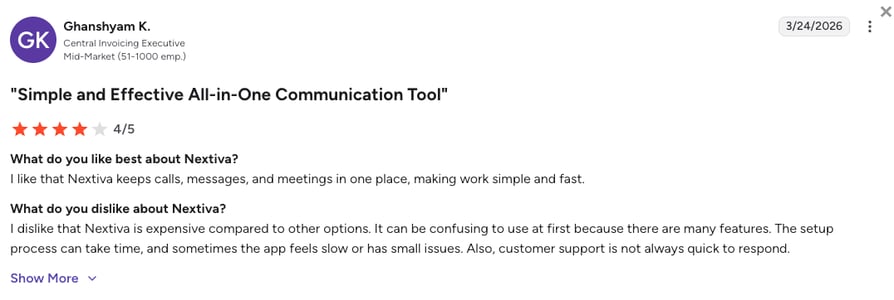
| 6 | Nextiva | Growing businesses unifying voice, SMS, and chat channels | $15/user/month (Core) | 4.5/5 (3,600+) |
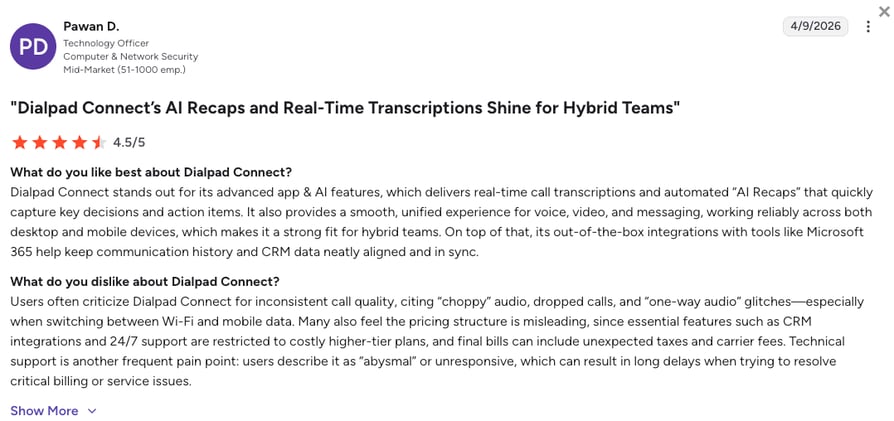
| 7 | Dialpad | Teams wanting built-in AI transcription on every call | $15/user/month (Standard) | 4.4/5 (4,200+) |
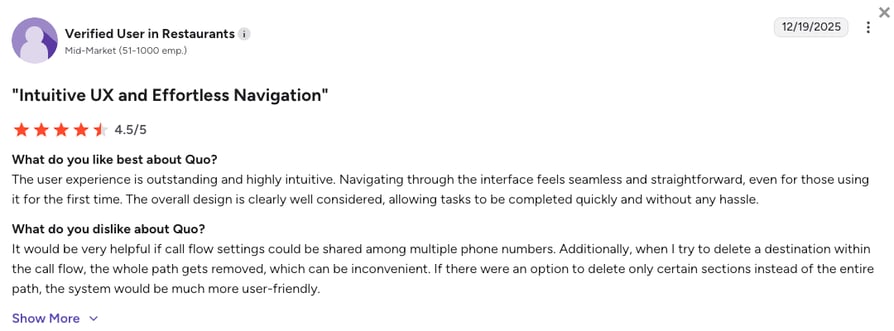
| 8 | Quo (formerly OpenPhone) | Text-heavy startups sharing numbers as a team | $15/user/month (Starter) | 4.7/5 (3,400+) |
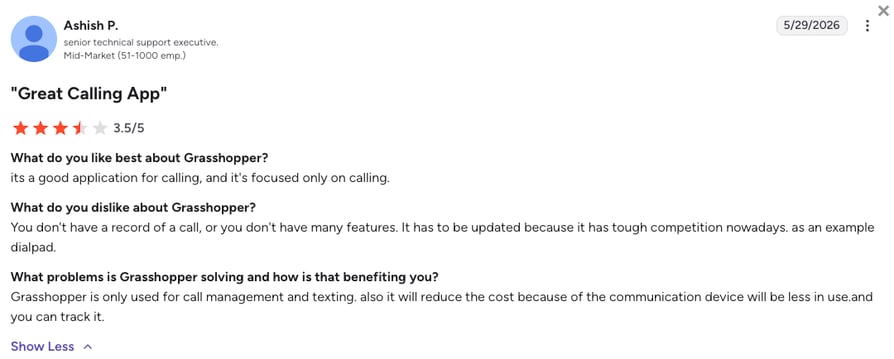
| 9 | Grasshopper | Solopreneurs wanting a flat-rate number over per-seat pricing | $14/mo flat (True Solo) | 3.9/5 (150+) |
| 10 | KrispCall | Lean teams buying budget virtual numbers in many countries | $12/user/month (Essential, 5-user cap) | 4.5/5 (350+) |
Ten Rows in the Table. One Answer in 30 Minutes.
What Are the Best MightyCall Alternatives?
The best MightyCall alternatives in 2026 are CloudTalk, Aircall, JustCall, Ringover, and RingCentral. CloudTalk leads for growing sales teams, pairing dialers and two-way CRM sync with AI voice agents on one platform. Quo and Grasshopper fit tiny teams, while Nextiva and Dialpad suit unified comms and AI note-taking.
Why Are Teams Searching for a MightyCall Alternative?
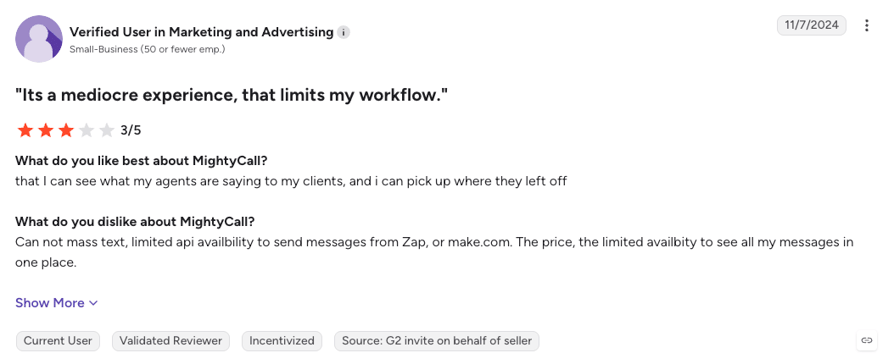
Teams search for a MightyCall alternative for three structural reasons: every plan carries a 3-user minimum, the dialers live on the $54 to $65 tiers, and the AI stops at call summaries instead of answering calls.
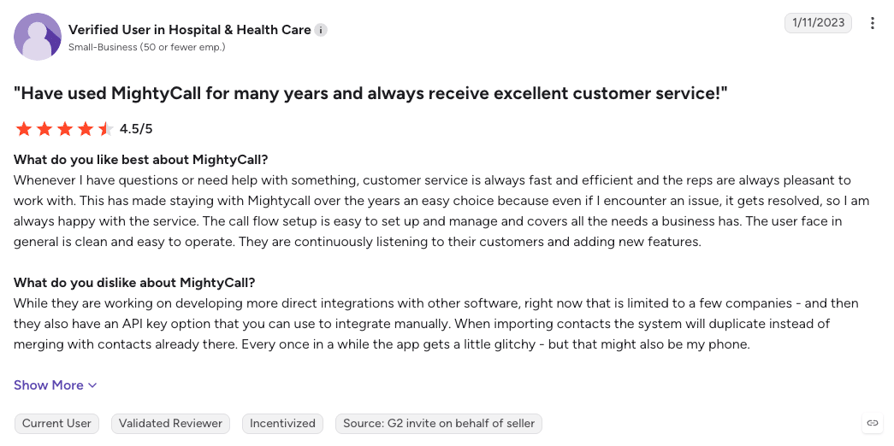
MightyCall itself is well-liked. It's easy to set up, support gets praised constantly, and the dialer suite is genuinely capable. For a small call center that fits its plan sizes, it does the job at a fair price.
On G2, MightyCall holds a 4.4/5 rating across 300+ reviews. Reviewers praise the intuitive interface and responsive support. The recurring gripes: connectivity hiccups, number and SMS management friction, and IVR setups that take real effort. Let's unpack the issues, then find you a better fit.
5 Main Cons of MightyCall That Make Businesses Look for an Alternative
- Every plan starts at 3 users, Enterprise at 5MightyCall's own pricing page puts a 3-user minimum on Core, Pro, and Power, so the $20 headline price really means $60/month before anyone dials. Solo operators and duos pay for empty seats from day one, and the Enterprise floor is 5 users at $65 each, or $325/month.
- The dialers you came for cost $54 to $65 per userPreview and progressive dialing only arrive on Power ($54/user/month), and the predictive dialer sits on Enterprise ($65/user/month, 5-user minimum). With the seat minimums, the real outbound floor is $162 to $325 a month before your first connected call.
- Four native integrations, and Zoho is still coming soonMightyCall's integrations page lists exactly HubSpot, Salesforce, Balto, and Zapier, plus an API. Everything else routes through Zapier chains, and Zoho remains marked as coming soon on the live pricing page. There's no native helpdesk or ecommerce sync at all.
- The AI summarizes calls but never answers oneAI call summaries start on Pro and answering machine detection on Power, and that's the whole AI story. There's no AI receptionist or voice agent anywhere in the product, so after-hours callers still land in voicemail, and one recent G2 reviewer flags the missing AI assistant in the IVR directly.
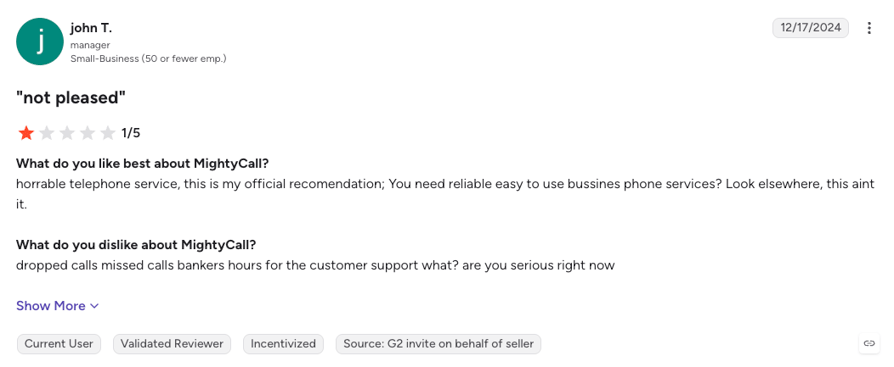
- Reviewers keep flagging connectivity and number managementAcross recent G2 reviews, the most repeated complaints are call connectivity issues, dropped calls, and number or SMS registration friction. On a platform pitched at high-volume calling, those reports deserve a hard look during the 7-day, 100-minute trial.
Where MightyCall Shines
For a small, US-focused team that lives in outbound campaigns, MightyCall's auto dialer suite is a real strength, and its support team earns a 9.4/10 satisfaction score on G2. If dialing volume is your whole job, our guide to the best AI sales dialer software shows what a modern outbound stack looks like around it.
What Is the Best Alternative to MightyCall?
CloudTalk is the best alternative to MightyCall for growing sales teams: the same dialing power (smart, preview, power, and parallel modes), minus the seat minimums and tier gates. You get numbers in 160+ countries, two-way CRM sync, and an AI receptionist that answers when your team can't.
Whether anything beats MightyCall depends on your setup. For a 3-person, US-only campaign team, MightyCall holds up fine. But teams that plan to add reps, markets, or AI usually want a platform that grows seat by seat, and that's the case we'll make today.
Why Do Teams Consider CloudTalk the Best MightyCall Alternative?
Buyers rank CloudTalk among the best MightyCall alternatives because it scales from a single seat. Plans start at $25/user/month (annual billing) with no seat minimums until Expert (3-seat minimum), on a 99.999% uptime SLA, with 24/7 chat and email support on every plan (phone on Expert).
5 Main Pros of CloudTalk and Why Businesses Switch from MightyCall
- Start with one seat, scale when you're readyThere's no minimum on Starter or Essential, so a solo founder pays $25/user/month, not triple it. Add reps one at a time and the bill follows your actual headcount, right up to Expert's modest 3-seat minimum.
- A dialer suite built to protect connect ratesThe Power Dialer (Expert, or a $15/user/month add-on on any plan) and Parallel Dialer ($39/user/month add-on) pair volume with spam protection, so more dials don't mean burned numbers.
- 100+ integrations with true two-way syncFrom Essential, 100+ integrations including HubSpot, Salesforce, Pipedrive, and Zendesk log calls, notes, and recordings to the right record automatically. Reps see CRM context inside the dialer instead of re-typing notes after every call.
- AI that answers the phone, not just the recapThe AI Receptionist picks up routine inbound calls with 50 free minutes on every account, then fixed tiers from $99/month (200 mins). Sales-led AI Voice Agents from $349/month handle qualification and booking. Callers who'd never leave a voicemail still leave a name and a reason.
- Numbers in 160+ countries on reliable infrastructureBuy and port international numbers as you enter new markets, with call quality backed by a 99.999% uptime SLA rather than a fair use asterisk.
Their Trial Gives You 100 Minutes. Ours Gives You 14 Days.
How We Chose the Best MightyCall Alternatives and Competitors
We aggregated user experiences from Reddit, Quora, and G2, reviewed every vendor's official pricing page, and did the seat-minimum math ourselves. Each platform was then scored against six benchmarks:
- Call Stability & ReliabilityUptime guarantees, call quality, and how often users mention dropped calls or spam-flagged numbers in reviews.
- Total Cost of OwnershipThe real monthly bill: seat prices, seat minimums, dialer tiers, add-ons, and contract commitments.
- CRM & Helpdesk Integration DepthWhether integrations sync data both ways natively, or lean on Zapier chains and manual exports.
- Global Coverage & Number AvailabilityHow many countries you can buy numbers in, and what happens to your existing number when you switch.
- Support Quality & AvailabilitySupport channels, hours, and whether smaller accounts get a human or a help center.
- AI & Automation CapabilitiesWhat the AI does on real phone calls, from summaries and machine detection to fully answering them.
Top 10 Alternatives to MightyCall for 2026
Services like MightyCall split into three camps: sales platforms with dialers and CRM sync, unified comms suites, and lightweight flat-rate numbers. The matrix lines MightyCall up against CloudTalk, Ringover, RingCentral, and Aircall, and all ten get a full profile below.
MightyCall vs. CloudTalk vs. Ringover vs. RingCentral vs. Aircall
| Feature | MightyCall | CloudTalk | Ringover | RingCentral (RingEX) | Aircall |
|---|---|---|---|---|---|
| Starting Price (annual) | $20/user/month (Core) | $25/user/month (Starter) | $15/user/month (Talk) | $20/user/month (Core) | $30/user/month (Essentials) |
| Seat Minimum | 3 users (5 on Enterprise) | None (3 on Expert) | 3 users + 12-month commitment | None | 3 licenses |
| Free Trial |  7 days (100 minutes) 7 days (100 minutes) | 14 days | 7 days (5 users, 300 mins) | 14 days | Yes |
| Unlimited Calling | All plans (fair use policy) | Unlimited inbound & internal, 500-minute outbound bundle on Starter | 110+ destinations | Unlimited US/CA domestic | Unlimited inbound (toll-free excluded) |
| Call Recording | All plans | From the start | All plans | On-demand from Core | From Essentials |
| CRM Integrations | 4 native (HubSpot, Salesforce, Balto, Zapier) | 100+ from Essential | From Business ($47/user/month) | From Advanced ($25/user/month) | 250+ (Salesforce CTI on Professional) |
| Dialer Type | Preview & progressive on Power ($54), predictive on Enterprise ($65) | Power Dialer (Expert, or $15/user/month add-on), Parallel Dialer ($39/user/month add-on). Smart & Preview on Expert. Click-to-call from Starter. | Power Dialer from Business | Not included in RingEX (RingCX sold separately) | Power Dialer on Professional |
| AI Features | Call summaries (Pro+), answering machine detection (Power) | AI Receptionist from $99/mo (50 free mins), AI Voice Agents from $349/mo, Conversation Intelligence $9/user/month | Transcription and summaries on all plans | AI Receptionist add-on from $39/mo, AI assistant per tier | 50 free AI Voice Agent minutes/month, AI Assist add-on |
| Business Numbers | 3 included, international as paid add-on | 160+ countries | 65+ countries (Business) | International numbers from $5.99/user/month | 1 per plan, local or toll-free |
| G2 Rating | 4.4/5 (300+) | 4.4/5 (1,850+) | 4.6/5 (450+) | 4.2/5 (1,400+) | 4.4/5 (1,600+) |
The MightyCall Seat-Minimum Math
MightyCall's $20 headline is really $60/month once the 3-user minimum kicks in. Want the dialers? Power is $54 times three users, or $162/month, and the predictive dialer needs Enterprise at $65 times five users, or $325/month. CloudTalk starts at one seat for $25/user/month, and the Power Dialer is a $15/user/month add-on on any plan.
1. CloudTalk: The Best MightyCall Alternative for Growing Sales Teams Dialing Globally with CRM Sync and AI Agents
What Is CloudTalk?
CloudTalk is an AI-powered business calling platform built for sales and support teams that live on the phone. It combines local numbers in 160+ countries with sales dialers, smart routing, and analytics. Setup is self-serve, and most teams make their first call the same day.
Against MightyCall, the trade is simple: you give up bundled unlimited SMS and gain everything that scales. CloudTalk starts at one seat, syncs both ways with 100+ CRMs, and adds AI agents that answer calls, three things MightyCall can't match today.
Why Is CloudTalk a Strong MightyCall Alternative?
- No seat minimums until Expert: start at $25/user/month with a single seat and add reps as revenue grows, instead of paying MightyCall's 3-user entry of $60/month from day one.
- Dialers plus connect-rate protection: the Power Dialer runs campaigns with dispositions and callback queues, Parallel Dialer calls 10 leads at once and connects your reps only when they pick up, while spam protection helps keep your numbers off carrier blocklists at volume.
- Two-way CRM sync from Essential: 100+ integrations log calls, notes, recordings, and outcomes to the right contact and deal automatically, so reps see full context inside the dialer.
- AI that picks up the phone: the AI Receptionist answers routine inbound calls 24/7 with 50 free minutes on every account to try it out, and more complex AI Specialists qualify and book on live calls.
- Global reach on a 99.999% uptime SLA: buy and port numbers across 160+ countries as you open new markets, with call quality your team can plan around.
What Are the Pros & Cons of CloudTalk?
| Pros | Cons |
|---|---|
| Scales from 1 seat at $25/user/month, no minimums until Expert (3 seats) | Voice-first by design: no native video calls or omnichannel inbox |
| Full dialer suite: Power, Smart & Preview on Expert, Power Dialer as a $15/user/month add-on on any plan | CRM integrations require the Essential plan ($29/user/month) |
| 100+ CRM and helpdesk integrations with native two-way sync from Essential | Parallel Dialer is a $39/user/month add-on on any plan, including Expert |
| AI Receptionist with 50 free minutes on every account, then fixed tiers from $99/month | |
| 24/7 chat and email support on all plans (phone on Expert) |
What Are CloudTalk's Plans & Pricing?
CloudTalk pricing starts at $25/user/month (Starter, billed annually), with the following plans:
CloudTalk Plans and Pricing
| Plan | Price (annual billing) | Key Features |
|---|---|---|
| Starter | $25/user/month | Unlimited inbound & internal calls, 500 outbound minutes (regional calling bundle), call queues, transfers, click-to-call, automatic call recording (1-month retention) |
| Essential | $29/user/month | Everything in Starter + IVR and smart routing, 100+ CRM/helpdesk integrations, workflow automation, unlimited recording retention |
| Expert | $49/user/month | Everything in Essential + Power, Smart & Preview Dialers, Salesforce integration, 24/7 phone support (3-seat min) |
| Conversation Intelligence (add-on) | $9/user/month | AI transcripts, call summaries, call scoring, sentiment analysis, and agent coaching insights |
| AI Receptionist (add-on) | From $99/month (200 min) | Inbound AI call answering, routing, logging; 50 free minutes on every account; tiers up to $699/mo (2,500 min) |
| AI Specialist (add-on) | From $349/month (1,000 min) | Sales-led custom AI voice agents for inbound and outbound workflows; plans scale up to $1,249/mo (5,000 min) |
What Do CloudTalk's Customers Say?
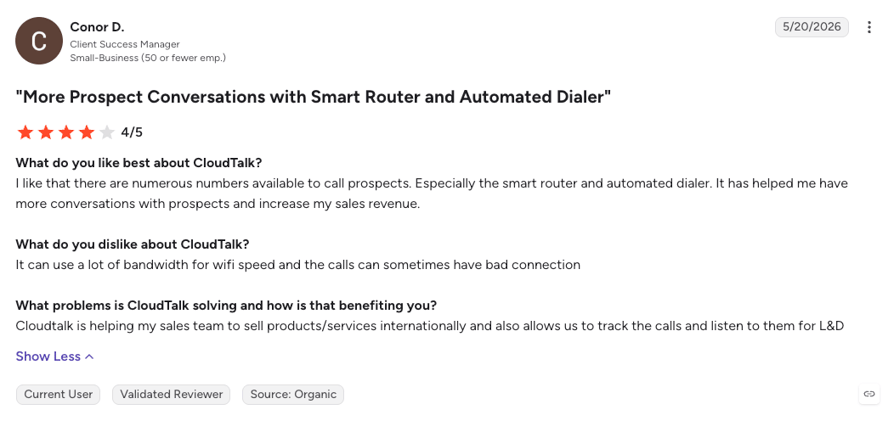
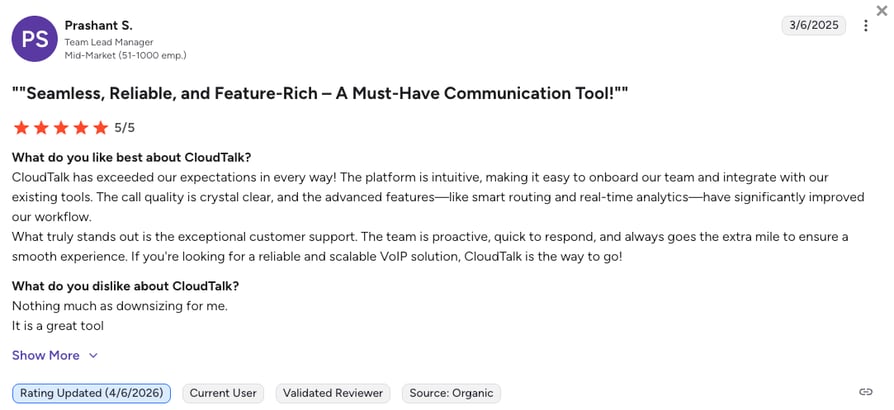
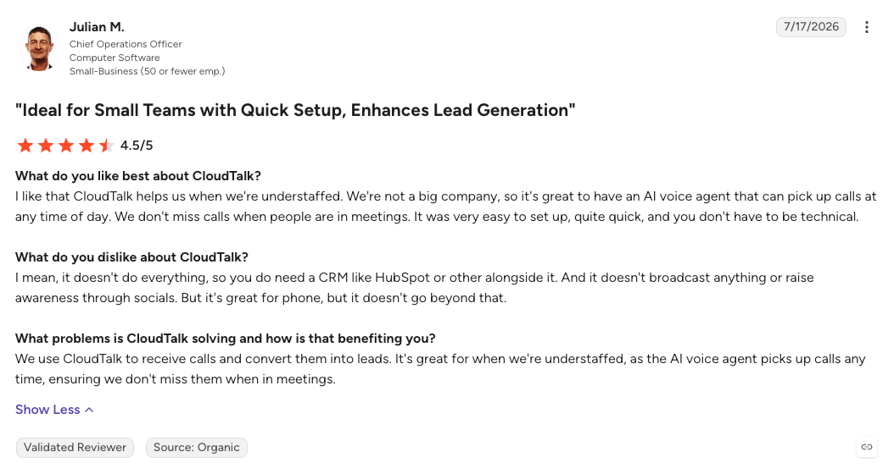
Reviewers consistently praise call quality, the clean interface, and how fast CRM records fill themselves in after every call. Sales teams call out the dialers and the number coverage when expanding into new countries.
The recurring critiques are fair ones: CRM integrations need Essential rather than Starter, and the newest AI features keep shipping fast enough that documentation sometimes trails behind. Nobody calls it bloated, which matters if you're leaving a tool you picked for simplicity.
CloudTalk Power Dialer in Action: My Mortgage Finder's Story
My Mortgage Finder, a UK mortgage brokerage, ran into the exact wall MightyCall's tiers build: manual dialing capped every rep at roughly 15 calls a day, and managers had no time to review what was said. With CloudTalk's Power Dialer and Conversation Intelligence, the team's activity jumped nearly sevenfold.
AJ Pyper, Mortgage Advisor at My Mortgage Finder, puts the new baseline bluntly:
"Now, if an agent makes less than 100 calls a day, we're asking what happened."
Mortgage Advisor at My Mortgage Finder

How Do G2 Users Rate CloudTalk?
On G2, CloudTalk holds a 4.4/5 rating across 1,850+ verified reviews, the same score MightyCall earns from a review base roughly six times smaller.
From 15 Dials a Day to 100+. You Just Read How.
2. Aircall: Best for Support Teams Needing Broad App Integrations
What Is Aircall?
Aircall is a cloud phone system built around its app marketplace. It serves support and sales teams that want calling stitched into their helpdesk and CRM stack. Every plan includes IVR, call recording, and SMS, with a softphone for desktop and mobile.
In a MightyCall vs Aircall comparison, both carry a 3-seat entry, but Aircall's 250+ integrations dwarf MightyCall's four. The trade: Aircall costs $10 more per seat, and unlimited outbound calling is reserved for its Custom plan.
Why Is Aircall a Strong MightyCall Alternative?
- An actual app ecosystem: 250+ integrations and API access ship on the entry plan, so your helpdesk, CRM, and ecommerce tools connect natively instead of through Zapier chains.
- Support workflows built in: smart routing, mandatory call tagging, and manual and automated queue callback arrive on Professional, features MightyCall spreads across supervisor tools.
- AI voice minutes included: every account gets 50 free AI Voice Agent minutes per month, with pay-as-you-go rates when you want the agent handling more inbound traffic.
What Are the Pros & Cons of Aircall?
| Pros | Cons |
|---|---|
| 250+ integrations and API access from the Essentials plan | 3-license minimum makes the real entry cost $90/month |
| Power Dialer and voicemail drop on Professional | Unlimited outbound calling is reserved for the Custom plan (25-license minimum) |
| 50 free AI Voice Agent minutes per account each month | Reviewers report call quality dips and SMS glitches |
What Are Aircall's Plans & Pricing?
Aircall pricing starts at $30/user/month (Essentials, annual billing, 3-license minimum), with the following plans:
Aircall Plans and Pricing
| Plan | Price (annual billing) | Key Features |
|---|---|---|
| Essentials | $30/user/month (3-license min) | 250+ integrations and API access, IVR, call recording, click-to-dial, SMS/MMS, unlimited inbound calls (toll-free excluded) |
| Professional | $50/user/month (3-license min) | Everything in Essentials + Power Dialer, voicemail drop, Salesforce CTI, advanced analytics, live monitoring, smart routing |
| Custom | Custom pricing (25-license min) | Everything in Professional + unlimited outbound calls, custom onboarding, SLA, single sign-on |
The 3-Seat Entry Math
Aircall's $30 seat becomes a $90/month commitment the moment you sign up, and the sales features you'd leave MightyCall for sit on the $50 Professional tier, or $150/month for three licenses. CloudTalk unlocks its Power Dialer as a $15/user/month add-on on any plan, from a single seat.
What Are Aircall's Customers Saying?
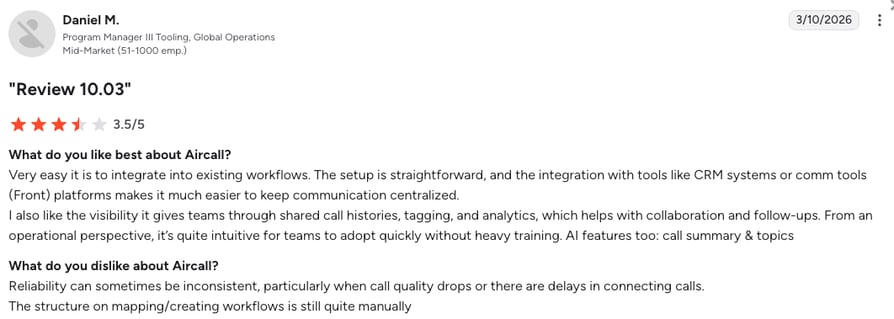
Reviewers love the ease of setup and the depth of the HubSpot and Salesforce connections, with 228+ reviews praising usability. The recurring complaints are call quality dips on Wi-Fi, slow recording uploads, and SMS features that feel unfinished.
How Do G2 Users Rate Aircall?
On G2, Aircall holds a 4.4/5 rating across 1,600+ reviews, matching CloudTalk's score on a similarly large base.
3. JustCall: Best for SMB Outbound Teams Running Calls and SMS in One Place
What Is JustCall?
JustCall is an AI-powered communication platform for SMB sales and support teams. It bundles calling, SMS, WhatsApp, and email outreach into one workspace. The pitch is volume outreach without gluing five tools together.
Searches for MightyCall vs JustCall usually come down to texting. JustCall treats SMS as a first-class channel with campaigns and automations, while MightyCall's messaging leans on registration hoops. The catch: JustCall's dialer starts one tier up.
Why Is JustCall a Strong MightyCall Competitor?
- Texting that pulls its weight: SMS, WhatsApp, and calling share one workspace with business texting workflows, so follow-ups don't live in a separate tool.
- A real sales dialer suite: the Sales Dialer arrives on Pro with campaign workflows, and AI call scoring, coaching, and sentiment analysis stack on Pro Plus for teams that coach from calls.
- Integrations from the first tier: 100+ CRM and data integrations ship with the $29 Team plan, five times MightyCall's roster before you touch Zapier.
What Are the Pros & Cons of JustCall?
| Pros | Cons |
|---|---|
| Calls, SMS, WhatsApp, and email outreach in one workspace | Sales Dialer requires Pro ($49/user/month, 2-user minimum) |
| Sales Dialer with campaign workflows from Pro | AI call scoring and coaching live on Pro Plus ($89/user/month) |
| 100+ integrations included on the entry Team plan | Reviewers report call quality issues and surprise add-on charges |
What Are JustCall's Plans & Pricing?
JustCall pricing starts at $29/user/month (Team, annual billing, 2-user minimum), and it offers the following plans:
JustCall Plans and Pricing
| Plan | Price (annual billing) | Key Features |
|---|---|---|
| Team | $29/user/month (2-user min) | Calling, SMS, call recording, 100+ integrations, 14-day free trial |
| Pro | $49/user/month (2-user min) | Everything in Team + Sales Dialer with campaign workflows |
| Pro Plus | $89/user/month (2-user min) | Everything in Pro + AI call scoring, AI coaching, sentiment analysis |
| Business | Custom pricing (10-user min) | Custom controls, support, and volume pricing for larger teams |
The Dialer Tier Jump
JustCall's $29 headline doesn't dial for you: the Sales Dialer needs Pro at $49, and with the 2-user minimum that's a $98/month floor. Add AI coaching and you're at $178/month for two seats. CloudTalk keeps dialing an add-on decision, $15/user/month for the Power Dialer on any plan, instead of a tier decision.
What Are JustCall's Customers Saying?
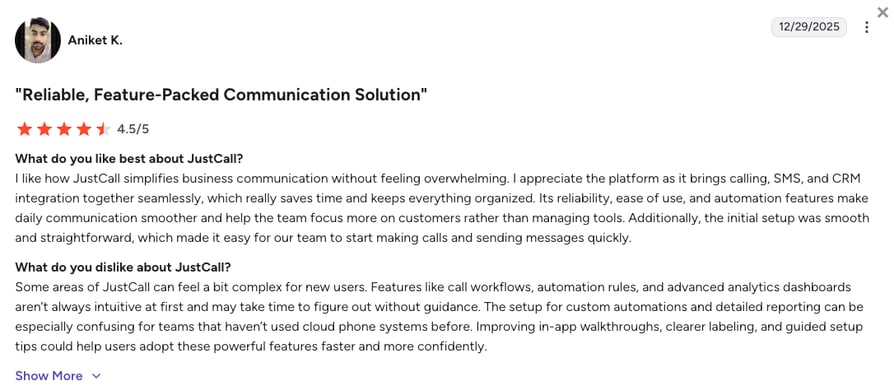
With roughly 853 mentions of ease of use, reviewers clearly find JustCall approachable, and the CRM logging earns steady praise. The flip side is heavily documented too: call quality and sync complaints, plus pricing-transparency gripes about add-ons and upgrades.
How Do G2 Users Rate JustCall?
On G2, JustCall holds a 4.3/5 rating across 2,300+ reviews, a large and active review base for an SMB tool.
4. Ringover: Best for Sales and Support Teams Calling International Destinations Daily
What Is Ringover?
Ringover is a European cloud calling platform known for bundling unlimited international calls into flat per-seat plans. It targets sales, support, and recruiting teams that spend hours on cross-border calls. AI transcription and summaries ship on every tier.
Where MightyCall meters nothing but stays domestic-minded, Ringover's Talk plan covers 110+ destinations for $15. The fine print matters, though: standard plans carry a 3-user minimum and a 12-month commitment, and the entry tier is web-only.
Why Is Ringover a Strong Alternative to MightyCall?
- International calling without a meter: unlimited calls to 110+ destinations start on the $15 Talk plan, where MightyCall treats international numbers as paid add-ons.
- AI on every plan: call transcription, summaries, and recording are included from Talk, features MightyCall gates behind Pro.
- A sales bundle on Business: the $47 tier packs a Power Dialer, advanced IVR, coaching tools like double listening and whispering, and 100+ integrations in one jump.
What Are the Pros & Cons of Ringover?
| Pros | Cons |
|---|---|
| Unlimited calls to 110+ destinations from the $15 Talk plan | 3-user minimum plus a 12-month commitment on standard plans |
| AI transcription, summaries, and call recording on all plans | Talk is web-only, with one company number and no integrations |
| Business tier bundles Power Dialer, coaching, and 100+ integrations | The jump from $15 to $47 buys the features sales teams actually need |
What Are Ringover's Plans & Pricing?
Ringover pricing starts at $15/user/month (Talk, annual billing, 3-user minimum), and you can choose from these plans:
Ringover Plans and Pricing
| Plan | Price (annual billing) | Key Features |
|---|---|---|
| Talk | $15/user/month (3-user min) | 1 company number, unlimited calls to 110+ destinations, SMS, call recording, AI transcription and summaries, web app only |
| Business | $47/user/month (3-user min) | Everything in Talk + numbers from 65 countries, advanced IVR, 100+ integrations, Power Dialer, coaching tools |
| Advanced | Custom pricing | Everything in Business + call campaigns, voicemail drop, local presence dialing, single sign-on |
The 12-Month Commitment
Ringover's $15 entry looks like the cheapest sales setup here, but Talk is a web-only plan with one shared company number and zero integrations. The workable sales tier is Business at $47 times three users, or $141/month, locked in for 12 months. Budget for the plan you'll actually run, not the one on the banner.
What Are Ringover's Customers Saying?
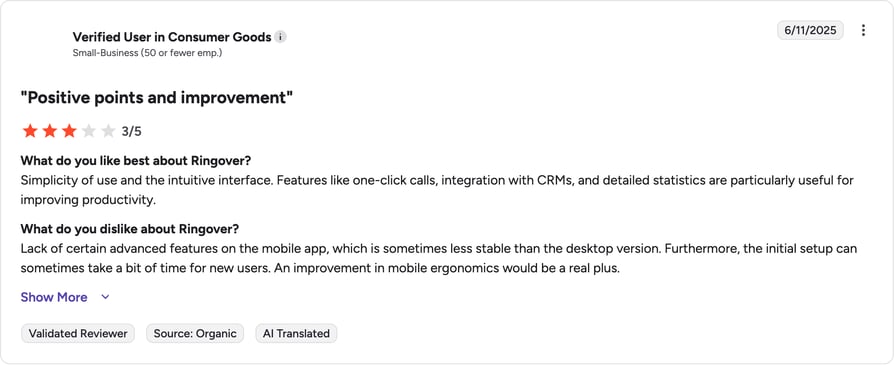
Reviewers praise the intuitive design, call quality, and the Pipedrive and HubSpot sync, with support earning 51+ positive mentions. Complaints center on price for small single-number teams, transcription accuracy, and occasional mobile SMS sync glitches.
How Do G2 Users Rate Ringover?
On G2, Ringover holds a 4.6/5 rating across 450+ reviews, the highest score in this comparison, though from a smaller base than CloudTalk or Aircall.
5. RingCentral (RingEX): Best for Larger Teams Wanting Calls, Video, and Messaging in One Suite
What Is RingCentral?
RingCentral sells RingEX, a unified communications suite that folds phone, video meetings for up to 300 participants, and team messaging into one app. It suits mid-sized and larger companies standardizing every channel on a single vendor. An AI assistant with notes and transcriptions is built in.
Against MightyCall, RingEX wins on breadth and loses on outbound: there's no sales dialer inside RingEX plans, since RingCentral sells its RingCX contact center products separately, and most MightyCall vs RingCentral reviews actually end on that split.
Why Is RingCentral a Strong MightyCall Alternative?
- One suite for every channel: unlimited domestic calling, HD video meetings for 300 participants, and team messaging replace two or three separate subscriptions.
- CRM integrations at $25: the Advanced tier connects Salesforce, HubSpot, and hundreds of other apps, with multi-site management for distributed offices.
- An AI receptionist you can bolt on: RingCentral's AI Receptionist add-on starts at $39 and handles routing, appointment booking, and lead capture on top of any RingEX plan.
What Are the Pros & Cons of RingCentral?
| Pros | Cons |
|---|---|
| Calls, video (300 participants), and messaging in one app | No native sales dialer in RingEX; RingCX is sold separately |
| CRM integrations and multi-site management from Advanced ($25/user/month) | Reviewers describe admin setup as complex and spread across menus |
| AI Receptionist add-on from $39/month for routing and lead capture | Toll-free minutes and SMS allowances are tiered, so heavy use pushes upgrades |
What Are RingCentral's Plans & Pricing?
RingCentral pricing starts at $20/user/month (Core, annual billing), with the following plans available:
RingCentral RingEX Plans and Pricing
| Plan | Price (annual billing) | Key Features |
|---|---|---|
| Core | $20/user/month | Unlimited domestic calling, on-demand call recording, 100 toll-free minutes, 25 SMS/user, HD meetings (300 participants), AI assistant |
| Advanced | $25/user/month | Everything in Core + CRM integrations, multi-site management, 1,000 toll-free minutes, 100 SMS/user |
| Ultra | $35/user/month | Everything in Advanced + 10,000 toll-free minutes, 200 SMS/user, webinar, unlimited storage, device analytics |
The Suite Surcharge
RingEX prices the suite, not the sales motion: CRM sync needs Advanced, heavy texting needs Ultra, and outbound dialing needs a separate RingCX product entirely. If you're leaving MightyCall for the dialers, check what the full stack costs before assuming the $20 Core seat is the bill. Our review of RingCentral's AI Receptionist breaks down the add-on economics.
What Are RingCentral's Customers Saying?
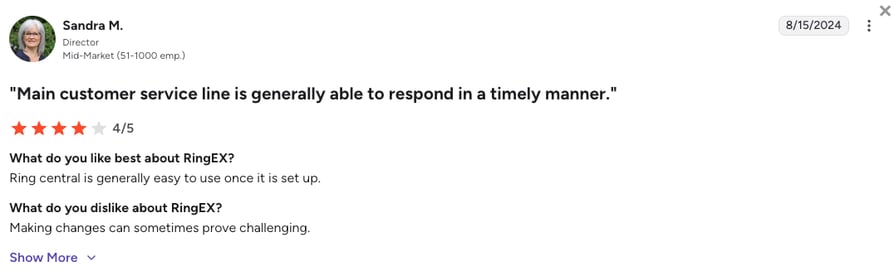
Reviewers value the all-in-one consolidation and reliability, with ease of use cited in 216 reviews. The recurring friction points are admin configuration spread across menus, inconsistent support response times, and costs that climb as add-ons stack.
How Do G2 Users Rate RingCentral?
On G2, RingEX holds a 4.2/5 rating across 1,400+ reviews, solid for a platform serving everyone from clinics to call centers.
6. Nextiva: Best for Growing Businesses Unifying Voice, SMS, and Chat Channels
What Is Nextiva?
Nextiva is a unified customer experience platform that starts as a business phone system and scales into a full contact center. It serves growing businesses that want voice, SMS, video, and chat under one roof. Its XBert AI Receptionist answers calls, texts, and chats around the clock.
Compared with MightyCall, Nextiva undercuts the entry price at $15 with no seat minimum, and it reaches much further up-market. The trade-off is that its AI receptionist and several conveniences arrive as paid add-ons rather than plan features.
Why Is Nextiva a Strong MightyCall Competitor?
- More channels for less: the $15 Core plan bundles voice, business SMS, video meetings, and team chat, where MightyCall's $20 seat is voice and text alone.
- A real inbound call center at $25: Engage adds toll-free numbers and minutes, advanced reporting, live chat with a chatbot, and inbound call flow tooling.
- Room to grow into CX: the Scale tier turns the same platform into a blended inbound and outbound operation with AI transcription, summaries, and skills-based routing.
What Are the Pros & Cons of Nextiva?
| Pros | Cons |
|---|---|
| Voice, SMS, video meetings, and team chat from $15/user/month | XBert AI Receptionist is a paid add-on (from $99/month) on every tier |
| Engage tier adds an inbound call center with live chat at $25/user/month | Outbound campaign capabilities only arrive on the $75 Scale tier |
| Scales to a full CX platform with AI transcription and skills-based routing | Reviewers describe a real learning curve during initial setup |
What Are Nextiva's Plans & Pricing?
Nextiva pricing starts at $15/user/month (Core, annual billing), and the platform offers the following plans:
Nextiva Small Business Plans and Pricing
| Plan | Price (annual billing) | Key Features |
|---|---|---|
| Core | $15/user/month | Inbound and outbound voice, business SMS, video meetings, call routing, team chat, mobile app |
| Engage | $25/user/month | Everything in Core + toll-free number and minutes, advanced reporting, inbound call center, live chat and chatbot |
| Scale | $75/user/month | Full CX platform: voice and web chat, blended inbound and outbound, AI transcription and summary, skills-based routing |
The Add-On Stack
Nextiva's $15 seat is honest, but the always-on answering everyone wants now lives in XBert, an AI receptionist add-on from $99/month on top of any plan. CloudTalk's equivalent starts at the same $99/month with 50 free minutes already included on every account, and the two are worth comparing side by side.
What Are Nextiva's Customers Saying?
Support is Nextiva's calling card, with roughly 127 reviews praising responsive, patient help through setup. Reliability and call quality earn steady mentions too. The gripes: setup complexity with third-party hardware, reporting limitations, and pricing that feels high once add-ons land.
How Do G2 Users Rate Nextiva?
On G2, Nextiva holds a 4.5/5 rating across 3,600+ reviews, one of the strongest score-to-scale combinations in this list.
7. Dialpad: Best for Teams Wanting Built-In AI Transcription on Every Call
What Is Dialpad?
Dialpad is an AI-first communications platform whose Connect product covers calling, messaging, and meetings. It suits teams that want every call transcribed, summarized, and searchable without add-ons. Local numbers are available in 50+ countries.
The MightyCall vs Dialpad question splits on where the AI works: Dialpad's AI writes everything down in real time from the $15 plan, while MightyCall's summaries start on its $38 Pro tier. Dialpad, though, keeps CRM integrations and 24/7 support one tier up.
Why Is Dialpad a Strong MightyCall Alternative?
- AI included at the bottom tier: real-time call transcription and instant call summaries ship on the $15 Standard plan, features MightyCall reserves for Pro at $38.
- One app for calls, chat, and meetings: unlimited calling, messaging, and HD meetings live together, trimming a videoconferencing subscription off the stack.
- International footing: local numbers in 50+ countries and multi-office management from Pro suit teams spread across time zones.
What Are the Pros & Cons of Dialpad?
| Pros | Cons |
|---|---|
| Real-time AI transcription and call summaries on the $15 Standard plan | CRM integrations and 24/7 support require Pro ($25/user/month) |
| Calls, messaging, and meetings unified in one app | Reviewers report SMS delivery and functionality problems |
| Local numbers available in 50+ countries | Autonomous AI agents live in Dialpad's separate products with their own pricing |
What Are Dialpad's Plans & Pricing?
Dialpad pricing starts at $15/user/month (Standard, annual billing), with the following tiers available:
Dialpad Connect Plans and Pricing
| Plan | Price (annual billing) | Key Features |
|---|---|---|
| Standard | $15/user/month | Unlimited calling, AI transcription, instant call summaries, messaging, HD meetings |
| Pro | $25/user/month | Everything in Standard + CRM integrations, 24/7 support, multi-office management |
| Enterprise | Custom pricing | Everything in Pro + SSO, user access controls, unlimited office locations, 99.9% uptime SLA |
The Real-Time AI Split
Dialpad Connect transcribes brilliantly, but it's the note-taker, not the receptionist: autonomous AI agents and live agent assist sit in Dialpad's separate AI Agent and contact center products with their own pricing. If you're weighing MightyCall against Dialpad for a small sales team, our head-to-head breaks the choice down.
What Are Dialpad's Customers Saying?
Users praise the AI transcription and summaries, the unified app, and an interface that's easy to navigate. Complaints cluster around call quality during network switches, SMS features that never quite behave, and essentials like CRM sync sitting on higher tiers.
How Do G2 Users Rate Dialpad?
On G2, Dialpad Connect holds a 4.4/5 rating across 4,200+ reviews, the largest review base of any tool on this list.
8. Quo (formerly OpenPhone): Best for Text-Heavy Startups Sharing Numbers as a Team
What Is Quo (formerly OpenPhone)?
Quo, formerly OpenPhone, is a modern business phone app built around shared numbers and message threads. It fits startups and small teams that text customers as much as they call them. Its Sona AI agent, included from the entry plan, answers and captures missed calls.
This is the exact matchup from the Reddit thread below: MightyCall dials better, Quo feels simpler. Quo starts at $15 with no seat minimum and a cleaner inbox, but power dialing isn't its game, and CRM integrations skip the Starter plan.
Why Is Quo a Strong Alternative to MightyCall?
- No ghost seats: Quo starts at $15/user/month for exactly the users you have, while MightyCall bills three seats minimum whether you fill them or not.
- Shared numbers with context: teammates work one number together with visible message history, a clean fit for small teams juggling SMS customer service.
- An AI answer on day one: the Sona AI agent ships from Starter with 1,000 free credits, catching missed calls before they become voicemail.
What Are the Pros & Cons of Quo (formerly OpenPhone)?
| Pros | Cons |
|---|---|
| Shared numbers and team inboxes from $15/user/month, no seat minimum | CRM integrations skip Starter and begin on Business ($23/user/month) |
| Sona AI agent included from the Starter plan | Automatic call recording starts on Business; Starter records manually |
| AI summaries and transcripts for every call from Business | Reviewers report call disconnections and unclear fees at scale |
What Are Quo (formerly OpenPhone)'s Plans & Pricing?
Quo pricing starts at $15/user/month (Starter, annual billing), and it lets you choose from the following plans:
Quo Plans and Pricing
| Plan | Price (annual billing) | Key Features |
|---|---|---|
| Starter | $15/user/month | Calling, SMS, shared numbers (up to 10 users), manual call recording, Sona AI agent with 1,000 free credits |
| Business | $23/user/month | Everything in Starter + CRM integrations (HubSpot, Salesforce), automatic recording, AI summaries and transcripts for all calls, analytics |
| Scale | $35/user/month | Everything in Business + AI call tags, priority support, inbound phone support |
The Starter Integration Gap
Quo's $15 Starter keeps the CRM out: HubSpot and Salesforce sync begin on Business at $23, and AI summaries on Starter only cover calls Sona handled. A two-person team that needs logging lands at $46/month, at which point the comparison with per-seat platforms carrying dialers is worth running honestly. You can explore it deeper in one of our VoIP comparisons.
What Are Quo (formerly OpenPhone)'s Customers Saying?
Quo owns one of the happiest review bases in the category: 700+ reviews cite the ease of use, and support replies drawing praise for 15-minute response times. The recurring negatives are call disconnections, occasional lag, and pricing that turns confusing as teams add numbers and users.
How Do G2 Users Rate Quo (formerly OpenPhone)?
On G2, Quo holds a 4.7/5 rating across 3,400+ reviews, the highest score on this list.
9. Grasshopper: Best for Solopreneurs Wanting a Flat-Rate Number Over Per-Seat Pricing
What Is Grasshopper?
Grasshopper is a virtual phone service that layers a business number over your personal cell. It's built for solopreneurs and very small teams who want to look professional without running a phone system. Pricing is flat per month, not per user.
Grasshopper is the anti-MightyCall on economics: flat plans from $14 to $80 with zero seat math attached. What you give up is the call center layer entirely, so it fits owners answering their own phone, not teams running campaigns.
Why Is Grasshopper a Strong MightyCall Competitor?
- Flat rates, no seat math: True Solo runs $14/month for one user, and Solo Plus covers unlimited users at $25/month flat, against MightyCall's $60 three-seat entry.
- Simple by design: calls forward to the phones you already carry, with virtual phone system basics like extensions, greetings, and instant response texts.
- Low-risk to try: a 7-day free trial plus a 7-day money-back guarantee makes testing it nearly free.
What Are the Pros & Cons of Grasshopper?
| Pros | Cons |
|---|---|
| Flat-rate plans from $14/month instead of per-user pricing | Available in the USA and Canada only |
| Unlimited users on Solo Plus and above at one flat price | Reviewers note the feature ceiling: no CRM sync or call recording as teams grow |
| 7-day trial plus a 7-day money-back guarantee | Reviewers describe a cancellation process that takes lengthy support calls |
What Are Grasshopper's Plans & Pricing?
Grasshopper pricing works on flat monthly rates rather than per-seat fees, starting at $14/month (True Solo, annual billing), with the following plans to choose from:
Grasshopper Plans and Pricing
| Plan | Price (annual billing) | Key Features |
|---|---|---|
| True Solo | $14/month flat | 1 user, 1 number, 1 extension, calling and SMS, instant response texts |
| Solo Plus | $25/month flat | Unlimited users, 1 number, 3 extensions |
| Small Business | $80/month flat | Unlimited users, multiple numbers, unlimited extensions |
The US-Only Ceiling
Grasshopper works in the USA and Canada, full stop. Its own site turns visitors from other regions away. If your customers, or your future hires, sit anywhere else, you'll outgrow it the day you expand. Platforms selling numbers across 160+ countries keep that door open.
What Are Grasshopper's Customers Saying?
Reviewers like the easy setup Grasshopper offers, the price, and the clean separation of work and personal calls. The negative themes are harder-edged: a cancellation process several reviewers call difficult, app instability, and support that loops without resolving.
How Do G2 Users Rate Grasshopper?
On G2, Grasshopper holds a 3.9/5 rating across 150+ reviews, the lowest score on this list, though its fans praise exactly the simplicity it promises.
10. KrispCall: Best for Lean Teams Buying Budget Virtual Numbers in Many Countries
What Is KrispCall?
KrispCall is a budget cloud phone system that sells virtual numbers in 100+ countries. It targets lean startups and agencies that want a global-looking presence at the lowest possible seat price. A unified callbox collects calls, texts, and voicemails per number.
Against MightyCall, KrispCall wins on the sticker: $12 versus a $60 minimum entry. The structure differs, though. KrispCall meters calling per minute and SMS per segment on top of the subscription, and its Essential tier skips call recording entirely.
Why Is KrispCall a Strong Alternative to MightyCall?
- The cheapest per-seat start here: Essential costs $12/user/month with no multi-seat minimum, a fifth of MightyCall's real entry cost.
- Numbers in 100+ countries: KrispCall's catalog of international virtual numbers suits agencies managing local presence across many markets.
- A usable sales tier at $32: Standard adds the Power Dialer, call recording, transcription, bulk SMS, and the Salesforce integration in one step.
What Are the Pros & Cons of KrispCall?
| Pros | Cons |
|---|---|
| Entry seats at $12/user/month, the lowest on this list | No free trial, just a 14-day money-back guarantee on the subscription |
| Virtual numbers available in 100+ countries | Call recording and transcription are locked to Standard and above |
| Standard tier bundles Power Dialer, recording, and bulk SMS at $32/user/month | Per-minute calling, per-segment SMS, and registration fees stack on top of the seat price |
What Are KrispCall's Plans & Pricing?
KrispCall pricing starts at $12/user/month (Essential, annual billing), with per-minute calling and per-segment SMS billed on top, and these plans:
KrispCall Plans and Pricing
| Plan | Price (annual billing) | Key Features |
|---|---|---|
| Essential | $12/user/month | Up to 5 users, calling, IVR, SMS; call and text usage billed separately |
| Standard | $32/user/month | Up to 50 users, Power Dialer, call recording, transcription and summary, bulk SMS, Salesforce integration |
| Enterprise | Custom pricing | Unlimited users, custom SLA, priority support |
The Usage Meter
KrispCall's $12 seat is the entry fee, not the bill: every call adds per-minute charges, every text bills per segment, and US sending needs one-time brand ($4.50) and campaign ($15) registrations. For a team actually dialing all day, model a real month of traffic before comparing it to flat bundles.
What Are KrispCall's Customers Saying?
KrispCall users like the price, the number coverage, and the simple callbox. The recurring complaints mirror its budget positioning: dropped calls, fees that surprise people at billing time, mobile app gaps, and analytics that stay shallow next to the bigger platforms.
How Do G2 Users Rate KrispCall?
On G2, KrispCall holds a 4.5/5 rating across 350+ reviews, a good score on a base that's still a tenth of CloudTalk's.
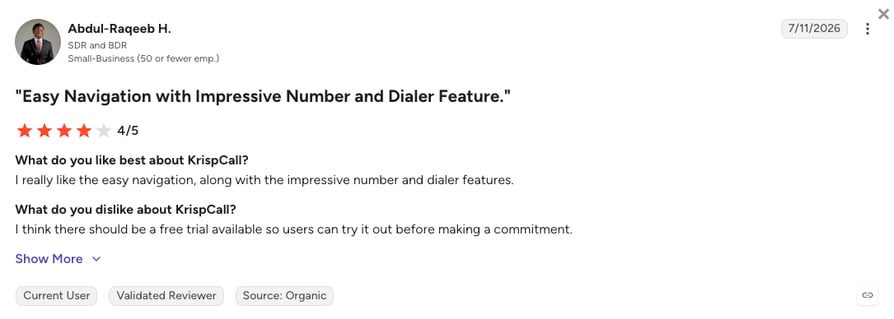
What Real Users Are Saying about MightyCall and Its Alternatives
Pricing pages tell you what a tool claims to do. Community threads tell you what happened after someone paid for it. Here's what buyers and users report across Reddit, Quora, and G2.
What Redditors Are Saying about MightyCall Alternatives
MightyCall threads cluster in r/smallbusinessowner, r/smallbusiness, and r/SalesOperations, and they cover the whole arc: choosing it, living with it, and pushing its dialer to the limit. Three threads stand out:
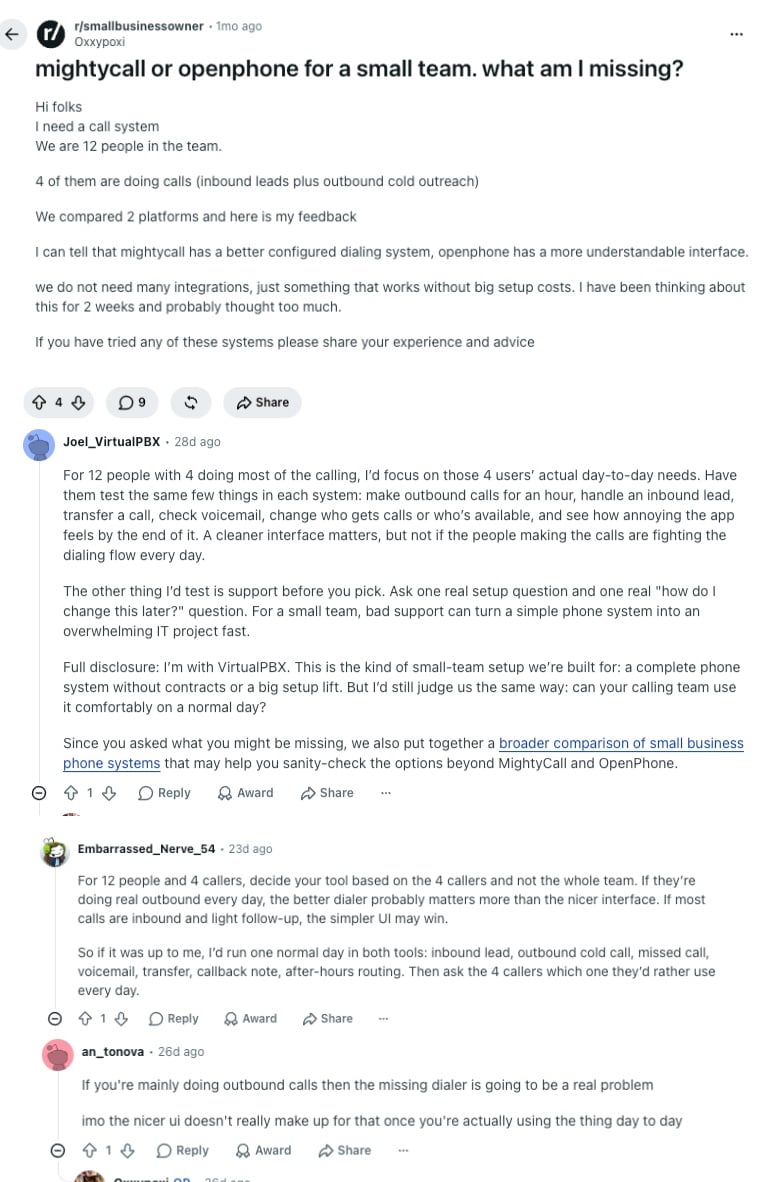
- MightyCall or OpenPhone for a small team: A 12-person business with four callers weighs MightyCall's stronger dialing against OpenPhone's simpler interface. The best replies say to decide by the four callers' actual day: run an outbound hour, an inbound lead, and a transfer in both. Teams that want the dialer strength and the simple workflow in one place usually end up trialing a power dialer platform with CRM logging built in, CloudTalk included.
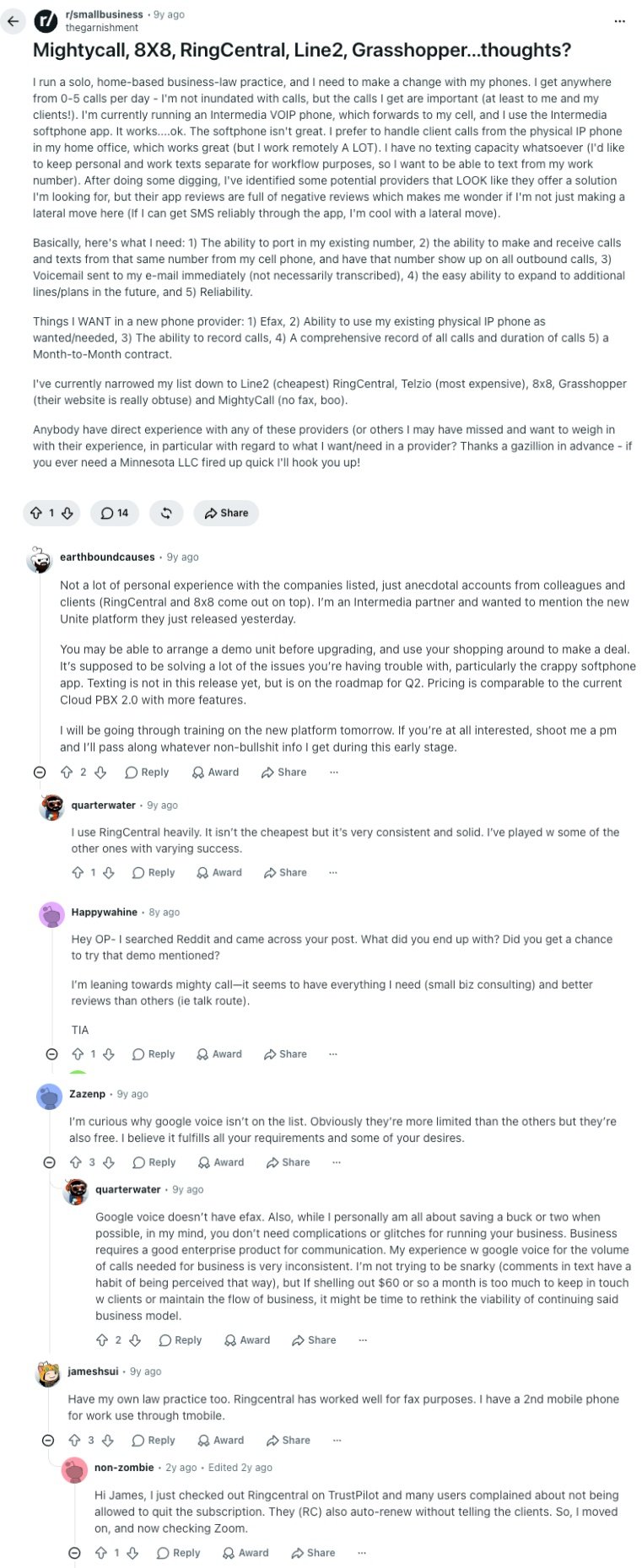
- MightyCall, 8x8, RingCentral, Line2, Grasshopper... thoughts? A solo law practice needs number porting, calls and texts from one number, voicemail to email, and month-to-month terms. Commenters back RingCentral for reliability and note gaps elsewhere, like fax. The useful takeaway: list your five must-haves before touching demos. Solo operators often land on flat-rate tools like Grasshopper, while owners planning to hire lean toward virtual phone systems for small businesses that scale seat by seat.
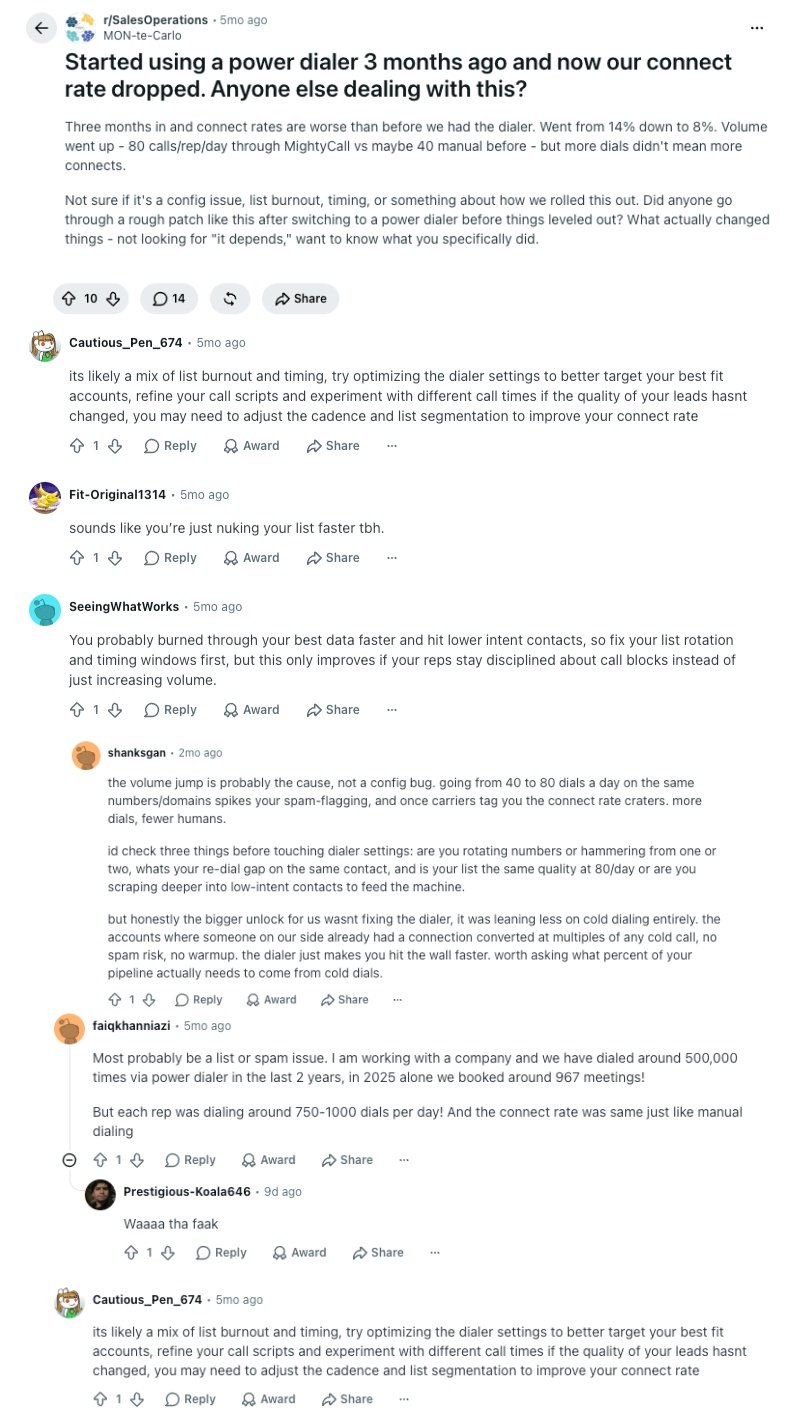
- MightyCall power dialer connect rate drops: An r/SalesOperations team doubled dials from 40 to 80 per rep per day on MightyCall and watched connect rates fall from 14% to 8%. Commenters point at list burnout and carriers spam-flagging the same few numbers at doubled volume, and recommend number rotation and re-dial gaps. It's the strongest argument in any thread for pairing dialers with spam protection and number health monitoring from day one.
What Quora Users Are Asking about MightyCall Alternatives
Quora's questions skew practical: which call platform plays nicely with the helpdesk, and which dialer actually syncs with the CRM. The same names keep coming up in the answers:
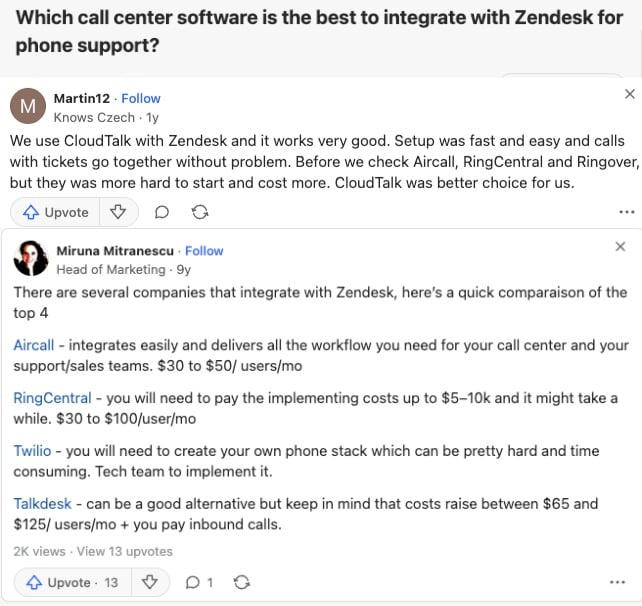
- Call center software with Zendesk integration: Answers repeatedly name CloudTalk for fast setup and calls landing on tickets cleanly, with Aircall, RingCentral, and Talkdesk compared on cost and rollout effort. One user sums up picking CloudTalk over pricier setups after testing. If phone support lives in your helpdesk, start with a native Zendesk call center integration rather than a Zapier bridge.
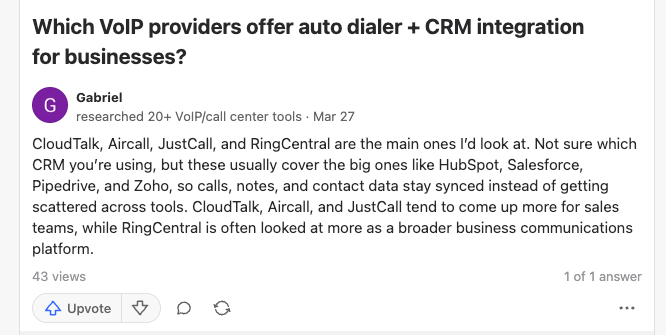
- Auto dialer with CRM integration: A researcher who compared 20+ VoIP tools shortlists CloudTalk, Aircall, JustCall, and RingCentral because they keep calls, notes, and contacts synced with HubSpot, Salesforce, Pipedrive, and Zoho. That's the practical bar for any MightyCall replacement: the dialer only pays off when every outcome lands in the CRM integration automatically.
How CloudTalk, MightyCall, Ringover, and RingEX Compare on G2
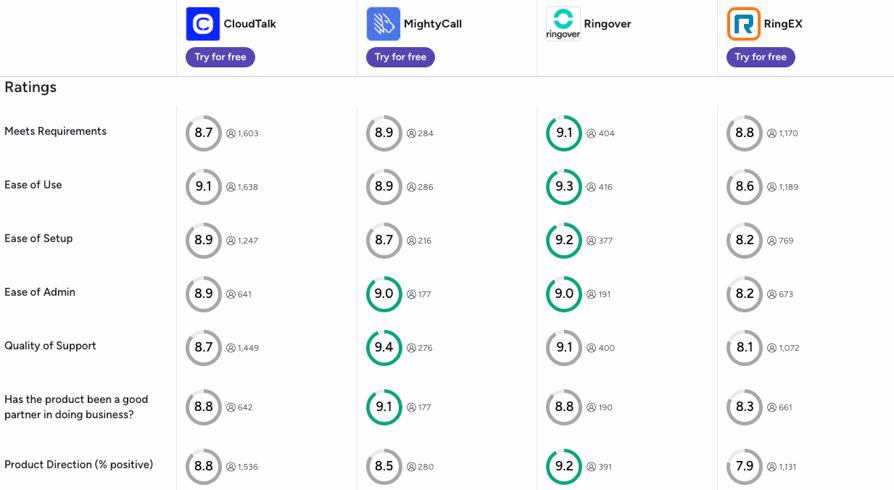
G2's side-by-side data shows how real users score the four platforms buyers cross-shop most, and the story isn't one-sided:
- Ease of use and setup: CloudTalk scores 9.1 on ease of use and 8.9 on setup against MightyCall's 8.9 and 8.7, with Ringover leading both at 9.3 and 9.2 and RingEX trailing at 8.6 and 8.2. If rollout speed matters, the lightweight platforms clearly win over the big suite.
- Quality of support: MightyCall's 9.4 is the best support score of the four, ahead of Ringover's 9.1 and CloudTalk's 8.7. Credit where due: if hand-holding tops your list, MightyCall delivers it.
- Depth of the review base: CloudTalk's scores draw on 1,600+ responses per category, five to six times MightyCall's roughly 280. A 9.4 from a small base and an 8.7 from a huge one aren't the same kind of signal, so weigh the sample, not just the score.
CloudTalk vs. MightyCall: Final Head-to-Head Comparison
The core split is scale: MightyCall is a small-team call center priced in 3-seat blocks, and CloudTalk is a business phone system that grows from one seat to a global sales floor. Here's the honest scorecard.
CloudTalk vs. MightyCall: Head-to-Head
| Feature | CloudTalk | MightyCall | Winner |
|---|---|---|---|
| Starting Price (annual) | $25/user/month | $20/user/month | MightyCall |
| Minimum Seats | 1 (3 on Expert) | 3 (5 on Enterprise) | CloudTalk |
| Free Trial | 14 days | 7 days, capped at 100 minutes | CloudTalk |
| Unlimited Calling & SMS | Unlimited inbound & internal calls, outbound bundles, SMS billed per message | Unlimited calls and texts on all plans (fair use) | MightyCall |
| Outbound Dialers | Power, Smart & Preview on Expert; Power Dialer $15/user/month add-on and Parallel Dialer $39/user/month add-on on any plan | Preview & progressive on Power ($54), predictive on Enterprise ($65, 5 seats) | CloudTalk |
| CRM Integrations | 100+ with two-way sync from Essential | 4 native (HubSpot, Salesforce, Balto, Zapier); Zoho coming soon | CloudTalk |
| AI Capabilities | AI Receptionist from $99/mo, AI Specialist from $349/mo, Conversation Intelligence $9/user/month | AI call summaries (Pro+), answering machine detection (Power) | CloudTalk |
| Global Numbers | 160+ countries | Local and toll-free, with international numbers as paid add-ons | CloudTalk |
| Call Recording | All plans (1-month retention on Starter, unlimited from Essential) | All plans | Tie |
| Quality of Support (G2) | 8.7/10 | 9.4/10 | MightyCall |
| Ease of Use & Setup (G2) | 9.1 and 8.9 | 8.9 and 8.7 | CloudTalk |
| G2 Rating | 4.4/5 across 1,850+ reviews | 4.4/5 across 300+ reviews | Tie |
The Growth Question
MightyCall wins its rows fairly: bundled unlimited calling and texting, plus a support team users love. But every win assumes your team stays at three to five seats and dials domestically. The moment you add a rep, a market, or an AI agent, the minimums and tier gates start charging you for growing.
How to Choose the Right MightyCall Alternative for Your Business
Choosing among alternatives to MightyCall software comes down to four things: team size, dialing volume, the tools your calls must sync with, and how much AI you want answering. Match your situation to the questions below.
What Is the Best MightyCall Dialer Alternative?
CloudTalk is the best MightyCall dialer alternative, because it protects connect rates instead of just raising dial counts. The Power Dialer runs campaigns with dispositions, callback queues, and voicemail drop, and the Parallel Dialer adds up to 10 lines when volume matters. Outbound-heavy industries like real estate lean on exactly this combination. Watch the walkthrough:
What Is the Best MightyCall Alternative for Global Calling and Virtual Numbers?
CloudTalk is the best MightyCall alternative for global calling, and the best solution for toll-free and local business numbers in one place: you can buy, port, and manage international numbers across 160+ countries from one dashboard. Ringover is the runner-up if flat-rate calling to 110+ destinations matters more than number coverage. Here's how the numbers side works:
Case Study: Revolut's Global Outbound
When Revolut's outbound sales team expanded across markets, they needed local numbers, a dialer, and a flawless HubSpot connection in one platform. With CloudTalk's Smart Dialer and local numbers in each market, they automated call logging end to end, saved their sales ops team 40+ hours a month, and onboarded 500+ reps.
What Is the Best MightyCall Alternative for AI Call Answering?
CloudTalk is the best MightyCall alternative for AI call answering, because its AI Receptionist actually picks up: it answers 24/7, handles the routine questions, routes the rest by intent, and captures a name, reason, and callback number from callers who'd never touch voicemail. Every account includes 50 free minutes, then fixed tiers from $99/month. Dialpad suits teams that mainly want AI notes on human calls. See it answer:
Which MightyCall Alternative Is Best for Solopreneurs and Small Teams?
Grasshopper and Quo are the best MightyCall alternatives for solopreneurs, since neither charges for seats you don't have: Grasshopper runs flat from $14/month, and Quo starts at $15 with easy setup and clean call forwarding. If you're a small business planning to hire callers, a virtual phone system for small business like CloudTalk grows one seat at a time without a replatform later.
Which MightyCall Alternative Is Best for CRM Integrations and Call Tracking?
CloudTalk is the strongest MightyCall alternative for CRM integrations: 100+ native, two-way integrations log every call, note, recording, and outcome to the right contact and deal, so marketing and sales see the same history. JustCall and Aircall are solid picks too. MightyCall's four native integrations mean most stacks end up on Zapier.
What's Better Than MightyCall for Support Teams?
Aircall is better than MightyCall for helpdesk-centered support teams, thanks to 250+ integrations and queue callback workflows, while Nextiva adds live chat alongside voice. CloudTalk wins for phone-led support: smart routing gets callers to the right person, and the AI Receptionist absorbs overflow and after-hours calls instead of sending them to voicemail.
What Is the Best MightyCall Alternative for Growing Teams?
CloudTalk is the best MightyCall alternative for growing teams, especially in sales. Everything that punishes growth at MightyCall stays flat here: seats from $25/user/month with no minimums until Expert, dialers as add-ons instead of $54+ tiers, numbers in 160+ countries as you expand, and one analytics view across human and AI calls. A 14-day trial proves it on your own call volume.
You Just Picked Your Scenario. Now Run It on Real Calls.
Ready to Make the Switch from MightyCall?
MightyCall earns its rating: for a 3-to-5 person, US-focused team living in outbound campaigns, it's a capable call center with support people genuinely praise.
But the reasons teams leave are structural. Every plan bills three seats minimum, the dialers sit on $54 to $65 tiers, four native integrations leave your stack on Zapier, and the AI never answers a call.
That's the CloudTalk case: start at one seat, add dialing power as add-ons, sync 100+ tools both ways, and let AI agents catch what your team can't. Let's wrap up with the main reasons to switch from MightyCall to CloudTalk:
- Pricing that follows your headcountSeats from $25 to $49/user/month on annual billing, from a single seat, with AI Receptionist tiers from $99/month.
- Dialers without the tier taxPower Dialer on Expert or as a $15/user/month add-on anywhere, Parallel Dialer at $39/user/month, with spam protection guarding your connect rates.
- 100+ integrations with two-way syncHubSpot, Salesforce, Pipedrive, and Zendesk stay current automatically from Essential, with CRM context inside the dialer.
- Coverage across 160+ countriesBuy and port numbers where your customers are, with call quality backed by a 99.999% uptime SLA.
- 5,500+ businesses already run on itBacked by 4.4/5 on G2 across 1,850+ verified reviews.
Join 5,500+ Businesses That Stopped Paying for Empty Seats
Frequently Asked Questions about MightyCall Alternatives
Quick answers on MightyCall pricing, seat minimums, HIPAA, migration, and the alternatives buyers compare it against most.
MightyCall is a cloud-based business phone and call center platform for small and mid-sized teams. It offers virtual numbers, multi-level IVR, call routing, recording, supervision tools, and auto dialers, working across web, desktop, and mobile apps with no hardware required.
MightyCall is best for small, US-focused teams running outbound call campaigns. Its preview, progressive, and predictive dialers, plus praised live support, fit 3-to-10 seat teams, and it works as straightforward small business VoIP. Solo operators fit less well because of the 3-user minimum.
MightyCall costs $20/user/month (Core), $38 (Pro), $54 (Power), or $65 (Enterprise) on annual billing. Core, Pro, and Power carry a 3-user minimum and Enterprise a 5-user minimum, so real entry bills run $60/month and up. The trial is 7 days and 100 minutes.
Yes, MightyCall is a good platform for its target size: it holds 4.4/5 on G2 across 300+ reviews, with standout support scores. In our testing methodology, it loses points on seat minimums, dialer tier gating, four native integrations, and AI limited to summaries.
MightyCall's pros are unlimited calling and texting on all plans, a full dialer suite, and well-rated support. The cons: 3-user minimums, dialers locked to $54+ tiers, few native integrations, and reviewers reporting connectivity hiccups and complex IVR setup.
MightyCall works entirely over the internet: you buy or port numbers, build call flows with multi-level IVR, and take calls in browser, desktop, or mobile apps. Outbound teams load contact lists into its dialers, including a predictive dialer on Enterprise.
MightyCall's main competitors are CloudTalk, Aircall, JustCall, Ringover, RingCentral, Nextiva, Dialpad, Quo (formerly OpenPhone), Grasshopper, and KrispCall. CloudTalk competes most directly on dialers and CRM sync, while Quo and Grasshopper chase its smallest customers.
The best MightyCall alternatives for small businesses are Quo, Grasshopper, and CloudTalk. The difference between Quo Phone vs MightyCall is roughly the same: simpler apps with no seat minimums versus MightyCall's dialer depth. For growing teams, virtual phone systems for small businesses that scale per seat win long-term.
Yes, CloudTalk is a better option than MightyCall for most sales teams. Dialing starts as a $15/user/month add-on rather than a $54 tier, the Smart Dialer and campaign tools arrive with Expert, and 100+ CRM integrations log every call outcome automatically.
The difference between MightyCall and CloudTalk comes down to scale: MightyCall bundles unlimited calling for 3-seat-minimum teams, while CloudTalk starts at one seat, covers 160+ countries, and adds AI agents plus a Parallel Dialer MightyCall doesn't offer. Both hold 4.4/5 on G2.
KrispCall is the cheapest MightyCall alternative per seat at $12/user/month, though per-minute calling bills on top. Ringover, Dialpad, Nextiva, and Quo all start at $15, and Grasshopper runs $14/month flat. Teams hunting free MightyCall alternatives usually land on Google Voice, which stays limited for business calling.
Yes, MightyCall states it is HIPAA compliant and built to protect patient information across calls, voicemails, recordings, and messages. If you're comparing alternatives for a medical practice, check each vendor's BAA terms first. Our guide to the best phone systems for healthcare covers the shortlist.
To migrate from MightyCall, start a porting request with your new provider, who coordinates the transfer while your number keeps working, and porting typically takes days. Rebuild IVR menus and routing in the new platform first, then port. Here's how getting a new virtual number works alongside porting.
The split between VirtualPBX vs MightyCall is focus: VirtualPBX centers on flexible PBX plans and business hours routing, while MightyCall leads with call center dialers and supervision. Pricing structures differ too, so evaluate VoIP pricing on your real seat count and minutes.
MightyCall beats Zoom Phone on outbound dialers, while Zoom Phone wins for teams already living in Zoom meetings and wanting cheap metered calling. They serve different jobs: campaigns versus unified meetings-plus-phone.