TL;DR Comparison Table: 10 Best Phonely AI Competitors
| # | Tool | Best For | Who Takes the Handoff | Starting Price | G2 Rating |
|---|---|---|---|---|---|
| 0 | Phonely AI (baseline) | Small teams that want a human-sounding AI answering agent on a free plan before they pay | Outside line, metered at $0.02/min | Free (100 min), Starter $33/month | 4.8/5 (11 reviews) |
| 1 | CloudTalk | SMB sales and support teams that want AI voice agents and the phone system for their humans on one platform | Your own team, same platform, transcript attached | $25/user/month (Starter) | 4.4/5 |
| 2 | Retell AI | Engineering teams building custom voice agents on pay-as-you-go pricing | Telephony you bring and wire yourself | From $0.055/min (voice engine, PAYG) | 4.8/5 |
| 3 | Smith.ai | Law firms and professional practices that want AI answering with live human backup | Smith.ai's live receptionists, billed per call | Free (25 calls), AI Pro $150/month | 4.9/5 |
| 4 | Synthflow | Enterprises deploying no-code voice agents on annual contracts | Your carrier or SIP trunk, scoped in the contract | From $30,000/year (Enterprise) | 4.5/5 |
| 5 | Bland AI | Developers running high-volume outbound campaigns | Your own phone system, transfers at $0.05/min | $0.14/min (Start, no platform fee) | 5.0/5 (11 reviews) |
| 6 | Goodcall | Local and multi-location service businesses that want flat-rate unlimited minutes | Your business line, or a callback | $66/agent/month (Starter) | 3.5/5 (1 review) |
| 7 | Dialpad Connect | Teams that want AI transcription and coaching inside a full business phone system | Your own team, same platform (AI Agent sold separately) | $15/user/month (Standard) | 4.4/5 |
| 8 | Aircall | Support and sales teams that need 250+ helpdesk and CRM integrations | Your own team, same platform | $30/user/month (3-license min) | 4.4/5 |
| 9 | Vapi | Developers who bring their own AI stack and pay per minute | Telephony you bring and wire yourself | $0.05/min platform fee plus provider costs | 4.2/5 (3 reviews) |
| 10 | Quo (formerly OpenPhone) | Small teams that want a shared-inbox phone with a built-in AI receptionist | Your own team on the same shared numbers | $15/user/month (Starter) | 4.7/5 |
Paying Phonely After the Handoff? Watch One Call Land on One Bill.
The best Phonely AI alternatives in 2026 are CloudTalk, Retell AI, Smith.ai, Dialpad, and Aircall. CloudTalk leads for teams that want an AI receptionist and the business phone system behind it, so the agent and the people it transfers to run on one line, one dashboard, and one bill. Retell AI wins for developers who want to build their own agent per minute, Smith.ai for practices that want a human receptionist behind the AI, Dialpad for AI notes on every human call, and Aircall for integration breadth. Whether you're on Phonely today or comparing it with these tools for the first time, the question that decides it is the same: who picks up when the AI can't finish the call, and what that costs you.
Why Are Teams Searching for a Phonely AI Alternative?
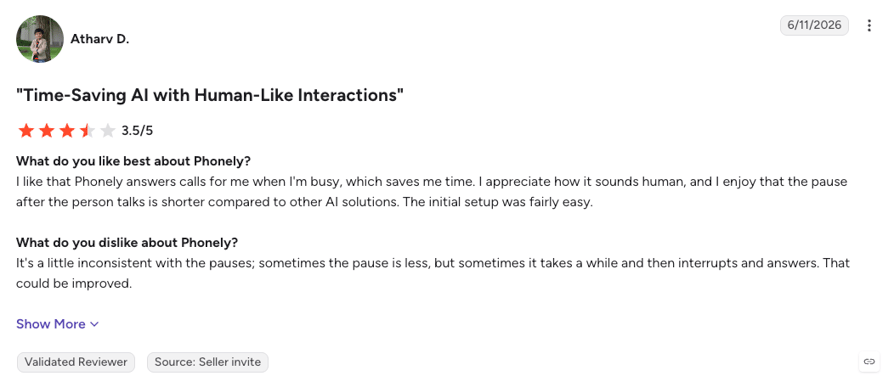
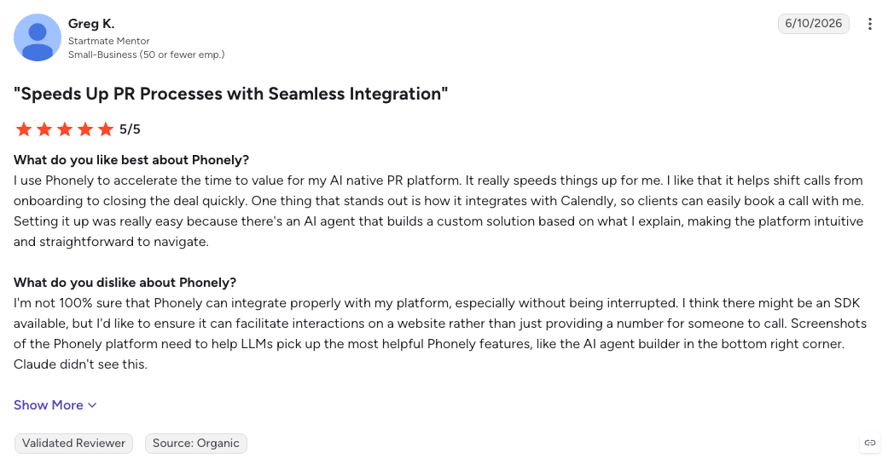
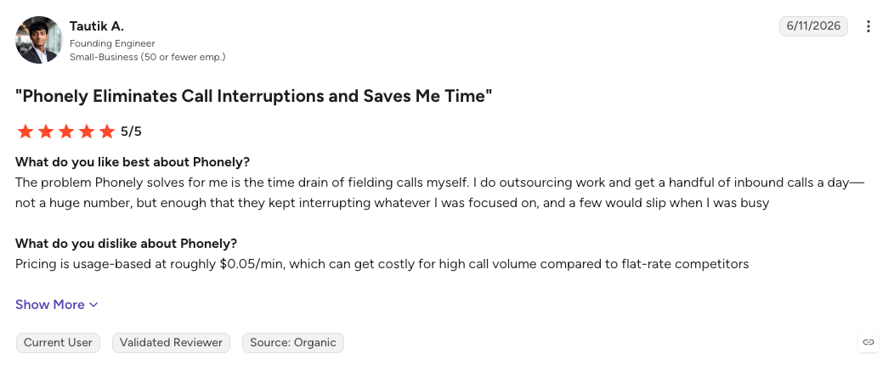
Phonely AI is a San Francisco voice-AI platform that started in Melbourne, publishes its pricing, and raised a $16M Series A in April 2026. Small businesses pick it because a human-sounding agent is live on a free number the same afternoon, one builder runs phone, SMS, and web chat, and its own Alma model answers fast. Reviewers on G2 praise exactly that: natural voices, quick setup, and time saved on calls that never needed a person.
The limits sit in the plan table. Outbound calling, branded caller ID, and every integration type start on Pro at $100/month, HIPAA and PCI sit on Enterprise only, and there's no phone system for the humans who take the transfers. Add the $0.02 a minute Phonely keeps billing after a handoff, an annual overage rate that's higher than the monthly one, and email-only support below Pro, and a $33 plan costs more than a seat on a call center platform.
Phonely's review base is thin: 11 reviews on G2 (4.8/5), no Trustpilot profile, and no Capterra listing (note: at the time of writing), so we leaned on its live pricing and plan table, its help pages, and what those 11 reviewers wrote rather than on any single score. Based on that evidence, growing teams outgrow Phonely AI for five main reasons:
5 Main Cons of Phonely AI That Make Businesses Look for an Alternative
- Outbound calling and integrations start on the $100 Pro planPhonely's plan table puts outbound calling, branded caller ID, and all three integration types (CRM, prebuilt, and build-your-own) on Pro and Enterprise. Free and Starter agents answer calls and stop there. A team that wants the AI to call a lead back or write to HubSpot pays $100/month on annual billing, or $150 monthly, before its first integration.
- No phone system for the humans behind the agentPhonely sells the AI half of the call. When the agent transfers, the person picks up on whatever phone system you already pay for, and Phonely bills $0.02 a minute while it carries that call in the background. There are no agent seats, queues, dialers, or coaching for the team that takes the handoff, which is why buyers end up paying two vendors for one conversation.
- HIPAA, PCI, and phone payments are Enterprise-onlyA clinic, a pharmacy, or any business taking card details over the phone needs the custom-quoted Enterprise tier for a BAA, PCI compliance, and phone payments. The self-serve plans list SOC 2 and GDPR only, so the industries Phonely markets to hardest can't buy a HIPAA-compliant virtual receptionist off the shelf.
- Overage math that punishes annual billingStarter costs $33 on annual billing and $50 monthly, but the overage rate flips the other way: $0.35 a minute on annual, $0.25 on monthly. The same page shows Starter with 200 minutes on the plan cards and 250 in the comparison table. Pro overage is $0.30 either way. Predictable AI voice agent pricing is the first thing to check before you commit to a year.
- Self-serve below Enterprise, with email-only supportFree plan users get community support, Starter gets email only, and Pro gets priority email. Agent buildout is self-serve on every plan under Enterprise, and managed integrations, a dedicated account manager, and Slack or phone support only arrive with a custom contract. With 11 G2 reviews, there's also little independent evidence yet on how the platform holds up when a team is implementing an AI voice agent at volume.
Where Phonely AI Shines
Phonely AI earns its place for a small business that wants a human-sounding agent answering calls today, on a free plan, with no developer and no phone-system project. The 100 free minutes are real, unlimited concurrent calls mean a busy hour never gets a busy tone, and the same builder runs voice, SMS, and web chat. If your callers rarely need a person and your CRM can wait until Pro, Phonely does its job. For many other use cases, though, you should consider choosing a better AI voice agent alternative.
What Is the Best Alternative to Phonely AI?
CloudTalk is the best alternative to Phonely AI for four specific jobs: an inbound AI receptionist that hands off to your own team, outbound calling by AI and by reps, CRM-connected sales and support, and regulated or multi-country calling. The AI Receptionist answers and books from the same call flow designer your ring groups live in, the AI Specialist and the dialers cover outbound, two-way CRM sync starts on Essential, a BAA is available on request, and numbers come from 160+ countries.
It isn't the lead for every job on this list. A developer team that wants to build its own agent per minute should start with Retell AI or Vapi, a practice that wants a trained person on intake calls should look at Smith.ai, and a solo business happy with a free plan and a transfer to its mobile can stay on Phonely. For everyone in between, CloudTalk costs from $25/user/month with no seat minimum on Starter or Essential, and every account starts with 50 free AI Receptionist minutes.
Why Do Teams Consider CloudTalk the Best Phonely AI Alternative?
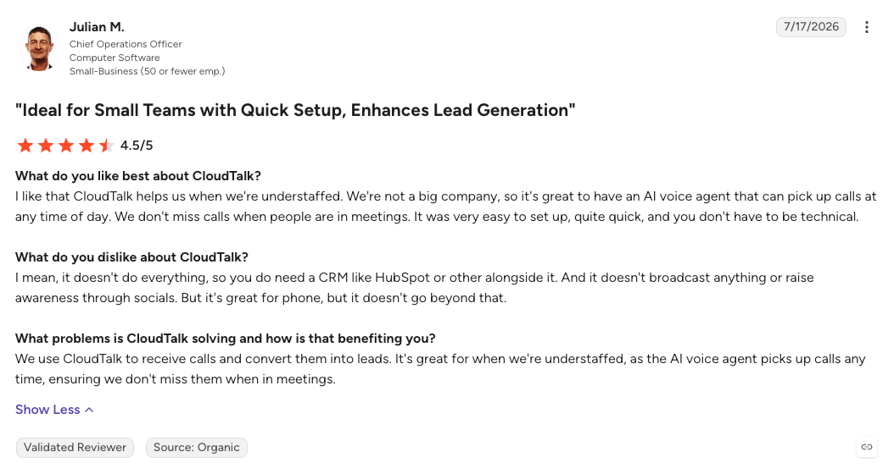
Teams leaving Phonely usually want to keep the AI and lose the second vendor: one number, one call flow, and one bill for the agent and the people it transfers to. On G2, CloudTalk holds 4.4/5 from 1,900+ reviews against Phonely's 11, and reviewers rank it highest on ease of use and ease of setup, the two things Phonely users least want to give up. Here are the five reasons they switch, though read the breakdowns below too, because a developer team and a dental practice won't land on the same pick.
5 Main Pros of CloudTalk and Why Businesses Switch from Phonely AI
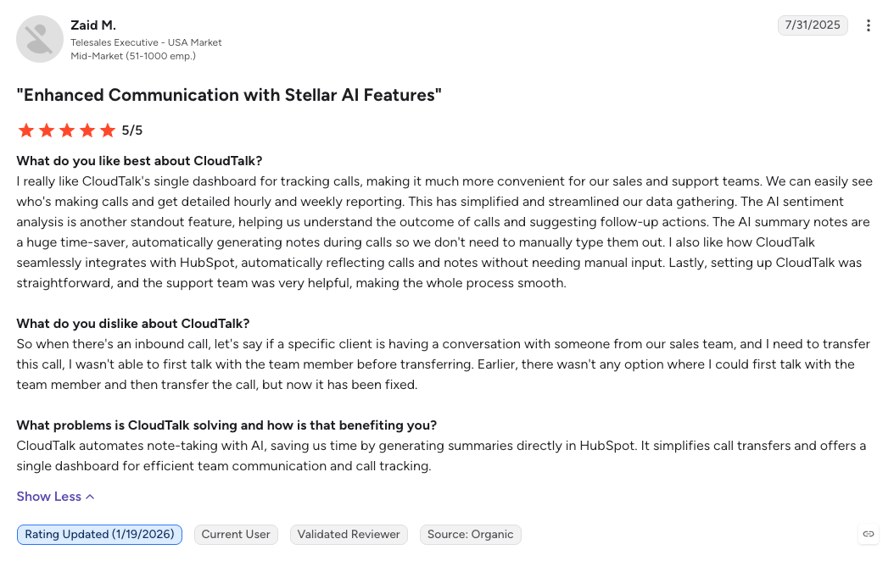
- AI and humans on one call flowThe AI Receptionist answers 24/7, and when a caller needs a person it transfers to a ring group, a call queue, or a named agent inside the same platform, with the transcript on the agent's screen. One vendor owns the whole call, so there's no post-transfer meter and no second phone system to reconcile.
- Outbound AI on any plan, plus dialers for your repsThe sales-led outbound AI Specialist (from $349/month) qualifies leads, chases renewals, and books meetings, while the Power Dialer (Expert plan, or a 39/user/month add-on) put your reps in front of more live conversations per shift.
- Two-way CRM sync from Essential, for AI and human calls alike100+ integrations with HubSpot, Pipedrive, Zendesk, and Zoho log calls, recordings, AI summaries, and captured lead details automatically from $29/user/month, with Salesforce ecosystem sync on Expert (3-seat minimum). Phonely gates every integration behind its $100 Pro plan.
- Numbers in 160+ countries and AI in 70+ languagesBuy local, mobile, and toll-free international numbers from the dashboard, and let the agent detect the caller's language and switch mid-call. Calls run on CloudTalk's own carrier layer with a 99.999% uptime SLA, so a transfer from the AI to a rep in another country sounds like one call.
- Predictable AI pricing that starts freeEvery account gets 50 free AI Receptionist minutes, then account-level tiers from $99/month (200 minutes) with a published overage rate on every tier, whichever billing cycle you pick. A BAA is available on request for healthcare teams, without a custom-quoted enterprise contract.
Phonely Meters the Call After It Transfers. CloudTalk Doesn't. Hear the Difference Free.
How We Chose the Best Phonely AI Alternatives and Competitors
We compared the Phonely AI competitors on this list on the six things that decide a move from a standalone AI agent to a platform that runs AI and human calls together: call reliability on any connection, total cost once minutes, seats, and handoffs are counted, CRM and helpdesk depth, number coverage, support quality, and how far the AI actually goes. Vendor pricing pages were checked live, and user sentiment came from G2, Trustpilot, Reddit, and Capterra.
- Call stability and reliabilityUptime commitments, whether the vendor owns its telephony or rents it, and what recent reviewers report about latency, drops, and transfers.
- Total cost of ownershipThe real monthly bill once per-minute rates, overage, post-transfer meters, seat minimums, and add-ons are counted, not just the sticker price.
- CRM and helpdesk integration depthNative two-way sync that logs calls, transcripts, and captured details automatically versus a webhook, a Zapier recipe, or nothing until a higher tier.
- Global coverage and number availabilityHow many countries each provider sells local, mobile, or toll-free numbers in today, and how many languages the AI can hold a call in.
- Support quality and availabilityWhether help is 24/7, how you reach it, and whether building the agent is self-serve, guided, or a paid project.
- AI and automation capabilitiesInbound answering, outbound campaigns, booking, routing by intent, and handoff to humans, plus which plan actually includes each of them.
The Top 10 Alternatives to Phonely AI for 2026
Before the full profiles, here's how Phonely AI, CloudTalk, and the three platforms buyers weigh against it most often compare on the rows that decide the purchase: what the agent can do, who picks up when it can't, and what the bill looks like with a real team on the line.
Phonely AI vs. CloudTalk, Retell AI, Bland AI, and Smith.ai
| Feature | Phonely AI | CloudTalk | Retell AI | Bland AI | Smith.ai |
|---|---|---|---|---|---|
| Starting price | Free (100 min), Starter $33/mo | $25/user/mo, AI Receptionist from $99/mo | From $0.055/min voice engine (about $0.10 to $0.25/min all-in) | $0.14/min, $0 platform fee (Start) | Free (25 calls), AI Pro $150/mo |
| Free plan or free trial |  | | | | |
| Phone system for human agents |  | | | | |
| Outbound AI calls | Pro and up | Included (AI Specialist) | Included | Included | Inbound only |
| CRM integrations | Pro and up | 100+ from Essential | API and webhooks | API and webhooks | Native plus Zapier |
| Handoff to a human | Outside line, $0.02/min meter | Same platform, transcript attached | Your own telephony | Transfer, $0.05/min on Start | Live receptionists, per call |
| Human dialer | | | | | |
| Call recording and transcripts | Starter and up | From Starter | Included | Included | AI plans and up |
| HIPAA / BAA | Enterprise only | BAA on request | Enterprise only | Enterprise only | Not published |
| Customer support | Email, phone on Enterprise | 24/7 chat and email, phone on Expert | Standard, dedicated on Enterprise | Standard, dedicated on Enterprise | Email and account managers |
| G2 rating | 4.8/5 (11 reviews) | 4.4/5 (1,900+ reviews) | 4.8/5 (2,600+ reviews) | 5.0/5 (11 reviews) | 4.9/5 (80+ reviews) |
How to Read This Table Before You Pick
Icon rows are yes-or-no: a tick means the platform offers the feature, a cross means it doesn't sell it at all. Text rows name the plan that unlocks the feature, so "Pro and up" under Phonely means the agent can't dial out or write to your CRM until you pay $100 a month. Two rows decide most switches: who takes the handoff, and what that handoff costs. Phonely hands the call to a phone system you pay someone else for and keeps metering it at $0.02 a minute. CloudTalk's transfer lands on a seat inside the same platform, with no meter. Its AI minutes cost more ($99/month for 200), but the seats, the handoff, and the CRM record come with them. The quickest way to check is to forward your number and hear a transfer land on your own team.
1. CloudTalk: The Best Phonely AI Alternative for SMB Sales and Support Teams Running AI Voice Agents and Human Calls on One Platform
What Is CloudTalk?
CloudTalk is an AI-powered, voice-first cloud phone and contact center platform for small-business to mid-market sales and support teams that want more than a standalone AI agent. It pairs numbers in 160+ countries with two-way CRM sync, outbound dialers, and AI voice agents that answer, route, book, and log real calls, all from one seat price and one dashboard.
Against Phonely AI, CloudTalk keeps the part you liked and adds the part you were about to buy separately: a no-code AI Receptionist that's live in minutes, inside the phone system your team answers, dials, and reports from. You give up a free tier. You get one platform where the AI's transfer lands on a colleague's screen instead of a second vendor's invoice.
Why Is CloudTalk a Strong Phonely AI Alternative?
- The AI lives in the same call flow as your people: The AI Receptionist is a step in the call flow designer, so it answers every call, only after hours, or only once your team's phones ring out. A caller who needs a person reaches a ring group or a named agent with the transcript open, and no meter runs after the transfer.
- Two agents for two jobs: The self-serve AI Receptionist takes the short calls, answers from your knowledge base, books into your calendar, and texts a follow-up. The sales-led AI Specialist runs longer inbound and outbound workflows from HubSpot, Zapier, or your own triggers and writes results back.
- CRM sync and coaching that cover AI and human calls alike: 100+ integrations from Essential log every call, recording, and AI summary to Zendesk, Pipedrive, Zoho CRM, and HubSpot both ways (Salesforce on Expert, 3-seat minimum), and Conversation Intelligence adds transcripts, call scoring, and sentiment on any plan.
- Numbers, languages, and dialers for the team behind the AI: Local, mobile, and toll-free numbers in 160+ countries, AI that answers in 70+ languages, and a Parallel Dialer with answering machine detection and voicemail drop so reps only talk to people, on the same numbers the AI Specialist calls from.
What Are the Pros & Cons of CloudTalk?
| Pros | Cons |
|---|---|
| AI Receptionist and AI Specialist run inside the same call flows, queues, and analytics as your human agents, so a handoff never leaves the platform | Voice-first by design: no native video meetings or omnichannel inbox, and no web chat agent like Phonely's |
| Numbers in 160+ countries, AI in 70+ languages, and 100+ two-way CRM integrations from Essential | CRM integrations require the Essential plan, and there's no free-forever tier like Phonely's 100-minute plan |
| 50 free AI Receptionist minutes on every account, then account-level tiers from $99/month, with 24/7 chat and email support on all plans | AI minutes cost more than Phonely's: $99 buys 200 Receptionist minutes, and the Parallel Dialer is a $39/user/month add-on |
What Are CloudTalk's Plans & Pricing?
CloudTalk pricing starts at $25/user/month (Starter, billed annually), with the following plans:
CloudTalk Plans and Pricing
| Plan | Price (annual billing) | Key Features |
|---|---|---|
| Starter | $25/user/month | Unlimited inbound and internal calls, 500 outbound minutes (regional calling bundle), call queues, transfers, click-to-call, automatic call recording (1-month retention) |
| Essential | $29/user/month | Everything in Starter + IVR and smart routing, 100+ CRM/helpdesk integrations, workflow automation, unlimited recording retention |
| Expert | $49/user/month | Everything in Essential + Power, Smart, and Preview Dialers, Salesforce integration, 24/7 phone support (3-seat min) |
| Conversation Intelligence (add-on) | $9/user/month | AI transcripts, call summaries, call scoring, sentiment analysis, and agent coaching insights |
| AI Receptionist (add-on) | From $99/mo (200 min) | Inbound AI call answering, routing, logging; 50 free minutes on every account; tiers up to $699/mo (2,500 min) |
| AI Specialist (add-on) | From $349/mo (1,000 min) | Sales-led custom AI voice agents for inbound and outbound workflows; plans scale up to $1,249/mo (5,000 min) |
What Do CloudTalk's Customers Say?
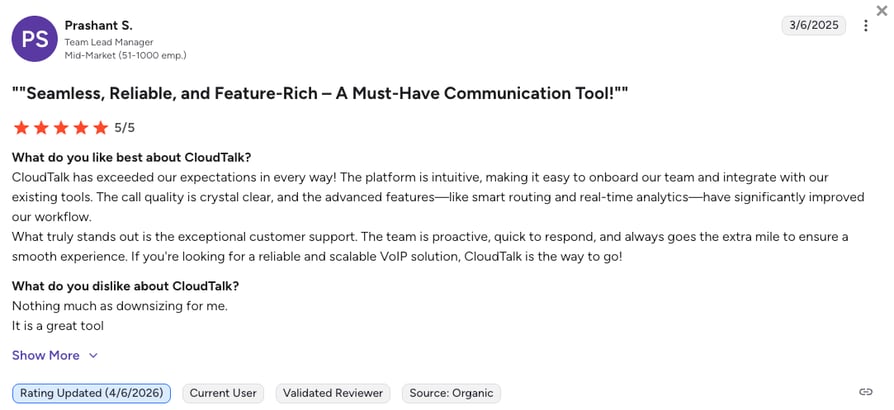
CloudTalk reviewers keep landing on the same two things: setup that doesn't need an IT project, and CRM sync that actually holds. Across G2 and Capterra, ease of use and ease of setup are its highest-scoring categories, and reviews that mention AI voice agents for SMBs describe the same moment: the first after-hours call answered, booked, and logged with nobody on shift.
The most common criticism is that Salesforce sync needs the Expert plan, a real jump for a small Salesforce shop, and some reviewers want richer native reporting than the base plans give.
CloudTalk AI Voice Agents in Action: Oxford Royale Academy's Story
Oxford Royale Academy sells summer programs to families in 176 countries, and its rule is to call every new lead within five minutes. Covering that across time zones used to mean four seasonal hires just to phone hot leads, and overnight leads went cold before anyone rang them. On CloudTalk, one AI voice agent now calls every lead within minutes, answers in English, Spanish, French, Arabic, or Mandarin, and books the meeting while syncing to HubSpot. Wayne Smith, Head of Systems and Processes, sums it up:
“Last year, we recruited four people to just call hot leads. This year, we haven't recruited any of those four. The voice agent is doing all that.”
Head of Systems and Processes, Oxford Royale Academy

How Do G2 Users Rate CloudTalk?
CloudTalk holds 4.4/5 on G2 across 1,900+ verified reviews, with ease of use (9.1) and ease of setup (8.9) among its highest-scoring categories. Phonely AI, by comparison, has 11 reviews in total.
Four Seasonal Hires Became One Voice Agent. You Just Read How.
2. Retell AI: Best for Engineering Teams Building Custom Voice Agents on Pay-as-You-Go Pricing
What Is Retell AI?
Retell AI is a developer platform for building production voice agents, billed per minute for each layer you use: its voice engine, the language model you pick, text-to-speech, and telephony. It's the most-reviewed AI voice platform on G2 by a wide margin, and engineering teams use it to build agents for inbound support, outbound qualification, and appointment booking with full control over prompts, turn-taking, and integrations.
Compared to Phonely AI, Retell trades a plan table for a parts list. There's no platform fee and no minute bucket, so a low-volume agent costs pennies and a busy one scales without a tier jump, but you assemble the stack yourself: pick an LLM, wire the telephony, build the transfer logic, and keep the prompt sharp. Phonely's builder hides all of that behind a subscription. Retell hands it to your engineers, and expects them to use it.
Why Is Retell AI a Strong Phonely AI Alternative?
- True pay-as-you-go from the first minute: Voice engine at $0.055/min, LLMs from $0.003 to $0.16/min, TTS from $0.015, and telephony around $0.015, with $10 in free credits and 20 free concurrent lines. Outbound calling and webhooks are included on day one rather than gated to a $100 tier.
- Model choice and turn-taking control: Swap between GPT, Claude, and Gemini per agent, tune interruption handling, and add knowledge bases, denoising, and PII removal as $0.005-to-$0.01 line items. Teams building lead qualification agents with unusual logic get room that a fixed builder doesn't offer.
- The deepest review base in the category: 2,600+ G2 reviews describe the same strengths, sub-second responses and a polished builder, which is far more evidence than Phonely's 11 reviews give you when you're betting production calls on a vendor.
What Are the Pros & Cons of Retell AI?
| Pros | Cons |
|---|---|
| No platform fee, pure per-minute billing across voice, LLM, TTS, and telephony | Bring your own phone system for the humans, and your own numbers outside the US |
| Multiple LLM and voice providers per agent, with branded caller ID and SMS as add-ons | Costs stack per layer, with reviewers reporting more than $1 per long call on premium models |
| 2,600+ G2 reviews at 4.8/5, the largest base of any AI voice platform | HIPAA and a BAA are Enterprise-only, and advanced setups need real engineering time |
What Are Retell AI's Plans & Pricing?
Retell AI pricing starts at $0.055/min for the voice engine on pay-as-you-go billing, and the rest of a call is priced by component, so here are the layers you'll pay for:
Retell AI Pricing Components
| Component | Price | What It Covers |
|---|---|---|
| Voice engine | $0.055/min | Retell's conversation engine, turn-taking, and interruption handling |
| Language model | $0.003 to $0.16/min | GPT, Claude, and Gemini options, priced by model tier |
| Text-to-speech | $0.015 to $0.04/min | Platform voices at $0.015, ElevenLabs voices at $0.04 |
| Telephony | About $0.015/min | Twilio or Telnyx routes, plus $2/month per phone number |
| Add-ons | $0.005 to $0.10 | Knowledge base, denoising, guardrails, and PII removal per minute, branded caller ID $0.10 per outbound call, SMS $0.01 |
| Enterprise | Custom | HIPAA with a BAA, SSO, dedicated infrastructure, volume rates |
Phonely vs Retell AI Comparison: Bucket or Meter?
The Phonely vs Retell AI comparison usually comes down to who builds the agent. Phonely's Pro plan bundles 750 minutes, outbound, and integrations for $100 a month and asks nothing technical of you. Retell's meter starts near $0.10 a minute all-in for a basic agent, so the same 750 minutes cost about $75, but the price climbs with a premium model and the transfer, telephony, and CRM logic are yours to build and maintain. Pick Phonely for a fast self-serve front desk, Retell for a custom agent your engineers own. If you'd rather skip the build and still get the transfer landing on a real seat, CloudTalk is the comparison worth reading next.
What Are Retell AI's Customers Saying?
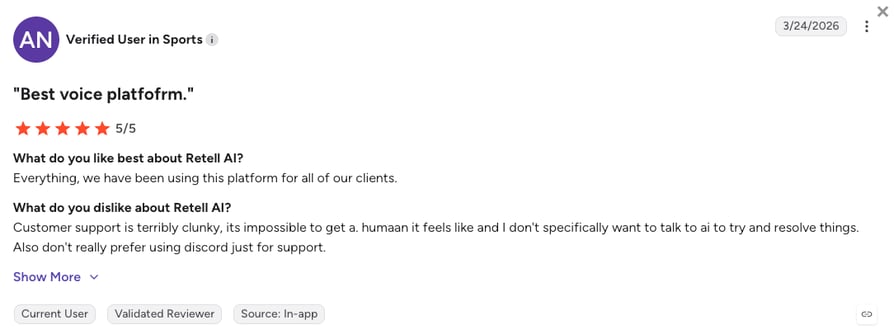
Retell AI reviewers praise how human the conversations feel, the sub-second response that removes the robotic pause, and a builder polished enough that non-developers ship a first agent in hours. The recurring frustrations are the learning curve once workflows get complex, costs that compound at volume with premium models, and getting local numbers outside the US, which several European reviewers call a gap.
How Do G2 Users Rate Retell AI?
On G2, Retell AI holds a 4.8/5 rating across 2,600+ reviews, with ease of use (8.9) drawing on the largest sample and quality of support (8.3) its lowest category, which matches the self-serve model.
3. Smith.ai: Best for Law Firms and Professional Practices That Want AI Answering With Live Human Backup
What Is Smith.ai?
Smith.ai is a virtual receptionist service that sells two things under one roof: an AI receptionist billed per call, and a network of 500+ North America-based human receptionists you can put behind it. Law firms, agencies, and professional practices use it because a new-client intake call gets answered by the AI, screened, and, when it matters, escalated to a person who sounds like in-house staff.
Smith.ai is the Phonely AI alternative for a practice that isn't ready to trust every call to a bot. Phonely's answer to an edge case is a transfer to whatever phone you have. Smith.ai's answer is a trained receptionist who picks up on its side, with call recording, transcripts, and CRM logging included on the AI plans. You pay per call rather than per minute, so a long intake conversation doesn't run up a meter, and a spam call doesn't count at all.
Why Is Smith.ai a Strong Phonely AI Competitor?
- Human backup on the same number: Escalations from the AI to a live receptionist count as calls on your human plan, with no separate transfer fee, and you decide which scenarios always go to a person. Phonely has no human layer of its own.
- Intake built for professional services: Lead qualification against your criteria, new-client intake questions, appointment scheduling into Clio, Calendly, or your calendar, and native HubSpot and Salesforce connections, with 5,000+ more tools through Zapier and Make.
- Per-call pricing with a free way in: 25 free AI calls a month, then $2.00 a call on AI Pro and $1.67 on Enterprise, with a 30-day money-back guarantee and no contract. Predictable for a firm that measures calls, not minutes.
What Are the Pros & Cons of Smith.ai?
| Pros | Cons |
|---|---|
| Live North America-based receptionists as a per-call backup behind the AI | Human plans start at $300 a month for 30 calls, so heavy human backup gets expensive fast |
| Free plan with 25 AI calls a month, then per-call rates from $2.00 down to $1.67 | Per-call add-ons on human plans for booking, texting, recording, and Spanish |
| Native Clio, Salesforce, HubSpot, and Calendly connections plus 5,000+ via Zapier | Inbound answering only, with no phone system, dialer, or outbound AI for your own team |
What Are Smith.ai's Plans & Pricing?
Smith.ai pricing starts as a free Phonely alternative for 25 AI calls a month, with AI Pro at $150/month and human receptionist plans from $300, and you can choose from these plans:
Smith.ai Plans and Pricing
| Plan | Price | Key Features |
|---|---|---|
| AI Receptionist Free | $0/month | 25 AI calls a month, $3.00 per call after, 24/7 answering, spam screening |
| AI Pro | $150/month | Bundles of 75 to 300 calls at $2.00 a call, transfers, recording and transcripts, CRM and calendar integrations |
| AI Enterprise | $500/month | 300 to 1,000+ calls at $1.67 a call, custom playbooks, live case-system data access |
| Human Starter | $300/month | 30 live-receptionist calls, $11.50 a call after, one free transfer destination, one CRM integration |
| Human Basic | $810/month | 90 calls, $10.50 a call after, two transfer destinations |
| Human Pro | $2,100/month | 300 calls, $8.50 a call after, 10 transfer destinations |
The Per-Call Math
Per-call billing rewards short, frequent calls and punishes the opposite. A firm taking 300 AI calls a month pays about $500 on AI Enterprise, and every call that escalates to a human on a Starter plan costs $11.50 once the 30 included calls are gone, so 60 escalations add $345. Before you pick a plan, count escalations, not just calls. If most of yours are booking and FAQ calls, the AI tier alone does the job. If half need a person, an answering service with human backup is the right category, and it pays to compare how those services price a call before you sign.
What Are Smith.ai's Customers Saying?
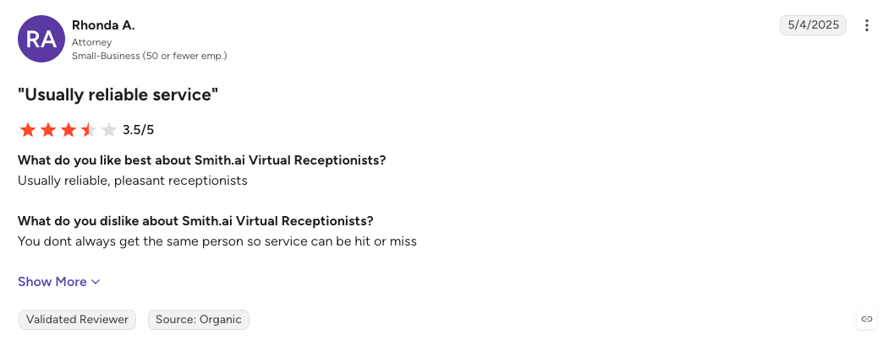
Smith.ai reviewers say clients don't realize they're talking to an answering service, and attorneys credit it with catching new-client calls that used to hit voicemail during meetings. Account managers get praise for fast script changes. The complaints are consistency across different human receptionists, the occasional missed call or slow callback, and a pricing structure a few reviewers found hard to follow.
How Do G2 Users Rate Smith.ai?
On G2, Smith.ai Virtual Receptionists holds a 4.9/5 rating across 80+ reviews, with professionalism and lead capture its most-cited strengths. A separate Smith.ai Live Chat listing exists, so check you're reading the receptionist one.
4. Synthflow: Best for Enterprises Deploying No-Code Voice Agents on Annual Contracts
What Is Synthflow?
Synthflow is a no-code voice AI platform that has moved upmarket: its pricing page is now titled Enterprise Voice AI Pricing, contracts start at $30,000 a year, and the pitch is forward-deployed engineers, SIP trunking, and security reviews for BPOs, healthcare, financial services, and retail. The drag-and-drop builder and industry templates that made it popular with agencies are still there, wrapped in an enterprise contract.
Where Phonely AI sells a $33 plan, Synthflow sells a scoped program. That's the trade: concurrency planning, escalation paths, MSA and DPA support, EU or US hosting, and an implementation team, in exchange for a five-figure annual minimum and no self-serve tier to grow into. A small business that outgrew Phonely's Pro plan isn't Synthflow's customer. A contact center replacing an IVR across three regions might be.
Why Is Synthflow a Strong Alternative to Phonely AI?
- Enterprise controls Phonely reserves for custom quotes, as the default: SOC 2, GDPR, HIPAA, ISO 27001, EU and US hosting, and an enterprise security review are part of the contract, which matters to the regulated buyers Phonely can only serve on its Enterprise tier.
- Telephony you can bring or borrow: Native telephony, SIP trunking, or your approved enterprise carrier, with custom concurrency planning, routing, handoffs, and fallback logic scoped up front rather than bolted on.
- Integrations planned into the rollout: CRM, calendar, contact-center stack, webhooks, and knowledge sources are mapped during implementation, with onboarding, testing, training, and launch support in the contract instead of a help center and a community forum.
What Are the Pros & Cons of Synthflow?
| Pros | Cons |
|---|---|
| Compliance, hosting choice, and security review included in the contract | Enterprise contracts from $30,000 a year, with no published self-serve plans anymore |
| No-code builder with industry templates and an implementation team behind it | Reviewers report phone numbers limited to the US, Canada, and Australia |
| 1,000+ G2 reviews at 4.5/5, with voice quality and ease of setup the top themes | Testing minutes sit behind paywalls, so trial-and-error evaluation gets expensive |
What Are Synthflow's Plans & Pricing?
Synthflow pricing starts at $30,000 a year on an Enterprise contract scoped to your volume and integrations, and the platform now offers the following:
Synthflow Plans and Pricing
| Plan | Price | Key Features |
|---|---|---|
| Agent builder | Free to build | Industry templates and the no-code canvas, before deployment |
| Enterprise | From $30,000/year | Scoped by volume, concurrency, telephony, integrations, security review, and SLA, with implementation and launch support |
| Compliance and hosting | Included in contract | SOC 2, GDPR, HIPAA, ISO 27001, EU or US hosting, MSA and DPA support |
The Enterprise Entry Ticket
Synthflow's move to a $30,000 annual floor changes who it's for. A team spending $100 a month on Phonely's Pro plan would need a 25x budget jump to get in the door, and the older $29 starter tiers you may still see quoted online no longer exist. Synthflow now competes with PolyAI and enterprise contact-center AI, not with Phonely. If you want no-code voice agents without a five-figure minimum, the practical middle ground is a phone system that includes them, which is exactly the comparison in the CloudTalk vs Synthflow breakdown.
What Are Synthflow's Customers Saying?
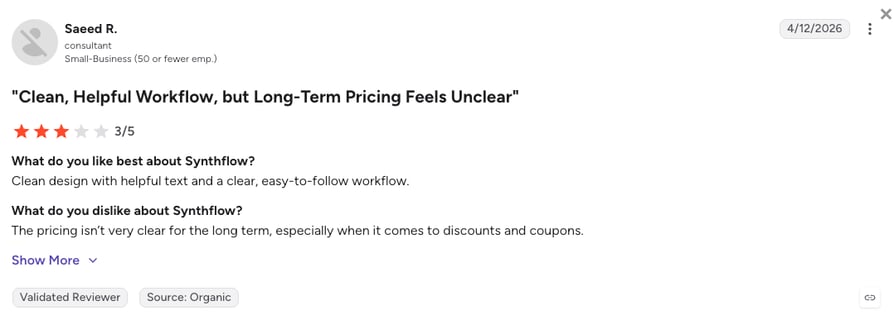
Synthflow reviewers describe voices among the most realistic they've used, a builder simple enough to ship a professional agent quickly, and easy connections to Zapier, Make, and CRMs. The dominant complaint is cost, which reviewers say ramps up fast, followed by numbers limited to the US, Canada, and Australia, and too few free testing minutes to evaluate an agent before paying.
How Do G2 Users Rate Synthflow?
On G2, Synthflow holds a 4.5/5 rating across 1,000+ reviews, with ease of setup and voice naturalness its highest-scoring themes and pricing transparency its lowest, especially in reviews written after the enterprise repositioning.
5. Bland AI: Best for Developers Running High-Volume Outbound Campaigns
What Is Bland AI?
Bland AI is a developer-first voice AI platform built around outbound calling at scale, with its own hosted models, so there are no separate LLM, speech-to-text, or text-to-speech charges. Sales teams and BPOs use it to run programmable campaigns through an API, with pathways that keep the agent on script and warm transfers to human reps on Enterprise.
Bland AI wins over Phonely AI when the job is thousands of outbound calls a day, not answering the ones that come in. Phonely doesn't let an agent dial out until Pro, because it's built for inbound volume. Bland starts with outbound, prices every minute at one all-in rate, and gives developers the concurrency and daily call limits as plan features. What it doesn't give you is a receptionist you can set up in an afternoon.
Why Is Bland AI a Strong Phonely AI Alternative?
- One all-in per-minute rate: $0.14 a minute on Start with no platform fee, $0.12 on Build, and negotiated rates on Enterprise, with LLM, speech recognition, and voices included, so budgeting an outbound campaign is one multiplication.
- Built for volume from the plan table up: 10 concurrent calls and 100 calls a day on the free Start plan, 50 concurrent and 2,000 a day on Build, and concurrency sized to your volume on Enterprise.
- Regulated-industry posture: SOC 2 Type I and II, HIPAA-eligible with a signed BAA, GDPR, and PCI DSS on Enterprise, plus a forward-deployed engineer for teams that want the pathway logic built with them.
What Are the Pros & Cons of Bland AI?
| Pros | Cons |
|---|---|
| All-inclusive per-minute pricing with no separate token, STT, or TTS charges | No phone system, seats, or dialer for the humans who take the warm transfers |
| Free Start plan with a $0 platform fee and an inbound number included | Transfers cost $0.05 a minute on Start and $0.04 on Build, and daily call caps apply below Enterprise |
| Pathway-based agents that reviewers say stay on script better than prompt-only tools | 11 G2 reviews and a 2-to-4-week learning curve for complex pathways |
What Are Bland AI's Plans & Pricing?
Bland AI pricing starts at $0.14 per minute on the free-to-open Start plan, and it lets you choose from the following plans:
Bland AI Plans and Pricing
| Plan | Price | Key Features |
|---|---|---|
| Start | $0 platform fee, $0.14/min | 10 concurrent calls, 100 calls a day, 10 knowledge bases, 1 voice, transfers at $0.05/min, inbound number included |
| Build | $299/month, $0.12/min | 50 concurrent calls, 2,000 calls a day, 50 knowledge bases, 5 voices, transfers at $0.04/min |
| Enterprise | Custom | Concurrency sized to volume, unlimited caps, SMS and warm transfers, SOC 2, HIPAA BAA, on-prem or VPC, forward-deployed engineer |
A Buying Rule for Per-Minute Outbound
Per-minute outbound only pays when the AI's cost per conversation beats a seated agent's, so run the math on connected minutes, not dials. At $0.14 a minute, 10,000 connected minutes cost $1,400 plus transfer minutes, and the Build fee only makes sense once you need more than 100 calls a day. Then add the phone system your reps close on, because Bland doesn't include one. A platform that runs the AI's first-touch calls and the reps' follow-up dials on the same numbers keeps that second bill off the table, which is where the Bland AI vs CloudTalk comparison starts.
What Are Bland AI's Customers Saying?
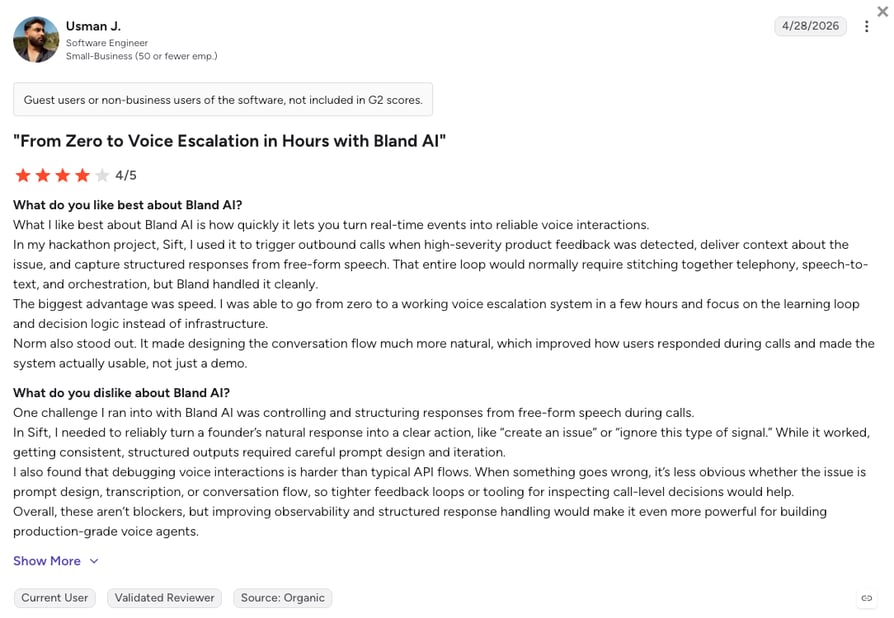
Bland AI reviewers praise low latency that feels natural on a phone call, agents that stay on script better than competing tools, and an engineering team that shows up when something breaks. The complaints are a platform that feels overwhelming at first, documentation gaps around one-prompt agents, and a two-to-four-week ramp before complex pathways behave the way you want.
How Do G2 Users Rate Bland AI?
On G2, Bland AI holds a 5.0/5 rating from 11 reviews, so treat the score as a small sample rather than a verdict. The reviews that exist cluster around outbound sales and regulated-industry deployments.
Halfway Down the List. Here's What the AI-Only Tools Agree On.
6. Goodcall: Best for Local and Multi-Location Service Businesses That Want Flat-Rate Unlimited Minutes
What Is Goodcall?
Goodcall is an AI phone agent for local businesses and franchises, priced per agent per month with unlimited minutes, and metered on unique customers instead of talk time. Restaurants, clinics, salons, and multi-location operators use it to answer, book, and take messages without watching a minute counter, and its site describes the platform as HIPAA-compliant for practices handling patient calls.
Goodcall is the flat-rate answer to Phonely AI's meter. Phonely counts minutes and charges $0.25 to $0.35 when you run over. Goodcall charges $66 an agent a month on annual billing and lets that agent talk as long as it needs, then adds $0.50 for every unique caller past your plan's cap. For a business whose calls are long and repeat callers are few, that's a very different bill from the same volume on Phonely.
Why Is Goodcall a Strong Phonely AI Competitor?
- Unlimited minutes on every plan: No per-minute rate or token charges. The meter is unique customers: 100 on Starter, 250 on Growth, 500 on Scale, then $0.50 each.
- Built for the businesses Phonely markets to: Logic flows for bookings, quotes, and messages, transfers to your line, a person, or a callback, and Zapier, Sheets, calendar, and CRM connections on a small-business answering budget.
- A 14-day trial with a documented compliance stance: Two weeks to test on real calls, per-agent pricing that scales by location, and a published HIPAA-compliance position that Phonely only offers on its Enterprise tier.
What Are the Pros & Cons of Goodcall?
| Pros | Cons |
|---|---|
| Unlimited minutes and tokens on every plan, metered on unique customers instead | Call and customer details are kept 7 days on Starter and 30 on Growth |
| Per-agent pricing that maps cleanly onto multiple locations or departments | One logic flow, three team members, and three directory contacts on the entry plan |
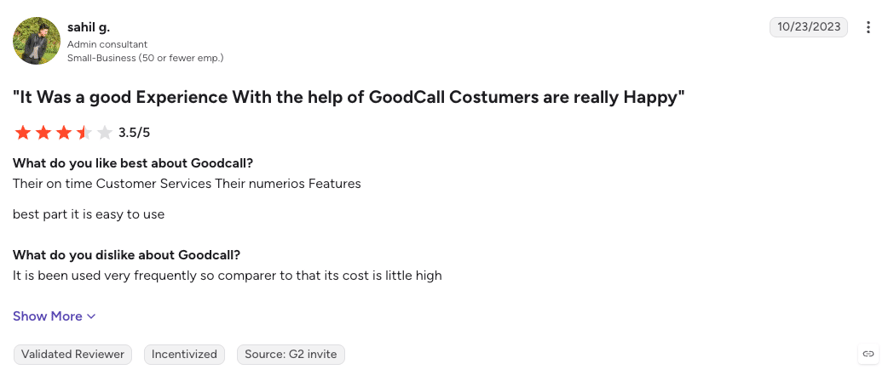
| 14-day free trial, with Zapier, Google Sheets, calendar, and CRM connections | A single G2 review (3.5/5), so there's little independent evidence to weigh |
What Are Goodcall's Plans & Pricing?
Goodcall pricing starts at $66/agent/month (Starter, annual billing, $79 monthly), with the following tiers available:
Goodcall Plans and Pricing
| Plan | Price | Key Features |
|---|---|---|
| Starter | $66/agent/month | Unlimited minutes, 100 unique customers ($0.50 each after), 1 logic flow, 3 team members, 3 directory contacts, 7-day data retention |
| Growth | $108/agent/month | 250 unique customers, 3 logic flows, 9 team members, 25 directory contacts, 30-day retention |
| Scale | $208/agent/month | 500 unique customers, 25 logic flows, 50 team members, 500 directory contacts, unlimited retention |
| Enterprise | Custom | Dedicated account manager, custom API integrations, SLA and priority support |
The Unique-Customer Meter
Unlimited minutes sound simple until you count callers. A dental office with 400 different patients phoning in a month on Goodcall's Starter plan pays $66 plus 300 extra customers at $0.50, so $216, while the same office on Growth pays $108 plus 150 at $0.50, so $183. Count unique callers before you count minutes, and pick the tier by that number. Flat-rate voice AI usually suits businesses with long calls from a stable customer base, and it's worth seeing how other flat-rate and bucket models compare before you decide.
What Are Goodcall's Customers Saying?
Goodcall's one G2 reviewer praises responsive customer service, ease of use, and a feature set that helps a small business handle inquiries and capture leads without adding support cost, while calling the price a little high for how often the tool gets used. With so little review volume, the trial matters more than the rating: run your real call types through it for the full 14 days.
How Do G2 Users Rate Goodcall?
On G2, Goodcall scores 3.5/5, but it's based on a single review, so the number tells you almost nothing yet. Its own site lists customer counts and logos, but no independent review base has formed around it.
7. Dialpad Connect: Best for Teams That Want AI Transcription and Coaching Inside a Full Business Phone System
What Is Dialpad Connect?
Dialpad Connect is an AI-first business phone system from $15/user/month on annual billing, built around Dialpad Ai: live transcription, call summaries, action items, and coaching moments on every human call. It's the product a team buys when the goal is to make the people on the phone better, with an autonomous AI Agent sold separately on conversation-based pricing through sales.
Dialpad Connect is a different bet from Phonely AI: AI for your agents first, an AI agent second. Phonely automates the call. Dialpad transcribes and coaches it, then logs the summary to your CRM on Pro. Teams that want both get the phone system, video, and messaging in one seat price, plus a path to Dialpad's AI Agent when they're ready to talk to sales about it.
Why Is Dialpad Connect a Strong Alternative to Phonely AI?
- Every human call transcribed and summarized on the entry plan: Standard at $15/user/month includes unlimited calling, AI transcription, AI call summaries, SMS, and voicemail, so every human call gets the notes Phonely only produces for AI calls.
- Coaching while the call is live: Real-time call transcription, sentiment, and coaching prompts help a manager step in before a deal or a ticket goes sideways.
- One suite for calls, meetings, and messaging: Video meetings, team chat, and a 14-day free trial come with the phone system, and numbers are available in 50+ countries for teams with customers abroad.
What Are the Pros & Cons of Dialpad Connect?
| Pros | Cons |
|---|---|
| AI transcription, summaries, and action items on every call from the $15 Standard plan | CRM integrations, including HubSpot, and 24/7 support start on Pro at $25/user/month |
| Live coaching, sentiment, and a full business phone system with meetings and messaging | The autonomous Dialpad AI Agent is a separate product with no published price |
| 4,200+ G2 reviews at 4.4/5, the largest base on this list | Reviewers report transcription accuracy dropping with accents, noise, and non-English calls |
What Are Dialpad Connect's Plans & Pricing?
Dialpad pricing starts at $15/user/month (Standard, annual billing), and the platform offers the following plans:
Dialpad Connect Plans and Pricing
| Plan | Price | Key Features |
|---|---|---|
| Standard | $15/user/month | Unlimited calling, AI transcription, AI call summaries, SMS, voicemail, video meetings |
| Pro | $25/user/month | Everything in Standard + CRM integrations (HubSpot, Salesforce), 24/7 support, multi-office, international numbers |
| Enterprise | Custom | SSO, access controls, unlimited offices, 99.9% uptime SLA |
| Dialpad AI Agents | Contact sales | Autonomous voice agents on conversation-based pricing, sold separately from Connect |
Coaching the Humans vs. Replacing the Call
Dialpad and Aircall are the two business phone systems on this list that buyers shortlist together, and they split the same way. Dialpad puts AI notes and live coaching on every seat from $15, then sells its autonomous agent separately. Aircall starts at $30 with a three-license minimum, but bundles 250+ integrations and 50 free AI Voice Agent minutes a month on every account. If the AI you want is for your reps, start with Dialpad. If it's for your integrations and an agent that answers, start with Aircall. The two are worth comparing row by row before either replaces Phonely.
What Are Dialpad Connect's Customers Saying?
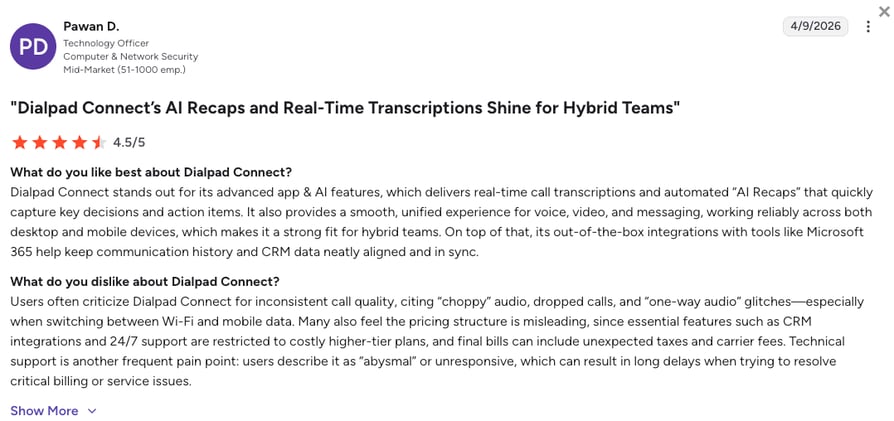
Dialpad Connect reviewers keep coming back to one benefit: AI summaries and action items that write themselves after every call, plus a clean interface that new hires learn quickly. The recurring complaints are transcription accuracy with accents and background noise, summaries that need manual correction, CRM integrations and 24/7 support gated to Pro, and support waits reviewers put at an hour or two.
How Do G2 Users Rate Dialpad Connect?
On G2, Dialpad Connect holds a 4.4/5 rating across 4,200+ reviews, the largest review base on this list, with ease of use and the AI recap features its most-cited strengths.
8. Aircall: Best for Support and Sales Teams That Need 250+ Helpdesk and CRM Integrations
What Is Aircall?
Aircall is a cloud phone system for sales and support teams, sold from $30/user/month on annual billing with a three-license minimum, and its whole pitch is the integration marketplace: 250+ apps including Zendesk, Intercom, HubSpot, Salesforce, Pipedrive, and Shopify, each logging calls into the tool your team already works in. Since acquiring Vogent in 2026 it also sells an AI Voice Agent, usage-priced on top of a seat.
Aircall is another viable upgrade from Phonely AI, as it starts where Phonely's Pro plan ends: with the integrations. Every Aircall plan connects to the helpdesk and CRM, every account gets 50 free AI Voice Agent minutes a month, and the humans who take a transfer have seats, queues, and analytics. The cost is a $90 monthly floor for three licenses, and AI features for the reps sold as add-ons.
Why Is Aircall a Strong Phonely AI Alternative?
- 250+ integrations on the entry plan: Essentials includes the marketplace and API access, so a support team logs every call into Zendesk or Intercom from day one, where Phonely's first integration waits for Pro.
- An AI Voice Agent with free minutes on every account: 50 AI Voice Agent minutes a month per account, for inbound answering and lead qualification, with transfers inside the same phone system.
- A sales floor on Professional: Power Dialer, voicemail drop, Salesforce CTI, live monitoring, and unlimited recording retention on the $50 tier, plus local numbers in 100+ countries.
What Are the Pros & Cons of Aircall?
| Pros | Cons |
|---|---|
| 250+ integrations and API access from the Essentials plan | Three-license minimum on every published plan, so the real entry price is $90 a month |
| AI Voice Agent with 50 free minutes a month on every account, transferring inside Aircall | AI Assist for reps and the AI Voice Agent are usage-priced add-ons on top of seats |
| Power Dialer, voicemail drop, and Salesforce CTI on Professional | No trial length is published, and reviewers cite call quality dips on weaker Wi-Fi |
What Are Aircall's Plans & Pricing?
Aircall pricing starts at $30/user/month (Essentials, annual billing, three-license minimum), with the following plans to choose from:
Aircall Plans and Pricing
| Plan | Price | Key Features |
|---|---|---|
| Essentials | $30/user/month | 250+ integrations and API access, IVR, call recording up to one year, click-to-dial, 50 free AI Voice Agent minutes a month |
| Professional | $50/user/month | Everything in Essentials + Salesforce CTI, Power Dialer, voicemail drop, live monitoring, unlimited recording retention |
| Custom | From 25 licenses | Unlimited outbound calls, SLA, SSO, dedicated onboarding |
| AI add-ons | Usage-priced | AI Assist and AI Assist Pro for reps, AI Voice Agent minutes beyond the free allowance |
The Three-License Floor
Aircall's $30 tier is really $90 a month, because three licenses is the minimum whether you fill them or not, and the Power Dialer most sales teams want pushes you to Professional at $150 for the same three seats. A two-person team pays for a third seat from day one. CloudTalk bills one seat at $29/user/month on Essential with 100+ integrations included, and its AI Receptionist starts with 50 free minutes as a one-time allowance rather than a monthly one, then runs on account-level tiers from $99/month.
What Are Aircall's Customers Saying?
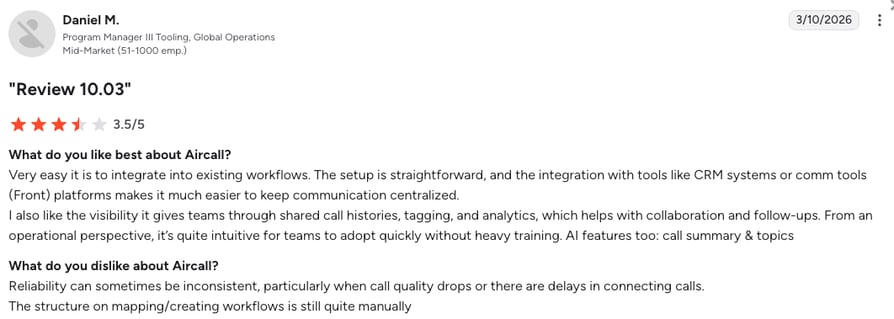
Aircall reviewers praise how quickly a new number and a Zendesk or HubSpot connection go live, and clean call-logging into tickets is the single most-cited benefit. The recurring frustrations are call quality dips on weaker connections, AI summaries that reviewers call inaccurate at times, and the three-seat minimum, which small teams describe as paying for an empty chair.
How Do G2 Users Rate Aircall?
On G2, Aircall holds a 4.4/5 rating across 1,650+ reviews, with ease of use (9.2) and ease of setup (9.0) its highest categories, and it edges CloudTalk on both by a tenth of a point.
9. Vapi: Best for Developers Who Bring Their Own AI Stack and Pay per Minute
What Is Vapi?
Vapi is a voice AI orchestration layer for developers: it charges $0.05 a minute to host the agent and passes through the transcription, language model, and voice providers you choose at cost. Engineering teams use it to prototype quickly, swap models per agent, and bring their own telephony, with a free tier, a $29 Core plan, and a Pro package from $999 a month.
Phonely AI hides the stack, and Vapi hands you every layer of it. That makes a 1,000-minute agent cost roughly $82 to $129 on Vapi depending on the models you pick, against $100 on Phonely's Pro plan, but the transfer logic, the numbers outside its SIP, and the compliance are yours to configure. It's the most customizable option on this list and the one with the fewest reviews.
Why Is Vapi a Strong Alternative to Phonely AI?
- Bring your own models and keys: Deepgram, OpenAI, ElevenLabs, and others billed at provider cost with no markup, or $0 if you use your own API keys, on top of the $0.05 hosting fee. Swapping a model is a setting.
- Telephony without a transport fee: Vapi's own SIP and WebSockets carry calls free, while Twilio, Vonage, and Telnyx routes are passed through at cents a minute, the DIY voice AI path for teams that already run a carrier.
- A free tier to prototype on: One phone number, four concurrent calls, $5 in credits, and the full model catalog before you pay anything, with Core at $29 adding five numbers and ten concurrent calls.
What Are the Pros & Cons of Vapi?
| Pros | Cons |
|---|---|
| $0.05/min hosting with provider costs passed through at no markup | HIPAA compliance is a $2,000/month add-on, and Pro packages start at $999/month |
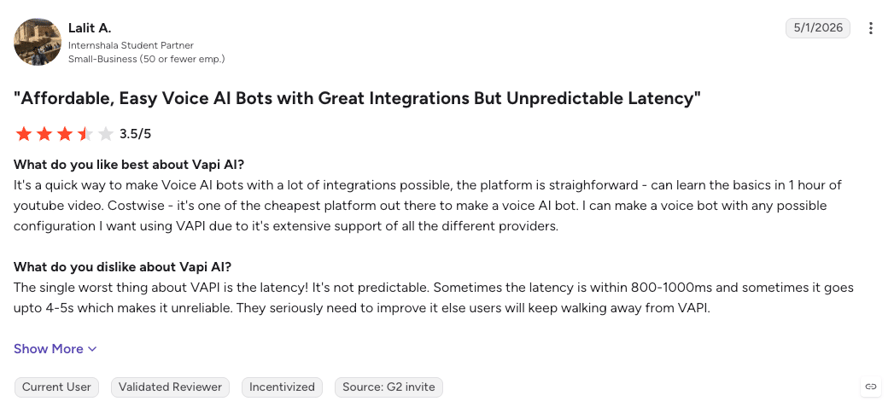
| Free tier with the full model catalog, then a $29 Core plan | 3 G2 reviews, with one calling latency unreliable at 800 ms to several seconds |
| Full control over models, voices, telephony, and every step of the call | Everything the humans need, from seats to queues, has to come from another vendor |
What Are Vapi's Plans & Pricing?
Vapi pricing starts at $0.05 per minute for hosting plus provider costs, with a free tier to start on, and it offers the following plans:
Vapi Plans and Pricing
| Plan | Price | Key Features |
|---|---|---|
| Free | $0 + $0.05/min hosting | 1 phone number, 4 concurrent calls, $5 in credits, 14-day data retention |
| Core | $29/month + usage | 5 phone numbers, 10 concurrent calls, 30-day retention |
| Pro | From $999/month | 10% of hosting fees as the package price, 10 numbers, 30 concurrent calls, 180-day retention |
| Premier | Custom | Custom numbers, concurrency, and retention |
| Add-ons | $2,000/month HIPAA, $10/line extra concurrency | HIPAA-eligible infrastructure and a BAA, additional concurrent lines, extra organizations at $20 each |
Who Vapi's Pricing Actually Suits
Vapi is the cheapest way to run a voice agent if your team already owns the rest: a carrier, a CRM integration, an on-call engineer, and a phone system for the humans. The moment you need a BAA, the $2,000 monthly add-on costs more than most of the self-serve platforms on this list combined. Vapi suits a product team building voice into its own software, and rarely a business that just wants its phone answered. The same trade-off shows up when you compare Vapi with a platform that ships the stack pre-assembled.
What Are Vapi's Customers Saying?
Vapi's few reviewers call it one of the cheapest ways to build a voice AI bot and say the basics can be learned in an hour. The same reviews ask for a simpler mode of the dashboard for non-engineers and flag latency that swings from under a second to several seconds, which one reviewer called unreliable for production calls.
How Do G2 Users Rate Vapi?
On G2, Vapi holds a 4.2/5 rating from just 3 reviews at the time of writing, so read it as early feedback rather than a consensus, and weigh the Product Hunt and Trustpilot comments developers leave alongside it.
10. Quo (formerly OpenPhone): Best for Small Teams That Want a Shared-Inbox Phone With a Built-In AI Receptionist
What Is Quo (formerly OpenPhone)?
Quo (formerly OpenPhone) is a modern phone system for small teams built around shared numbers and a shared inbox for calls and texts, from $15/user/month on annual billing. Its Sona AI agent answers calls 24/7 on every plan with 1,000 free credits a month, about ten calls, and every plan gets AI summaries for the calls Sona handles.
Quo is a friendlier first phone system for a small business than Phonely AI, especially because the AI receptionist comes with the seats instead of the other way round. Phonely gives you the agent and leaves the team's phones to someone else. Quo gives a five-person team shared numbers, texting, and Sona on the same $15 seat, with a 7-day trial and no seat minimum. What it lacks is a dialer, 24/7 support, and CRM sync below Business.
Why Is Quo a Strong Phonely AI Competitor?
- Sona AI on every plan, with free credits: 1,000 free automation credits a month cover about ten AI-answered calls, then credit packs run from $25 a month, with transcripts and summaries on Starter.
- Shared numbers and a team inbox: Up to ten users on one number on Starter, with calls, texts, and voicemails in one thread your whole team can see, an SMS workflow a solo AI agent doesn't replace.
- No seat minimum and a 7-day trial: One user, $15, done. HubSpot and Salesforce integrations, automatic recording, and AI summaries for all calls arrive on Business at $23.
What Are the Pros & Cons of Quo (formerly OpenPhone)?
| Pros | Cons |
|---|---|
| Sona AI receptionist on every plan with 1,000 free credits a month | No dialer of any kind, and phone support only on Scale, weekdays 8 to 5 Pacific |
| Shared numbers, texting, and a team inbox from $15/user/month with no seat minimum | CRM integrations and automatic call recording start on Business at $23/user/month |
| 3,400+ G2 reviews at 4.7/5, with ease of use and support the top themes | Reviewers report ringing and connection failures and dropped calls as the top complaints |
What Are Quo (formerly OpenPhone)'s Plans & Pricing?
Quo pricing starts at $15/user/month (Starter, annual billing), and you can choose from these plans:
Quo (formerly OpenPhone) Plans and Pricing
| Plan | Price | Key Features |
|---|---|---|
| Starter | $15/user/month | Shared numbers for up to 10 users, calls and texts, manual recording, Sona AI with 1,000 credits, AI summaries for Sona calls, email support |
| Business | $23/user/month | Everything in Starter + HubSpot and Salesforce integrations, automatic recording, AI summaries and transcripts for all calls, live chat support |
| Scale | $35/user/month | Everything in Business + AI call tags, priority support with inbound phone support on weekdays |
| Sona credit packs | From $25/month | 4,000 credits (about 40 calls) at $25 up to 60,000 credits at $199, with per-call overage from $1.00 down to $0.45 |
Who Sona Actually Suits
Ten free AI calls a month is a taste, not a receptionist. A shop taking 200 AI-answered calls needs the $99 credit pack on top of its seats, which is close to what a dedicated AI answering tier costs, and the seats still can't dial a list. Quo suits a small team whose calls and texts live in one inbox and whose AI needs are light. If the phone rings 30 times a day and most of those calls should be answered by AI, it pays to look at answering services and receptionist platforms built for that volume first.
What Are Quo (formerly OpenPhone)'s Customers Saying?
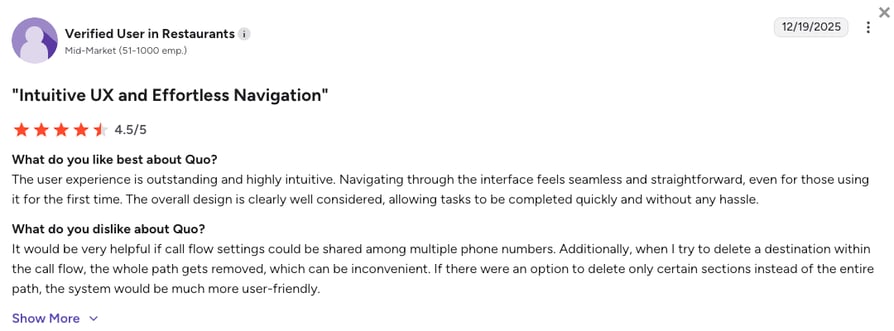
Quo reviewers praise ease of use, responsive support, and the shared inbox that keeps a team's calls and texts in one place, and they call Sona a real help for after-hours calls and lead qualification. The recurring complaints are calls that don't ring or connect, dropped calls, pricing confusion around add-ons, and Sona occasionally asking questions the caller already answered.
How Do G2 Users Rate Quo?
On G2, Quo (formerly OpenPhone) holds a 4.7/5 rating across 3,400+ reviews, with ease of use and customer support its most-cited strengths and connection reliability its most-cited weakness.
What Real Users Are Saying about Phonely AI and Its Alternatives
Pricing pages tell you what an AI agent claims to do. Real user threads tell you whether it holds up on a Tuesday afternoon when a customer wants a person. Here's what Reddit and G2 say about Phonely AI and the alternatives people actually shortlist.
What Redditors Are Saying about Phonely AI Alternatives
Phonely AI rarely gets its own thread on Reddit, and that's the first useful signal: the category is discussed by tool family, not by brand. The three threads worth reading sit in r/AgentsOfAI, r/AI_Agent_Reviews, and r/CustomerSuccess, and between them they cover the developer platforms, the receptionist and appointment-setter tools, and the support teams trying to decide whether AI helps at all.
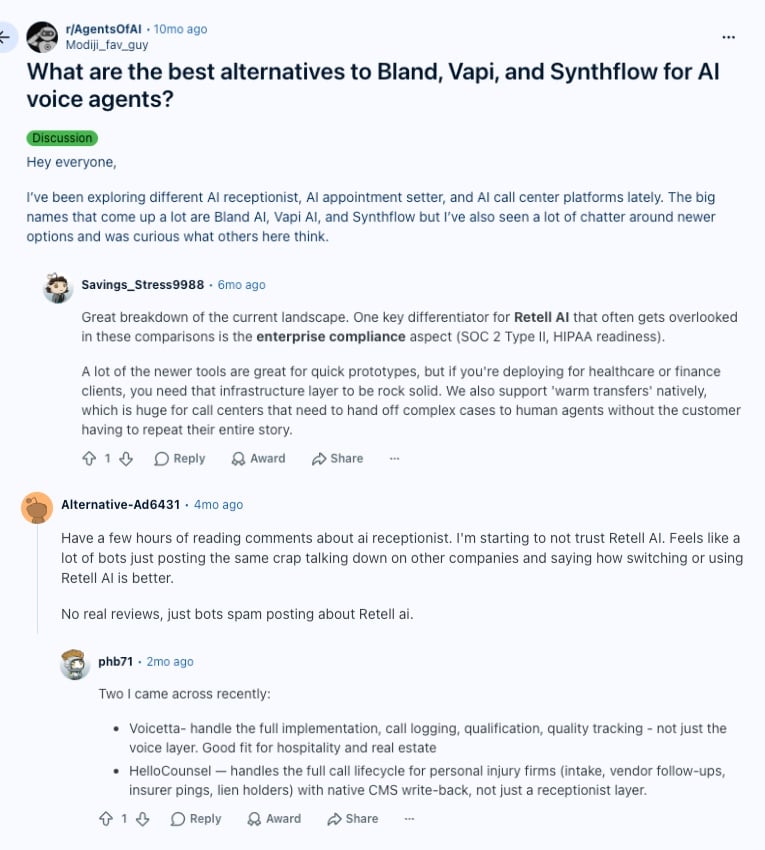
- Best AI voice agent alternatives to Bland, Vapi, and Synthflow: Asked for alternatives to the three developer platforms, the r/AgentsOfAI thread lands on Retell AI for enterprise compliance (SOC 2 Type II, HIPAA readiness) and native warm transfers, then turns skeptical when one reader notes that a lot of the praise reads like the same bot posting about Retell in every thread. The takeaway for a Phonely buyer is the shopping list itself: compliance below the enterprise tier and a warm transfer that keeps the caller's context are the two features people check first, and both are things a phone system with the agent built in handles as a routing step rather than an add-on.
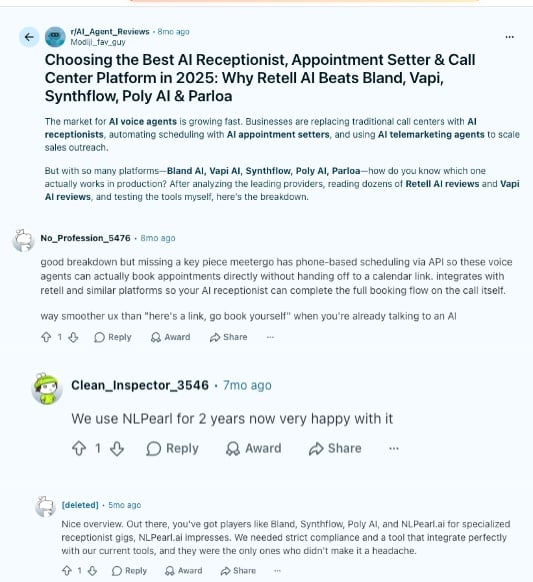
- Booking on the call vs. sending a link: The r/AI_Agent_Reviews thread starts as a vendor-written ranking and gets more useful in the replies, where one commenter points out that the best receptionist tools book the appointment on the phone through the calendar's API instead of texting a link, and another says the deciding factors were strict compliance and integration fit with the tools already in use. Phonely can book through its integrations from Pro. CloudTalk's AI appointment scheduling does it from the receptionist tier, into your live calendar, with an SMS confirmation after.
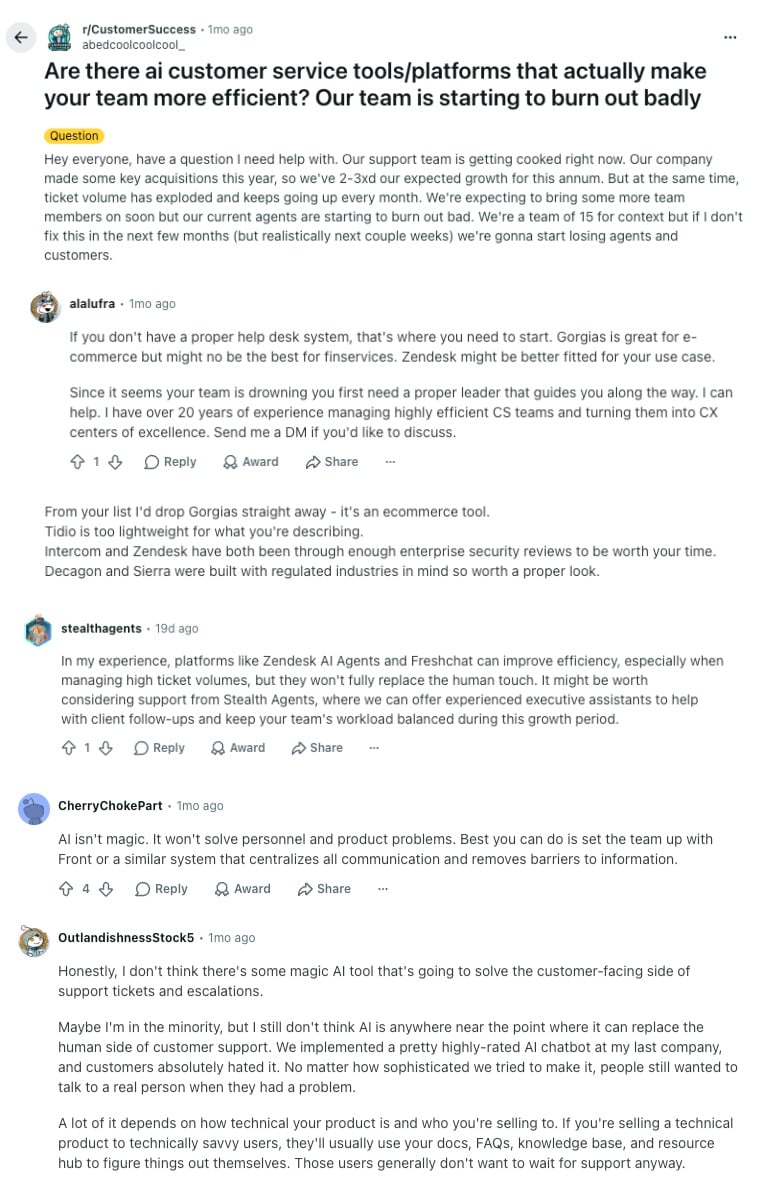
- AI customer service tools for a team that's burning out: A 15-person support team in r/CustomerSuccess, tickets doubling after acquisitions, asks which AI tools actually make a team more efficient. The replies are sober: sort out the help desk first, expect security reviews, and remember that a customer who has a real problem still wants a real person, which one commenter learned after their highly rated chatbot was hated by customers. That's the case for pairing AI with humans on one line rather than replacing them. The best AI for customer service calls answers the repeatable questions and hands the rest to a person who can see the transcript, which is how CloudTalk, Smith.ai, and Aircall all approach it, and where a standalone agent like Phonely leaves you to build the human half yourself.
How Do the Best Phonely AI Alternatives Compare on G2?
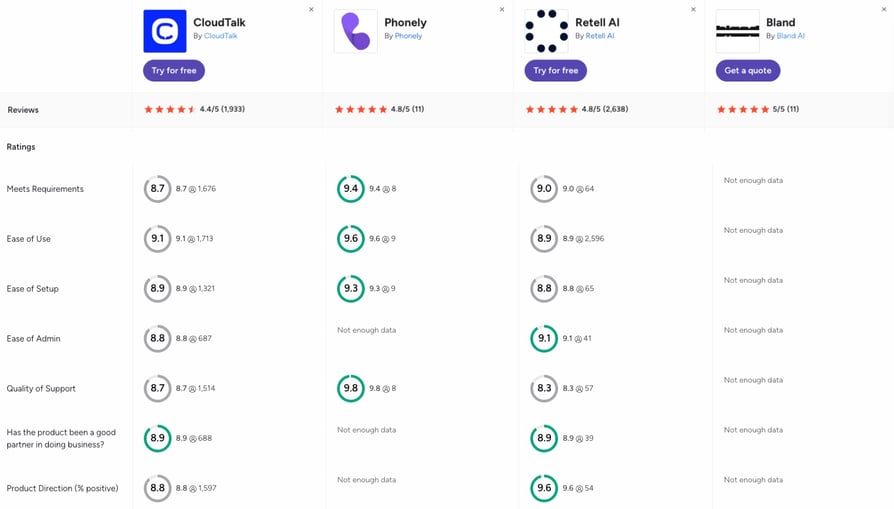
The Bland AI vs Retell AI vs Phonely comparison on G2, with CloudTalk in the mix, makes one thing obvious before you read a single score: CloudTalk holds 4.4/5 from 1,900+ reviews and Retell AI 4.8/5 from 2,600+, while Phonely and Bland have 11 reviews each. Phonely's category scores look near perfect, and the sample size is why.
- Review depth: Phonely's 9.8 for quality of support rests on eight responses and its 9.6 for ease of use on nine, with three of its seven categories showing not enough data, and Bland shows not enough data across the board. CloudTalk's scores draw on 680 to 1,710 responses each. A 9.8 from eight people and an 8.7 from 1,500 aren't measuring the same thing.
- Where Retell and CloudTalk split: Retell AI leads on meeting requirements (9.0 vs 8.7) and product direction, and its ease-of-use score comes from 2,590+ responses, the deepest sample on the page. CloudTalk leads on ease of setup (8.9 vs 8.8), quality of support (8.7 vs 8.3), and ease of use (9.1 vs 8.9), which lines up with the self-serve, developer-first model on one side and a supported phone system on the other.
- What the scores don't rate: Phonely's reviewers are rating a self-serve AI agent against what a self-serve AI agent promises, and it delivers. Nobody is scoring it on a dialer, a queue, or two-way CRM sync for human calls, because it doesn't sell them. CloudTalk is rated on all of that by teams running AI call center software at volume, and still lands within a point of Phonely's headline numbers.
CloudTalk vs. Phonely AI: Final Head-to-Head Comparison
The core split is simple: Phonely AI is a self-serve AI agent done well, free to start, fast to sound human, and happy to answer calls, texts, and web chats from one builder. CloudTalk is the AI calling platform a sales or support team actually works from, with the agent, the seats, the dialers, and the CRM sync on the same line.
The table calls it straight. Phonely wins four rows outright, and they matter to a specific kind of business. CloudTalk takes the rest.
CloudTalk vs. Phonely AI: Final Head-to-Head
| Feature | CloudTalk | Phonely AI | Winner |
|---|---|---|---|
| Starting price | $25/user/mo (Starter, annual) | Free (100 min), then $33/mo (Starter, annual) | Phonely AI |
| Free tier | Trial plus 50 AI minutes | 100 minutes a month, forever | Phonely AI |
| Phone system for human agents | Included from Starter | Bring your own | CloudTalk |
| AI receptionist setup | No-code, minutes, 50 free minutes to test | No-code, minutes, 100 free minutes to test | Phonely AI |
| Outbound AI calls | AI Specialist, from $349/mo | Pro and up | CloudTalk |
| Human dialers | Four dialer modes | None | CloudTalk |
| CRM integrations | 100+ from Essential | Pro and up | CloudTalk |
| Channels | Voice and SMS | Voice, SMS, and web chat | Phonely AI |
| Handoff to a human | Same platform, transcript attached, no meter | Outside line, $0.02/min post-transfer | CloudTalk |
| HIPAA / BAA | BAA on request | Enterprise only | CloudTalk |
| Global numbers and languages | 160+ countries, AI in 70+ languages | 1 to 5 numbers included, 100+ voices and languages | CloudTalk |
| Customer support | 24/7 chat and email, phone on Expert | Email, phone on Enterprise | CloudTalk |
| G2 rating | 4.4/5 (1,900+ reviews) | 4.8/5 (11 reviews) | CloudTalk |
The Verdict
If you're a small business that mostly needs calls answered, wants to start free, and can live with the agent transferring to whatever phones you already have, Phonely AI's free plan is hard to beat, and there's no reason to pay for more. The moment a transfer needs to land on a colleague's screen, a rep needs to call a list, a call needs to reach HubSpot without paying for Pro, or a clinic needs a BAA without a custom quote, you've outgrown a standalone agent. CloudTalk is built for exactly that next step if you want AI and humans on one phone line, and you can prove it on your own number before paying for a single seat.
How to Choose the Right Phonely AI Alternative for Your Business
Four questions decide it:
- who takes the call when the AI can't finish it
- whether your team dials out or only answers
- where the call has to land (CRM, calendar, helpdesk)
- and what compliance your industry expects
Find your scenario below and jump to the pick.
What Is the Best Phonely Alternative for Healthcare?
CloudTalk is the best Phonely alternative for healthcare. It signs a BAA on request for the phone system, recordings, and transcripts, carries SOC 2 Type II and GDPR, and lets a clinic run a healthcare AI voice agent that books, reschedules, and answers hours-and-directions calls, with no enterprise quote in the way. The HIPAA-covered setup for the voice agent is arranged during onboarding, and protected health information stays out of text messages unless your BAA covers that channel.
Runners-up: Goodcall calls itself HIPAA-compliant with flat-rate minutes, but its pricing page doesn't say which plan includes a BAA, so ask first. Smith.ai adds human receptionists for intake calls that shouldn't go to a bot. Phonely, Retell, and Bland keep the BAA on enterprise tiers, and Vapi sells it as a $2,000 monthly add-on. Whichever you pick, test the agent on a script with hard rules: the calls clinics regret are improvised medical answers and outdated FAQs.
What this means for a clinic:
The receptionist in the video runs on the same platform that signs your BAA, so patient calls, bookings, and recordings stay under one agreement rather than split across an AI vendor and a phone vendor. See which AI voice agents handle patient calls, booking, and reminders with compliance in mind.
What Is the Best Phonely AI Alternative for AI Phone Answering, AI Receptionists, and AI Voice Agents?
CloudTalk is the best Phonely AI alternative for AI phone answering, AI receptionists, and AI voice agents, because the AI Receptionist is a step in your call flow rather than a separate product. It answers every call, only after hours, or only when your team's phones ring out, routes by what the caller said, and hands anyone who needs a person to your team on the same platform. 50 free minutes on every account let you hear it on your own number first. Retell AI is the pick if your engineers want to build the agent themselves, Synthflow if you're an enterprise buying a scoped program.
Signature Capability
See CloudTalk’s AI Voice Agent in Action!
CeTe is an AI that talks like a human: no breaks, no training, no time off. It makes and answers calls, updates CRMs, books meetings, and loops in a human only when needed.
Press play to hear it. Want a wow moment? Get a free test call and try it live.

Whichever tool you test, run the same five checks on it. How long is the pause at pickup, and again at transfer? Does it ask for a name before it asks why you're calling? How fast does it read a phone number back? What does it do when a question isn't in the knowledge base? Do callers stay on past the first five seconds? The best AI voice agents pass all five without a prompt engineer on call, and the conversational AI software behind them lets you fix the greeting, the pace, and the fallback yourself. Here's how an AI receptionist and a human one handle the same call:
What this means for you:
You don't have to choose between the two. On CloudTalk the AI takes the first layer and your people take the calls that need judgment, on one line, with the transcript already on their screen.
Which Phonely AI Alternative Is Best for Call Centers and Inbound Support Teams?
CloudTalk is the best Phonely AI alternative for call centers and inbound support teams: call queuing, skill-based routing, IVR, live monitoring with whisper and barge, and an AI Receptionist that takes the first layer of every inbound call and hands the rest to an agent with the transcript attached. What the AI resolved and what it handed off sit in the same analytics, so a support lead sees one queue, not two dashboards.
Dialpad Connect is the runner-up for AI notes and coaching on every human call, Aircall for a team living inside Zendesk or Intercom. Phonely can answer a support line, but the moment a caller needs an engineer, the case has to be created and routed somewhere Phonely doesn't run.
Autenti Cut Live Support Calls by About 40% With Nine Voice Agents
The e-signature company runs nine AI voice agents across three teams and two languages on CloudTalk, and live teams now pick up about 40% fewer calls while the pickup rate rose 20%. Its support lead had hoped for a 10% drop.
What Is the Best Phonely AI Alternative for Appointment Setting and Virtual Reception?
CloudTalk is the best Phonely AI alternative for appointment setting and virtual reception. The AI Receptionist checks your live calendar, books the slot while the caller is still on the line, and sends the confirmation by SMS. It also captures what a voicemail never does: name, reason for calling, availability, and a callback number, pushed to your CRM.
Smith.ai is the runner-up when you want a human receptionist behind the AI for intake, Goodcall when unlimited minutes matter more than integrations. Phonely books through its integrations from Pro, which works, but that's also where the bill and the second vendor start.
Circle Gym Lifted Trial Bookings 150% by Booking on the Call
Instead of texting a scheduling link, the gym's AI voice agent asks what time works and books it, and trial bookings rose 150%, from four a day to ten, while the owner saved 20+ hours a week.
What's Better Than Phonely AI for Outbound Sales and Automated Dialing at Scale?
CloudTalk is the strongest Phonely AI alternative for outbound sales and automated dialing at scale, because it runs both kinds of outbound on one platform. The AI Specialist calls new leads within seconds of a form fill, qualifies them, and books the meeting. The AI sales dialer puts reps through a list on the same numbers, with answering machine detection, voicemail drop, and number rotation keeping pickup rates up. Bland AI is the pick for a developer team running tens of thousands of scripted calls a day, Retell AI when the outbound logic needs custom code.
Judge it on cost per conversation against a seated rep, not cost per minute: an agent that's half as persuasive but reaches twenty times more people still wins the campaign. One honest note on size: the AI Specialist is sales-led from $349/month, so a two-person shop on Phonely's Starter should start with the AI Receptionist and add the Specialist when the first rep joins. Phonely doesn't dial out at all below Pro.
Trevo Reached 20x More Customers per Campaign
The retailer's 50-person call center could reach about 5% of its database in a season. On CloudTalk's AI voice agent, every campaign now reaches 20x more customers, returning customers finish in under 30 seconds, and the human team moved to the calls worth their time.
Trevo Reached 20x More Customers per Campaign. See the Agent That Did It.
Which Phonely AI Alternative Has the Best CRM and Scheduling Integrations?
CloudTalk and Aircall are the Phonely AI alternatives with the best CRM and scheduling integrations, in different ways.
Aircall has the longer list, 250+ apps on its entry plan, and if a niche helpdesk decides it, that breadth wins. CloudTalk's 100+ integrations are the ones a sales or support team runs its day on: HubSpot, Salesforce (on Expert), Pipedrive, Zendesk, Zoho, Intercom, and Shopify, most of them native and two-way, so contact details load before the call and the recording, transcript, and AI summary land after it, for AI and human calls alike. The rest is reachable through the API, Zapier, and Make.
Both leave Phonely's Pro-only integrations behind, and the AI Receptionist books into Google Calendar or your booking tool from the receptionist tier.
What this means for you:
Pick Aircall if one specific app on its list is non-negotiable. Pick CloudTalk if you want the AI's captured lead to become a CRM record on its own, with no webhook recipe to maintain.
Which Phonely Competitor Offers Human-Agent Backup?
Smith.ai is the Phonely competitor that offers human-agent backup as a service: 500+ North America-based receptionists the AI can escalate to, billed per call, which suits a law firm or practice that wants a trained person on intake calls without hiring one. CloudTalk makes your own team the backup, on the same platform, through a ring group or a queue the AI transfers into with context, and it can ring your people first and fall back to the AI only when nobody picks up. Phonely transfers to an outside line and keeps metering the call. Retell, Bland, and Vapi leave the human side to whatever telephony you bring.
Which Phonely AI Alternative Is Best for Global Calling and Virtual Numbers in Other Countries?
CloudTalk is the best Phonely AI alternative for global calling and virtual numbers in other countries: local, mobile, and toll-free virtual phone numbers in 160+ countries from one dashboard, calls on its own carrier layer with a 99.999% uptime SLA, and AI that answers in 70+ languages and switches mid-call when a caller replies in another one. Phonely includes one to five numbers per plan and 100+ voices and languages, but the numbers, SIP trunking, and custom telephony a multi-country team needs sit on Pro and Enterprise. Aircall (numbers in 100+ countries) is the runner-up. Quo covers a US small team that wants a second line and shared texting, not a footprint abroad.
What Is the Best Phonely AI Alternative for Small Businesses on a Budget?
Quo and Smith.ai are the best Phonely AI alternatives for small businesses on a budget, depending on what the budget has to cover. Quo: shared numbers, texting, and Sona AI answering about ten calls a month on a $15 seat with no minimum. Smith.ai: 25 free AI calls a month, then $2 a call on AI Pro, which suits a practice that counts calls rather than minutes. CloudTalk makes sense the day that business wants to grow: seats from $25/user/month with no seat minimum on Starter or Essential, 50 free AI Receptionist minutes, then account-level AI tiers from $99/month, so the AI cost doesn't climb with every hire. Whichever you choose, start on the lowest tier that covers your real call volume and step up when the usage report says so.
Check out more options:
See how AI voice agents fit small teams that can't add headcount but can't miss calls either.
What Is the Best Phonely AI Alternative for Ecommerce?
CloudTalk is the best Phonely AI alternative for ecommerce. Its AI voice agent for ecommerce answers the order-status, returns, and delivery calls that flood a store's line, looks the order up through the Shopify, HubSpot, and Zendesk integrations from Essential, and hands the exceptions to a support agent with the transcript open. Peak season is the test: the AI takes the volume spike, your team takes the escalations, both show up in one set of analytics. Retell AI is the alternative if your engineers want to wire the order lookup themselves, Aircall if the store's support already lives in Gorgias or Zendesk.
What Is the Best Phonely AI Alternative for Growing Teams?
CloudTalk is the best Phonely AI alternative for growing teams, because the things that get expensive or impossible on a standalone agent are the things growth demands: a transfer that lands on a colleague's screen, outbound AI and a dialer when the first sales hire starts, CRM sync that doesn't wait for a $100 tier, numbers in the next country before the office opens there, and a BAA the day a healthcare client asks. The AI Receptionist stays account-level, so the AI bill doesn't multiply with headcount. The best use cases for AI voice agents tend to arrive in order, answering first, booking second, outbound third, and a platform where AI and humans share one call flow, one CRM record, and one set of call analytics is the one you don't have to replace at each step.
You Just Picked Your Scenario. Now Hear It on Your Own Number.
Ready to Make the Switch from Phonely AI?
Phonely AI earns its place for a small business that wants a human-sounding agent answering calls today, on a free plan, from a builder that also covers texts and web chat, with a fast model behind the voice.
But the reasons teams search for a Phonely AI alternative are structural. Outbound and integrations wait for a $100 tier, a BAA waits for a custom quote, a transfer leaves the platform and keeps metering, and there are no seats, queues, or dialers for the people who take the call. The agent stays an agent while the rest of your calling operation lives somewhere else.
The CloudTalk platform is built the other way round: the phone system comes first, and the AI Receptionist and AI Specialist sit inside it. Three things follow from that:
- The handoff never leaves the platformThe AI Receptionist answers, routes by intent, and books, then transfers to a queue or a named agent with the transcript attached and no post-transfer meter.
- One bill for the agent and the seatsSeats from $25/user/month with no minimum on Starter or Essential, 50 free AI Receptionist minutes, then account-level AI tiers from $99/month.
- Proof at scale5,500+ businesses and 4.4/5 on G2 across 1,900+ verified reviews, with 24/7 chat and email support on every plan.
Join 5,500+ Businesses That Put AI and Humans on One Phone Line
Frequently Asked Questions about Phonely AI Alternatives
Quick answers on how Phonely AI works, what it costs, where it stops, and how the alternatives compare.
Phonely AI is a San Francisco voice-AI platform for building AI agents that answer calls, texts, and web chats from one no-code builder, running on its own Alma model. Small businesses use it for AI phone answering, lead capture, and booking, starting on a free plan with 100 minutes a month. Its main limits are outbound and integrations gated to the $100 Pro plan, HIPAA on Enterprise only, and no phone system for the humans who take its transfers.
Phonely AI costs $0 on its Free plan (100 minutes, one number), $33/month on Starter with annual billing or $50 monthly (250 minutes, $0.35 or $0.25 per extra minute), and $100/month on Pro with annual billing or $150 monthly (750 minutes, $0.30 per extra minute, outbound and integrations included). Enterprise is quoted from 5 cents a minute and adds HIPAA and PCI. Post-transfer minutes bill at $0.02 on the self-serve plans.
CloudTalk is the best Phonely AI alternative in 2026 for teams that want an AI receptionist and the phone system behind it on one platform, from $25/user/month with 50 free AI minutes. Retell AI is the pick for developers building custom agents per minute, Smith.ai for practices that want human backup, and Dialpad for AI notes on every human call. The right one depends on who picks up when the AI can't finish.
Yes, there are free and cheaper alternatives to Phonely AI. Smith.ai answers 25 AI calls a month free, Vapi and Bland AI have free-to-open developer tiers billed per minute, and Quo bundles about ten AI-answered calls into a $15 seat. CloudTalk isn't free, but every account gets 50 free AI Receptionist minutes as a one-time allowance, and the 14-day trial covers the phone system around them.
CloudTalk is the best Phonely alternative for healthcare businesses that want a BAA without an enterprise quote, since it signs one on request and pairs it with SOC 2 Type II and GDPR. Goodcall calls itself HIPAA-compliant and suits clinics that want flat-rate minutes, and Smith.ai adds human receptionists for intake. Phonely, Retell, and Bland keep the BAA on enterprise tiers, and HIPAA-compliant call handling on Vapi is a $2,000 monthly add-on.
Smith.ai is the Phonely competitor that offers human-agent backup as a service, with 500+ live receptionists the AI escalates to, billed per call on your human plan. CloudTalk makes your own team the backup: the call flow can ring your people first and fall back to the AI, or let the AI answer and transfer to a queue with the transcript attached, all on one platform. Phonely transfers to an outside line and meters the call at $0.02 a minute afterward.
Aircall has the widest CRM list among Phonely alternatives, with 250+ integrations on its entry plan, while CloudTalk has the deepest for a calling team: 100+ native, two-way integrations from Essential that log AI and human calls, recordings, and summaries to HubSpot, Pipedrive, Zendesk, and Zoho, plus Salesforce on Expert (3-seat minimum). For scheduling, CloudTalk's AI Receptionist books into your live calendar from the receptionist tier. Phonely's integrations start on Pro.
Yes, you can keep your existing phone number when switching from Phonely. Most alternatives port numbers in, and CloudTalk handles number porting with its team, or you can forward your Phonely number to a CloudTalk number while the port completes. Messages don't port: export your transcripts, SMS threads, and captured lead data before you cancel, and rebuild the knowledge base on the new platform, since agent prompts and flows don't transfer between vendors.
CloudTalk is the best Phonely alternative for high-volume call centers, because it runs the AI Receptionist, skill-based routing, queues, IVR, live monitoring, and dialers on one platform, so the AI takes the first layer and agents take the rest with shared analytics. Dialpad Support and Aircall's Custom plan suit large human teams, and Bland AI a developer-run outbound floor. An AI voice agent for high call volume matters more than the meter once a queue is involved.
CloudTalk compares with Phonely as a full AI calling platform against a standalone AI agent. Phonely wins on a free tier, a web chat agent, and the fastest self-serve start. CloudTalk wins on the phone system for human agents, outbound AI and dialers, 100+ CRM integrations from Essential, a BAA on request, numbers in 160+ countries, and 24/7 support, with the AI voice agent ROI coming from one bill instead of two. Both set up an AI receptionist in minutes.
Phonely compares to Retell AI as a bundled plan against a per-minute meter. Phonely sells minute buckets with a builder anyone can use, and gates outbound and integrations to its $100 Pro plan. Retell AI charges from $0.055 a minute for its voice engine plus model, voice, and telephony costs, includes outbound and webhooks from the start, and expects your engineers to build the agent. Retell has 2,600+ G2 reviews to Phonely's 11, and both keep HIPAA on enterprise tiers.
Yes, Phonely supports SMS automation on its paid plans. Its AI SMS feature extends the same agent flows to text conversations for follow-ups, reminders, and scheduling, metered against your minutes (its plan table lists AI SMS as 1/5 min on Starter and 1/10 min on Pro), while the Free plan sends notifications only. CloudTalk's AI Receptionist sends SMS follow-ups after a call, such as a booking confirmation, and human agents text from the same numbers.
Retell AI is the better AI voice agent for custom builds, Bland AI for high-volume outbound campaigns, and Phonely for a self-serve inbound receptionist launched without a developer. On G2, Retell holds 4.8/5 from 2,600+ reviews, while Bland and Phonely each rest on 11. None of them includes a phone system for the humans who take the transfer, the gap CloudTalk closes against Bland AI by running the agent inside the call flow.
The best Phonely AI alternatives for small businesses are CloudTalk, Quo, Smith.ai, and Goodcall. CloudTalk suits a small business that plans to grow, with seats from $25/user/month and an account-level AI Receptionist that doesn't multiply with headcount. Quo fits a two-person team that lives in texts, Smith.ai a practice wanting human backup, and Goodcall a local business wanting unlimited minutes. A small-business AI phone system should start on its lowest tier and step up with real usage.
Phonely, Smith.ai, and Dialpad AI are three different products. Phonely is a self-serve AI agent for calls, texts, and chat, with outbound and integrations on Pro. Smith.ai is an AI receptionist billed per call with live human receptionists behind it. Dialpad AI is transcription, summaries, and coaching for the humans on a business phone system, plus a separately sold autonomous agent. CloudTalk does all three, AI answering, human handoff, and conversation intelligence software, on one platform.