Summary: Forethought AI Pricing
Forethought pricing hovers around a median of $74,483 a year across 69 purchases, ranging from $35,670 to $151,400.
What that number hides: implementation at $10,000 to $50,000, Voice AI at $30,000 to $80,000 a year, escalators of 3% to 7%, and a qualification gate of 20,000 historical tickets before anyone will quote you at all.
Important: Forethought AI doesn't publish a price. Three plans, all quote-only, priced as a platform access fee plus outcome-based usage, so the bill tracks resolved conversations rather than seats. The only attributable benchmark is Vendr's procurement data:
*Third-party benchmark data (Vendr), not Forethought list prices.
Forethought AI Pricing Guide
| Section | Quick Answer |
|---|---|
| How much does Forethought AI cost? | No published price at any tier. Team, Professional and Enterprise are quote-only, priced as a platform access fee plus outcome-based usage |
| Who sells Forethought now? | Zendesk. Announced 11 March 2026, closed 26 March, on sale as "Forethought AI agents by Zendesk" from 4 June |
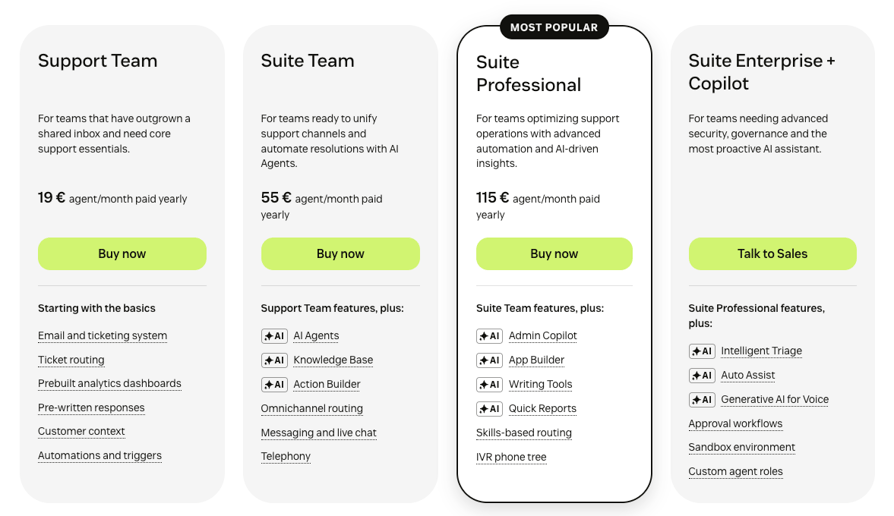
| What the Zendesk stack underneath costs | Published: Support Team $19, Suite Team $55, Suite Professional $115 per agent/month annual, Suite Enterprise + Copilot quote-only, Copilot $50 |
| Forethought AI pricing plans | Team (called "Basic" in the comparison table), Professional, Enterprise. Email, voice and Slack start at Professional |
| What will you actually pay? | Vendr reports a median annual contract of $74,483 across 69 purchases, with observed contracts from $35,670 to $151,400 |
| Forethought AI hidden costs | Implementation $10,000-$50,000, Voice AI $30,000-$80,000 a year, annual escalators of 3%-7%, plus overage the vendor confirms but doesn’t price |
| The data floor | Forethought’s own FAQ asks for 20,000+ historical tickets and at least 2,000 email or chat tickets a month |
| What buyers say about the pricing | There’s no public number to react to. The structural issues are transparency, budget predictability and cost of entry |
| What to ask for in a quote | Overage rate in writing, volume headroom, an escalator cap, implementation fees, no auto-renewal |
| Forethought AI alternatives | CloudTalk, Intercom Fin, Freshdesk with Freddy AI |
| Is Forethought AI worth it? | Yes at high, steady email and chat volume. No if you’re phone-heavy, below the data floor, or need a number before a sales call |
| Frequently asked questions | How does outcome-based pricing work? Is there a free trial? What did Zendesk pay for Forethought? |
Getting Quoted by Forethought? Run the Numbers on CloudTalk First.
How Much Does Forethought AI Cost?
Forethought AI costs on average of about $74,483/year. On the low range it's around $35,670 and the high quote goes up to $151,400. Its three plans (Team, Professional, Enterprise) and its three add-ons all sit behind a “Get a Quote” button, with no free plan and no free trial. Buyers now purchase through Zendesk, which acquired Forethought in March 2026.
Pricing is a platform access fee plus outcome-based usage, so the bill tracks support volume, not headcount. Email, voice and Slack sit on the Professional tier, Forethought asks for 20,000+ historical tickets, and overage applies above your contracted band. Other conversational AI platforms price the same job very differently.
*Third-party benchmark data (Vendr), not Forethought list prices.
Forethought AI Pricing Snapshot: All Public Plans
| Plan | Best For | Starting Price | Add-Ons | Free Trial |
|---|---|---|---|---|
| Team (labeled "Basic" in Forethought’s own plan comparison table) | Not published. No Vendr contract data isolates this tier, and the email gate moves most buyers to Professional before signing | Not published. Quote only | Multibrand, Analytics API, Discover, knowledge gap detection, autoflow gap detection (all quote-based) | None. Proof of Value engagement instead |
| Professional | Support orgs that answer customers by email, voice or Slack | Not published. Vendr bands: $30,000–$70,000/yr at 5,000–15,000 tickets/mo, $60,000–$150,000/yr at 15,000–50,000. Voice AI adds $30,000–$80,000/yr | Multibrand, Analytics API, Discover, knowledge gap detection, autoflow gap detection (all quote-based) | None. Proof of Value engagement instead |
| Enterprise | Multi-brand and regulated teams that need API access and governance controls | Not published. Vendr band: $150,000–$300,000+/yr above 50,000 tickets/mo | Multibrand (Analytics API, knowledge gap detection and autoflow gap detection are included at this tier) | None. Proof of Value engagement instead |
Compare Before You Get Quoted.
Who Sells Forethought Now, and Why It Changes Your Quote
Zendesk announced a definitive agreement to acquire Forethought on 11 March 2026, and confirmed the deal had closed on 26 March. It said the acquisition accelerated its own product roadmap by more than a year. Neither company disclosed a price, which fits Zendesk’s pattern: TechCrunch noted that the rare deals where Zendesk has published a figure were modest ones, $29.8 million for Zopim in 2014 and $45 million for BIME in 2015. Forethought had raised $115 million in total funding, and the deal was widely reported as Zendesk’s largest acquisition in nearly two decades. Anyone quoting a purchase price is guessing.
On 4 June 2026 the product went on sale as “Forethought AI agents by Zendesk.” Zendesk customers buy it as a Zendesk add-on. If you’re not a Zendesk customer, Zendesk says Forethought is still available to purchase and can be integrated with your platform across all supported channels.
So Forethought AI customer service pricing now runs through Zendesk sales rather than Forethought sales. Raise these on the first call:
- Whose paper the contract sits on, and which entity holds the service-level agreement (SLA)
- Whether the quote arrives bundled with Zendesk Suite licenses you don’t need
- How the outcome-based model gets reconciled with Zendesk’s own AI agent pricing over time
Zendesk has said publicly that existing Forethought customers can expect uninterrupted service, and that new customers can adopt the product with no requirement to use the Zendesk platform. Take that at face value, then ask for it in writing.
Nobody has confirmed the future of Forethought for Slack either way, so if Slack matters to your internal support, name it in the contract. Voice is worth pricing separately too, since Zendesk bills its own telephony product on its own terms; our breakdown of Zendesk Talk pricing shows what that side of the stack costs.
What the Zendesk Stack Underneath a Forethought Quote Costs
Forethought’s own price is invisible, but the platform it now attaches to publishes its. If your quote arrives bundled with Zendesk licenses, these are the numbers underneath it, per agent per month on annual billing.
The Published Zendesk Prices Under a Forethought Quote
| Plan or Add-On | Price per Agent/Month (Annual) | What It Covers |
|---|---|---|
| Support Team | $19 | Email and social ticketing only. No live chat, no voice |
| Suite Team | $55 | Adds messaging, live chat, voice, help center and AI agents |
| Suite Professional | $115 | Adds skills-based routing and IVR. Where most mid-market support orgs land |
| Suite Enterprise + Copilot | Quote only | Moved behind a "talk to sales" button, so the tier above Professional stopped publishing a number |
| Copilot add-on | $50 | Human-agent assist, billed on top of any Suite plan |
| Forethought AI agents by Zendesk | Quote only | Sold as a separate add-on at every tier, on top of everything above |
Zendesk’s own AI agents changed shape in 2026. They’re now included in every plan with a small allowance of automated resolutions per agent per month, and metered per resolution above that allowance. Zendesk doesn’t publish the per-resolution rate; third-party teardowns cluster around $1.50 to $2.00, which is an estimate rather than a quote. Forethought sits on top of all of it as its own line item, which is why the seat price matters even when the AI is what you’re buying.
What Pricing Plans Does Forethought AI Offer?
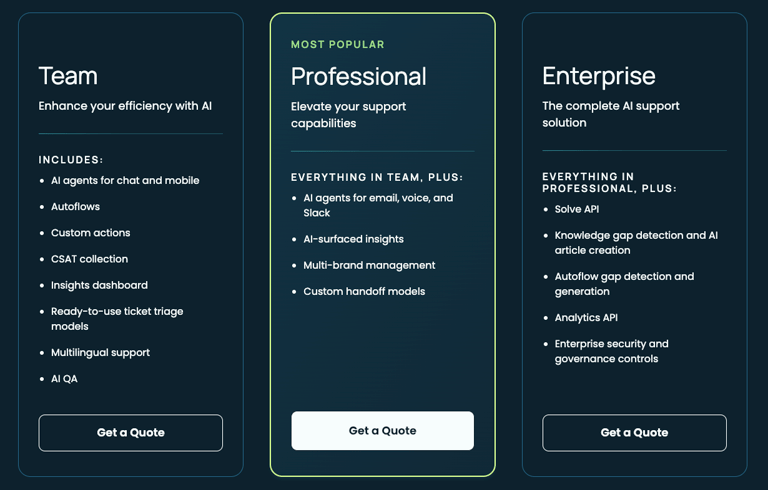
Forethought AI pricing plans come in three tiers, all quote-only: Team, Professional and Enterprise. Forethought describes the model in its own pricing FAQ as a blend of platform access fees and an outcome-based pricing cost, with optional add-ons and a referral to the sales team for anything more specific. There’s no Forethought AI pricing per month at any tier and no per-seat rate; Forethought prices against the volume of conversations its AI handles.
According to TrustRadius’s 2026 B2B Buying Disconnect Report1, transparent pricing has been software buyers’ number one request of vendors for four years running, since TrustRadius started asking in 2023. Forethought publishes none of it. You can read the entire Forethought AI customer service features and pricing matrix without ever seeing a number attached to it. Quote-only pricing is still common at the enterprise end of AI customer service, but it isn’t universal, and the comparison later in this guide shows how differently the same category can be priced.
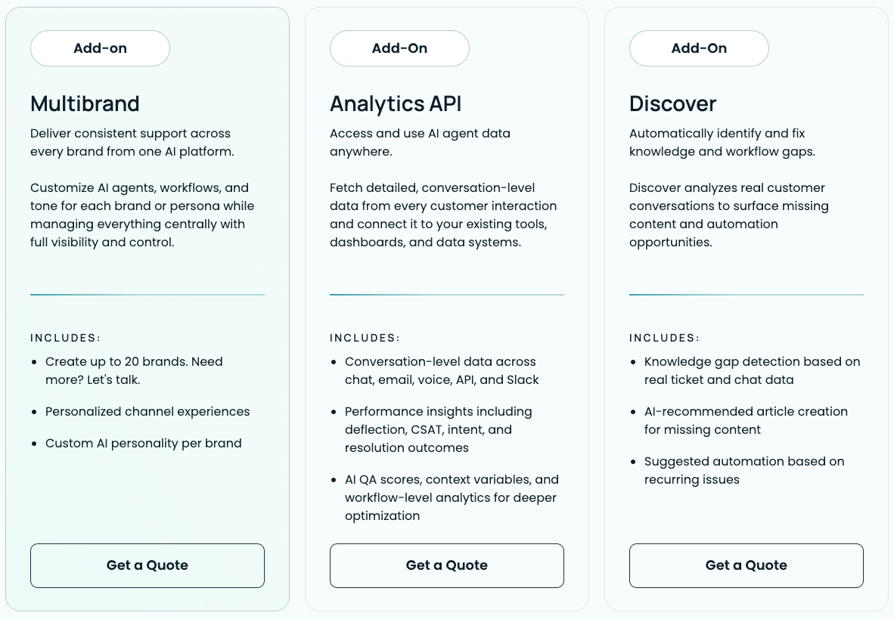
The add-on lineup moved with the seller as well. Zendesk’s help center documentation for the product lists the add-ons as Assist, Discover, Agent QA and AI QA, a different set from the Multibrand, Analytics API and gap-detection add-ons still shown on Forethought’s own pricing page. Both lists are quote-only, and the Zendesk one is what a current quote gets built from.
Forethought Team: Chat and Mobile Deflection, Price on Request
The entry tier suits a single-brand support desk that wants AI agents answering chat and in-app messages, plus enough reporting to tell whether it’s working. Forethought doesn’t publish billing terms. Vendr’s procurement data for Forethought buyers indicates most contracts run as annual subscriptions billed monthly or annually, quoted either as a platform fee plus usage or as a flat annual fee against a defined ticket volume band.
What’s included, per Forethought’s plan card:
- AI agents for chat and mobile
- Autoflows and custom actions
- CSAT (customer satisfaction) collection and an insights dashboard
- Ready-to-use ticket triage models
- AI QA (quality assurance), capped at 1 rubric
- Brand management for up to 2 brands
- Standard security and standard support
Who it’s for, and what to watch out for:
This tier fits a chat-first product company whose customers rarely email, which is a smaller group than it sounds. Email, voice and Slack all sit one tier up, so most support orgs end up quoting Professional inside the first sales call. The AI QA cap is the other pinch point: one rubric means one definition of "good," which is thin for any team running QA across more than a single queue. Note too that multilingual support appears on this plan’s feature card while Forethought’s own comparison table gates it higher, so confirm it in writing before you assume it’s included. And if you’re a chat-only team under 2,000 tickets a month, Forethought won’t sell to you at all (see the data floor below).
Forethought Professional: Email, Voice and Slack, Price on Request
Forethought marks Professional as “Most popular,” and the channel matrix explains why. It’s the first tier where AI agents work on email, voice and Slack, which is the configuration most support organizations run. Pricing stays quote-only, and the outcome-based component means your invoice tracks the volume of conversations the AI resolves.
Everything in Team, plus:
- AI agents for email, voice and Slack
- AI-surfaced insights
- Multi-brand management for up to 20 brands
- Custom handoff models, up to 3
- AI QA, raised to 5 rubrics
- “Ask the expert” support
Who it’s for, and what to watch out for:
Treat this as the real entry point and budget accordingly, because pricing the Team tier in your business case will understate the deal by a full tier. The value here is genuine: multi-channel resolution plus handoff logic is the part of the product that moves ticket volume off your queue. What to watch is voice. Unlocking the channel on this plan isn’t the same as running it. Vendr’s contract data shows Voice AI arrives as a separate line item, with telephony and routing work at deployment on top of an ongoing annual charge, which the cost section below breaks down. If most of your support load is phone calls, price that against dedicated voice AI agents for call deflection before you compare Forethought to anything else.
Forethought Enterprise: API Access and Governance, Price on Request
The top tier aims at multi-brand and regulated operations that need Forethought’s data inside their own systems, plus the security and governance controls a procurement review will ask for. It’s also the only tier with programmatic access to the resolution engine itself.
Everything in Professional, plus:
- Solve API
- Knowledge gap detection and AI article creation
- Autoflow gap detection and generation
- Analytics API
- Enterprise security and governance controls
- AI QA, raised to 20 rubrics, and up to 6 custom handoff models
- Advanced security and advanced support
Who it’s for, and what to watch out for:
This is the tier for a support org that treats deflection as a data problem: knowledge gaps found automatically, articles drafted from them, conversation-level analytics pushed into a warehouse. The value case holds if you have an analytics team to consume it. If you don’t, you’re paying an enterprise premium for two APIs nobody will call. It’s the same test that decides whether conversation intelligence software pays for itself: someone has to act on the output. The upgrade trigger here is subtler than the channel gate. Knowledge gap detection, autoflow gap detection and the Analytics API all sell as add-ons below this tier, so a Professional buyer who wants all three should price both routes before signing.
Forethought AI Channel Availability by Plan
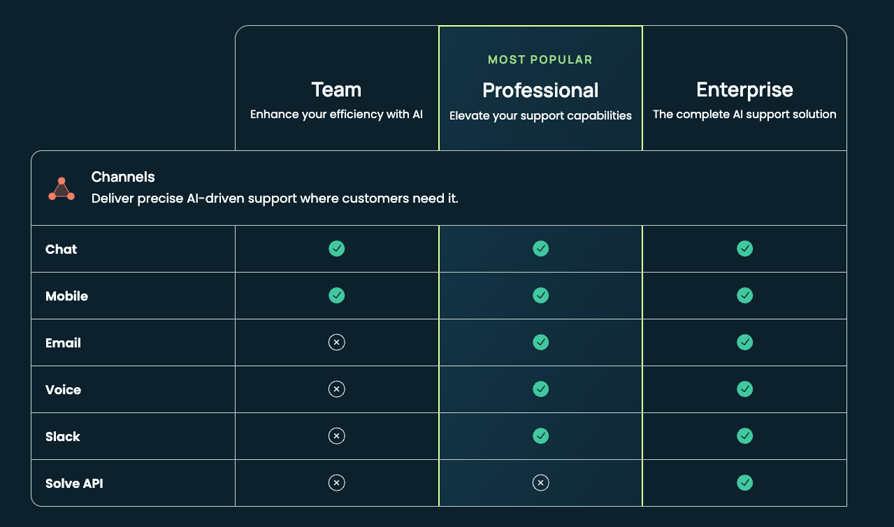
Two of the three Forethought AI plans hide your most common support channel behind an upgrade.
Forethought AI Channel Availability Matrix
| Channel | Team (Basic) | Professional | Enterprise |
|---|---|---|---|
| Chat | |||
| Mobile | |||
| Voice | |||
| Slack | |||
| Solve API |
Before anyone discusses volume with you, your channel mix has already decided your tier.
Know What’s Included, Upfront.
What Will Forethought AI Actually Cost?
For the shape of the whole dataset: Vendr reports a median annual contract of $74,483 across 69 purchases, with observed contracts running from $35,670 to $151,400, and an average buyer saving of 22% off the opening number. Vendr is a SaaS procurement platform reporting what its own customers paid. Those numbers aren’t Forethought’s list price, and Vendr doesn’t claim they are; outside a sales call, nobody sees one.
What Forethought AI Costs Across Four Buyer Scenarios
| Scenario | Support Profile | Tier the Channels Force | Annual Platform + Usage (Vendr Band) | One-Off Costs (Vendr) | Year-One Range |
|---|---|---|---|---|---|
| 1. Small support team | 8,000 tickets/month, chat and email | Professional | $30,000 – $70,000 | Implementation $10,000 – $50,000 | $40,000 – $120,000 |
| 2. Mid-market support org | 25,000 tickets/month, omnichannel, no voice | Professional | $60,000 – $150,000 | Implementation $10,000 – $50,000 plus custom integration $5,000 – $25,000 | $75,000 – $225,000 |
| 3. Phone-heavy support team | 25,000 tickets/month plus 8,000 calls/month | Professional | $60,000 – $150,000 base plus $30,000 – $80,000 Voice AI | Implementation $10,000 – $50,000 plus voice deployment $10,000 – $30,000 | $110,000 – $310,000 |
| 4. Enterprise, multi-brand | 60,000+ tickets/month, API access, multiple brands | Enterprise | $150,000 – $300,000+ | Implementation $10,000 – $50,000 plus custom integration $5,000 – $25,000 | $165,000 – $375,000+ |
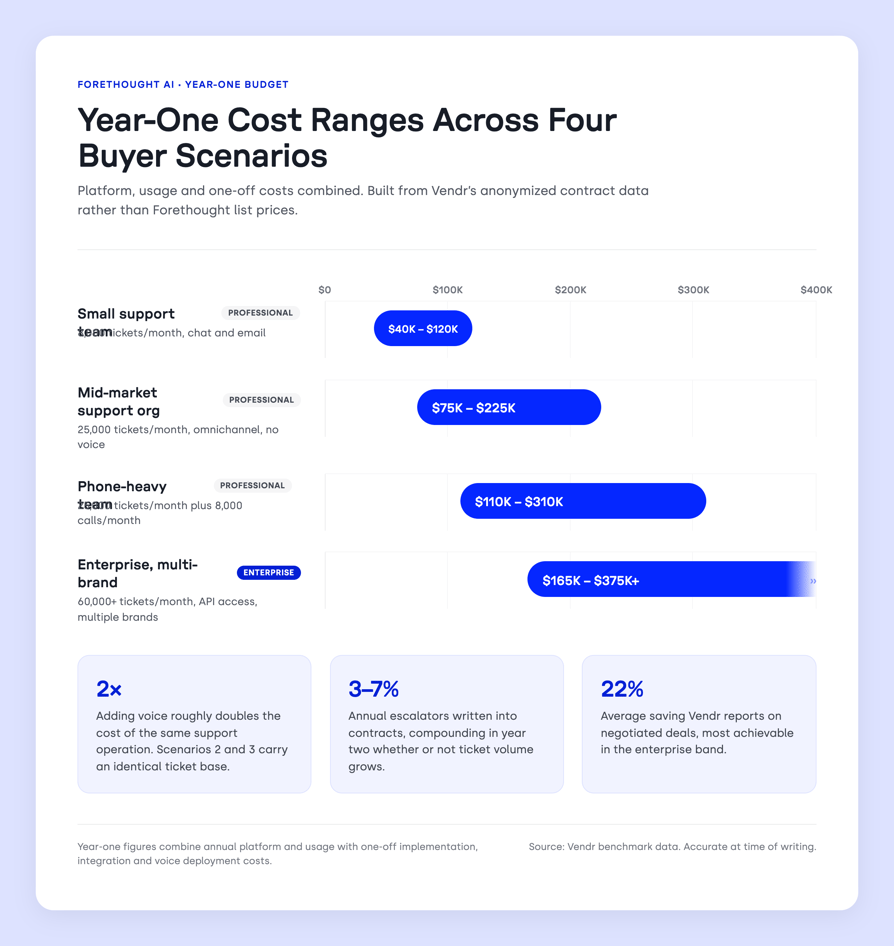
- Scenario 1, step by step. Email decides the tier, so the quote starts at Professional rather than Team. Vendr’s smallest documented cohort, 5,000 to 15,000 tickets a month, lands at $30,000 to $70,000 a year. Add implementation at $10,000 to $50,000 and year one sits between $40,000 and $120,000. Check one thing first: a young company doing 8,000 tickets a month may still fail Forethought’s 20,000 historical-ticket requirement, and no budget line fixes that.
- Scenario 2, step by step. At 25,000 tickets a month you’re in Vendr’s mid-market band of $60,000 to $150,000 a year. Teams this size usually run a non-standard helpdesk or an internal system, so add a custom integration at $5,000 to $25,000 on top of implementation. Then add the escalator. Vendr reports annual uplifts of 3% to 7% written into contracts, so at 5% your year-two platform cost is $63,000 to $157,500 before your ticket volume grows at all.
- Scenario 3, step by step. This is where Forethought AI support automation pricing bends hardest. The ticket base matches Scenario 2 exactly, but Vendr puts Voice AI infrastructure work at $10,000 to $30,000 at deployment and the ongoing Voice AI add-on at $30,000 to $80,000 a year for 5,000 to 15,000 calls a month. Voice roughly doubles the cost of the same support operation. That’s the reason phone-first teams should price a dedicated voice platform alongside the quote instead of after it.
- Scenario 4, step by step. Above 50,000 tickets a month Vendr’s enterprise band starts at $150,000 and reaches past $300,000, and Enterprise becomes mandatory if you need the Solve API or the Multibrand add-on. You do get negotiating room back. This is the band where Vendr’s 22% average saving is most achievable, because you’re the size of account that gets a discount desk involved.
Two things hold across all four scenarios. The escalator compounds every year whether or not your volume grows, and the outcome-based component turns a good quarter for your business into a bigger invoice. For a sense of how differently a published per-seat model behaves at the same team sizes, our breakdown of how much call center software costs prices the same headcount without a quote.
Are There Hidden Costs in Forethought AI’s Pricing?
Forethought AI customer support pricing has a second layer underneath the license. Forethought confirms in its own FAQ that additional usage charges may apply if your usage exceeds the plan’s limits and purchase volume, without publishing a rate, and the rest of the cost stack sits in the implementation and infrastructure around the product.
Forethought AI Hidden and Variable Cost Categories
| Cost Category | What Forethought Publishes | Third-Party Benchmark (Vendr) |
|---|---|---|
| Implementation and onboarding | 30 to 90 days to full setup, plus paid "support engineer services" for complex setups. No fee published | $10,000 – $50,000+ |
| Custom integrations | Nothing published | $5,000 – $25,000+ |
| Voice AI deployment (telephony, routing, carrier work) | Nothing published | $10,000 – $30,000 one-off |
| Voice AI, ongoing | Nothing published | $30,000 – $80,000/year at 5,000 – 15,000 calls/month |
| Usage overage | Confirmed in the vendor FAQ, unpriced | Often priced above the base per-unit rate |
| Annual price escalator | Nothing published | 3% – 7% |
| Add-ons (Multibrand, Analytics API, Discover) | Quote only | Not benchmarked |
| Training beyond contracted sessions | Nothing published | Billed separately |
| Data retention and analytics lookback | Nothing published | Contracts may cap storage, conversation history and lookback periods |
The Data Floor That Decides Whether You Can Buy at All
Forethought’s FAQ states that its AI performs effectively with a historical ticket data volume of 20,000+ and requires at least 2,000 email or chat tickets per month to operate smoothly. That’s the vendor’s own number rather than a reviewer’s opinion, and it’s the most important line in this guide for anyone running a small support team. Teams below it that still want to automate customer service have to look at tools without a historical-data requirement.
Salesforce’s 2026 State of Service: AI Agents Edition2 found that 72% of service operations professionals say data readiness is a major blocker to AI, against 59% of customer service leaders. The people closest to the data worry about it most, and Forethought has turned that worry into a published entry requirement.
The Gap Between Signing and Value
Forethought publishes an implementation window of 30 to 90 days. Set that against the same Salesforce report, which found that 70% of organizations with AI service agents observe measurable value within 60 days of deployment. A Forethought buyer can spend the entire industry time-to-value window still in setup, and that’s before the internal effort lands.
Forrester’s 2026 predictions for customer service3 put it plainly: 30% of enterprises will create parallel AI functions that mirror human service roles, including managers who onboard and coach AI agents and specialists who unblock them when they falter. Budget for those people alongside the platform, the same way you would for any deployment of AI in customer service that touches live customers.
Pricing Without the Surprises.
What Do Buyers Say About Forethought AI’s Pricing?
What buyers can say publicly about Forethought AI’s pricing is limited, because Forethought publishes none of it. Two constraints follow from that. There’s no published number for anyone to react to, and we don’t reproduce review quotes, ratings or counts we haven’t verified ourselves. So nothing below is a paraphrased review. What follows is what the vendor’s own published terms and Vendr’s contract data structurally mean for a buyer. Forethought’s G2 review page is the place to check current sentiment for yourself.
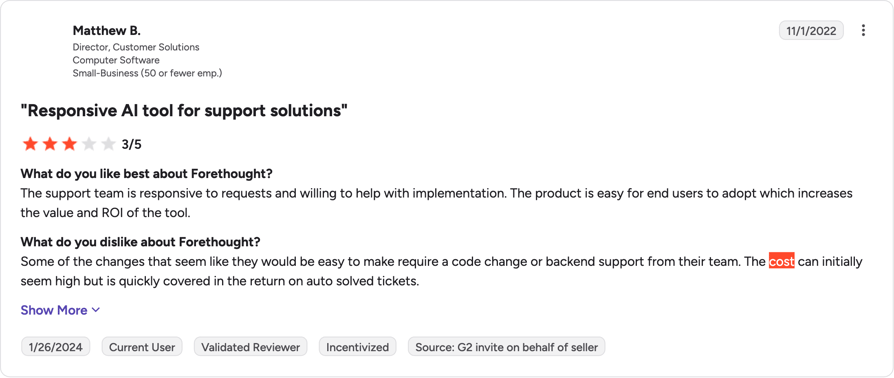
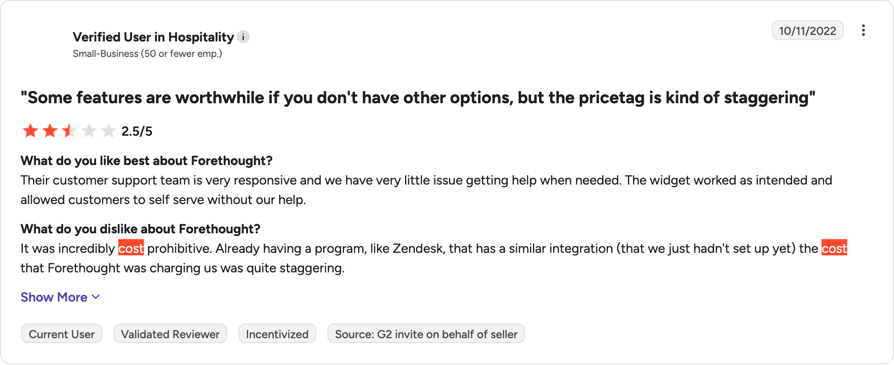
- Transparency: you can’t build a business case without a call. All six purchasable items on Forethought’s pricing page carry a “Get a Quote” button and no number, and the vendor’s own answer to “How does pricing work?” is a referral to sales. For anyone comparing AI customer service solutions side by side, Forethought is the column of the spreadsheet you can’t fill in before a sales cycle, which is exactly the friction the TrustRadius data measures.
- Budget predictability: a good quarter costs you more. Outcome-based pricing means the invoice tracks the volume of conversations the AI resolves, and Vendr reports that contracts define a band with overage above it. Growth you’d normally celebrate arrives as an unbudgeted line item, unless you negotiate the overage rate and volume headroom before signing.
- Cost of entry: the license isn’t the bill. Forethought publishes a 30 to 90 day implementation window and paid support engineer services for complex setups. Vendr puts implementation at $10,000 to $50,000 and custom integrations at $5,000 to $25,000. Year-one total cost of ownership can run well above the subscription, which matters most for teams whose finance function approved the subscription figure alone.
- Who the model shuts out. The 20,000 historical ticket and 2,000 monthly ticket floor is a qualification gate published by the vendor, not a recommendation. No negotiation moves it, so a small support desk below the floor won’t get a quote at all, at any price.
- Upgrade pressure: the entry tier is narrower than it looks. Email, voice and Slack all sit on Professional, and QA rubrics step from 1 to 5 to 20 across tiers. Any team that answers customers by email, which is most of them, is on Professional from day one. Price the realistic tier, not the advertised entry point.
- Vendor relationship: you’re buying from Zendesk now. The commitments Zendesk made at acquisition are on the record and should be read at face value. What nobody has answered yet is how the outcome-based model will line up with Zendesk’s own AI agent pricing at renewal, or what happens to Forethought for Slack.
What Should You Ask For in a Forethought Quote?
Quote-only pricing cuts both ways for a Forethought buyer. You can’t budget without a sales call, but no list price anchors you either, and Vendr’s data shows buyers negotiate an average of 22% off. Ask for these before you sign:
- Overage rate in writing: at or below your base per-unit rate.
- Volume headroom: 20% to 30% built into the contracted band.
- Escalator cap: a ceiling on the annual uplift, or its removal on a multi-year term.
- Implementation fees: waived, or itemized and reduced.
- Bundled pricing: across products rather than standalone line items, now that Zendesk holds the paper.
- Auto-renewal: removed.
- Runway: 60 to 90 days before your target go-live, since compressed timelines correlate with worse pricing in Vendr’s dataset.
Most buyers give away that last one by starting the conversation too late. If you’re building the evaluation from scratch, our call center software buyer’s guide covers the requirements questions that apply to any voice or AI vendor you shortlist.
Which Alternatives Are Better and Cheaper Than Forethought AI?
The three strongest alternatives to Forethought AI are CloudTalk for phone-first support and sales teams, Intercom Fin for per-resolution ticket deflection, and Freshdesk with Freddy AI for teams priced out of Forethought. All three publish what Forethought doesn’t. TrustRadius’s 2026 B2B Buying Disconnect Report1 found that 83% of buyers shortlist three or fewer products, and a vendor who won’t name a price is easy to cut from a list that short. If you want a wider field, we also rank the best AI for customer service calls.
Forethought AI Alternatives at a Glance
| Provider | Best For | Starting Price | Published Price? |
|---|---|---|---|
| CloudTalk | Phone-first support and sales teams that want voice AI as the core product | $25/user/mo | |
| Intercom Fin | Ticket deflection with a published per-resolution price | From $0.99 per outcome | |
| Freshdesk with Freddy AI | Teams priced out of Forethought entirely | $19/agent/mo | |
| Forethought AI | High-volume email and chat support orgs with a procurement function | Not published. Quote only |
1. CloudTalk: Best for Phone-First Support and Sales Teams
What Is CloudTalk?
CloudTalk is the global AI business calling software built for SMB growth, trusted by 5,500+ businesses across 100+ countries. It covers virtual numbers in 160+ countries, IVR (interactive voice response), call queues, skill-based routing, call recording, the AI Sales Dialer, AI Conversation Intelligence and the AI Voice Agent (CeTe) for autonomous inbound and outbound conversations.
The category difference matters, because it decides whether CloudTalk belongs on your list at all. Forethought is a ticket-deflection platform for a helpdesk. CloudTalk is a calling platform with 100+ native integrations, including Zendesk, Freshdesk, Intercom, Help Scout, Front, Gorgias and Kustomer, so it sits alongside your helpdesk rather than replacing it. If your support and sales load runs through the phone, that’s the overlap worth pricing.
Signature Capability
See CloudTalk’s AI Voice Agent in Action!
CeTe is an AI that talks like a human: no breaks, no training, no time off. It makes and answers calls, updates CRMs, books meetings, and loops in a human only when needed.
Press play to hear it. Want a wow moment? Get a free test call and try it live.

Why Is CloudTalk Better Than Forethought AI?
- You can build a budget without a sales call, because plan and add-on prices are published. That is the one thing buyers have asked vendors for more than anything else, four years running.
- There’s no data floor. Forethought publishes a 20,000 historical ticket and 2,000 ticket per month requirement; CloudTalk publishes no equivalent gate, so a 12-person team can start.
- Voice is the core product instead of a tier-gated add-on. Vendr’s data puts Forethought’s Voice AI at $30,000 to $80,000 a year on top of the base for moderate call volume.
- Agents get help on live calls. AI Agent Assist surfaces answers and next steps during the conversation rather than after it.
- You can test it yourself. CloudTalk runs a 14-day free trial instead of a vendor-led Proof of Value engagement.
- Time to value is shorter. Forethought publishes a 30 to 90 day implementation window, which eats most of the 60-day mark Salesforce found for measurable AI value.
CloudTalk AI voice agents handled approximately 30% of inbound support calls.
SaaS & IT services

What Does CloudTalk Cost?
- Starter: $25/user/month, billed annually. Includes IVR and skill-based call routing, the Call Flow Designer, unlimited call queues and the desktop and mobile apps.
- Essential: $29/user/month. Adds the Smart Dialer, the 100+ integration catalog, API and data sync, workflow automation and unlimited call recording storage.
- Expert: $49/user/month. Adds the Salesforce integration, the Power Dialer, wallboards, real-time call monitoring and advanced analytics.
- Custom: contact sales for enterprise SLAs, dedicated support and specific compliance arrangements.
- Add-ons: AI Voice Agents are always an add-on, starting at $99/month for 200 minutes. AI Conversation Intelligence is always an add-on at $9 per user/month billed annually. Power Dialer is included on Expert and sold as a $15 per user/month add-on on Starter or Essential. Parallel Dialer is an add-on at $39 per user/month.
- Free trial: 14 days.
What Is CloudTalk’s Rating on G2?
CloudTalk’s current G2 rating is 4.4/5 from 1,702+ reviews. Reviewers most often point to call quality, integration breadth and fast setup, the categories that matter most when voice is the channel carrying your support load.
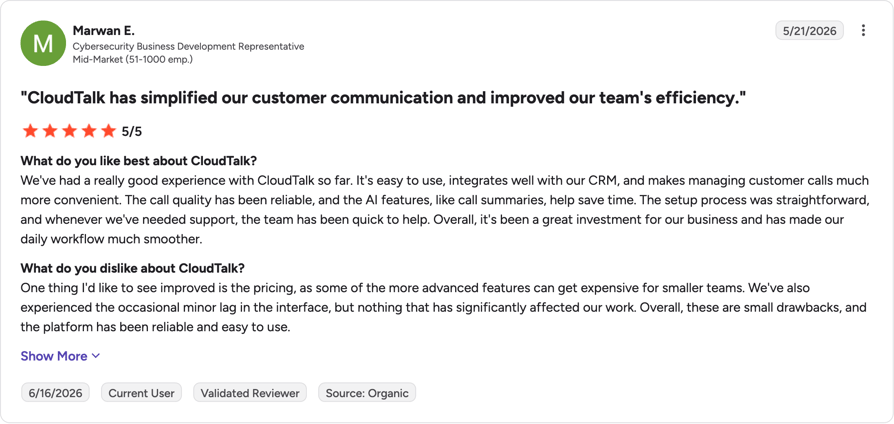
CloudTalk vs. Forethought AI at a Glance
Forethought publishes no price at any tier and asks for 20,000+ historical tickets before it will sell to you, with voice arriving as a separate line item Vendr puts at $30,000 to $80,000 a year. CloudTalk starts at $25/user/mo with IVR, skill-based routing and unlimited call queues on Starter, treats voice as the core product, and runs a 14-day free trial instead of a vendor-led Proof of Value.
2. Intercom Fin: Best for Ticket Deflection With a Published Per-Resolution Price
What Is Intercom Fin?
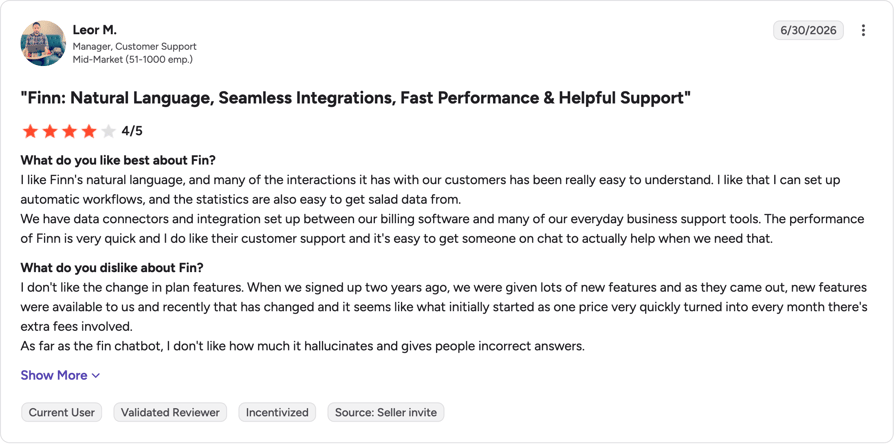
Fin is Intercom’s AI agent, built to resolve customer conversations without a human. It runs inside Intercom, and it also runs standalone on top of an existing helpdesk, so you can put it in front of your current ticket queue without buying Intercom seats. Teams that keep phone support separate often connect it through CloudTalk’s Intercom integration so calls land against the same customer record.
Why Is Intercom Fin Better Than Forethought AI?
Fin gives you the cleanest transparency contrast available. Intercom publishes the exact per-outcome price Forethought won’t disclose, defines in writing what counts as a billable outcome, and states plainly that no contract is required on its self-serve plans. Forethought asks you to enter a sales cycle before you learn the shape of the bill. Fin lets you model it in a spreadsheet in ten minutes.
What Does Intercom Fin Cost?
- Fin AI Agent: from $0.99 per outcome, on every plan.
- Fin standalone on your existing helpdesk: $0.99 per outcome with no seat costs and no setup, integration or platform fees, subject to a minimum monthly commitment.
- Intercom seats: Essential $29 per seat/month, Advanced $85 per seat/month, Expert $132 per seat/month.
- Copilot add-on: $29 per agent/month billed annually, or $35 billed monthly, with unlimited usage.
- Other add-ons: Proactive Support Plus at $99/month including 500 messages; the Pro add-on at $99/month including analysis of 1,000 conversations and 2,000 credits, with extra credits at $0.01 each.
- Contract required: no. Essential and Advanced sell self-serve, monthly or annual.
3. Freshdesk With Freddy AI: Best for Teams Priced Out of Forethought
What Is Freshdesk With Freddy AI?
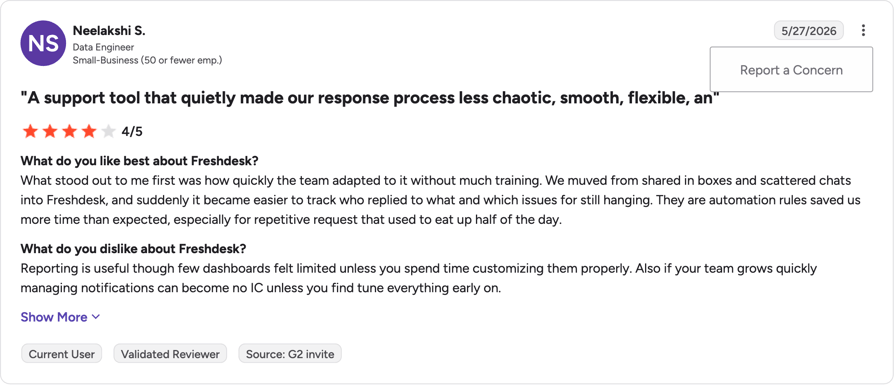
Freshdesk is Freshworks’ helpdesk, and Freddy AI is the AI layer on top of it: an AI agent for customer-facing resolution, a copilot for human agents, and an insights product for analytics. Freshworks sells all of it on published per-agent pricing with a published AI session rate. If calls are part of the picture, CloudTalk’s Freshdesk integration logs them into the same ticket.
Why Is Freshdesk Better Than Forethought AI?
It answers the affordability question Forethought can’t. Forethought publishes a 20,000 historical ticket floor, and Vendr’s lowest documented volume band starts around $30,000 a year. Freshdesk starts at $19 per agent per month with 500 Freddy AI Agent sessions included, which is a different order of commitment for a team of eight.
What Does Freshdesk Cost?
- Growth: $19 per agent/month, billed annually. Freddy AI Agent with the first 500 sessions included.
- Pro: $55 per agent/month, billed annually. Same AI agent allowance.
- Enterprise: $89 per agent/month, billed annually. Adds Freddy AI Insights.
- Additional AI Agent sessions: $49 per 100 sessions.
- Freddy AI Copilot: $29 per agent/month billed annually, on Pro and Enterprise.
- Day passes: $2 on Growth, $7 on Pro, $12 on Enterprise.
- Connector app tasks: $80 per 5,000 tasks.
How Does Forethought AI Pricing Compare With the Alternatives?
Forethought AI vs. CloudTalk vs. Intercom Fin vs. Freshdesk
| Platform | Pricing Model | Published Price? | Buy Without a Sales Call? | Where the Cost Grows |
|---|---|---|---|---|
| Forethought AI | Platform access fee plus outcome-based usage | No, quote only at every tier | No. Proof of Value engagement, then a quote | Ticket volume bands, overage, voice, implementation, annual escalators |
| CloudTalk | Per user/month plus named add-ons | Yes | Yes, 14-day free trial | Seats, plus AI Voice Agent minutes and AI Conversation Intelligence |
| Intercom Fin | Per resolved outcome, optional seats | Yes | Yes, self-serve on Essential and Advanced, no contract | Resolution volume, seats, add-on messages and credits |
| Freshdesk with Freddy AI | Per agent/month plus AI sessions | Yes | Yes, published per-agent pricing | Agents, and AI sessions above the 500 included |
One note for anyone who wants Forethought’s technology on a published plan price: Zendesk’s own AI agents come included in all Suite and Support plans with a small monthly allowance of automated resolutions, then meter per resolution above it, while “Forethought AI agents by Zendesk” stays a separate quote-based add-on on top of a seat price that runs $19 to $115 per agent per month. The published Zendesk stack is the floor under any Forethought quote.
Test Voice AI Yourself.
Is Forethought AI Worth It, and Who Should Buy It?
Forethought is a serious product with a real qualification gate, and most of the disappointment around it comes from teams who were never in its market. Salesforce’s 2026 State of Service: AI Agents Edition2 found that 66% of customer service organizations now use agentic AI, up from 39% a year earlier, so automating resolution is table stakes. The question is whether this vendor’s cost structure fits your volume.
Who Should Buy Forethought AI
- Support orgs running 20,000+ historical tickets and at least 2,000 a monthThis is Forethought’s own published qualification gate, so clearing it is the first test of whether you are in its market at all.
- Teams whose support load is mostly email and chatThose are the channels the product is built around, and the ones where outcome-based pricing works in your favor.
- Buyers with a procurement function that can hold a discount conversationVendr’s data shows an average 22% saving off the opening number, and the enterprise band is where that is most achievable.
- Companies already inside the Zendesk ecosystem, or comfortable joining itQuotes now run through Zendesk sales, so the contract, the SLA and the bundling all sit on Zendesk’s paper.
Who Should Look Elsewhere
- Anyone who needs a number before they can open a business caseEvery tier and every add-on is quote-only, so the spreadsheet column stays empty until a sales cycle finishes.
- Teams below the data floorFreshdesk with Freddy AI starts at a fraction of Forethought’s smallest observed contract, and lighter AI for small business tools sell self-serve.
- Support operations that run through the phoneVendr’s data shows the Voice AI add-on can cost as much again as the base platform, while a dedicated calling platform publishes its prices and treats voice as the core product.
- Buyers who want to test before they commitA vendor-led Proof of Value runs on the vendor’s timeline, which a self-serve trial does not.
Is Forethought AI free at any level?
No. There’s no free plan and no free trial, and you can’t sign up without talking to sales. The Proof of Value is a vendor-led engagement that uses your own data to demonstrate the platform before you buy, which is genuinely useful, but it’s still a sales motion with your team’s time inside it.
One last frame for the business case. Deloitte’s State of AI in the Enterprise report4 surveyed 3,235 senior leaders in late 2025 and found that while 66% of organizations report productivity and efficiency gains from enterprise AI, only 40% report reducing costs. A Forethought AI subscription justified purely on headcount savings is the version of this deal most likely to disappoint at renewal. Build the case on resolution quality and response time instead, and hold the cost argument to what you can measure in the first 90 days.
See Your Voice Costs Upfront.
Sources:
- TrustRadius
- Salesforce
- Forrester Research
- Deloitte
Forethought AI Pricing FAQ
Common questions about Forethought AI costs, its outcome-based pricing model, hidden fees, the Zendesk acquisition and how it compares to alternatives.
Forethought charges a platform access fee plus usage tied to the conversations its AI resolves, per its own pricing FAQ. There’s no per-seat rate: the bill tracks support volume, not headcount. Vendr reports contracts set a ticket band, with overage above it. It’s call deflection as a line item.
Neither. Forethought’s own FAQ says it runs a Proof of Value engagement instead: a vendor-led pilot built on your data. It’s useful, but it runs on the vendor’s timeline, unlike a self-serve trial where you test AI voice agents for sales and support before anyone quotes you.
Implementation, integration and voice costs sit on top of the subscription, plus overage Forethought confirms but won’t price. Vendr’s ranges: implementation $10,000 to $50,000, integrations $5,000 to $25,000, Voice AI $30,000 to $80,000 a year, escalators 3% to 7%. Factor them in before counting on reducing call center costs.
No. Forethought publishes a floor of 20,000 historical tickets and 2,000 email or chat tickets a month, and Vendr’s lowest documented band starts around $30,000 a year. A ten-person desk is below the qualification gate, not just the budget. Look at self-serve AI customer service for growing businesses instead.
Forethought quotes 30 to 90 days in its own FAQ, after which you’re paired with a customer success manager. That’s a long runway against the 60-day mark Salesforce reports for measurable AI value. Write your timeline into the contract, and check what it takes to implement an AI voice agent yourself.
Worth it for teams with high, steady ticket volume, mostly email and chat, and a procurement function that can negotiate. Vendr’s median contract is $74,483 a year, so the case rests on resolution volume, not headcount savings. It’s weakest when your 24/7 customer service load lands on the phone.
CloudTalk publishes its prices and Forethought doesn’t. CloudTalk pricing runs $25, $29 and $49 per user/month on Starter, Essential and Expert, with AI Voice Agents and AI Conversation Intelligence always add-ons. Forethought quotes a platform fee plus usage, so you can’t compare until a sales call.
Forethought AI is a customer support automation platform whose AI agents resolve tickets across chat, mobile, email, voice and Slack. It’s an intelligent customer service layer on top of a helpdesk, not a replacement for one. Zendesk acquired it in March 2026.
Zendesk hasn’t disclosed the price. It announced the deal on 11 March 2026 and closed it on 26 March, with no figure in either release. Forethought had raised $115 million in total funding, and the acquisition was widely reported as Zendesk’s largest in nearly two decades. What changed for buyers: quotes come from Zendesk sales now, and voice you run beside it, through a Zendesk call center integration, is priced separately.
Forethought is an established support-AI vendor with a real product and, now, Zendesk’s backing. Its published gate of 20,000+ historical tickets tells you honestly who it’s built for. We haven’t scored it here: no verified review data was available. If your volume sits on the phone, an AI call center fits better.