10 Best Mitel Alternatives: TL;DR Comparison Table
| # | Tool | Best For | Starting Price | G2 Rating |
|---|---|---|---|---|
| 1 | CloudTalk | Growing SMB to mid-market sales and support teams | $25/user/month | 4.4/5 |
| 2 | RingCentral | Enterprises wanting one all-in-one UCaaS suite | $20/user/month | 4.2/5 |
| 3 | 3CX | IT-led teams wanting a self-hosted or self-managed PBX | Free tier; paid by simultaneous calls | 4.4/5 |
| 4 | Aircall | Support teams needing a big app-integration marketplace | $30/user/month (3-seat min) | 4.4/5 |
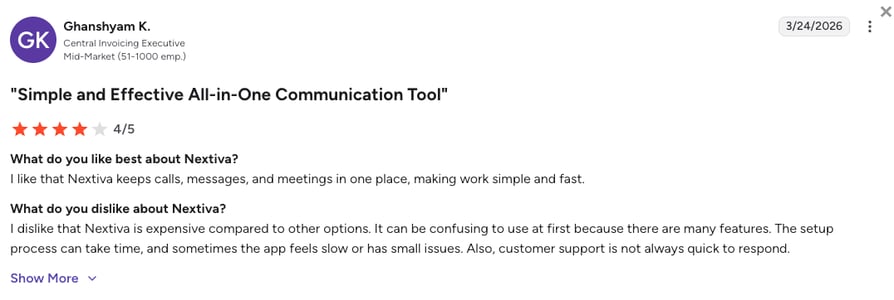
| 5 | Nextiva | Multi-location teams wanting reliable UCaaS | $15/user/month | 4.5/5 |
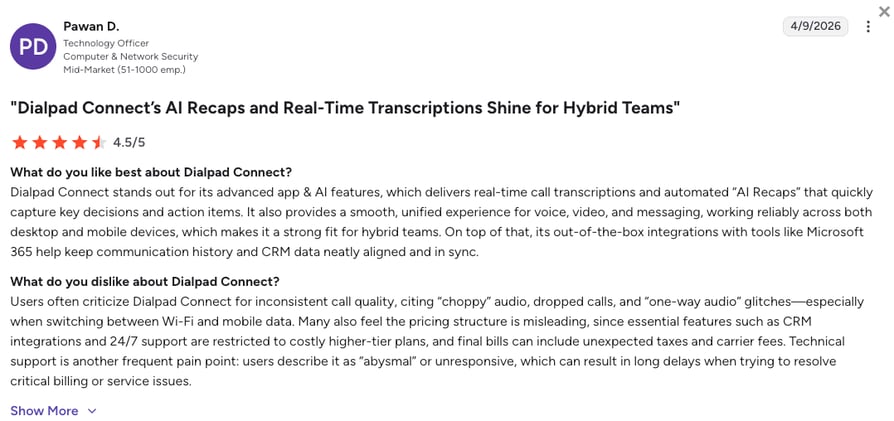
| 6 | Dialpad | Teams wanting built-in AI transcription and coaching | $15/user/month | 4.4/5 |
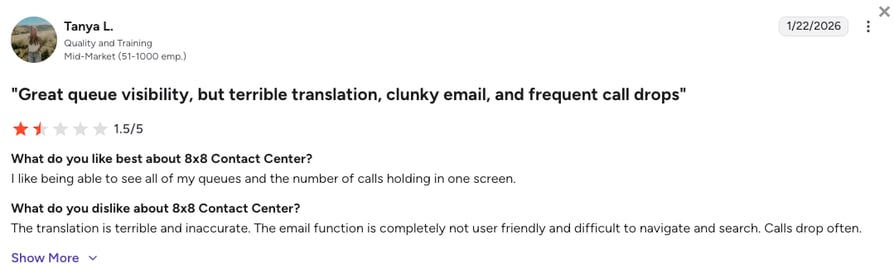
| 7 | 8x8 | Global teams blending phone and contact center | $24/user/month | 4.1/5 |
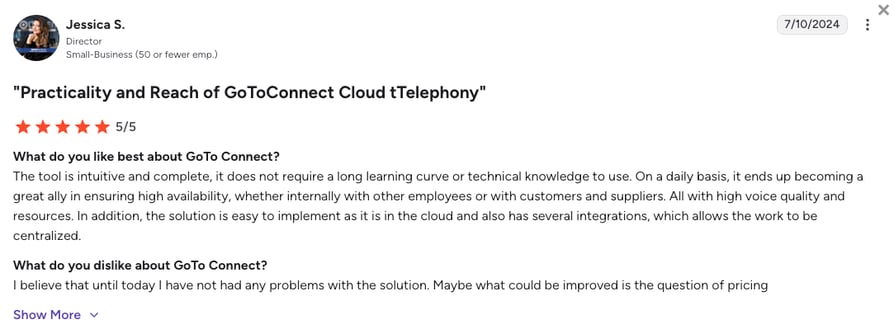
| 8 | GoTo Connect | Small businesses wanting fast, simple setup | $26/user/month | 4.4/5 |
| 9 | Vonage | Teams wanting telephony plus communication APIs | $13.99/line/month | 4.3/5 |
| 10 | Genesys Cloud CX | 200+ seat enterprises needing full omnichannel | $75/user/month | 4.4/5 |
Skip the Quote. See It Live.
Why Are Teams Searching for a Mitel Alternative?
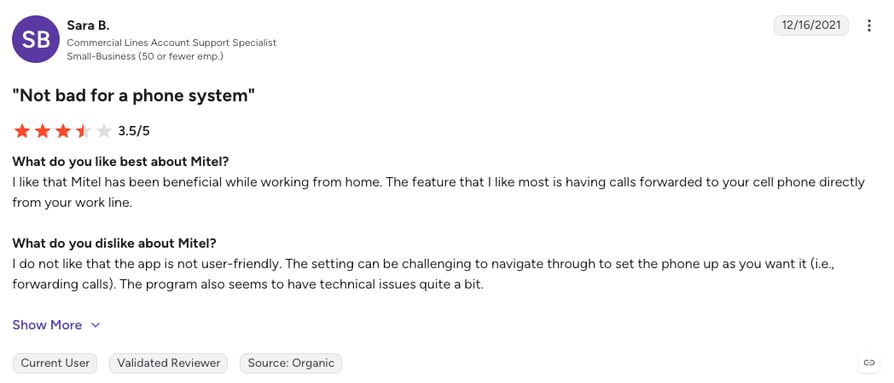
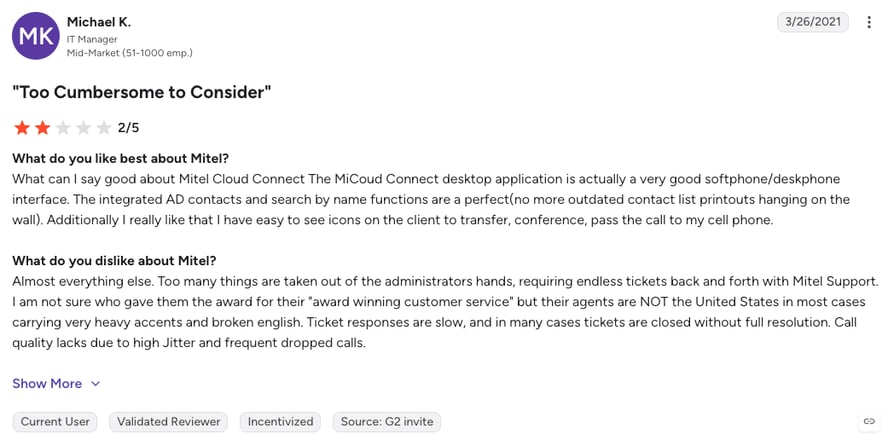
Let's start fair: Mitel isn't a bad phone system. The platform currently holds a 3.8/5 on G2 across 200+ reviews, and plenty of enterprises have run on Mitel hardware for years without complaint.
The catch is that the platform is winding down, not the product. Between a cloud service that just went dark, pricing you only get by quote, and a legacy hardware core, teams keep asking the same question: how long do you keep betting on Mitel? Here are the five reasons that search happens.
5 Main Cons of Mitel That Make Businesses Look for an Alternative
- A cloud platform being switched off, not upgradedMitel's MiCloud Connect was permanently shut down on June 24, 2026, after RingCentral bought the cloud platform. Customers were pushed onto RingCentral by default or left to find a new business phone system fast, and it follows a Chapter 11 restructuring¹ that makes betting on Mitel's long-term roadmap a real risk. Your calling platform shouldn't have an expiry date.
- Pricing you can't see without a sales callMitel pricing is quote-only and partner-sold. Indicative cloud rates start near $21/user/month, but hardware, onboarding, and support are billed separately, and you get a demo instead of a free trial.
- A hardware-bound, legacy coreMuch of Mitel's base still runs on on-premise PBX hardware. On Reddit, users describe dropped calls and conferencing glitches on aging systems that need a firmware update or a full hardware swap to fix.
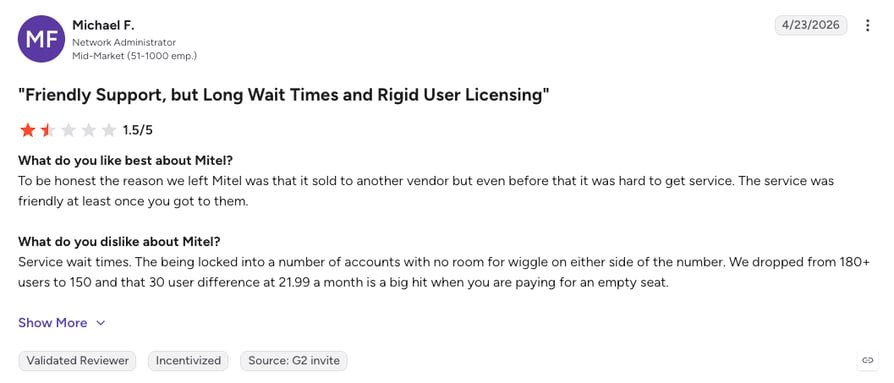
- Support and setup that wear smaller teams downMitel scores just 7.2 for quality of support and 7.3 for ease of setup on G2, among its weakest categories. Buyers report slow, hard-to-reach support and thin training material, a recurring theme in Mitel community threads.
- A thin AI story and an uncertain road aheadMitel scores only 6.2 for product direction on G2, the weakest signal here, a sign users doubt where the platform is heading. Tools like Mitel Voice Assist trail the built-in AI voice agents cloud-native rivals ship today.
Where Mitel Still Shines
If you run a large, hybrid or on-premise operation that wants voice, video, and messaging under one roof and has the IT team to manage it, Mitel's unified communications suite is still a capable system. It's also often used in hospitality, especially among mid-sized established hotels needing analog guest room support and MiVoice Office. The question is whether that fits a team your size, and whether you want to manage the hardware.
What Is the Best Alternative to Mitel?
CloudTalk is the best Mitel contact center alternative for growing sales and support teams. It gives you cloud-native calling, two-way CRM sync, outbound dialers, and built-in AI in one platform you set up yourself, with none of Mitel's hardware or quote-only friction.
Why Do Teams Consider CloudTalk the Best Mitel Alternative?
CloudTalk is a voice-first contact center platform built for teams of roughly 5 to 200 seats. Plans start at $25/user/month with unlimited inbound calls, a 500-minute outbound bundle, call queues, transfers, and click-to-call, on three clear tiers that top out at $49/user/month.
There's no seat minimum until the Expert plan (3 seats), uptime runs at 99.999%, and you can buy virtual numbers in 160+ countries with no enterprise contract. Every account also includes 50 free AI Receptionist minutes to start with, so you can test AI call handling before you pay for it (CloudTalk's AI voice agent plans start at $99/month)
5 Main Pros of CloudTalk and Why Businesses Switch from Mitel
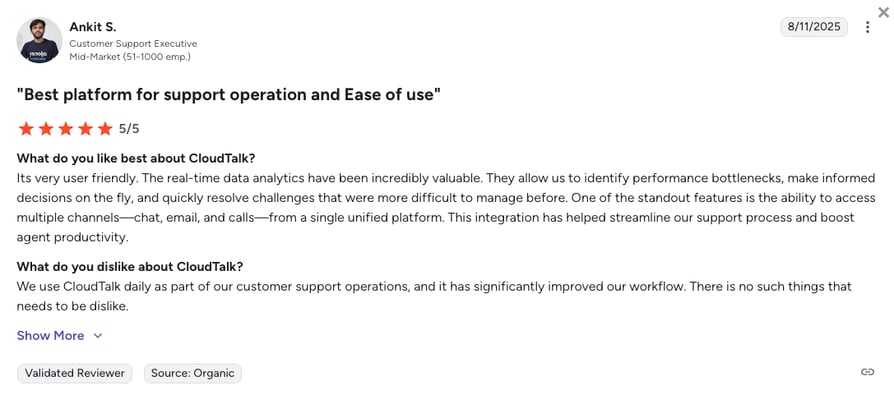
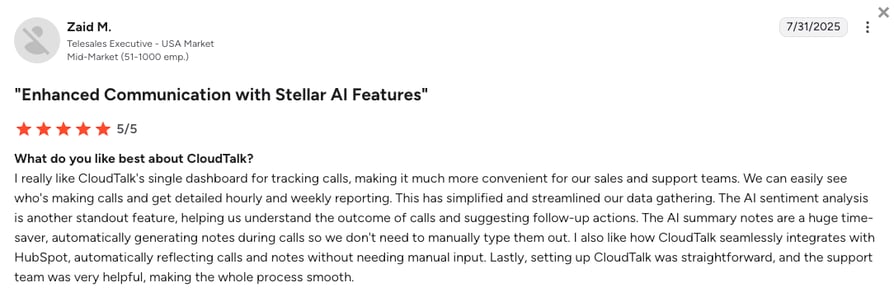
- Cloud calling that just works, no hardwareCloudTalk runs entirely in the cloud with 99.999% uptime and intelligent call routing, so there's no PBX box to patch or replace and no site visit to schedule.
- Flat pricing you can read on a pageThree publicly available tiers from $25 to $49/user/month, flat-rate AI add-ons like Conversation Intelligence from $9/user/month, plus a 14-day free trial. No quotes, no partner markup, and no separate hardware invoice.
- A migration you control, in 160 countriesNumber porting brings your existing numbers over, and you can add virtual numbers across 160 countries yourself. You pick the timeline, not a shutdown date.
- 24/7 human support, not a partner queueChat and email support runs 24/7 on every plan, with phone support on Expert. You reach CloudTalk directly instead of routing every ticket through a reseller.
- Built-in voice AI and true two-way CRM syncThe AI Receptionist answers routine calls from $99/mo after 50 free minutes, AI Specialists handle booking and qualification from $349/mo, and 100+ CRM integrations, including HubSpot, Zendesk, Pipedrive, or Intercom, log every call automatically from Essential. Salesforce ecosystem integration becomes available from Expert.
Test It for 14 Days. No Contract Needed.
How We Chose the Best Mitel Alternatives and Competitors
We didn't rank these 10 platforms by gut feel. Instead, we aggregated verified user experiences from Reddit, Quora, and G2, checked every price against the vendor's live pricing page the week of publication, and scored each tool against six benchmarks key to any scaling business:
- Call Stability & ReliabilityUptime guarantees, call quality reports, and how often users mention dropped calls in reviews.
- Total Cost of OwnershipThe real monthly bill: seat prices, hardware, add-ons, seat minimums, and setup costs.
- CRM & Helpdesk Integration DepthWhether integrations sync data both ways, and which pricing tier unlocks them.
- Global Coverage & Number AvailabilityHow many countries you can buy numbers in, and what international calling actually costs.
- Support Quality & AvailabilitySupport channels, hours, and whether smaller accounts get a human or a portal.
- AI & Automation CapabilitiesWhat the AI does, what it costs, and whether it's built in or a bolt-on add-on.
The Top 10 Alternatives to Mitel for 2026
Before we dive into the individual breakdowns of the best Mitel competitors, here's how the platform compares with CloudTalk and three of the strongest alternatives to Mitel software: 3CX, Aircall, and RingCentral. These are the top alternatives to Mitel communication solutions that teams shortlist most, and the same four platforms appear in the G2 comparison further down the page.
Mitel vs. CloudTalk vs. 3CX vs. Aircall vs. RingCentral
| Feature | Mitel | CloudTalk | 3CX | Aircall | RingCentral |
|---|---|---|---|---|---|
| Starting Price | Quote-based (from ~$21/user/month cloud) | $25/user/month (Starter) | Free tier; licensed by simultaneous calls | $30/user/month (3-seat min) | $20/user/month (Core) |
| Seats Minimum | None published (quote-based) | 1 seat (3 on Expert) | Licensed by simultaneous calls | 3 seats | 1 seat |
| Free Trial |  Demo only Demo only |  14 days 14 days | Free tier + trial | 7 days | 14 days |
| Call Recording | Add-on / edition-dependent | From the start | Included (self-hosted) | Included | From Advanced |
| CRM Integrations | Limited, edition-dependent | 100+ tools from Essential | Built-in CRM templates | 200+ marketplace apps | 300+ from Advanced |
| AI Features | Nascent (Voice Assist add-on) | AI Receptionist, AI Voice Agents, Conversation Intelligence | Limited | AI add-on | AI assistant (add-on) |
| Dialer Type | Outbound contact center add-on | Power Dialer (Expert or $15/user/month add-on), Parallel Dialer ($39/user/month add-on on any plan). Smart & Preview Dialer on Expert. Click-to-call from Starter. | Basic dialer | Power Dialer (add-on) | Auto-dialer (add-on) |
| Analytics & Reporting | Edition-dependent | Real-time dashboards, call analytics | Built-in reports | Analytics+ add-on | Advanced+ tiers |
| Country/Number Coverage | Partner and region-dependent | 160+ countries | Via your SIP trunk provider | 100+ countries | 100+ countries |
| Customer Support | Partner-led; slower direct support | 24/7 (phone on Expert) | Community and partner; paid support | Business hours; 24/7 higher tiers | 24/7 support |
The Mitel Cost Trap: The Quote Hides the Real Bill
That ~$21/user/mo cloud rate is only the starting line. Mitel deals add hardware or handset costs, professional-services onboarding, per-edition feature add-ons, and ongoing partner support fees, and there's no free trial to test the fit first. A CloudTalk seat is one published price with the calling, routing, and integrations already inside it.
1. CloudTalk: The Best Mitel Alternative for Growing Sales and Support Teams
What Is CloudTalk?
CloudTalk is a voice-first, AI-powered contact center platform for fast-growing sales and support teams, roughly 5 to 200 seats. It combines calling in 160+ countries, two-way CRM sync, automatic outbound dialers, and AI call handling in one product you set up without a partner or a single piece of hardware.
Where Mitel sells a hardware-anchored suite through resellers, CloudTalk sells the working core of a contact center at a per-seat price you can read on a page.
Why Is CloudTalk a Strong Mitel Alternative?
- Cloud-native calling with 99.999% uptime: There's no PBX hardware to patch or replace, and intelligent routing keeps calls connected across sites.
- Flat, published pricing: Three tiers from $25 to $49/user/mo on annual billing, plus a 14-day free trial. No quotes, no partner markup.
- Outbound dialers built for sales: The Power Dialer comes with Expert (or a $15/user/mo add-on on any plan), and the Parallel Dialer ($39/user/mo add-on) dials up to 10 lines at once.
- AI you can budget for: The AI Receptionist answers routine calls from $99/mo after 50 free minutes, and AI Voice Agents handle booking and lead qualification from $349/mo, at fixed monthly prices.
- Coverage in 160 countries: You can easily buy and port virtual numbers yourself (or with CloudTalk's assistance), so entering a new market doesn't mean a fresh Mitel quote.
What Are the Pros & Cons of CloudTalk?
| Pros | Cons |
|---|---|
| Flat per-seat pricing from $25/user/month with no hardware | Voice-first by design: no video calls or omnichannel inbox |
| Live in hours with self-serve setup and a 14-day free trial | CRM integrations require the Essential plan ($29/user/month) |
| 100+ CRM and helpdesk integrations from Essential | Parallel Dialer only available as a $39/user/month add-on |
| AI Receptionist (50 free minutes) and AI Voice Agents at fixed monthly prices | |
| 24/7 chat and email support on all plans (phone on Expert) |
What Are CloudTalk's Plans & Pricing?
CloudTalk pricing starts at $25/user/month (Starter, billed annually), with the following plans:
CloudTalk Plans and Pricing
| Plan | Price (annual billing) | Key Features |
|---|---|---|
| Starter | $25/user/month | Unlimited inbound & internal calls, 500 outbound minutes (regional calling bundle), call queues, transfers, click-to-call, automatic call recording (1-month retention) |
| Essential | $29/user/month | Everything in Starter + IVR and smart routing, 100+ CRM/helpdesk integrations, workflow automation, unlimited recording retention |
| Expert | $49/user/month | Everything in Essential + Power, Smart & Preview Dialers, Salesforce integration, 24/7 phone support (3-seat min) |
| Conversation Intelligence (add-on) | $9/user/month | AI transcripts, call summaries, call scoring, sentiment analysis, and agent coaching insights |
| AI Receptionist (add-on) | From $99/month (200 min) | Inbound AI call answering, routing, logging; 50 free minutes on every account; tiers up to $699/mo (2,500 min) |
| AI Voice Agent (add-on) | From $349/month (1,000 min) | Sales-led custom AI agents for inbound and outbound workflows; plans scale up to $1,249/mo (5,000 min) |
What Do CloudTalk's Customers Say?
Across G2 and Capterra, reviewers most often praise how fast CloudTalk goes live, the call quality across international routes, and CRM integrations that log calls without agent effort. The recurring theme is relief: teams replace a system they needed a partner for with one they run themselves.
The most common criticism is that Salesforce deep-sync requires the Expert plan, a real tier jump for smaller Salesforce shops. Some reviewers also want richer native reporting, which is where the Conversation Intelligence add-on usually comes in.
CloudTalk Global Scale in Action: Revolut's Story
Revolut is proof that you don't need a legacy enterprise phone system to run at global scale. The fintech grew its SDR operation from zero to more than 500 reps in 18 months on CloudTalk, using deep CRM sync, real-time dashboards, and local numbers across its markets, exactly the reach a hardware-bound Mitel setup makes slow and costly.
Jamie Devlin, Revolut's Head of Operations for Business Sales, sums up the outcome:
”We managed to reduce sales operations by 40 hours per month and give our team the tools they need to scale globally — without sacrificing efficiency.”
Head of Operations for Business Sales at Revolut

How Do G2 Users Rate CloudTalk?
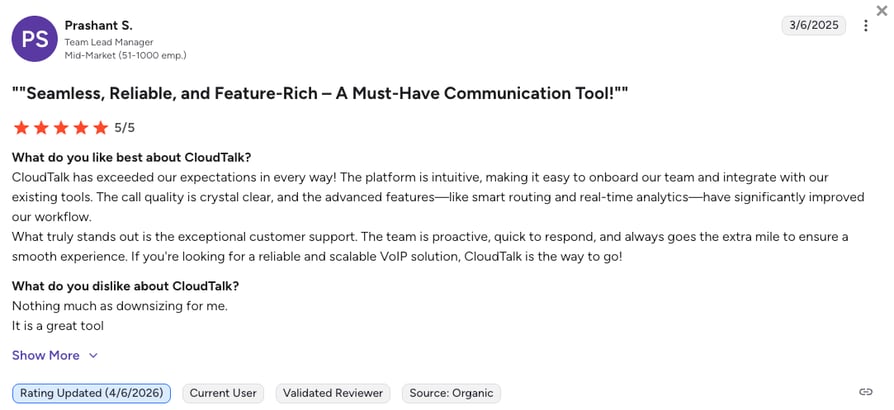
CloudTalk holds 4.4/5 on G2 across 1,800+ verified reviews, with ease of use and quality of support among its highest-scoring categories.
Ready to Leave Mitel Behind?
2. RingCentral: Best for Enterprises Wanting One All-in-One UCaaS Suite
What Is RingCentral?
RingCentral is the all-in-one UCaaS (Unified Communications as a Service) heavyweight, and the default landing spot for Mitel's MiCloud Connect customers, since RingCentral bought that platform and migrates it onto RingEX. It bundles calling, video, team messaging, and a contact center add-on for mid-size and enterprise teams.
Why Is RingCentral a Strong Mitel Alternative?
- The built-in migration path from MiCloud: If you're on MiCloud Connect, RingCentral is the default move, with porting tools and a working relationship with Mitel behind it.
- One suite for phone, video, and messaging: RingEX bundles all three, so a Mitel shop replacing MiCollab gets those channels in one place.
- 300+ integrations from the Advanced tier: Salesforce, HubSpot, and Microsoft sync natively, well past Mitel's edition-limited connectors.
What Are the Pros & Cons of RingCentral?
| Pros | Cons |
|---|---|
| All-in-one UCaaS: phone, video, and messaging | Higher tiers get expensive fast |
| 300+ integrations on Advanced and up | Feature sprawl can overwhelm smaller teams |
| Global carrier network and reliable uptime | Best value needs annual, higher-seat contracts |
What Are RingCentral's Plans & Pricing?
RingCentral pricing starts at $20/user/month (Core, annual billing), with the following plans:
RingCentral (RingEX) Plans and Pricing
| Plan | Price (annual billing) | Key Features |
|---|---|---|
| Core | $20/user/mo | Unlimited calling, video meetings (100), team messaging, IVR, AI writing assistant |
| Advanced | $25/user/mo | Everything in Core + call recording, 300+ integrations, auto call notes |
| Ultra | $35/user/mo | Everything in Advanced + unlimited storage, advanced analytics, device analytics |
Is Mitel the Same as RingCentral?
What Are RingCentral's Customers Saying?
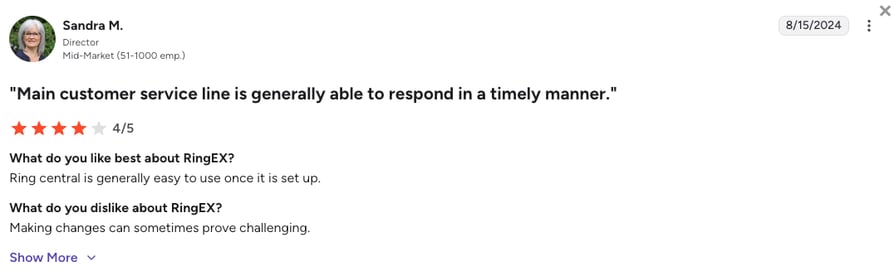
Reviewers praise the all-in-one breadth and reliability. A common complaint is that pricing climbs quickly once you add features, and that support can slow down after onboarding.
How Do G2 Users Rate RingCentral?
RingCentral holds 4.2/5 on G2 across 1,400+ verified reviews, a solid score for a platform of its size.
3. 3CX: Best for IT-Led Teams Wanting a Self-Hosted or Self-Managed PBX
What Is 3CX?
3CX is a self-hosted or self-managed phone system that IT teams can run on their own servers or in 3CX's cloud. It's licensed by simultaneous calls rather than per user, which makes it the closest match for a Mitel shop that liked owning its PBX.
Why Is 3CX a Strong Mitel Competitor?
- Own your system, minus the legacy hardware: Run 3CX on your own server or its cloud, with the control on-premise Mitel admins are used to and none of the aging appliances.
- Licensed by simultaneous calls, not seats: Teams with lots of light users pay for concurrent calls instead of every headcount, which can cut costs sharply.
- Call queues, video, and CRM templates built in: Core call center features and live chat come in the box, with no per-feature add-on ladder.
What Are the Pros & Cons of 3CX?
| Pros | Cons |
|---|---|
| Concurrent-call licensing can lower cost | Self-hosting means IT owns uptime and security |
| Self-host or cloud, your choice | Setup and maintenance need technical skills |
| Free Startup tier for small teams | Support is community or paid-tier |
What Are 3CX's Plans & Pricing?
3CX pricing is unusual: it's licensed by simultaneous calls rather than per user, with a free edition and paid tiers (prices shift with 3CX's promotions), and the editions break down like this:
3CX Plans and Pricing
| Plan | Price (annual billing) | Key Features |
|---|---|---|
| Free | Free | Small teams and trials, hosted by 3CX, call queues, mobile and web apps, low simultaneous-call cap |
| Basic | Licensed by simultaneous calls | Standard PBX: call queues, apps, self-host or 3CX-hosted |
| Pro | Licensed by simultaneous calls | Advanced call center, CRM integration, call recording, reporting |
| AI Edition | Licensed by simultaneous calls | Everything in Pro + AI receptionist, transcription, and assistant |
The Self-Host Trap
What Are 3CX's Customers Saying?
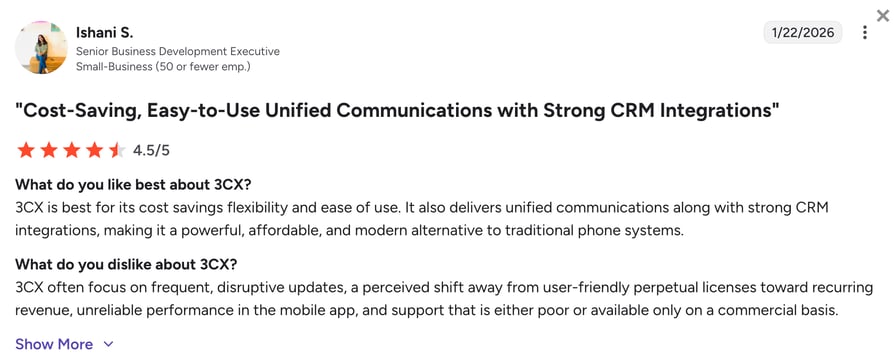
3CX admins love the control and the concurrent-call pricing. The recurring issue is that you own the maintenance, and non-technical teams find setup and updates harder than a fully hosted platform.
How Do G2 Users Rate 3CX?
3CX holds 4.4/5 on G2 across 500+ verified reviews, strong for a self-managed system.
4. Aircall: Best for Support Teams Needing a Big App-Integration Marketplace
What Is Aircall?
Aircall is a cloud phone system for sales and support teams that live inside their other tools. Its biggest draw is a 200+ app marketplace, so calls, notes, and tickets sync with the CRM and helpdesk a team already runs.
Why Is Aircall a Strong Mitel Alternative?
- 200+ integrations out of the box: Salesforce, HubSpot, Zendesk, and Intercom connect in clicks, far past Mitel's edition-limited connectors.
- Fast, self-serve setup: Provision numbers and go live the same day, with no partner or hardware install.
- Shared call inbox and clean workflows: Support teams route, comment, and assign calls like tickets, a modern take Mitel's UC suite doesn't match.
What Are the Pros & Cons of Aircall?
| Pros | Cons |
|---|---|
| 200+ app marketplace integrations | 3-seat minimum on every plan |
| Quick self-serve setup | Analytics and some features are paid add-ons |
| Shared inbox and collaboration features | Per-seat cost adds up at scale |
What Are Aircall's Plans & Pricing?
Aircall pricing starts at $30/user/month (Essentials, 3-seat minimum, annual billing), and it offers the following plans:
Aircall Plans and Pricing
| Plan | Price (annual billing) | Key Features |
|---|---|---|
| Essentials | $30/user/mo (3-seat min) | Unlimited US/Canada calls, 100+ integrations, click-to-dial, IVR |
| Professional | $50/user/mo | Everything in Essentials + Salesforce, analytics, Power Dialer, live coaching |
| Custom | Custom | Unlimited calling, custom onboarding, API access, SLA |
The Add-On Trap
What Are Aircall's Customers Saying?
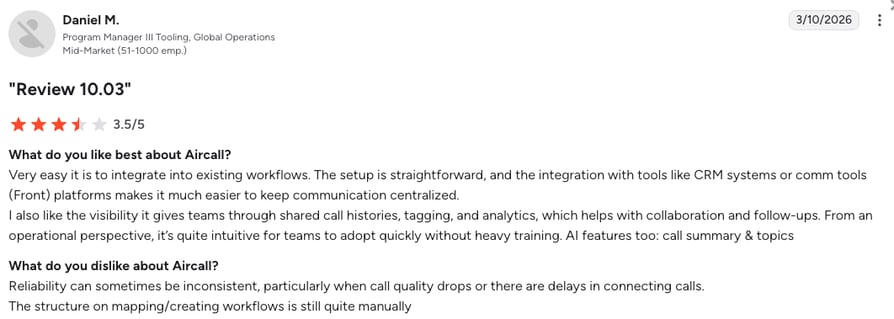
Users like the marketplace and the clean interface. Complaints center on the 3-seat minimum, call quality on some international routes, and support response times.
How Do G2 Users Rate Aircall?
Aircall holds 4.4/5 on G2 across 1,600+ verified reviews.
5. Nextiva: Best for Multi-Location Teams Wanting Reliable UCaaS
What Is Nextiva?
Nextiva is a UCaaS platform known for reliability and multi-location setups. It bundles calling, video, and team messaging, with a full contact center suite on its top tier, aimed at businesses that want one dependable system across sites.
Why Is Nextiva a Strong Mitel Alternative?
- Reliability built for multiple sites: Nextiva's uptime record and multi-location tools suit the branch-office setups many Mitel customers run.
- Calling, video, and messaging in one plan: A Mitel shop replacing MiCollab gets those channels without stitching tools together.
- 24/7 support with strong reviews: Nextiva's support scores well on G2, a clear step up from Mitel's 7.2.
What Are the Pros & Cons of Nextiva?
| Pros | Cons |
|---|---|
| Strong reliability and multi-location support | Contact center features jump to a $75 tier |
| Well-rated 24/7 customer support | CRM depth trails specialist call tools |
| UCaaS channels bundled in one plan | Add-ons needed for advanced analytics |
What Are Nextiva's Plans & Pricing?
Nextiva pricing starts at $15/user/month (Core, annual billing), with the following plans available:
Nextiva Plans and Pricing
| Plan | Price (annual billing) | Key Features |
|---|---|---|
| Core | $15/user/mo | Unlimited calling, 100 SMS/user, voicemail transcription, basic analytics |
| Engage | $25/user/mo | Everything in Core + call recording, CRM integrations, AI assistant |
| Power Suite CX | $75/user/mo | Full omnichannel contact center with AI, workforce management, advanced routing |
The Tier Jump Trap
What Are Nextiva's Customers Saying?
Reviewers rate the reliability and support highly. The common critique is that deeper contact center and CRM features sit on pricier tiers, and the platform can feel heavy for a small team.
How Do G2 Users Rate Nextiva?
Nextiva holds 4.5/5 on G2 across 3,600+ verified reviews, one of the higher-rated UCaaS platforms here.
6. Dialpad: Best for Teams Wanting Built-In AI Transcription and Coaching
What Is Dialpad?
Dialpad built its business phone, Dialpad Connect, around live AI: real-time transcription, call summaries, and coaching on every call. For a Mitel shop that wants built-in intelligence instead of a Voice Assist bolt-on, it's an easy shortlist.
Why Is Dialpad a Strong Mitel Alternative?
- AI transcription and summaries built in: Every call is transcribed and summarized automatically, where Mitel's AI is an early-stage add-on.
- Real-time coaching for agents: Live assist surfaces answers mid-call, useful for both sales and support teams.
- Self-serve setup from $15: The Connect plan goes live without a partner, unlike Mitel's sales-led deals.
What Are the Pros & Cons of Dialpad?
| Pros | Cons |
|---|---|
| Built-in AI transcription and summaries | CRM integrations need the $25 Pro tier |
| Self-serve, cloud-native setup | Contact center is a separate, pricier product |
| Clean, modern interface | Coverage thinner outside core regions |
What Are Dialpad's Plans & Pricing?
Dialpad pricing starts at $15/user/month (Connect Standard, annual billing), and it lets you choose from the following plans:
Dialpad Connect Plans and Pricing
| Plan | Price (annual billing) | Key Features |
|---|---|---|
| Standard | $15/user/mo | Unlimited calling, AI transcription, AI call summaries, SMS, voicemail |
| Pro | $25/user/mo | Everything in Standard + call recording, CRM integrations, international numbers |
| Enterprise | Custom | Advanced admin, SSO, guaranteed uptime, priority support |
The Two-Product Trap
What Are Dialpad's Customers Saying?
Users praise the transcription accuracy and coaching. Criticism centers on telephony coverage outside the US and features split across two product lines that are easy to confuse.
How Do G2 Users Rate Dialpad?
Dialpad holds 4.4/5 on G2 across 4,200+ verified reviews, though the listing covers the Dialpad platform broadly.
7. 8x8: Best for Global Teams Blending Phone and Contact Center
What Is 8x8?
8x8 blends UCaaS and a contact center on one global platform. With calling in dozens of countries and contact center tiers on top, it's a natural fit for a Mitel enterprise that spans regions.
Why Is 8x8 a Strong Mitel Competitor?
- Global calling built in: Unlimited calling across many countries suits multinational teams leaving a region-locked Mitel setup.
- UCaaS and contact center in one platform: Phone, video, and a contact center scale together, a familiar model for Mitel enterprise buyers.
- Published UCaaS pricing: The X2 and X4 tiers have clear rates, unlike Mitel's quote-only model.
What Are the Pros & Cons of 8x8?
| Pros | Cons |
|---|---|
| Global calling across many countries | Contact center tiers (X6-X8) are quote-only |
| UCaaS and contact center on one platform | Costs climb fast for full CCaaS |
| Published entry-tier pricing | Interface can feel dated to some users |
What Are 8x8's Plans & Pricing?
8x8 pricing starts at $24/user/month (X2, annual billing), with the following tiers available:
8x8 Plans and Pricing
| Plan | Price (annual billing) | Key Features |
|---|---|---|
| X2 | $24/user/mo | UCaaS phone: unlimited calling (US/Canada), video, team messaging |
| X4 | ~$44/user/mo | Everything in X2 + contact center features, advanced analytics, supervisor tools |
| X6-X8 | From ~$85/user/mo | Full CCaaS contact center suite with omnichannel and workforce management |
The CCaaS Jump Trap
What Are 8x8's Customers Saying?
Reviewers value the global reach and the all-in-one scope. Complaints focus on quote-only contact center pricing, occasional support delays, and an interface some find dated.
How Do G2 Users Rate 8x8?
8x8 holds 4.1/5 on G2 across 200+ verified reviews.
8. GoTo Connect: Best for Small Businesses Wanting Fast, Simple Setup
What Is GoTo Connect?
GoTo Connect is a UCaaS platform built for small businesses that want a phone system up fast. Its visual dial-plan editor and bundled meetings make it one of the simpler setups for a team leaving Mitel.
Why Is GoTo Connect a Strong Mitel Alternative?
- Fast, simple setup: A visual dial-plan editor lets non-technical admins build call flows in minutes, no partner required.
- Meetings bundled with the phone: GoTo Meeting is included, covering the video a Mitel shop used MiCollab for.
- Unlimited calling across 50+ countries on the Customer Experience (CX) tier: International coverage without a bespoke Mitel quote.
What Are the Pros & Cons of GoTo Connect?
| Pros | Cons |
|---|---|
| Easy, visual setup and admin | Pricing hidden behind Contact Sales |
| Bundled meetings and messaging | Contact center features jump to ~$80 |
| Unlimited international calling on higher tier | Reporting is lighter than specialist tools |
What Are GoTo Connect's Plans & Pricing?
GoTo Connect pricing starts at $26/user/month (Phone System, annual billing), with the following plans to choose from:
GoTo Connect Plans and Pricing
| Plan | Price (annual billing) | Key Features |
|---|---|---|
| Phone System | ~$26/user/mo | Unlimited domestic calling, IVR, visual dial plan, GoTo Meeting, call recording |
| Customer Experience (CX) | ~$34/user/mo | Everything in Phone System + unlimited calling in 50+ countries, CRM integrations, advanced reporting |
| Contact Center | ~$80/user/mo | Full contact center with AI, analytics, and omnichannel routing |
The Unexpected Price Trap
GoTo Connect lists most pricing as Contact Sales, so the ~$26 figure comes from verified industry data, not a public page. The same goes for its newly introduced AI receptionist feature. Get a written quote before comparing, and confirm which tier includes the features you need.
What Are GoTo Connect's Customers Saying?
Users like how quickly it deploys and the bundled meetings. The common gripe is opaque pricing and reporting that trails dedicated contact center tools.
How Do G2 Users Rate GoTo Connect?
GoTo Connect holds 4.4/5 on G2 across 1,400+ verified reviews.
9. Vonage: Best for Teams Wanting Telephony Plus Communication APIs
What Is Vonage?
Vonage pairs a business phone system with a strong communications API platform. Teams that want standard telephony now and the option to build custom voice or SMS flows later put it on the shortlist.
Why Is Vonage a Strong Mitel Alternative?
- Telephony plus programmable APIs: Run a normal phone system and, when you need it, build custom voice, SMS, or verification flows on Vonage's APIs.
- Published per-line pricing: Clear Mobile, Premium, and Advanced tiers beat Mitel's quote-only model.
- 99.999% SLA on Premium: Enterprise-grade reliability without an on-premise appliance.
What Are the Pros & Cons of Vonage?
| Pros | Cons |
|---|---|
| Business phone plus developer APIs | Priced per line, and taxes add up |
| Published per-line pricing | Call recording is an add-on until Advanced |
| High reliability SLA on Premium | APIs need developer resources to use |
What Are Vonage's Plans & Pricing?
Vonage pricing for its Unified Business Comms suite starts at $13.99/line/month (Mobile, 1-4 lines, annual billing), with the following plans:
Vonage Plans and Pricing
| Plan | Price (annual billing) | Key Features |
|---|---|---|
| Mobile | $13.99/line/mo | Unlimited calling and SMS, mobile and desktop apps, basic CRM integrations |
| Premium | $20.99/line/mo | Everything in Mobile + video meetings (200), 99.999% SLA, full CRM integrations |
| Advanced | $27.99/line/mo | Everything in Premium + on-demand call recording, visual voicemail, call groups |
The Per-Line Trap
What Are Vonage's Customers Saying?
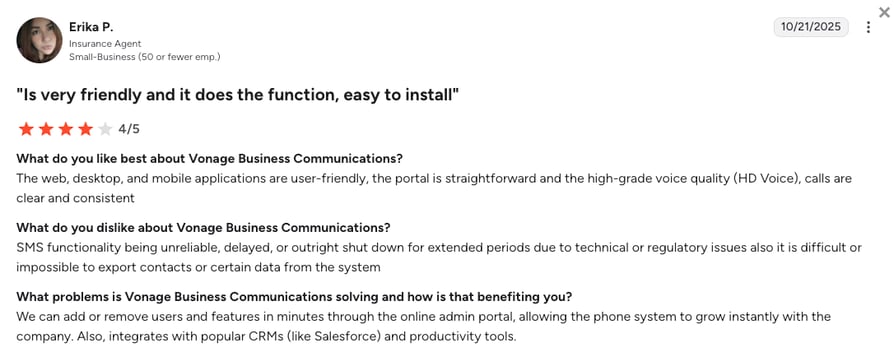
Reviewers like the reliability and the API flexibility. Complaints focus on per-line costs with added fees, and on features like recording sitting behind the top tier.
How Do G2 Users Rate Vonage?
Vonage holds 4.3/5 on G2 across 500+ verified reviews.
10. Genesys Cloud CX: Best for 200+ Seat Enterprises Needing Full Omnichannel
What Is Genesys Cloud CX?
Genesys Cloud CX is an enterprise contact center platform with omnichannel routing, native AI, and full workforce engagement on its upper tiers. For a large Mitel operation that needs true CCaaS depth, it's the enterprise-grade option.
Why Is Genesys Cloud CX a Strong Mitel Competitor?
- Full omnichannel orchestration: Voice, digital, and routing at enterprise scale, well beyond Mitel's contact center add-ons.
- Native AI on every plan: AI ships on all tiers rather than waiting for a top suite.
- Published per-user tiers: Four clear plans you can budget from, unlike Mitel's quote-only enterprise deals.
What Are the Pros & Cons of Genesys Cloud CX?
| Pros | Cons |
|---|---|
| Enterprise omnichannel and routing depth | Enterprise scale and complexity |
| Native AI included on every tier | AI tokens can run out and cost extra |
| Published four-tier pricing | Overkill for small or mid teams |
What Are Genesys Cloud CX's Plans & Pricing?
Genesys Cloud CX pricing starts at $75/user/month (CX 1, annual billing), and the platform offers the following plans:
Genesys Cloud CX Plans and Pricing
| Plan | Price (annual billing) | Key Features |
|---|---|---|
| CX 1 | $75/user/mo | Voice contact center: routing, IVR, recording, dashboards |
| CX 2 | $115/user/mo | Everything in CX 1 + omnichannel digital, quality assurance |
| CX 3 | $155/user/mo | Everything in CX 2 + full workforce engagement management |
| CX 4 | $240/user/mo | Everything in CX 3 + expanded AI at the best token value |
The Token Trap
What Are Genesys Cloud CX's Customers Saying?
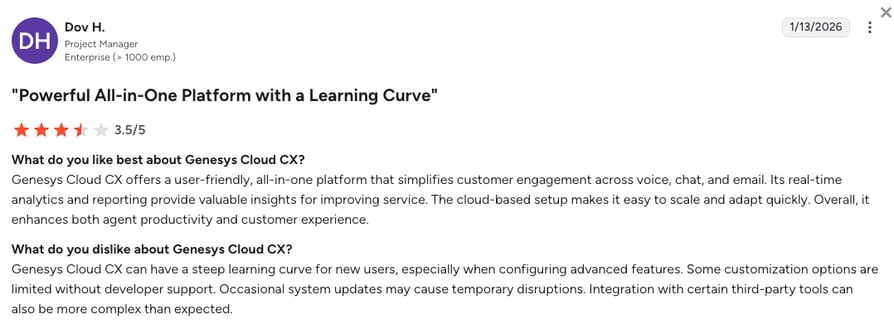
Reviewers praise the routing engine and customization. The recurring complaints are complexity and token-based AI billing that surprises first-year admins.
How Do G2 Users Rate Genesys Cloud CX?
Genesys Cloud CX holds 4.4/5 on G2 across 1,500+ verified reviews.
What Real Users Are Saying about Mitel and Its Alternatives
Pricing pages tell you what a platform does. Community threads tell you whether it works as promised, at your size, with your team. Here's what buyers and admins are actually saying across Reddit, Quora, and G2's comparison data.
What Redditors Are Saying about Mitel Alternatives
Search "mitel alternatives reddit" and you land in active r/VOIP and r/RingCentral threads where admins compare Mitel against RingCentral, 3CX, Avaya, and newer cloud tools. Three discussions stand out:
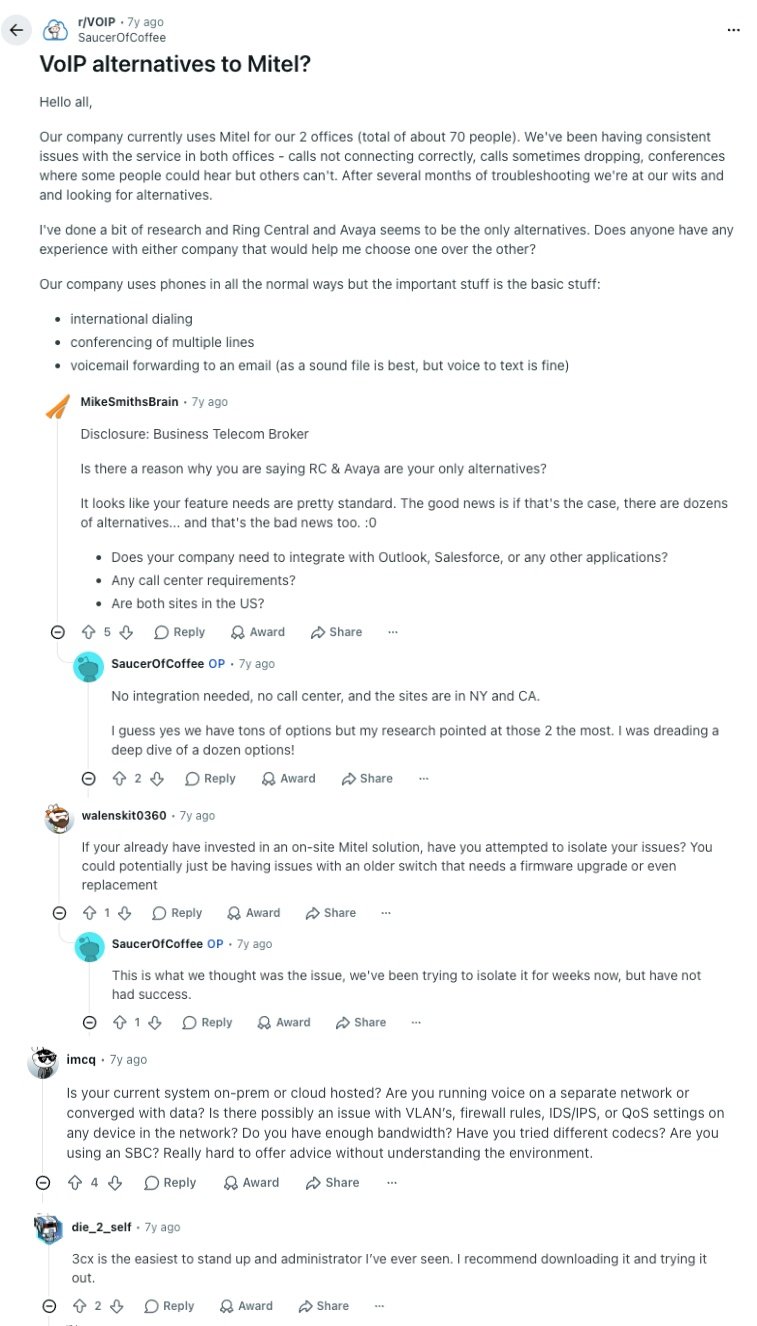
- Best Mitel VoIP alternatives: A 70-person company in r/VOIP asked for the best VoIP alternatives to Mitel after months of dropped calls and broken conference audio. Replies pushed RingCentral, Avaya, and 3CX ("the easiest to stand up"). The thread is a few years old, so newer cloud-native options like CloudTalk have entered since, but the core pain, aging systems dropping calls, still drives the search today.
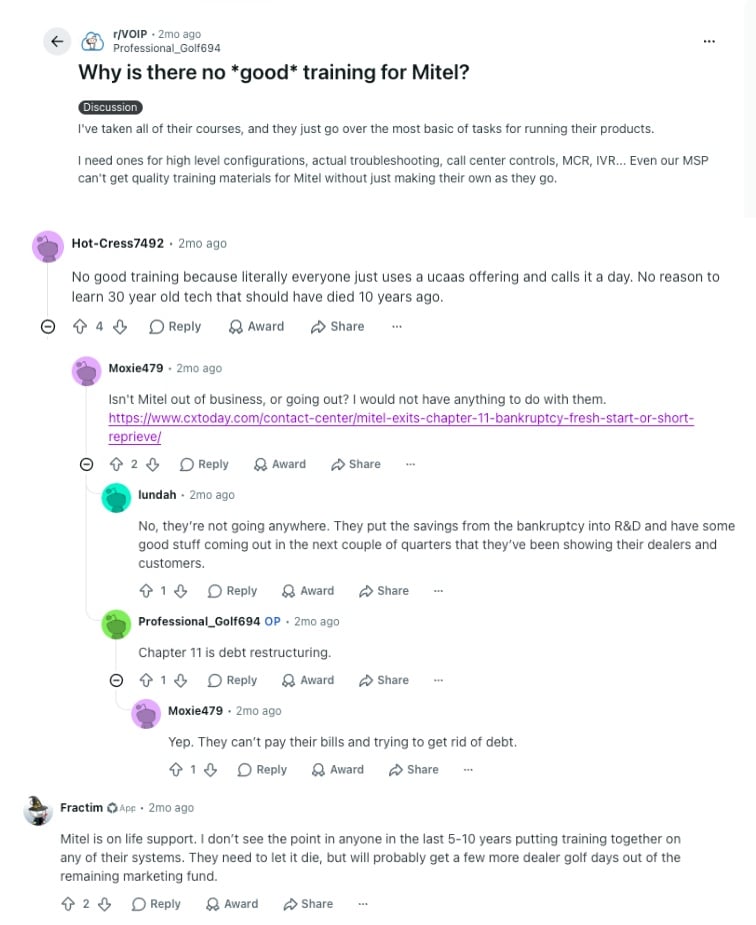
- Mitel training and legacy tech: In r/VOIP, a thread asking why there's no good Mitel training turned into a debate about the platform's future, with users calling it dated and pointing to Mitel's Chapter 11 filing. Worth being clear: Chapter 11 is a debt restructuring, not a shutdown, and Mitel emerged from it and keeps operating.
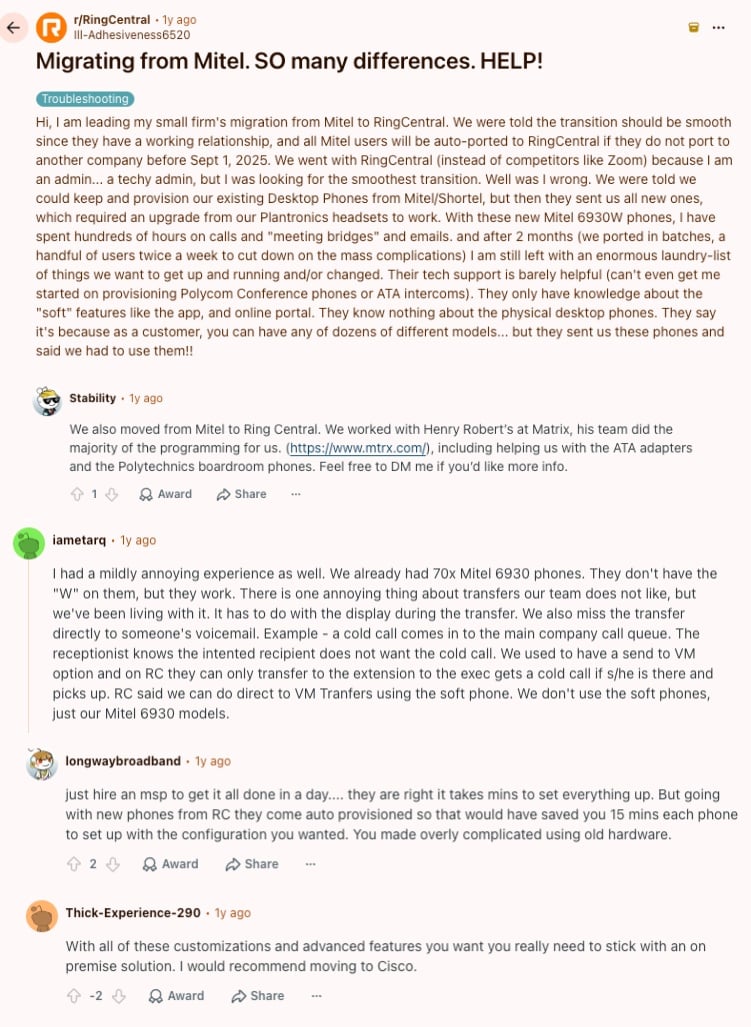
- Migrating from Mitel to the cloud: An r/RingCentral thread walks through a firm's move off Mitel, including the reality that MiCloud Connect customers were pushed toward RingCentral before the cutoff. It's a useful look at migration pain, and a reminder that number porting and same-day cloud setup make the switch far less disruptive.
What Quora Users Are Asking about Mitel Alternatives
Type "software similar to Mitel" or "platforms like Mitel" into a search bar and Quora threads point you toward the same cloud tools, each more than a decent alternative to Mitel's software. Three questions map directly onto why teams shortlist Mitel replacements:
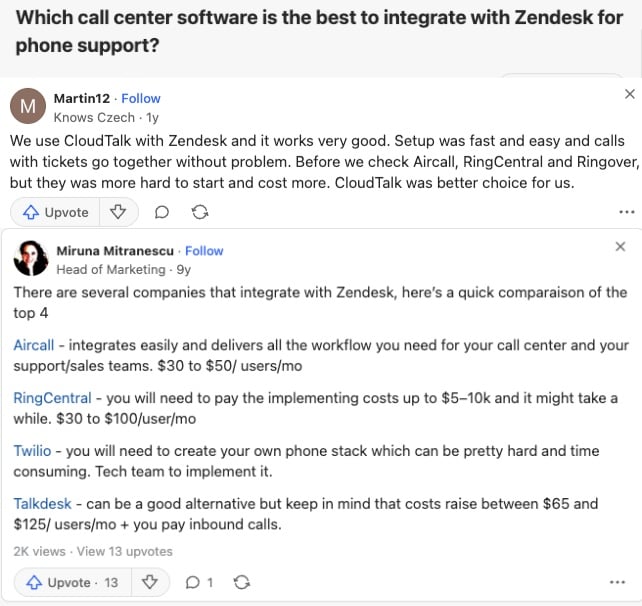
- Best call center software for Zendesk phone support: The top answer weighs Aircall, RingCentral, and Talkdesk, while a verified user reports choosing CloudTalk because the Zendesk integration meant "calls with tickets go together without problem," and it was cheaper and easier to start than the others.
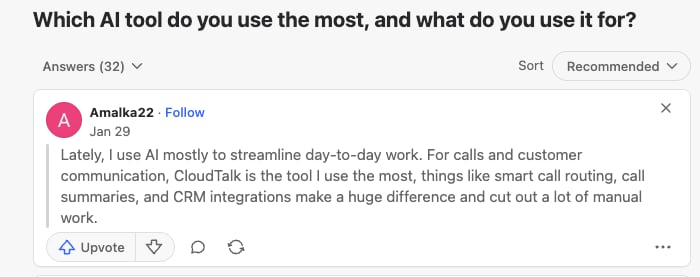
- Favorite AI tools for calls and customer work: One user names CloudTalk as the tool they reach for most, citing smart call routing, call summaries, and CRM integrations. It's a useful signal for anyone eyeing a Mitel AI voice agent: where Mitel Voice Assist is still early, teams pick platforms with an AI receptionist and voice agents built in.
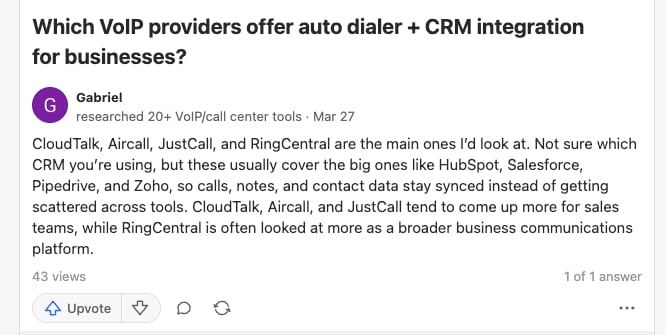
- Auto dialer with CRM integration for business: A reviewer who tested 20+ VoIP tools names CloudTalk, Aircall, JustCall, and RingCentral as the options that keep calls, notes, and contacts synced across Salesforce, HubSpot, and Pipedrive, with CloudTalk and JustCall coming up most for sales teams running a power dialer.
How the Best Mitel Alternatives Compare on G2: Mitel vs CloudTalk, 3CX, and Aircall
G2's side-by-side comparison data puts verified user scores behind the fit question. Here's a quick look at the main compared areas and how Mitel stacks up against these 3 popular alternatives:
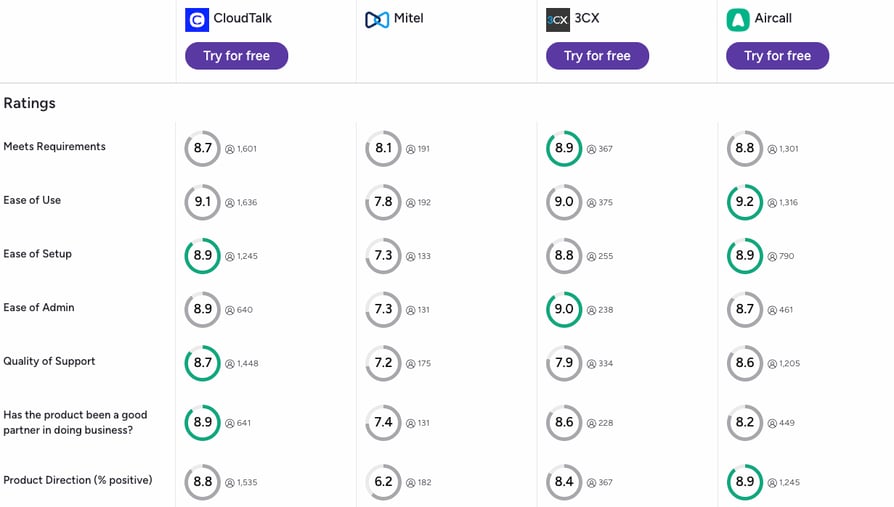
- Ease of setup and admin: CloudTalk scores 8.9 on both setup and administration, against Mitel's 7.3 and 7.3. That gap is on-premise overhead showing up in user data.
- Product direction: CloudTalk scores 8.8 and Aircall 8.9 for product direction, while Mitel sits at 6.2, the clearest sign of a platform users feel is stalling. 3CX lands at 8.4.
- Support and ease of use: CloudTalk leads support at 8.7 to Mitel's 7.2, and ease of use at 9.1 to 7.8. 3CX and Aircall also outscore Mitel across the board, though Aircall edges ease of use at 9.2, a reminder that no single tool sweeps every category.
CloudTalk vs. Mitel: Final Head-to-Head Comparison
Here's the core split between the two: Mitel is a hardware-anchored unified communications suite sold by quote through partners, strongest for large hybrid or on-premise operations. CloudTalk is a voice-first cloud platform built for 5 to 200 seat sales and support teams that want the working core without the hardware or the sales cycle.
CloudTalk vs. Mitel
| Feature | CloudTalk | Mitel | Winner |
|---|---|---|---|
| Starting Price | $25/user/month (Starter, annual) | Quote-based (from ~$21/user/mo) | CloudTalk |
| Free Trial | 14 days, self-serve | Demo only | CloudTalk |
| Minimum Agents | 1 seat (3 on Expert) | None published (quote-based) | Tie |
| Deployment | Cloud, self-serve | Cloud, on-prem, or hybrid | Mitel |
| CRM Integrations | 100+ from Essential, Salesforce on Expert | Limited, edition-dependent | CloudTalk |
| Auto Call Recording | From the start (1-month retention on Starter, unlimited on higher plans) | Add-on / edition-dependent | CloudTalk |
| Unified Comms (Video & Messaging) | Voice-first only | Voice, video, and messaging via MiCollab | Mitel |
| Outbound Dialers | Power, Smart, Preview & Parallel Dialer options | Outbound contact center add-on | CloudTalk |
| AI Features | AI Receptionist from $99/mo (50 free min), AI Voice Agents from $349/mo, Conversation Intelligence $9/user/mo | Nascent (Voice Assist add-on) | CloudTalk |
| Global Coverage | 160+ countries, self-serve, quick activation | Partner and region-dependent | CloudTalk |
| Installed Base & Heritage | Newer cloud platform | Decades of enterprise telephony, large install base | Mitel |
| Vendor Stability | Independent, growing SaaS | Recently exited Chapter 11 restructuring | CloudTalk |
| Customer Support | 24/7 chat & email all plans (phone on Expert) | Partner-led; slower direct support | CloudTalk |
| G2 Rating | 4.4/5 (1,800+ reviews) | 3.8/5 (200+ reviews) | CloudTalk |
The Structural Difference
Mitel's real constraint isn't quality, but rather the model they're using: hardware, quote-only pricing, and a cloud line that just shut down. CloudTalk is built the other way, a per-seat cloud platform you can try free for 14 days, with numbers in 160 countries and CRM sync that follows the customer from first call to renewal.
How to Choose the Right Mitel Alternative for Your Business
Choosing the right Mitel alternative for your business depends on four things: your seat count, the tools your team already lives in, where your customers are, and whether you want cloud or on-premise. These Mitel phone system competitors split along a few clear lines, so match your situation to the questions below.
What's Better Than Mitel for Sales and Support Teams?
CloudTalk is better than Mitel for sales and support teams, because it puts the tools those teams use daily in one cloud platform: reliable calling, two-way CRM sync, outbound dialers, and analytics. There's no hardware to manage and no quote to chase, and pricing runs a flat $25 to $49/user/month that's designed to scale with your business.
Which Mitel Alternative Is Best for Multi-Site and Remote Teams?
CloudTalk is the best Mitel alternative for multi-site and remote teams, since agents work from anywhere with just a browser and you can buy local virtual numbers in 160+ countries. RingCentral and Nextiva are strong if you also want bundled video and messaging in the same suite.
What Is the Best Mitel Alternative for CRM-Heavy Workflows?
CloudTalk is the best Mitel alternative for CRM-heavy workflows, with 100+ two-way integrations from the Essential plan, including top CRM and helpdesk tools like HubSpot, Pipedrive, and Zendesk (plus Salesforce deep-sync on Expert). Every call, note, and recording logs to the CRM automatically, so reps stop copying data by hand. Another strong pick is Aircall, which boasts an even bigger app marketplace.
Which Mitel Alternative Is Best for On-Premise or Self-Managed Setups?
3CX is the best Mitel alternative for teams that want to keep an on-premise or self-managed setup, since it runs on your own servers and licenses by simultaneous calls. If you're open to leaving hardware behind, though, a cloud business phone system like CloudTalk removes the maintenance entirely.
What Is the Best Mitel Alternative for Large Enterprises Needing a Full Contact Center?
For large enterprises needing a full contact center, Genesys Cloud CX, RingCentral, and 8x8 carry the most weight among Mitel competitors in the telecommunications industry, with omnichannel routing and workforce tools. CloudTalk still fits as the calling and sales layer for teams that want CRM-connected voice without enterprise complexity.
What Is the Best Mitel Alternative for Growing Teams?
CloudTalk is the best Mitel alternative for growing teams, and it's the scenario the platform is built for. Growing teams need three things Mitel makes hard: adding seats without a new quote (flat per-seat tiers), entering new markets without a partner (numbers in 160 countries), and layering capability as they scale, from the Smart Dialer on Expert to an AI Receptionist that answers routine calls. With CloudTalk, you can start on Starter and comfortably keep growing tier by tier.
Outgrowing Your Mitel System?
Ready to Make the Switch from Mitel?
If you run a large hybrid or on-premise operation that wants voice, video, and messaging under one roof and has the IT team to manage it, Mitel can still do the job. It has decades of telephony behind it, and plenty of enterprises are happy on it.
But if you're a growing sales or support team tired of quotes, hardware, and a cloud line that just went dark, the math has changed. CloudTalk gives you the working core: reliable calling, two-way CRM sync, dialers, analytics, and AI at fixed prices, with none of the legacy overhead. It's the Mitel alternative for business teams that want to move fast.
Here's what the switch from Mitel to CloudTalk actually gets you:
- Transparent per-seat pricingThree tiers from $25 to $49/user/month on annual billing, with add-ons at published flat prices, no quotes or unexpected charges later on.
- Coverage across 160 countriesBuy, port, and manage international numbers from the dashboard, with no partner and no bespoke contract.
- AI that starts free50 AI Receptionist minutes on every account, Conversation Intelligence at $9/user/month, and custom AI Voice Agents from $349/month.
- 100+ integrations from EssentialHubSpot, Pipedrive, Zendesk, and the rest of your stack sync both ways, and a deep sync with Salesforce ecosystem on Expert.
- 5,500+ businesses on boardCloudTalk is backed by 99.999% uptime, and it offers 24/7 chat and email support on every plan (+ phone on Expert).
Join 5,500+ Businesses That Already Made the Switch
Sources:
- CX Today, Mitel Exits Chapter 11 Bankruptcy: A Fresh Start or Short Reprieve?
Frequently Asked Questions about Mitel Alternatives
Direct answers to the questions buyers ask most when comparing Mitel with other phone systems and contact center platforms.
Mitel is a business communications vendor that sells phone systems, unified communications, and contact center software across on-premise, cloud, and hybrid setups. It's best known for MiVoice and MiCollab, aimed at mid-size and enterprise organizations. It's a capable business phone system, though pricing is quote-only and largely hardware-anchored.
Yes, Mitel is still an active company that sells and supports its phone systems. It recently restructured its debt through Chapter 11 and continues to serve on-premise and hybrid customers, though it wound down its MiCloud Connect cloud service. Many teams now compare it against cloud-native Mitel alternatives like CloudTalk.
Mitel filed for and emerged from Chapter 11 bankruptcy protection, using the process to cut roughly $1.15 billion in debt rather than to shut down. It's a debt restructuring, not a closure, and the company keeps operating. Still, the episode is one reason teams are shopping for a more stable, cloud-native phone system.
No, Mitel and RingCentral are separate companies. RingCentral did buy Mitel's MiCloud cloud platform and now migrates those customers onto its own RingEX service, which is why the two names come up together. If you were on MiCloud Connect, RingCentral is the default path, but not the only one.
Mitel's MiCloud Connect was permanently shut down on June 24, 2026, after RingCentral acquired the platform. Customers had to either move to RingCentral's RingEX by default or pick a new provider and port their numbers before the deadline. Many used the moment to compare cloud phone systems rather than auto-migrate.
Mitel doesn't publish clear per-user pricing. Cloud rates have started around $21/user/mo, but most deals are quote-based through partners, with hardware, onboarding, and support billed separately, and a demo instead of a free trial.
It depends on your team. 3CX is better for IT-led teams that want a self-hosted or self-managed system with concurrent-call pricing, while Mitel suits larger operations that want a vendor-managed suite with hardware. Both ask more of IT than a cloud tool does. For a hands-off option, a cloud platform like CloudTalk is easier to run than either 3CX or Mitel.
Mitel offers standard enterprise security, but how secure it is depends on deployment. On-premise systems put patching and protection on your IT team, and older Mitel gear that misses updates becomes a risk. Cloud-native alternatives handle security, GDPR, and SOC 2 compliance centrally instead. A cloud phone system like CloudTalk keeps updates and compliance managed for you.
Yes, schools and universities can use Mitel phones, and many do for campus telephony. That said, education teams increasingly prefer cloud systems that cost less to run and need no on-site hardware. CloudTalk is one such Mitel alternative for schools, with per-seat pricing, easy setup, and numbers in 160 countries.
For small businesses, CloudTalk's Starter plan at $25/user/month with no seat minimum is the strongest fit, with unlimited inbound calls, queues, and a 500-minute outbound bundle. Very small teams can even start with an AI virtual receptionist that CloudTalk offers. GoTo Connect and Nextiva are good UCaaS options, and 3CX suits IT-savvy teams on a budget.
To migrate from Mitel with minimal downtime, port your numbers to the new provider, build call flows in parallel, and cut over team by team once tested. Number porting keeps your existing numbers, and cloud tools let you run both systems briefly during the switch. CloudTalk supports porting and same-day setup to keep calls flowing.
CloudTalk offers some of the deepest CRM integrations among Mitel alternatives, with 100+ two-way connections from the Essential plan, including HubSpot, Pipedrive, and Zendesk, plus Salesforce deep-sync on Expert. Aircall and RingCentral integrate widely too. The difference is two-way sync that logs every call automatically, not just click-to-dial.
The best alternatives to Mitel are CloudTalk for cloud-native sales and support calling, RingCentral and Nextiva for all-in-one UCaaS, 3CX for a self-managed PBX, Aircall and Dialpad for integration-first teams, and Genesys Cloud CX for enterprise contact centers. CloudTalk is our top alternative to Mitel for growing teams that want CRM sync and AI without the hardware.