Quick Summary of 8x8 vs. RingCentral
- 8x8 is built for global reach:Unlimited international calling to 14 countries on X2 and 48 on X4, unlimited SMS, HIPAA BAAs as standard, and 500-participant video. The catch is that pricing is quote-only, with third-party estimates around $24 to $44/user/month.
- RingCentral is built for domestic depth and clarity:Published pricing from $20/user/month, 300+ integrations, and stronger team chat. The catch is SMS caps of 25, 100 and 200 messages per user per month by tier, and international calling parity needs paid add-ons.
- Verdict: there is no universal winner.On G2 the two flagship products are tied at 4.2/5. The decision comes down to how much international calling you need and how much you value a published price.
- A third option: CloudTalkLocal numbers in 160+ countries with fully published per-user pricing from $25/user/month and native CRM sync, so global reach and pricing transparency stop being a trade-off.
Introduction
Both platforms serve calling teams well, but for different priorities. The right 8x8 vs RingCentral 2026 pick depends on your use case, global calling reach or transparent domestic pricing and integration depth, not on a universal ranking.
8x8, founded in 1987 and now serving around 3 million business users, leads on international reach. Unlimited outbound calling covers 14 countries on its X2 plan and 48 on X4, SMS is unlimited rather than metered, HIPAA Business Associate Agreements come as standard rather than a paid add-on, and video meetings hold up to 500 participants. It holds 4.2/5 on G2 from 818+ reviews for 8x8 Work, its flagship phone system.
RingCentral, on the market for over 20 years, comes at the same problem from the domestic side: publicly published pricing from $20/user/month, an app gallery of 300+ integrations, stronger team chat and collaboration, and granular tiers that let you buy exactly the feature set you need. RingEX, its flagship phone system, holds 4.2/5 on G2 from 1,300+ reviews, the larger sample of the two.
The split is clean:
- 8x8 fits globally distributed teams that call across borders daily and would rather have a bundled calling area than a per-minute bill.
- RingCentral fits domestic US teams, particularly over 50 seats, that want a price they can budget against and an integration for everything already in their stack.
Below we work through the decision layer by layer: strengths, features, international calling, total cost, integrations, security, usability and reviews. Or jump straight to the key differences table for the full RingCentral vs. 8x8 comparison at a glance.

Want global calling reach and a published price?

8x8 vs. RingCentral: Core Strengths of Each Platform
Both are mature unified-communications providers with two decades or more behind them, and both will run a business phone system competently. They win on different axes: global reach and simplicity against domestic pricing transparency and integration depth. For any ringcentral vs 8x8 decision, the honest framing is parallel strengths, not a winner and a loser.
- 8x8 optimizes for international calling reach and setup simplicity
- RingCentral optimizes for pricing transparency and domestic integration depth
Where 8x8 Shines
| Strength | Why it matters |
|---|---|
| Unlimited international calling areas | Unlimited outbound to 14 countries on X2 and 48 on X4. For a team calling the UK, Germany or Australia daily, this single line can outweigh the rest of the contract. |
| Unlimited SMS with no monthly cap | Texting is not metered per user, which removes the overage math that dominates RingCentral's plan comparison. |
| HIPAA BAAs as standard | Business Associate Agreements come with the contract rather than a top-tier gate, and PCI redaction in call recordings works without engineering effort. |
| Simple setup out of the box | Reviewers consistently describe the admin portal as straightforward, and G2 rates 8x8 higher than RingCentral on ease of administration. |
| Published per-region uptime | 8x8 posts monthly uptime by region on its trust site, which is more operational transparency than most competitors offer. |
Where RingCentral Shines
| Strength | Why it matters |
|---|---|
| Publicly published pricing | Core at $20, Advanced at $25 and Ultra at $35 per user per month, billed annually. You can budget a rollout without a sales call, which you cannot do with 8x8. |
| 300+ integration app gallery | Roughly five times 8x8's native integration count, and notably deeper on domestic US tools like ServiceNow, Canvas and Smarsh. |
| Stronger team chat and collaboration | Messaging, file sharing and task management are first-class rather than bolted on, which matters if the phone system doubles as the internal comms tool. |
| Granular tiers for feature control | Call recording, whisper and barge monitoring, and advanced analytics each sit at a known tier, so you buy the level you need instead of negotiating a bundle. |
| Documented compliance you can download | A public trust portal carries HITRUST CSF, SOC 2 Type II, SOC 3, ISO 27001, 27017, 27018 and 22301, with signed BAAs for healthcare customers. |
At a Glance: 8x8 vs. RingCentral, Key Differences
Use this ringcentral 8x8 comparison table to identify what matters most for your use case, then jump to the relevant section for detail.
| Dimension | 8x8 | RingCentral | Best suited for |
|---|---|---|---|
| Pricing transparency | Quote-only; public list prices withdrawn in 2023 | Fully published: $20 / $25 / $35 per user/month annually | Teams that need a number before a sales call |
| International calling model | Unlimited to 14 countries (X2) or 48 (X4), bundled | Domestic US and Canada unlimited; international via paid add-ons | Globally distributed teams |
| SMS allowance | Unlimited texting, no monthly cap | 25 (Core), 100 (Advanced), 200 (Ultra) per user/month, then overages | Teams running text-heavy outreach |
| Domestic integration breadth | Around 60 native integrations | 300+ app gallery, deep on US enterprise tools | Domestic US teams over 50 seats |
| Team chat and collaboration | Present but secondary to voice | First-class messaging, files and tasks | Teams using the phone system as internal comms |
| HIPAA and compliance | BAAs standard, FedRAMP Moderate, PCI redaction | HITRUST CSF, SOC 2 Type II, ISO 27001, BAAs for healthcare | Both are credible; regulated buyers should read both trust pages |
| Setup complexity | Simple out of the box; rated higher on ease of admin | More configuration, more control | Teams without dedicated IT lean 8x8 |
| Contact center fit | 8x8 Contact Center, 4.1/5 from 235 G2 reviews | RingCX from $65/agent/month; Contact Center 4.1/5 from 185 reviews | Both viable; 8x8's CCaaS is the more mature of the two |
| Review volume and rating | 4.2/5 on G2 from 818+ reviews (8x8 Work) | 4.2/5 on G2 from 1,300+ reviews (RingEX) | Tied on rating; read the themes, not the stars |
8x8 Features vs. RingCentral Features
The 8x8 vs RingCentral features question splits along one line: 8x8 bundles reach, RingCentral bundles choice. Here is what each does well, and where each falls short.
8x8 Features
8x8's core strength is global reach. Unlimited international calling and unlimited texting are bundled into the plan rather than sold per country or per message, and the platform pairs UCaaS and CCaaS under one contract. The trade-off is that you cannot price any of it without talking to a salesperson.
What 8x8 Does Well:
- Bundled international calling areas: Unlimited outbound to 14 countries on X2 and 48 on X4, which removes per-minute anxiety for teams calling Europe or APAC daily.
- Unlimited SMS with no per-user cap: Texting volume is not a budgeting variable, which is the clearest single contrast with RingCentral's tiered allowances.
- HIPAA BAAs and FedRAMP Moderate as standard: Compliance comes with the contract rather than a premium tier, and PCI redaction in recordings works without custom engineering.
- UCaaS and CCaaS on one platform: A rep transferring a lead to support hands over the same caller history and recording, on one login and one database.
- Video meetings up to 500 participants: Roughly double what most phone-system competitors include, with support for 46 languages in the meeting interface.
Where 8x8 Falls Short:
- Pricing is not published. 8x8 withdrew public list prices in 2023, so every tier now runs through sales. Third-party estimates put X2 at roughly $24/user/month rising to $44, and contact center seats well above that, but treat those as estimates, not official figures.
- The 48-country area is tier-gated, not standard. X2 covers 14 countries; the widely quoted 48 requires X4. Some destinations also exclude mobile numbers, and international toll-free usually still bills per minute.
- A narrower integration marketplace. Around 60 native integrations against RingCentral's 300+, and notably thinner on domestic US enterprise tools.
- Real cost is hard to model upfront. Regulatory recovery, E911 and usage overage fees compound, and multi-year contracts with early-termination clauses add commitment risk.
RingCentral Features
RingCentral's core strength is transparent, tiered pricing with strong domestic integrations and collaboration tools. You can read the price, see exactly which tier unlocks which feature, and connect almost anything in a US enterprise stack. The trade-off shows up in messaging allowances and international calling.
What RingCentral Does Well:
- Published, tiered pricing: Core $20, Advanced $25, Ultra $35 per user/month annually, with a clear line on what each tier adds.
- A 300+ app gallery: The deepest domestic US integration ecosystem in this comparison, including niche enterprise tools 8x8 does not cover.
- Genuine team chat and collaboration: Messaging, file sharing and task management are built in, not a checkbox, which suits teams consolidating internal comms.
- Granular feature tiers: Automatic call recording and whisper/barge monitoring arrive at Advanced; unlimited storage and 10,000 toll-free minutes at Ultra.
- Downloadable compliance evidence: A public trust portal with HITRUST CSF, SOC 2 Type II, ISO 27001 and BAAs, which shortens a security review considerably.
Where RingCentral Falls Short:
- SMS is capped on every tier. 25 messages per user per month on Core, 100 on Advanced, 200 on Ultra, then per-message overages from around $0.01. A single appointment-reminder workflow clears the Core allowance in days.
- International parity costs extra. Unlimited calling covers the US and Canada; matching 8x8's 48-country area means international numbers from around $5.99/user/month and per-minute international rates on top.
- Key features are gated upward. Core has no automatic call recording, no CRM integrations and no analytics dashboards, which pushes most customer-facing teams to Advanced as the practical floor.
- Toll-free minutes are pooled and small. 100 minutes across the whole account on Core, 1,000 on Advanced, 10,000 on Ultra, with no unlimited option at any tier.
Feature-by-Feature Comparison
| Feature | 8x8 | RingCentral | CloudTalk |
|---|---|---|---|
| International calling model | Unlimited to 14 (X2) or 48 (X4) countries | US and Canada unlimited; international via add-ons | Local numbers in 160+ countries |
| SMS/texting allowance | Unlimited, no cap | 25 / 100 / 200 per user/month by tier | SMS and MMS with automation and templates |
| HIPAA compliance | BAAs standard on contract | BAAs for healthcare customers, HITRUST certified | GDPR, SOC 2 Type II and HIPAA tooling across plans |
| Team chat and collaboration | Present, secondary to voice | First-class messaging, files and tasks | Focused on calling, with CRM as the system of record |
| Call monitoring | Barge, monitor and whisper on X4 | Whisper and barge from Advanced ($25) | Call monitoring with live coaching |
| Advanced analytics tier | Supervisor analytics on X4 | Basic on Core; full analytics from Advanced | Real-time dashboards and agent reporting |
| Native CRM sync | Salesforce and major CRMs, around 60 integrations total | 300+ gallery; Salesforce needs Advanced | Native Salesforce, HubSpot, Pipedrive |
| Pricing transparency | Quote-only | Fully published | Published per-user pricing from $25/user/month |
| Contact center fit | Mature CCaaS on the same contract | RingCX from $65/agent/month | AI Voice Agents as a usage-based add-on |
Try all of CloudTalk's features for free!
International Calling & Global Reach: 8x8 vs. RingCentral
This is the widest gap in the whole comparison, and the one most likely to decide it. If your team calls outside its home country every day, the difference between a bundled calling area and a per-minute international rate compounds fast: a handful of reps calling Europe daily can run up more in international minutes than the entire seat cost. On 8x8 vs RingCentral international calling, 8x8 bundles what RingCentral sells separately. The important caveat is that 8x8's widely quoted 48-country area sits on X4, not on the entry X2 plan, which covers 14. Verify current country lists on both vendors' sites before you commit, because these move.
| Dimension | 8x8 | RingCentral | CloudTalk |
|---|---|---|---|
| Countries with unlimited calling included | 14 on X2, 48 on X4 | US and Canada only | Local and toll-free numbers in 160+ countries |
| SMS/texting allowance | Unlimited, no monthly cap | 25 / 100 / 200 per user/month by tier, then overages | International SMS and MMS that follows the voice footprint |
| Cost to match the wider calling area | Included, but requires the X4 tier | International numbers from around $5.99/user/month plus per-minute rates | Included in the plan, with local carrier routing |
| International toll-free | Typically billed per minute even on unlimited plans | From around $14.99/user/month plus a $25 one-time fee | Toll-free numbers available across the coverage footprint |
| Best fit by geography | Teams calling heavily into Western Europe and APAC | Domestic US and Canada operations | Teams selling into many markets that want local presence |
8x8 Pricing vs. RingCentral Pricing
The 8x8 vs RingCentral pricing comparison has an unusual problem: only one side will tell you the number. RingCentral publishes every tier; 8x8 withdrew its public list prices in 2023 and now quotes custom on everything. That makes any RingCentral pricing vs 8x8 pricing table part fact and part estimate, and we have labeled which is which.
8x8 Pricing
- Pricing model: quote-based across all tiers8x8 does not publish list prices. Every plan, UCaaS and contact center alike, runs through a sales conversation.
- X2 (unified communications): estimated around $24/user/monthThird-party estimate along with user reviews, not an official figure. Unlimited calling to 14 countries.
- X4 (unified communications): estimated up to $44/user/monthThird-party estimate backed by some user claims. Expands the unlimited area to 48 countries and adds supervisor analytics and call monitoring.
- Contact center (X6, X7, X8): quote-only, materially higherReported well above the UCaaS tiers per seat.
- Contract: annual or multi-year, with negotiable discountsReported discounts vary by size and term, and early-termination exposure is real.
RingCentral Pricing
- Core: $20/user/month annually ($30 monthly)Unlimited US and Canada calling, IVR, call queues, video for 100. No automatic call recording, no CRM integrations, no analytics dashboards, and 25 SMS per user/month.
- Advanced: $25/user/month annually ($35 monthly)Adds automatic call recording, whisper and barge monitoring, CRM integrations including Salesforce and HubSpot, and 100 SMS per user/month.
- Ultra: $35/user/month annually ($45 monthly)Adds unlimited storage, 10,000 pooled toll-free minutes, extended analytics, and 200 SMS per user/month.
- Customer Engagement Bundle: quote-basedUltra plus the Business SMS and Call Queues Boosters, for lightweight contact center use.
- Add-ons: RingCX from $65/agent/month, AI Receptionist from $39Analytics, AI and contact center capability sit outside the seat price.
Pricing Compared Line by Line
Read this RingCentral vs 8x8 pricing table with one caveat in mind: the RingCentral column is published, the 8x8 column is estimated.
| Pricing dimension | 8x8 | RingCentral | CloudTalk |
|---|---|---|---|
| Pricing transparency | Quote-only since 2023 | Fully published on the website | Published per-user pricing on the pricing page |
| Entry price | Estimated around $24/user/month | $20/user/month annually ($30 monthly) | From $25/user/month |
| What's included at entry | Unlimited calling to 14 countries, unlimited SMS | US and Canada calling, IVR, queues, 25 SMS | Unlimited inbound, call queues, transfers, recording |
| Cost for call monitoring | X4 tier, estimated up to $44/user/month | Advanced, $25/user/month | Included from the mid tier |
| Cost for advanced analytics | X4 supervisor analytics | Advanced and Ultra tiers | Analytics included, AI as a $9/user/month add-on |
| International calling cost | Bundled into the tier | Add-ons from around $5.99/user/month plus per-minute rates | Included in the plan |
| Contract commitment | Annual or multi-year, early-termination exposure | Annual for the advertised rate; monthly costs $10 more per seat | Monthly or annual, no seat minimum |
CloudTalk's Pricing
Now, compare it to CloudTalk's transparent and predictable pricing, so you always know what you're paying for.
Flexible Pricing Plans to Scale with You
Compare our plans
See How CloudTalk Works!
Take a quick sneak peek into how CloudTalk functions.
8x8 Integrations vs. RingCentral Integrations
On 8x8 vs RingCentral integrations, the gap is roughly five to one, and it is the clearest structural advantage RingCentral holds.
8x8 Integrations
8x8 carries roughly 60 native integrations, covering the major CRMs and helpdesks: Salesforce, Microsoft Teams, Slack, Zendesk, HubSpot and Microsoft Dynamics. Microsoft Teams is the standout, with 8x8 running calling natively inside Teams rather than as a sidecar. The marketplace is consistently reported as narrower than RingCentral's, particularly for domestic US enterprise tools, and non-native connections need setup work from a technical team.
RingCentral Integrations
RingCentral's app gallery spans 300+ integrations, the broadest in this comparison. Beyond the standard CRM and helpdesk set it reaches domestic US enterprise and vertical tools that 8x8 does not cover, which is why it tends to win evaluations at larger, US-centric organizations. The caveat is tiering: Salesforce and other CRM integrations require the Advanced plan at $25/user/month, so the $20 Core price is not the price for a team that needs CRM logging.
Integration Capability Compared
| Integration capability | 8x8 | RingCentral | CloudTalk |
|---|---|---|---|
| Total native integrations | Around 60 | 300+ app gallery | 100+ popular app integrations |
| CRM sync depth | Salesforce and major CRMs on higher tiers | Deep, but Salesforce requires Advanced | Native sync with Salesforce, HubSpot and other major CRMs |
| Microsoft Teams | Native calling inside Teams, a genuine strength | Supported through the app gallery | MS Teams integration available |
| Domestic US tool coverage | Thinner on US enterprise and vertical tools | The strongest of the three | Covers the mainstream CRM, helpdesk and sales-engagement stack |
| Developer and API access | Communications APIs on a pay-per-use model | Public API and webhooks | Public API, webhooks and Zapier |
| Workflow automation | Available on higher tiers | Through the gallery and add-ons | Built-in workflow automation, no code |
Security & Compliance: 8x8 vs. RingCentral
This is the section where the two are closest, and where a common assumption turns out to be wrong. Both document compliance thoroughly, and neither has a meaningful gap against the other for a standard regulated deployment.
8x8 Security & Compliance
- HIPAA BAAs as standardBusiness Associate Agreements come with the contract rather than as a paid add-on, which is genuinely unusual in this category.
- FedRAMP Moderate authorizationRelevant if you sell into US public sector, and a differentiator RingCentral does not lead with.
- PCI redaction in call recordingsCard data is redacted without custom engineering work, useful for any team taking payments by phone.
- GDPR and ISO certificationsStandard coverage, with per-region uptime published on the 8x8 trust site. Verify the current certification list before signing.
RingCentral Security & Compliance
- HITRUST CSF certificationA healthcare-specific certification that goes beyond a HIPAA self-attestation, downloadable from the public trust portal.
- SOC 2 Type II and SOC 3Annual third-party audits, with the SOC 2+ report mapping controls to the HIPAA Security Rule.
- ISO 27001, 27017, 27018 and 22301Information security, cloud controls, cloud privacy and business continuity, all certified.
- Signed BAAs for healthcare customersAvailable for covered entities, alongside FINRA controls and PIPEDA coverage.
Security & Compliance Compared
| Security & compliance | 8x8 | RingCentral |
|---|---|---|
| GDPR | Yes | Yes |
| SOC 2 | Yes, verify current attestation type | SOC 2 Type II and SOC 3, published |
| ISO certifications | ISO certified, verify current scope | ISO 27001, 27017, 27018 and 22301 |
| HIPAA | BAAs standard on contract | BAAs for healthcare customers, plus HITRUST CSF |
| Sector-specific | FedRAMP Moderate, PCI redaction in recordings | FINRA controls, PIPEDA, PCI SAQ-D |
| Encryption | Encryption in transit as standard | Encryption in transit as standard |
| SSO / SAML | Supported, confirm scope by tier | Supported, confirm scope by tier |
| Evidence access | Trust site with per-region uptime | Public trust portal with downloadable reports |
Worth correcting a common claim:
You will find comparisons asserting that RingCentral documents HIPAA less clearly than 8x8. That does not hold up. RingCentral publishes HITRUST CSF certification, SOC 2 Type II mapped to the HIPAA Security Rule, and signed BAAs for healthcare customers, all accessible from its trust portal. Both vendors are credible here; the honest difference is that 8x8 includes BAAs by default while RingCentral scopes them to healthcare customers. For regulated readers weighing a third option, CloudTalk covers GDPR, SOC 2 Type II and HIPAA tooling across plans.
Usability & Support: 8x8 vs. RingCentral
8x8 Usability & Support
- Simple out of the box: reviewers repeatedly describe setup and call-flow configuration as straightforward, and G2 scores 8x8 above RingCentral on ease of administration.
- 24/7 support on all plans: web case, chat and phone are available across tiers rather than gated to the top one.
- Support consistency is the weak spot: response times are reported as uneven, with some tickets running past 48 hours.
- Mobile app reliability complaints: dropped calls when switching networks and delayed push notifications come up often enough to test during a trial.
RingCentral Usability & Support
- Comparable ease of setup: G2 rates both platforms similarly on getting started, and RingEX reviewers praise how simple it is to change settings.
- Slightly lower ease-of-admin scores: in direct G2 comparisons RingCentral trails 8x8 on administration and quality of support.
- More surface to configure: the breadth of tiers, add-ons and integrations is the source of both its flexibility and its complexity.
- Contract friction is a recurring theme: auto-renewal terms and add-on billing come up repeatedly in user discussions, so read the renewal clause.
Usability Compared
| Dimension | 8x8 | RingCentral |
|---|---|---|
| Setup time | Fast, described as simple out of the box | Fast for standard flows, longer with add-ons |
| Ease of administration | Rated higher in direct G2 comparisons | Capable but more configuration surface |
| Quality of support | Rated slightly higher on G2, but consistency varies | Responsive on contact center; mixed on RingEX tiers |
| Support availability | 24/7 across plans | 24/7 across plans |
| Call quality reputation | Solid, with mobile app instability the main flag | Solid, with admin complexity the main flag |
| Scalability | UCaaS and CCaaS on one contract | Granular tiers plus RingCX for contact center |
The CloudTalk Angle:
Both platforms make you trade global reach against domestic depth and pricing clarity. CloudTalk combines local numbers in 160+ countries, native CRM sync, and published per-user pricing in one platform, on the same Call Flow Designer your whole team uses.
Get local phone numbers your customers will trust.
8x8 Reviews vs. RingCentral Reviews on G2
G2 is the most widely used peer review platform for B2B software, and the 8x8 vs RingCentral reviews picture is closer than most comparisons admit. Compared like for like, the two flagship phone systems are tied at 4.2/5: 8x8 Work from 818+ reviews against RingEX from 1,300+. On the contact center side they are tied again at 4.1/5, with 8x8 Contact Center on 235 reviews and RingCentral Contact Center on 185. Where they separate is on sub-scores, not stars: 8x8 rates higher on ease of administration and quality of support, RingEX rates higher on overall G2 Score and integration breadth. Pull the live figures before you decide, because review counts shift monthly.
G2 Ratings Compared
| Review dimension | 8x8 | RingCentral |
|---|---|---|
| Phone system rating | 4.2/5 (8x8 Work) | 4.2/5 (RingEX) |
| Phone system review base | 818+ reviews | 1,300+ reviews |
| Contact center rating | 4.1/5 (235 reviews) | 4.1/5 (185 reviews) |
| Reviewer profile | 58.6% small business | 57.8% small business |
| Most-praised themes | Ease of use, simple setup, international calling, call quality | Unified experience across call, chat and video, ease of management, integration breadth |
| Most-flagged complaints | Inconsistent support response times, mobile app instability, opaque pricing | SMS caps, feature gating across tiers, add-on and renewal billing friction |
| Sub-score edge | Ease of administration and quality of support | Overall G2 Score and integration coverage |
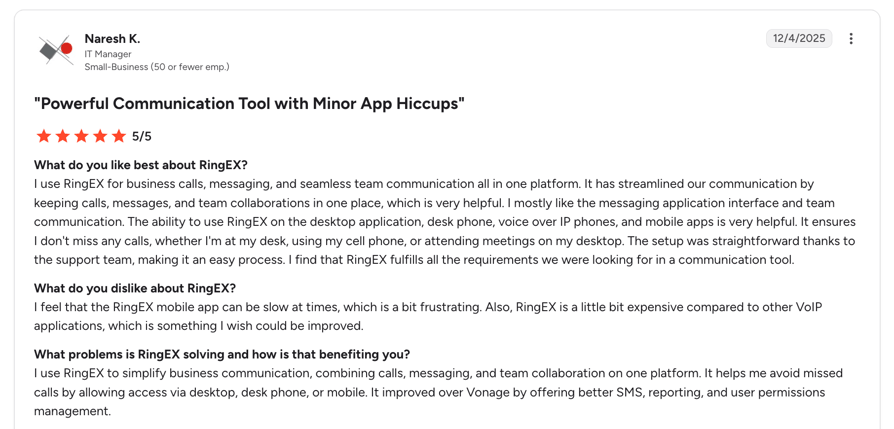
What Real Users Say About 8x8 On G2
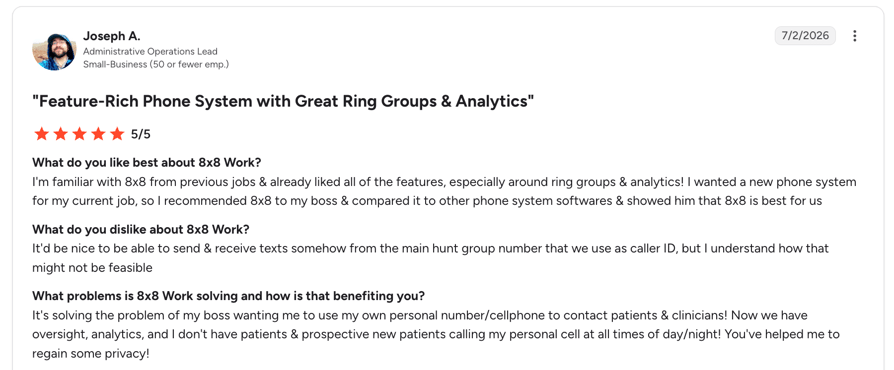
Three themes repeat across verified 8x8 Work reviews:
- Simplicity is the headline. Reviewers describe the platform as straightforward and reliable for daily calls and team communication, with new team members productive without much training.
- International calling gets named explicitly. Users with global operations single out not needing an extra tool for international calls as a reason they chose 8x8.
- Support fixes things, eventually. Several reviewers describe Salesforce integration problems that support did resolve, but only after sustained back-and-forth.
What Real Users Say About RingCentral On G2
And three from verified RingEX reviews:
- Consolidation is the draw. Reviewers value having calls, team messaging, SMS and video in one platform rather than switching between apps.
- Administration is praised, not just usage. Admins specifically call out how simple it is to change settings and manage the phone system, which is unusual praise in this category.
- The fine print is the complaint. Auto-renewal terms, SMS compliance charges, and add-on billing come up repeatedly and are worth reading closely before signing.
CloudTalk has thousands of positive reviews. They can't all lie, right?
8x8 Reviews vs. RingCentral Reviews on Reddit
Community threads surface what review sites smooth over. The patterns differ from the star ratings in a useful way.
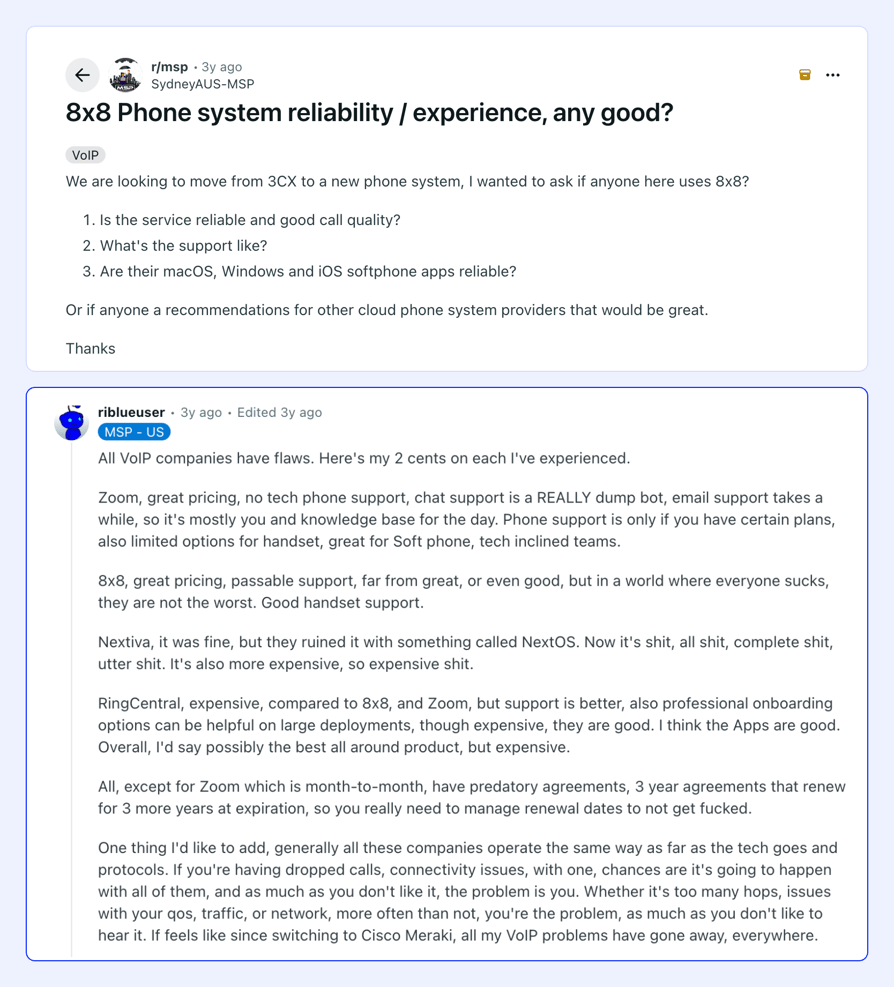
What Real Users Say About 8x8 On Reddit
- The international calling area is the reason people stay. Threads about 8x8 keep returning to teams whose European or APAC calling would cost more in per-minute charges elsewhere than the whole 8x8 contract.
- Opaque pricing is the reason people hesitate. The most common frustration is being unable to compare 8x8 against anything without first booking a sales call.
- Admin experience gets defended. Users who moved from RingCentral often cite the simpler admin portal as the specific reason.
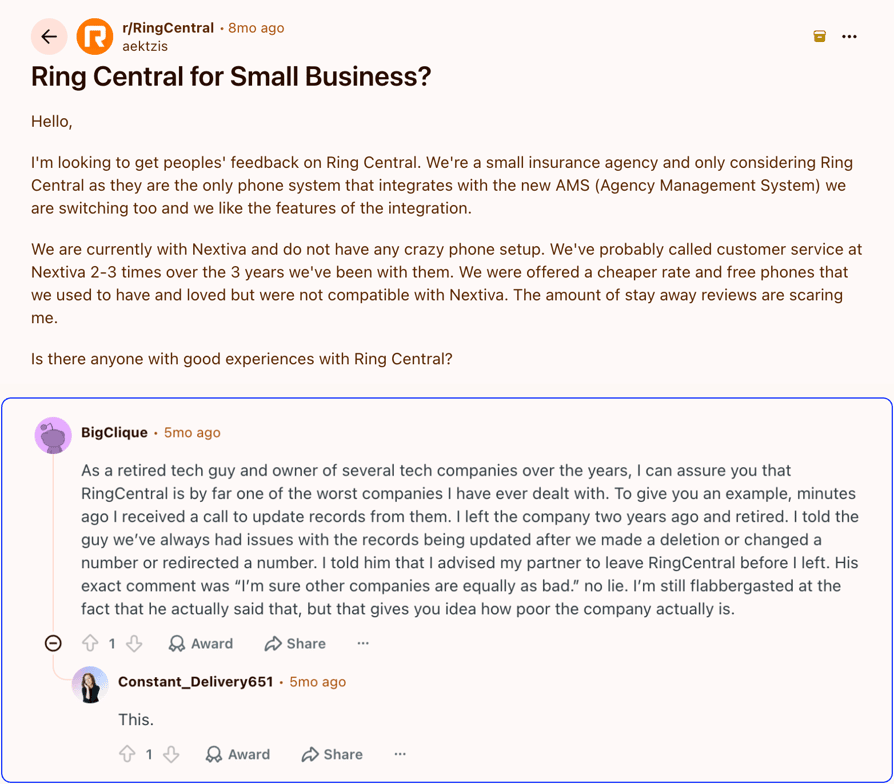
What Real Users Say About RingCentral On Reddit
- SMS caps are the recurring shock. Teams discover the 25-message Core allowance in production rather than in evaluation, then get pushed up a tier or into per-message billing.
- Contract terms draw warnings. Auto-renewal and hidden fees, particularly around SMS compliance registration, are the most-repeated caution in RingCentral threads.
- The integration library keeps it on shortlists. Teams wired into Salesforce, ServiceNow and a helpdesk daily consistently say the app gallery justifies the price.
8x8 Pros & Cons vs. RingCentral Pros & Cons
A quick summary of both platforms: what they're strong at, and what they currently lack.
8x8 Pros & Cons
| Pros | Cons |
|---|---|
| Unlimited international calling to 14 countries on X2 and 48 on X4 | Pricing is not published; every tier requires a sales conversation |
| Unlimited SMS with no per-user monthly cap | The widely quoted 48-country area is gated to X4, not standard |
| HIPAA BAAs standard, plus FedRAMP Moderate and PCI redaction | Around 60 native integrations against RingCentral's 300+ |
| UCaaS and CCaaS on one contract with a shared caller record | Real first-year cost is hard to model, with regulatory and overage fees on top |
| Rated higher than RingCentral on G2 for ease of administration | Support response times are inconsistent, and mobile app stability draws complaints |
| Video meetings for up to 500 participants, with per-region uptime published |
RingCentral Pros & Cons
| Pros | Cons |
|---|---|
| Fully published pricing at $20, $25 and $35 per user/month annually | SMS capped at 25, 100 and 200 per user/month by tier, then overages |
| 300+ app gallery, the deepest domestic US integration ecosystem here | Matching 8x8's international calling area requires paid add-ons |
| Strong team chat, file sharing and task management built in | Core lacks call recording, CRM integrations and analytics dashboards |
| Granular tiers, so you buy the exact feature level you need | Toll-free minutes are pooled and capped at every tier, with no unlimited option |
| Downloadable compliance evidence including HITRUST CSF and SOC 2 Type II | Slightly lower G2 sub-scores for support and ease of administration |
| The larger review base of the two, at 1,300+ G2 reviews for RingEX |
...or choose the third option and skip the trade-off.
Which Team Fits Which Platform?
Fit depends on international calling needs, team size, geography, and whether pricing transparency or global reach matters more, not on which platform is "better." On 8x8 vs RingCentral for small business specifically, the deciding factor is usually whether you call abroad: a domestic US team of ten will find RingCentral easier to budget, while a ten-person team with customers in Europe will get more from 8x8's bundled calling area.
| 8x8 is the right fit for... | RingCentral is the right fit for... |
|---|---|
| Globally distributed teams that call across borders daily | Domestic US teams, particularly over 50 seats |
| Businesses with high texting volume that would blow through an SMS cap | Teams that need a published price to get budget approved |
| Healthcare and public-sector buyers wanting BAAs and FedRAMP as standard | Organizations with a deep US enterprise stack to integrate |
| Teams that value a simple admin portal over granular tier control | Contact-center-heavy deployments needing granular analytics tiers |
| Companies consolidating UCaaS and contact center onto one contract | Teams using the phone system as their internal collaboration hub |
8x8 vs. RingCentral: The Verdict
So, is 8x8 better than RingCentral? On the evidence, no, and neither is the reverse. The two flagship products are tied at 4.2/5 on G2, both have been in this market for over two decades, and both will run your phone system competently. The choice comes down to budget visibility, integration needs and growth plans, not platform quality.
Choose 8x8 if you…
- Call internationally every day and want a bundled calling area rather than a per-minute bill
- Send high volumes of SMS and refuse to manage a per-user message allowance
- Need HIPAA BAAs, FedRAMP Moderate or PCI redaction without negotiating them as extras
- Want UCaaS and contact center on one contract with a shared caller record
- Have no dedicated IT resource and want the simpler admin portal of the two
- Are comfortable running a procurement process to get a price
Choose RingCentral if you…
- Operate mainly in the US and Canada, where its unlimited calling already covers you
- Need a published price you can put in a budget without a sales call
- Run a deep US enterprise stack and need an integration for everything in it
- Want team chat, files and tasks in the same tool as the phone system
- Prefer granular tiers so you pay only for the feature level you use
- Need downloadable compliance evidence to clear a security review quickly
The Bottom Line:
Both platforms are strong at what they are built for. The deciding factor is how much international reach you need and how much pricing transparency matters to you, not which product is better. And if neither trade-off fits, 8x8's opaque pricing or RingCentral's SMS caps and paid international add-ons, CloudTalk offers local numbers in 160+ countries with fully published per-user pricing and native CRM sync in one platform. See how it compares in our 8x8 alternative breakdown.
Or choose CloudTalk to elevate your business.
Frequently Asked Questions About 8x8 vs RingCentral
Neither is universally better, and on G2 the two flagship products are tied at 4.2/5, with 8x8 Work on 818+ reviews and RingEX on 1,300+. 8x8 wins on international calling, unlimited SMS and standard HIPAA BAAs. RingCentral wins on published pricing, 300+ integrations and team chat. Pick on your use case, or look at a 8x8 alternative that covers both.
RingCentral is cheaper to evaluate because it publishes prices: $20, $25 and $35 per user per month annually. 8x8 withdrew public pricing in 2023, and third-party estimates put X2 around $24 rising to roughly $44 for X4. Whether 8x8 is cheaper in practice depends on how much you would pay RingCentral for international calling and SMS add-ons.
8x8, clearly. Unlimited outbound calling covers 14 countries on X2 and 48 on X4, bundled into the plan. RingCentral's unlimited calling covers the US and Canada, and matching 8x8's reach means international numbers from around $5.99/user/month plus per-minute rates. Note that 8x8's 48-country area needs the X4 tier, and international toll-free usually still bills per minute on both.
8x8 includes unlimited texting with no monthly cap. RingCentral meters it: 25 messages per user per month on Core, 100 on Advanced and 200 on Ultra, with overages from roughly $0.01 per message. For any team running appointment reminders or text-based outreach, that difference decides the comparison on its own.
RingCentral, by roughly five to one: a 300+ app gallery against around 60 native integrations for 8x8. The caveat is tiering, since Salesforce and other CRM integrations need the Advanced plan at $25/user/month rather than Core. 8x8's counter is native Microsoft Teams calling, which it does better than RingCentral.
Both, and the difference is packaging rather than depth. 8x8 includes Business Associate Agreements as standard on contract and adds FedRAMP Moderate. RingCentral publishes HITRUST CSF certification, SOC 2 Type II mapped to the HIPAA Security Rule, and signs BAAs for healthcare customers. Comparisons claiming RingCentral documents HIPAA less clearly are not accurate.
It depends on geography. A domestic US small business will usually prefer RingCentral, because $20/user/month is published and budgetable and Core covers unlimited US and Canada calling. A small business with customers abroad will get more from 8x8's bundled international area, provided it is willing to go through a sales call to get a price.
They are level. Compared like for like, 8x8 Work and RingEX both hold 4.2/5, and 8x8 Contact Center and RingCentral Contact Center both hold 4.1/5. Comparisons that show 8x8 ahead usually set 8x8's phone system against RingCentral's contact center product. 8x8 does edge ahead on ease of administration and quality of support sub-scores.
That depends what pushed you off RingCentral. If it was SMS caps or paid international add-ons, 8x8 addresses both. If you want global coverage and published pricing together, CloudTalk offers local numbers in 160+ countries with native CRM sync from $25/user/month. Our RingCentral alternative guide covers the full shortlist.
Yes. Your numbers belong to you, and number porting moves them between providers. Keep the old service active until the port completes so callers can still reach you. Build your call flows on the new platform while the port runs, and budget two to four weeks for the carrier paperwork.