Aircall vs Talkdesk 2026: Which One Should You Choose?
TL;DR
- Aircall focuses on simplicity. It offers lower starting prices, self-serve setup, 200+ integrations, and transparent pricing. It’s a strong fit for smaller sales and support teams that want to get started quickly.
- Talkdesk focuses on advanced contact center operations. It offers deeper reporting, predictive dialing, broader security and compliance coverage, and a 99.999% SLA on higher-tier plans. It’s better suited to larger teams with more complex requirements.
Choose Aircall for faster deployment and predictable costs. Choose Talkdesk for advanced contact center features, high-volume outbound calling, and enterprise compliance needs.
This Talkdesk vs. Aircall comparison looks at 2026 pricing, features, integrations, security, deployment, scalability, and user reviews to help you decide whether Aircall or Talkdesk is the better fit for your team.
Aircall vs. Talkdesk: Core Strengths of Each Platform
Aircall and Talkdesk take different approaches to business communications. Aircall focuses on a simpler, more self-serve experience and a broad integration catalog. Talkdesk is built for larger, more complex contact center operations, with deeper enterprise features, security certifications, and advanced reporting.
Here’s where each platform stands out.
Where Aircall Shines
| Strength | Why it matters |
|---|---|
| Affordable plans | Essentials starts at $30 and Professional at $50/month, making Aircall more accessible for smaller teams. |
| Monthly or annual billing | Aircall runs both, with annual marketed at 25% off, so commitment is a lever rather than a requirement. |
| 200+ integrations | A broad integration catalog makes it easier to connect Aircall with existing CRM and business tools. |
| Self-serve setup | Numbers, IVR and users are configured in the admin panel, with no professional services engagement before your first call. |
| AI minutes on every plan | All three plans include 50 free AI Voice Agent minutes per account per month, plus 100 extra at sign-up. |
Where Talkdesk Shines
| Strength | Why it matters |
|---|---|
| More than 30 certifications | SOC 2, SOC 3, ISO 27001, ISO 27701, HIPAA, PCI, GDPR, FedRAMP and NIST are all listed, which shortens security review for regulated buyers. |
| 99.999% uptime SLA | Contractual, on the Elite and Industry Experience Clouds editions. Aircall publishes a 99.95% uptime figure, and the difference is roughly five minutes of downtime a year versus four hours. |
| Predictive dialing for high-volume outbound | Talkdesk Dialer starts calls before agents are available, helping them make more calls. Talkdesk says this can increase outbound volume by 200–300%. |
| Custom reporting at the top tiers | Custom Reporting (Live and Explore), Screen Recording, Performance Management and Workforce Management sit on Elite and above. |
| A free entry tier for small businesses | Talkdesk Express gives US and Canadian firms under 50 employees 25 licenses and $100 in credit, with no contract. |
Aircall vs. Talkdesk Comparison At a Glance
Aircall is the more affordable, self-serve option for smaller teams, while Talkdesk is built for larger contact centers with more advanced features. The biggest differences are pricing, deployment, outbound calling, reporting, and AI costs.
| Dimension | Aircall | Talkdesk | WInner |
|---|---|---|---|
| Pricing transparency | All plan prices published; add-on prices published | All four edition prices published; AI and add-on prices quote-only | Aircall for teams that need a final number without a sales call |
| Entry price | $30 per license/month, billed annually | $85 per user/month | Aircall for budget-led buyers under 100 seats |
| Real entry cost | $90/month, because of the 3-license minimum | Free via Talkdesk Express, if you qualify | Talkdesk Express for US and Canada teams under 50 employees |
| Seat minimum | 3 licenses on Essentials and Professional; 25 on Custom | Not published | Aircall for small teams and published seats |
| Deployment time | Self-serve, live the same day | Project-based, involves IT | Aircall for teams with no rollout budget |
| Predictive dialing | Not listed; only Power Dialer | Predictive, preview and power dialer | Talkdesk for high-volume outbound operations |
| Custom reporting depth | Analytics+ is a $15 per license/month add-on | Custom Reporting (Live and Explore) on Elite and above | Talkdesk for contact centers that live in reports |
| AI cost structure | Published: AI Assist $9, AI Assist Pro $49 per license/month | Copilot, Autopilot, Navigator and Identity are quote-based | Aircall for predictable AI budgeting |
| Total integrations | 200+ | 60+ contact center integrations | Aircall for breadth; Talkdesk for depth on enterprise stacks |
| Uptime commitment | 99.95% SLA | 99.999% SLA on Elite and Industry Experience Clouds | Talkdesk for operations with contractual uptime requirements |
| G2 standing | 4.4/5 from 1,656+ reviews | 4.4/5 from 2,599+ reviews | Talkdesk for a larger review base |
Aircall vs Talkdesk Features
Aircall focuses on making business calling easy to set up and manage, especially for CRM-centric teams. Talkdesk goes further into contact center operations, with advanced routing, dialing, reporting, and workforce management.
What Are Aircall's Key Features?
Aircall combines business calling with CRM tools and self-serve administration. It’s a good fit for teams that want to get up and running quickly without a complex contact center setup.
What Aircall Does Well
- Native CRM telephony. Salesforce CTI (computer telephony integration) comes with Professional, so reps dial and log inside the record.
- Self-serve number and IVR setup. An admin configures numbers, routing and users in the app.
- Outbound sequencing without a second tool. Power Dialer, Voicemail Drop, and campaigns come with Professional.
- A very large connector catalog. 200+ integrations across CRM, helpdesk, e-commerce and collaboration tools.
- AI you can try before you buy. 50 free AI Voice Agent minutes a month on every plan.
Where Aircall Falls Short
- No predictive dialer listed on Aircall's published plans. Its Power Dialer is available instead.
- Reporting depth costs extra. Analytics+ is a $15 per license/month add-on.
- The headline price is not the entry price. The 3-license minimum turns $30 into $90 a month.
- Narrower compliance coverage. SOC 2 Type 2, HIPAA, and GDPR are listed; its own PCI DSS certification is not.
What Are Talkdesk's Key Features?
Talkdesk is designed for more complex contact center operations. Its strengths are advanced dialing, reporting, workforce management, and compliance features built for larger teams and higher call volumes.
What Talkdesk Does Well
- Reporting and workforce tooling for operations. Call center analytics run deep here: Custom Reporting, Screen Recording, Performance Management and Workforce Management sit on Elite and above.
- Predictive, preview, and power dialing. Predictive mode calls ahead of agent availability to reduce wait time between calls.
- Infrastructure it will put in a contract. A 99.999% SLA on Elite and above, and 8 global points of presence deliver low-latency voice connectivity and high availability.
- Compliance breadth. More than 30 certifications, including HIPAA, PCI, FedRAMP and ISO 27001.
- A real free tier for small US and Canadian businesses. 25 licenses and $100 of credit for companies under 50 employees.
Where Talkdesk Falls Short
- The published price isn't the final bill. Copilot, Autopilot, Navigator, Interaction & Quality Analytics and Identity are all quoted separately.
- The uptime SLA is tier-gated. 99.999% covers Elite and above, not the $85 and $105 editions.
- Rollout is a project. Consultant-led onboarding and IT involvement are the norm.
- No annual discount toggle. Aircall advertises 25% off annual billing; Talkdesk's page shows no equivalent.
Feature-by-Feature Comparison
| Feature | Aircall | Talkdesk |
|---|---|---|
| Native CRM integration | Salesforce CTI from Professional; 250+ integrations overall | 60+ contact center integrations plus the AppConnect marketplace |
| Dialing modes | Power Dialer from Professional | Predictive, preview and power dialing |
| Custom report builder | Analytics+ add-on, $15 per license/month | Custom Reporting (Live and Explore) on Elite and above |
| Live call monitoring and coaching | Available on higher plans | Screen Recording and Performance Management on Elite and above |
| AI suite inclusion | 50 free AI Voice Agent minutes per account/month on all plans; AI Assist from $9 per license/month, AI Assist Pro $49 | Quote-based add-on on every edition, including Elite |
| IVR and routing | Self-serve IVR configured in the admin panel | Enterprise routing designed during implementation |
| Deployment model | Self-serve, browser-based | Consultant-led implementation |
| Seat minimum | 3 licenses on Essentials and Professional; 25 on Custom | Not published |
Deployment & Onboarding Speed: Aircall vs. Talkdesk
Deployment speed is easy to overlook, but it can have a big impact. Aircall can be set up in an afternoon by your team, while Talkdesk typically involves consultants because of its more complex routing, reporting, and compliance setup. Neither approach is better. It depends on whether you want a quick setup or a more structured rollout.
| Dimension | Aircall | Talkdesk |
|---|---|---|
| Typical time to first live call | Same day, self-serve | Weeks, project-dependent |
| Onboarding model | Self-serve; onboarding support on custom plan | Consultant-led implementation |
| Trial process | 7-day free trial that gives you access to Essentials and Professional features | Talkdesk Express: 25 licenses plus $100 credit, US and Canada, under 50 employees |
| Credit card required for trial | No credit card needed | No commitment or contract required for Express |
| IT or developer involvement | None for standard setup | Not for standard; IT needed for more complex developments |
Aircall vs. Talkdesk Pricing
Aircall pricing starts at $30 per license/month, while Talkdesk pricing starts at $85 per user/month. Both publish their main plan prices, but Talkdesk’s AI features and some add-ons are quote-based. Here’s how their pricing compares.
How Much Does Aircall Cost?
Aircall offers three plans, billed per license per month. Annual billing gets the lower rate, while monthly billing costs more.
| Plan | Price | Key details |
|---|---|---|
| Essentials | $30/license/month | 3-license minimum, so $90/month is the actual starting cost |
| Professional | $50/license/month | Adds Salesforce CTI, Power Dialer, Voicemail Drop, outbound campaigns, and the full AI Assist suite |
| Custom | Quote-based | 25-license minimum |
| Add-on | Price |
|---|---|
| AI Assist | $9/license/month |
| AI Assist Pro | $49/license/month |
| Analytics+ | $15/license/month |
| WhatsApp in Aircall | $10/license/month |
| Aircall for Salesforce Voice | $30/license/month |
| AI Voice Agent | $175/500 minutes or $725/2,500 minutes |
How Much Does Talkdesk Cost?
Talkdesk publishes prices for its four main editions. Its AI features and some other add-ons require a quote.
| Plan | Price | Key details |
|---|---|---|
| Digital Essentials | $85/user/month | Digital contact center edition |
| Voice Essentials | $105/user/month | Adds voice capabilities |
| Elite | $165/user/month | Adds Custom Reporting, Screen Recording, Performance Management, Workforce Management, and Automated Notifications |
| Industry Experience Clouds | $225/user/month | Industry-specific contact center package |
| Talkdesk Express | Free to start | US and Canada only; businesses under 50 employees; 25 licenses and $100 credit; no contract |
| AI / Add-on | Price |
|---|---|
| Copilot | Quote-based |
| Autopilot | Quote-based |
| Navigator | Quote-based |
| Interaction & Quality Analytics | Quote-based |
| Identity | Quote-based |
Pricing Compared Line by Line
| Pricing dimension | Aircall | Talkdesk |
|---|---|---|
| Published pricing | Plans and add-ons published | Plans published; AI and some add-ons quote-based |
| Entry price | $30/license/month annually | $85/user/month, or Talkdesk Express free for eligible businesses |
| Seat minimum | 3 licenses; 25 on Custom | Not published |
| Free trial/offer | 7-day-free trial | Express free offer for eligible businesses |
| AI pricing | Published per license and minute bundle | Quote-based |
Aircall vs Talkdesk Integrations
The main difference is how much integration work you need to do. Aircall focuses on quick, self-serve integrations, while Talkdesk is built for more complex contact center setups.
What Does Aircall Integrate With?
Aircall offers 200+ integrations across CRM, helpdesk, e-commerce, and collaboration tools. Most can be set up directly by your team, while deeper Salesforce functionality is available through its Professional plan and Aircall for Salesforce Voice add-on.
What Does Talkdesk Integrate With?
Talkdesk lists 60+ contact center integrations. Its integrations are designed for larger contact center setups, including CRM, workforce management, and data systems.
Integration Capability Compared
| Integration capability | Aircall | Talkdesk |
|---|---|---|
| Total native integrations | 200+ | 60+ |
| Salesforce sync depth | CTI from Professional; Salesforce Voice a $30 per license add-on | Syncs Salesforce Contacts and Leads, not Salesforce Accounts |
| Setup complexity | One-click, admin-configured | Depends on the type of connection you choose |
| Developer and API access | API access included with plans; API developer support from Custom | API access in all plans |
| Workflow automation | Via native integrations and API | Through a low-codeorchestration engine called Automation Flows |
Security & Compliance: Aircall vs. Talkdesk
Talkdesk has broader security and compliance coverage, including HIPAA, PCI DSS, ISO certifications, and public-sector frameworks. Aircall covers the core requirements, including SOC 2 Type 2, GDPR, encryption, and SSO, but has fewer certifications.
| Security & compliance | Aircall | Talkdesk |
|---|---|---|
| GDPR | Yes | Yes |
| SOC 2 | Yes, Type 2 | Yes, plus SOC 3 |
| HIPAA | Yes | Yes |
| PCI DSS | Not claimed directly | Yes |
| ISO 27001 | AWS data centers with ISO 27001 certification | Yes |
| Public-sector frameworks | Not listed | FedRAMP, ENS, NIST, BSI C5 |
| Encryption | TLS 1.2 in transit, AES-256 at rest | TLS 1.2 in transit, AES-256 at rest |
| Uptime commitment | 99.95% published | 99.999% SLA on Elite and Industry Experience Clouds |
Usability & Scalability: Aircall vs. Talkdesk
Aircall is easier to set up and manage, while Talkdesk is built to handle larger and more complex contact center operations. The right choice depends on whether you prioritize simplicity or scalability.
| Dimension | Aircall | Talkdesk |
|---|---|---|
| Setup time | Same day, self-serve | From minutes to weeks/months |
| Learning curve for agents | Low | Moderate |
| Admin configuration complexity | Low; limited depth to configure | High; deep routing and reporting logic |
| Scalability to enterprise agent counts | Practical for teams up to around 100 seats; Custom starts at 25 licenses | Designed for large contact centers, with 8 global points of presence |
| Published reliability | 99.95% uptime | 99.999% SLA on Elite and above |
| Support | 24/5 across EMEA, APAC and NA | 24/7 |
Aircall vs Talkdesk Reviews on G2
Both platforms have the same G2 rating, but Talkdesk has more reviews behind it. Aircall scores 4.4/5 from 1,657+ reviews, while Talkdesk also scores 4.4/5 from 2,599+ reviews. That gives Talkdesk roughly 900 more reviews behind the same score.
Aircall users often praise its ease of use, CRM and helpdesk integrations, reliability, and automatic call recording. Reviewers say it’s easy to set up and the dashboard is simple to navigate.
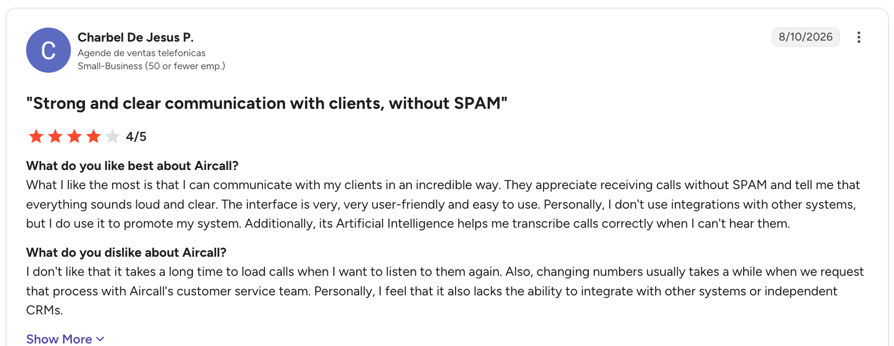
The most common complaints are about call quality, including dropped calls, uneven call distribution, and dialer issues. Some users also report slow loading when syncing call logs and missing features such as individual voicemail and better text handling.
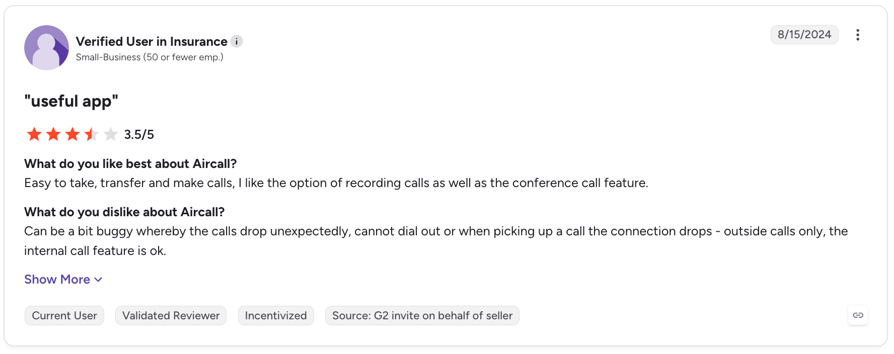
Talkdesk gets similar praise for its easy-to-use interface, all-in-one channel management, call handling, and CRM integrations. Reviewers also highlight its reporting and AI Copilot features for helping with QA and coaching.
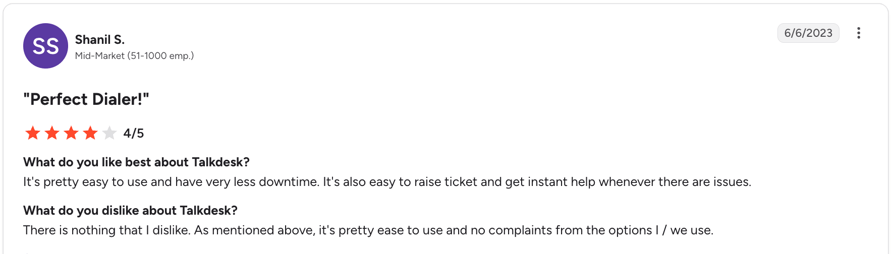
Common complaints include audio and dropped-call issues, occasional lag and glitches, and notification problems, such as unexpected offline status changes. Some users also want better scheduling and search features.
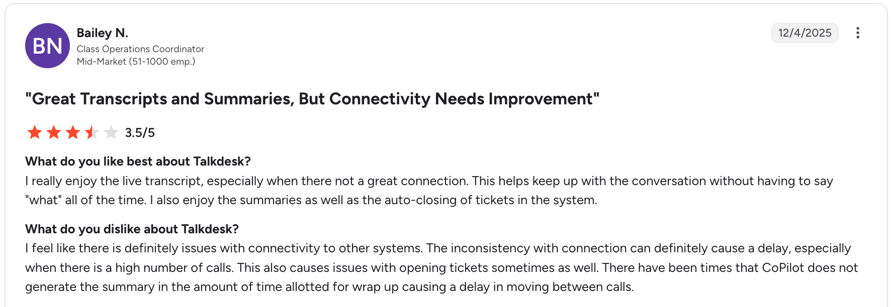
Overall, Aircall and Talkdesk have the same G2 score, but Talkdesk has a larger review base. The reviews show a similar trade-off: Aircall is easier to set up and use for smaller teams, while Talkdesk offers deeper contact center features and reporting but takes more time to learn. Both also get complaints about call quality and connection reliability.
Recommended Content
- Talkdesk Review 2026
Aircall Pros & Cons vs Talkdesk Pros & Cons
Aircall is easier to set up and more affordable, while Talkdesk offers more advanced contact center features and scalability. The right choice depends on which features matter most to your team.
Aircall Pros & Cons
| Pros | Cons |
|---|---|
| Every plan price is published, add-ons included | The 3-license minimum makes real entry $90/month, not $30 |
| Monthly and annual billing, with 25% off annual | No predictive dialer listed on Aircall's published plans |
| 200+ integrations | Salesforce CTI and Power Dialer both require the $50 Professional plan |
| Setup is self-serve and same-day | Deeper reporting means paying $15 per license for Analytics+ |
| 50 free AI Voice Agent minutes on every plan | Users report unreliable call quality |
| SOC 2 Type 2, GDPR, AES-256 at rest, 99.95% uptime | 24/5 customer support |
Talkdesk Pros & Cons
| Pros | Cons |
|---|---|
| All four edition prices are published | Entry is $85 per user/month |
| More than 30 certifications, including HIPAA, PCI and FedRAMP | The AI suite has no published price, so the edition price is not the bill |
| 99.999% uptime SLA on Elite and Industry Experience Clouds | That SLA does not apply to the $85 and $105 editions |
| Predictive, preview, and power dialing modes | Limited CRM integrations compared to competitors |
| Talkdesk Express: 25 free licenses and $100 credit | Express is limited to US and Canada businesses under 50 employees |
| 8 global points of presence, numbers in 160+ countries, MOS 4.25 | No annual discount toggle on the published pricing page |


Which Team Fits Which Platform?
Aircall is a better fit for smaller teams that want a quick, simple setup, while Talkdesk is better suited to larger teams with more advanced contact center needs. Here’s how the two platforms compare by team size, setup, features, and requirements.
| Aircall is the right fit for... | Talkdesk is the right fit for... |
|---|---|
| Sales and support teams under roughly 100 seats | Contact centers running hundreds of agents |
| Teams that need to be live this week, not this quarter | Teams with the budget and time for a more guided rollout |
| Buyers who want the full price on a public page | Buyers who need HIPAA, PCI, FedRAMP or ISO 22301 on the contract |
| Workflows that live inside HubSpot, Salesforce or Zendesk | Operations that live inside custom reports and workforce management |
| Teams that do not need predictive dialers or deep custom reporting | High-volume outbound teams that need predictive or preview dialing |
| Small US or European teams paying per license | US and Canadian businesses under 50 employees testing via Express |
Talkdesk vs. Aircall: The Verdict
Aircall is the better choice if you want a simpler setup, transparent pricing, and fast deployment. Talkdesk is a better fit if you need deeper contact center features, stronger compliance coverage, or advanced outbound calling. The right choice depends on the size and needs of your team.
Choose Aircall if you...
- Run a sales or support team of fewer than about 100 agents and want calls flowing this week.
- Need Salesforce, HubSpot or Zendesk telephony an admin switches on without a project plan.
- Want every price, add-ons included, published before you speak to a rep.
- Want monthly billing, with the 25% annual discount as a lever, not a requirement.
- Are testing AI calling and want free minutes on the plan you already pay for.
- Can live with an add-on for deeper analytics.
Choose Talkdesk if you...
- Run a contact center with hundreds of agents and complex routing.
- Work in a regulated industry, where HIPAA, PCI or FedRAMP settles the shortlist.
- Need a contractual 99.999% uptime SLA and will buy Elite or above for it.
- Run high-volume outbound and need predictive or agentless pacing, not just a power dialer.
- Depend on custom reporting, screen recording and workforce management in one platform.
- Are a US or Canadian business under 50 employees testing Talkdesk free through Express.
FAQ
On list price, yes: $30 per license per month on Aircall Essentials against $85 on Talkdesk Digital Essentials. Aircall's 3-license minimum makes real entry $90, and Talkdesk Express is free for eligible US and Canadian businesses under 50 employees.
Aircall, by a wide margin. An admin buys licenses, provisions numbers, builds an IVR and takes a call the same day, no IT ticket. Talkdesk can also be set up quickly, but implementation time varies from minutes to weeks depending on the setup and complexity.
Aircall is stronger for standard CRM integration setups, Talkdesk for enterprise ones. Aircall publishes a 200+ catalog with one-click setup. Talkdesk lists 60+ integrations.
Usually Aircall. The Aircall vs Talkdesk for small business call turns on the usual virtual phone system friction: published pricing and self-serve setup. Talkdesk Express is the exception, free under 50 staff.
Talkdesk has the broader AI feature set, while Aircall is simpler and more transparent on pricing. Talkdesk offers AI tools like Copilot and Autopilot, while Aircall publishes prices for AI Assist and includes 50 free AI Voice Agent minutes.
Talkdesk publishes the stronger numbers: a 99.999% SLA, while Aircall publishes 99.95%. Both are vendor figures, so treat them as inputs to your own call quality management baseline.
Aircall is better for smaller sales teams, while Talkdesk is stronger for high-volume outbound calling. Aircall includes Power Dialer, Voicemail Drop, and campaigns on Professional. Talkdesk adds predictive dialing, making it a better fit for larger outbound operations.
Express is free for US and Canadian businesses under 50 employees: 25 licenses, $100 in credit, no contract. Above that allotment, there is no listed price. The four published editions run $85 to $225 per user.
CloudTalk is a strong alternative if you want lower entry pricing and sales features without the complexity of a larger contact center platform. Pricing starts at $25/user/month with a 1-user minimum, while IVR, skill-based routing, and the AI Dialer cover core calling and outbound needs.