TL;DR Comparison Table: 10 Best Google Voice Competitors
| # | Tool | Best For | Beyond Google Voice | Starting Price | G2 Rating |
|---|---|---|---|---|---|
| 0 | Google Voice (baseline) | Solo founders and small teams already paying for Google Workspace | The baseline: a virtual number with calls, US texting, voicemail, and Gemini call notes inside Workspace | $10/user/month | 4.1/5 |
| 1 | CloudTalk | Scaling SMB to mid-market sales and support teams | AI Sales Dialer, two-way CRM sync, texting next to a call menu, local numbers in 160+ countries | $25/user/month | 4.4/5 |
| 2 | Dialpad | AI-centric mid-market teams that want coaching on every call | AI transcripts and summaries on every plan, with live coaching cards | $15/user/month | 4.4/5 |
| 3 | Line2 | Small teams that want a second business line on an app | A business number on the phone you carry, with toll-free numbers and an auto attendant on a budget | $13.75/month | 2.7/5 |
| 4 | Vonage | Teams that want a full business phone system with video and desk phones | Video meetings, desk phones, and 20+ app integrations on one per-line plan | $13.99/line/month | 4.3/5 |
| 5 | Quo (OpenPhone) | Shared inboxes and micro-teams | Shared numbers and team texting on an app that feels like iMessage | $15/user/month | 4.7/5 |
| 6 | Nextiva | Reliable unified communications with 24/7 support | Voice, video, chat, and 100 texts per user with 24/7 human support on every plan | $15/user/month | 4.5/5 |
| 7 | Zoom Phone | Teams inside the Zoom ecosystem | A phone line inside the Zoom app you already open every day | $10.50/user/month (metered), $16/user/month (US & CA Unlimited) | 4.6/5 |
| 8 | RingCentral | Heavy enterprise deployments | Enterprise-grade phone, video, and fax with hundreds of app integrations | $20/user/month | 4.2/5 |
| 9 | Grasshopper | Solopreneurs who want flat pricing | One flat monthly price, with unlimited users from Solo Plus | $14/month (flat) | 3.9/5 |
| 10 | Ooma Office | Hybrid setups with desk phones | Pre-configured desk phones, overhead paging, and virtual fax | $19.95/user/month | 4.5/5 |
Google Voice is a sound start for a solo founder or a team of three. You get a number inside Google Workspace, voicemail in Gmail, and a bill of $10 a head. However, once it turns into a proper sales or support line, you'll quickly see the all-manual setup isn't really sustainable: reps dial by hand, recording is a button on Starter, nothing lands in HubSpot or Pipedrive, and the first lead abroad sees a US caller ID. That's usually when people start searching for apps like Google Voice, just better.
The best Google Voice alternatives for a team at that point are CloudTalk, Dialpad, Quo, Nextiva, and Grasshopper. CloudTalk is the best Google Voice alternative for scaling sales and support teams, Dialpad for AI coaching on every call and real-time transcriptions, Quo for shared team inboxes, Nextiva for reliability with 24/7 support, and Grasshopper for flat-rate small teams. Before you compare any of them, name what gave out first: the texts, the CRM, or the number limits.
Why Are Teams Searching for a Google Voice Alternative?
Google Voice does the job it was built for: a work number for a Workspace user. Teams looking for an alternative to Google Voice usually aren't unhappy with it. They've hired a second rep, opened a second market, or added a call menu, and simply realized the product stops where their day starts.
Google Voice is Google's phone service: a virtual number for calls, texts, and voicemail that syncs across the web and the mobile apps, with call forwarding, spam filtering, voicemail transcription, and Gemini call notes on the Standard plan and up. And yes, there's a Google Voice app for iOS and Android, and our guide to Google Voice for business covers the setup. Want to explore the platform even further? Then check out our in-depth review.
Google sells three business plans, and Google Voice pricing runs $10, $20, and $30 per user a month for Starter, Standard, and Premier, and each one sits on top of a Google Workspace plan billed separately. Starter is capped at 10 users, and auto attendants, ring groups, and Gemini notes start on Standard.
On G2, Google Voice holds 4.1/5 from 150+ reviews, and on Capterra it sits at 4.5/5 from 700+. Reviewers like the price and the privacy of a second number, and the recurring complaint is that it's too basic once a business grows. Google lists 24/7 access to Voice support, though a handful of Trustpilot and Capterra reviewers report it was hard to reach once an account was flagged.
Read next to Google's help pages (we examined them for you), Google Voice's pros and cons come down to five reasons growing teams leave:
5 Main Cons of Google Voice That Make Growing Teams Leave
- A phone line, not a sales or support systemThere's no dialer, so reps key in every number. Recording is a button on Starter and only turns automatic on Premier. Routing stops at an auto attendant and ring groups, with no live view of who's on a call. For a team that lives on the phone, it's a business phone system with the middle missing.
- Texting stops behind call menus and can trigger temporary blocksAdmins in Google's own community forum report that a number set up as an auto attendant can't send or receive texts, so the line customers text goes quiet the day you add a call menu. Google's help pages add that Voice isn't meant for bulk messaging and that an account may be temporarily blocked from calling or texting when messages look like spam, such as one reminder sent to a long list.
- No native CRM syncVoice works with Gmail, Calendar, Meet, and Contacts. It has no native HubSpot, Pipedrive, Zoho, or Zendesk logging, and Google's Salesforce integration was a beta that's now closed. Every call gets typed into the CRM by hand, or the pipeline never knows it happened.
- Numbers and texting stop at the US borderGoogle sells Voice in 14 countries, and on the paid plans texting works only in the US. Google doesn't list toll-free numbers, and a rep calling Dublin or Sydney does it from a US number the lead doesn't recognize. Teams that need international numbers end up buying a second tool.
- Two bills and a user capFor a team, every Voice seat needs a Workspace seat first, so the $10 line is $10 plus whatever Workspace costs that user. Starter covers up to 10 users, so the eleventh hire moves the whole team to Standard at $20.
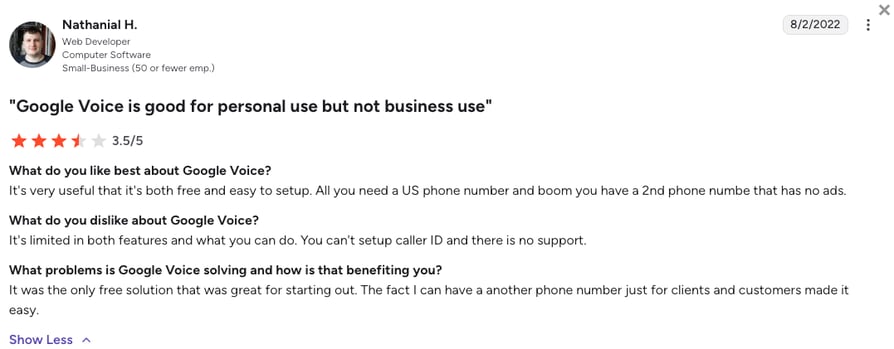


Google Voice earns its place for solo founders and small Workspace teams that call inside the US. The start is cheap with unlimited US calling, the Gmail, Calendar, and Meet fit is native, you can set it up yourself in an afternoon, there's a free personal version, and Google lists 24/7 support. For many other use cases, though, you should consider choosing a better VoIP alternative.
What Are the Best Alternatives to Google Voice?
CloudTalk is the best alternative to Google Voice for scaling sales and support teams. It brings what a Google number never will: an AI Sales Dialer and automatic recording on every call, two-way CRM sync, texting that keeps working next to a call menu, and local numbers in 160+ countries with a local caller ID. On top of that, CloudTalk's AI receptionist answers calls when nobody can, in 70+ languages.
However, as one size doesn't fit all, CloudTalk might not be the right Google Voice competitor for every team. A solo operator who calls inside the US and lives in Gmail can just as well stay on Google Voice, one person who wants a private second line gets it cheaper from Line2, and a company that runs its day in Zoom will find Zoom Phone the obvious shorter step. If you're the team in the middle, with a second rep hired or a second market opened, CloudTalk starts from $25/user/month, with no seat minimum on Starter or Essential.
On G2, CloudTalk holds 4.4/5 from 1,900+ reviews against Google Voice's 4.1/5 from 150+, and the widest gap between the two is quality of support, 8.7 against 7.2, which is the score that matters the day a number gets flagged.
Here are the five main reasons teams using Google Voice make (or should consider) the switch to CloudTalk:
5 Main Pros of CloudTalk and Why Businesses Switch from Google Voice
- A sales and support system, with humans on the other end of supportThe AI Sales Dialer runs campaigns in Power mode (included on Expert, or $15/user/month on Starter and Essential) and Parallel mode ($39/user/month add-on), every call is recorded from the first plan, IVR and queues live in the Call Flow Designer from Essential, and a real-time dashboard shows who's talking to whom. Support is 24/7 chat and email on every plan, with phone on Expert.
- Texting and a call menu on the same numberAn SMS-enabled CloudTalk number keeps texting when you build a call menu on it, and from Essential the call flow can even send an automatic text to a caller nobody could answer. Business SMS and WhatsApp sit on the same contact timeline as calls. Texts are pay-as-you-go rather than included in the plan, and CloudTalk's numbers team files the A2P 10DLC registration US texting needs.
- Native two-way CRM sync100+ integrations from Essential write calls, recordings, texts, and notes to HubSpot, Pipedrive, Zoho, and Zendesk by themselves, with Salesforce on Expert. Click a contact to call, hang up, and the record is already updated.
- Local numbers in 160+ countries, and you bring your Google Voice number with youBuy local, mobile, and toll-free virtual numbers from the dashboard and call customers abroad from a number they recognize. Your US number ports in, and number porting keeps it ringing with Google until the switch date.
- One per-user bill, with no Workspace requirement and no user capThree per-seat plans from $25/user/month, no seat minimum on Starter or Essential, and nothing to subscribe to first. Add the eleventh or the hundredth user without changing plans, and add AI as flat-priced add-ons or bundles rather than a plan jump.

How We Chose the Best Google Voice Alternatives and Competitors
We looked into what each platform does, and weighed every Google Voice competitor on this list against the six things that break first when a Workspace number becomes a team line, with each pricing page and help center read live and user sentiment taken from G2, Capterra, Trustpilot, and Reddit.
- Network stability and uptimePublished uptime commitments, carrier redundancy, and how often reviewers mention dropped or missed calls.
- AI and call notesTranscripts, summaries, and call scoring, and whether they're on the plan, an add-on, or missing.
- CRM syncNative two-way logging to HubSpot, Pipedrive, Zoho, Salesforce, and Zendesk, and the plan it starts on.
- Global numbers and textingCountries with local numbers, caller ID abroad, and the texting rules on the entry plan.
- Support responseWhether a human is reachable on the entry plan, on which channels, and what reviewers say about response times.
- Total cost, including minimums and add-onsSeat minimums, required parent subscriptions, texting bundles, and AI add-ons, so the sticker price can be compared with the real one.
The Top 10 Google Voice Alternatives for 2026
At a glance, this is how Google Voice stacks up against CloudTalk, Dialpad, Quo, and RingCentral, the four tools people weigh against it most, on the rows that decide a switch.
Google Voice vs. CloudTalk, Dialpad, Quo, and RingCentral
| Feature | Google Voice | CloudTalk | Dialpad | Quo | RingCentral |
|---|---|---|---|---|---|
| Starting price | $10/user/mo (Starter) + a Workspace plan | $25/user/mo | $15/user/mo | $15/user/mo | $20/user/mo |
| Seat minimum | None (Starter caps at 10 users) | None (3 on Expert) | None (3 on Pro) | None | None |
| Number coverage | US numbers, sold in 14 countries | Local numbers in 160+ countries | Local numbers in 50+ countries | US and Canada | Numbers in 100+ countries |
| SMS rules | US only on paid plans, no bulk texting | Pay-as-you-go, works next to a call menu | Included (US, CA, UK, AU) | Included (US and CA), consent rules | 25 texts/user/mo on Core |
| AI call notes | Gemini notes from Standard | AI Conversation Intelligence add-on, from $9/user/mo | Included on every plan | Automatic from Business | Paid add-on |
| Call menu (IVR) | Auto attendant from Standard | Call Flow Designer from Essential | Included | Phone menus from Business | Included |
| CRM sync | Google apps only | 100+ from Essential, Salesforce on Expert | From Pro | HubSpot and Salesforce from Business | From Advanced |
| Dialer | Manual dialing | AI Sales Dialer: Power (Expert, or $15/user/mo add-on), Parallel ($39/user/mo add-on) | Separate Sell product from $39/user/mo | None (auto-dialers against fair use) | None in RingEX (RingCX only) |
| Support access | 24/7 Voice support listed | 24/7 chat and email, phone on Expert | 24/7 from Pro | Chat and email | 24/7 listed |
| Free trial |  Via a Workspace trial | 14 days | 14 days | 7 days | 14 days |
| G2 rating | 4.1/5 (150+) | 4.4/5 (1,900+) | 4.4/5 (4,200+) | 4.7/5 (3,400+) | 4.2/5 (1,500+) |
Google Voice's $10 is the cheapest entry on the table, and it sits on top of a Workspace seat, with texting that stops at the US border and dialing done by hand. Three rows decide most switches: texting next to a call menu, calls reaching the CRM without typing, and whether a dialer exists at all. All four cover the other rows, some on a higher plan.
1. CloudTalk: The Best Google Voice Alternative for Scaling SMB Sales and Support Teams
What Is CloudTalk?
CloudTalk is an AI-powered, voice-first call center software for small-business to mid-market sales and support teams, with local numbers in 160+ countries, two-way CRM sync, the AI Sales Dialer, and AI voice agents on one platform.
Where Google Voice gives one person a number, CloudTalk gives a team a phone system: queues, a dialer, recording, texting next to the call menu, and a dashboard that shows the day as it happens.
Why Is CloudTalk a Strong Google Voice Alternative?
- Queues and call menus your managers edit themselves: Call queues on every plan and IVR from Essential, built in a drag-and-drop editor, with the number still texting once the menu is live. After hours, the AI receptionist picks up in 70+ languages, with 50 free minutes included.
- Every call on the contact record before the rep hangs up: 100+ integrations from Essential log calls, recordings, texts, and notes to HubSpot, Pipedrive, Zoho, and Zendesk, with Salesforce on Expert.
- Outbound that scales past hand dialing: The AI Sales Dialer runs as a Power Dialer and a Parallel Dialer, with local caller ID and spam protection.
What Are the Pros & Cons of CloudTalk?
| Pros | Cons |
|---|---|
| Dialer, routing, recording, CRM sync, and AI voice agents on one per-user plan, no parent subscription | Voice-first: no video meetings or team chat, so Google Meet stays for those |
| Local, mobile, and toll-free numbers in 160+ countries, with a local caller ID abroad | CRM integrations start on Essential, and Salesforce waits for Expert (3-seat minimum) |
| 24/7 chat and email support on every plan, and your Google Voice number ported in | Texts are pay-as-you-go rather than included, and the Parallel Dialer is a $39/user/month add-on |
What Are CloudTalk's Plans & Pricing?
CloudTalk pricing starts at $25/user/month on Starter, billed annually, with these plans:
CloudTalk Plans and Pricing
| Plan | Price (annual billing) | Key Features |
|---|---|---|
| Starter | $25/user/month | Unlimited US and Canada calls (fair use), 500 EU and UK outbound minutes, call queues, click-to-call, call recording with 1-month retention |
| Essential | $29/user/month | Everything in Starter + IVR and smart routing in the Call Flow Designer, 100+ CRM and helpdesk integrations, workflow automation, unlimited recording retention |
| Expert | $49/user/month | Everything in Essential + AI Sales Dialer with the Power Dialer, Smart Dialer, Salesforce integration, 24/7 phone support (3-seat min) |
| AI Conversation Intelligence (add-on) | $9/user/month | AI transcripts, call summaries, call scoring, sentiment analysis, and agent coaching insights |
| AI Conversation Intelligence Plus (add-on) | $19/user/month | Everything in AI Conversation Intelligence + call scoring templates auto-assigned by team, custom summary templates, custom topics, AI-drafted follow-up emails |
| AI Receptionist (add-on) | From $99/mo (200 min) | Inbound AI call answering, routing, logging; 50 free minutes on every account; tiers up to $699/mo (2,500 min) |
| AI Specialist (add-on) | From $349/mo (1,000 min) | Sales-led custom AI voice agents for inbound and outbound workflows; plans scale up to $1,249/mo (5,000 min) |
| Virtual Phone Numbers | From $6/number/mo | Local, toll-free, national, and mobile numbers in 160+ countries, instant self-serve in the US and Canada, SMS and WhatsApp on eligible numbers |
How Do Reviewers Rate CloudTalk?
CloudTalk holds 4.4/5 on G2 across 1,900+ reviews. Reviewers single out call quality and a CRM sync that keeps records current without typing. The common gripes are Salesforce waiting for Expert and texts billed per message.
CloudTalk CRM Logging in Action: Pipedrive's Story
Pipedrive's own sales team sells across time zones, and its reps used to copy phone numbers between tools to check a deal. Today 100% of call activity logs in Pipedrive by itself and the top SDRs make 270+ calls a month, with recordings their managers coach from. Spencer Smith, who leads US sales, explains why the logging mattered most:
“When you're trying to close deals across time zones you can't afford to wonder whether your system actually logged the call.”
Team Lead for US Sales, Pipedrive

2. Dialpad: Best for AI-Centric Mid-Market Teams That Want Coaching on Every Call
What Is Dialpad?
Dialpad is a UCaaS (Unified Communications as a Service) platform built around its own AI: every call on Dialpad Connect gets a live transcript, a summary, and action items, and reps see coaching cards mid-call.
Against Google Voice, Dialpad sells the opposite of a bare line: the AI Google gates behind Standard comes on Dialpad's $15 plan, though the product family is split into Connect, Sell, and Support.
Why Is Dialpad a Strong Google Voice Alternative?
- Coaching while the call is live: Real-time assist puts answers and objection handling on the rep's screen mid-call, where Gemini notes arrive after you hang up.
- AI transcripts and summaries on the entry plan: Call transcription, summaries, and action items come with Standard at $15, no add-on needed.
- Shared department lines that still text: Departments and ring groups route calls, and the same numbers send and receive SMS in the US, Canada, the UK, and Australia.
How Does Google Voice vs Dialpad Compare?
Google Voice vs Dialpad comes down to what the $5 gap buys. Google Voice is a $10 Workspace number with Gemini notes from Standard. Dialpad is $15 with AI transcripts and summaries on every call, plus CRM sync and 24/7 support on Pro.
For a founder who wants a number and nothing else, Google Voice is cheaper. For a team that coaches from calls, Dialpad vs Google Voice isn't close. Neither puts a sales dialer in the base plan, which is where CloudTalk comes in.
At the entry price the two are five dollars apart, and the jobs they do aren't. Google Voice sells a Workspace number, and Dialpad sells the AI around the call, with CRM sync one tier up. Our side-by-side puts their plans and ratings in one place.
What Are the Pros & Cons of Dialpad?
| Pros | Cons |
|---|---|
| AI transcripts and summaries from the Standard plan, with live coaching cards | CRM integrations and 24/7 support wait for Pro, with a 3-user minimum |
| No seat minimum on Standard, with a 14-day trial | Outbound dialing lives in Dialpad Sell, a separate product from $39/user/month |
| Texting on shared department lines in four countries | No SMS in continental Europe |
What Are Dialpad's Plans & Pricing?
Dialpad pricing starts at $15/user/month (Standard, annual billing), with these plans available:
Dialpad Plans and Pricing
| Plan | Price (annual billing) | Key Features |
|---|---|---|
| Standard | $15/user/mo | Unlimited calling in the US and Canada, AI transcripts and call summaries, SMS, voicemail, 14-day trial |
| Pro | $25/user/mo | Everything in Standard + CRM integrations (Salesforce, HubSpot), 24/7 support, international numbers, API access (3-user min) |
| Enterprise | Custom quote | Everything in Pro + SSO, 99.9% uptime SLA, unlimited offices, access controls (100-user min) |
How Do Reviewers Rate Dialpad?
Dialpad holds 4.4/5 on G2 across 4,200+ reviews. Reviewers rate the transcription accuracy and the app highly. The frustration is a feature set split across products, so the next tool a team needs often sits in one it hasn't bought.
3. Line2: Best for Small Teams That Want a Second Business Line on an App
What Is Line2?
Line2 is a second-line app from Ziff Davis: a US or Canadian business number on the phone you already carry, with unlimited US and Canada calls and texts, and an auto attendant from Growth.
Of the ten tools here, Line2 is the closest to how most people use Google Voice, a work number that rings your own phone, at a lower price and with no parent subscription.
Why Is Line2 a Strong Google Voice Competitor?
- A number with nothing to subscribe to first: The private line costs $7.99 a month and the Starter business plan $13.75, with no Workspace seat underneath.
- Toll-free numbers on the entry business plan: Starter lets you pick a local or a toll-free number, where Google doesn't list toll-free numbers for Voice at all.
- An auto attendant for less than Google charges: Growth adds the attendant and a call scheduler at $17.66, under Google's $20 Standard plan before the Workspace bill.
How Does Google Voice vs Line2 Compare?
Google Voice vs Line2 is a question of what you already pay for. Line2 sells a standalone number from $7.99 a month, with business plans from $13.75 to $21.83. Google Voice needs a Workspace plan first, then adds $10 to $30 per user for admin controls and Gemini notes.
For one person who wants a private second line, Line2 vs Google Voice goes to Line2. For a Workspace team of five, Google Voice is the tidier fit. Once two people need to answer one number and log it in a CRM, neither has an answer, and CloudTalk does.
Line2 wins on the sticker and on independence: one bill, one number, no Workspace seat. Google Voice wins once you want admin controls and call notes behind the number. Both stop at a forwarding list when a team needs to share the number, so compare them on what each costs at five users.
What Are the Pros & Cons of Line2?
| Pros | Cons |
|---|---|
| Cheapest standalone second line on this list, with no parent subscription | Routing is a forwarding list, with no shared inbox, CRM sync, or integrations |
| Toll-free numbers and an auto attendant on budget plans | Unlimited calls and texts cover the US and Canada only, and international calls bill per minute |
| No contract, with a 30-day money-back guarantee | Weekday-only support, and Trustpilot reviews cite dropped calls and delayed texts |
What Are Line2's Plans & Pricing?
Line2 pricing starts at $7.99 a month for a private number and $13.75 a month for the Starter business plan, both on annual billing, with these plans to choose from:
Line2 Plans and Pricing
| Plan | Price (annual billing) | Key Features |
|---|---|---|
| Private number | $7.99/mo | One US or Canadian number, unlimited US and Canada calls and texts, call screening and blocking |
| Starter | $13.75/mo | Local or toll-free business number, unlimited US and Canada calls and texts, call forwarding |
| Growth | $17.66/mo | Everything in Starter + auto attendant, call scheduler |
| Business | $21.83/mo | Everything in Growth + call recording, voicemail transcription, advanced reporting |
How Do Reviewers Rate Line2?
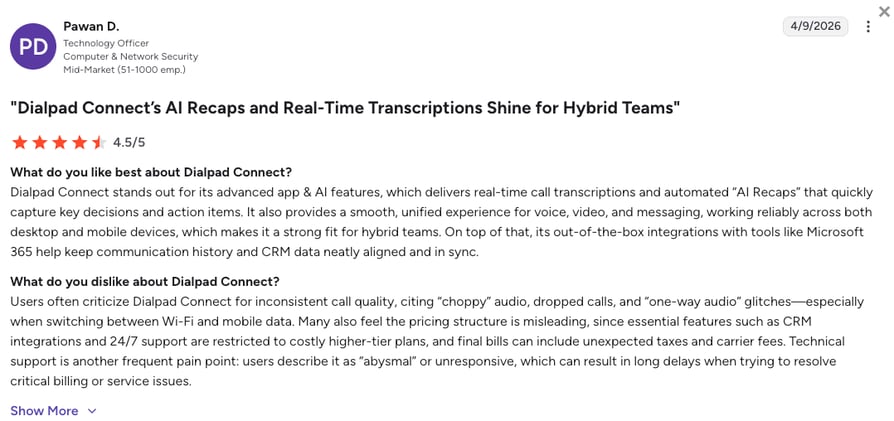
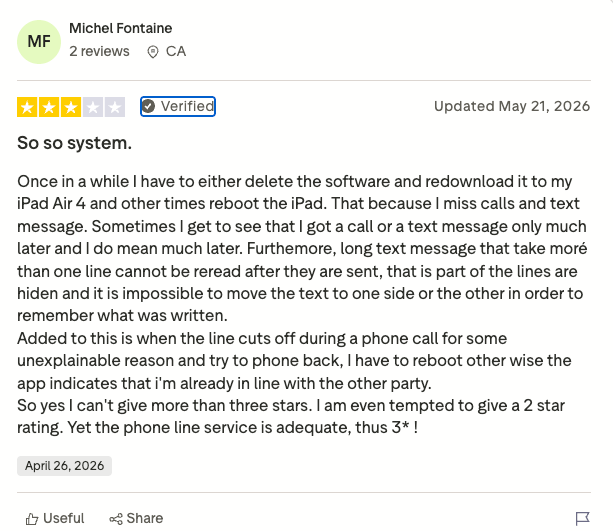
Line2 holds 2.7/5 on G2 from just under 15 reviews, so its 2.8/5 on Trustpilot across 800+ reviews gives a fuller picture. Reviewers like keeping work and personal calls apart on one phone. The complaints are an app that delivers calls and texts late or logs you out, numbers flagged as spam, and slow support.
4. Vonage: Best for Teams That Want a Full Business Phone System With Video and Desk Phones
What Is Vonage?
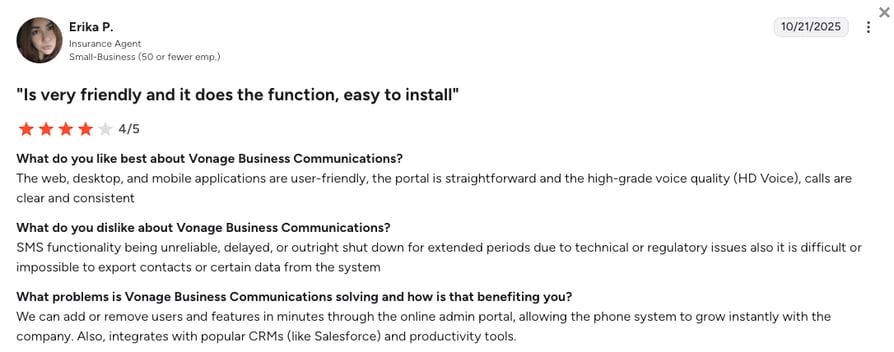
Vonage Business Communications is the business phone system in the Vonage family (its developer APIs are a separate product): unlimited US and Canada calling and texting, video meetings, desk phones, and an App Center of integrations, priced per line.
Vonage replaces Google Voice with a complete office phone system rather than a second number, though recording sits on the top tier and live support keeps office hours.
Why Is Vonage a Strong Google Voice Competitor?
- Video and team chat from the same login: Premium adds meetings for up to 200 people and team messaging, so internal and external calls run on one tool.
- Desk phones and CRM integrations: Premium supports desk phones and opens the App Center with 20+ integrations, CRMs included, where Google Voice connects to Google's own apps only.
- Numbers without a parent subscription: A local number comes with the line, and toll-free numbers are a $39.99-a-month add-on.
How Does Google Voice vs Vonage Compare?
Google Voice vs Vonage is a second number against a full phone system. Google Voice adds $10 to $30 per user to a Workspace plan. Vonage starts at $13.99 per line, with video, desk phones, and CRM integrations on Premium and recording on Advanced.
For a Workspace team that only needs a line, Google Voice is simpler. For an office that wants desk phones and video on one bill, Vonage vs Google Voice goes to Vonage. If recording on every call and a dialer matter more than video, CloudTalk includes both.
Vonage bills per line and Google Voice per user on top of Workspace, so the cheaper option flips with headcount. Three people sharing one Vonage line pay less than three Google Voice seats, and ten people with ten lines pay more. Our comparison runs both bills by team size.
What Are the Pros & Cons of Vonage?
| Pros | Cons |
|---|---|
| A complete office phone system with video, team chat, and desk phones | Call recording only on Advanced, capped at 15 hours a month |
| Unlimited US and Canada calls, SMS, and MMS on every plan, with month-to-month billing available | Live support keeps office hours (weekdays 8 a.m. to midnight ET, weekends 9 to 9), not 24/7 |
| No seat minimum, and one local number included for the life of the account | The annual rates are promotional and carry a one-year contract with an early termination fee |
What Are Vonage's Plans & Pricing?
Vonage pricing starts at $13.99/line/month (Mobile, annual terms), and it offers the following plans:
Vonage Business Communications Plans and Pricing
| Plan | Price (annual terms) | Key Features |
|---|---|---|
| Mobile | $13.99/line/mo | Unlimited US and Canada calling, SMS and MMS, desktop and mobile apps, voicemail, one local number included |
| Premium | $20.99/line/mo | Everything in Mobile + desk phone support, video meetings up to 200 participants, team messaging, App Center with CRM integrations, SSO |
| Advanced | $27.99/line/mo | Everything in Premium + on-demand call recording (15 hours a month), visual voicemail with transcription, call groups |
How Do Reviewers Rate Vonage?
Vonage Business Communications holds 4.3/5 on G2 across 500+ reviews. The praise goes to ease of use and reliability. The complaints that recur are texting limitations and the occasional dropped call.
5. Quo (OpenPhone): Best for Shared Inboxes and Micro-Teams
What Is Quo?
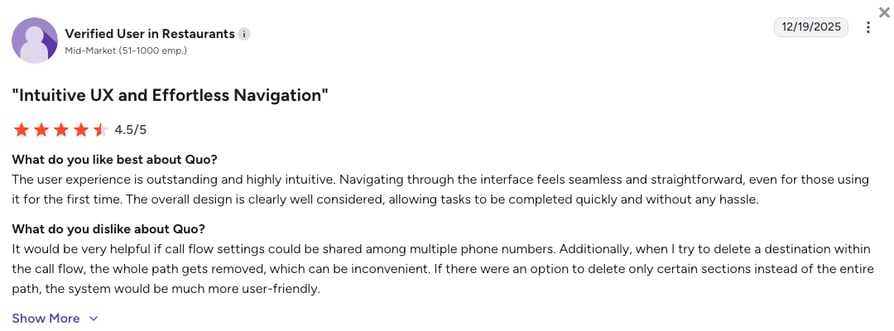
Quo (formerly OpenPhone) is a business phone app built around shared numbers and a team inbox: calling, texting, and an AI agent called Sona, in an app that behaves like iMessage.
Quo keeps what people like about Google Voice, a number on your iPhone. The main reason to switch, however, is that it adds the sharing Google never built.
Why Is Quo a Strong Alternative to Google Voice?
- One number the whole team answers: Up to 10 users share a number on Starter and unlimited on Business, with one call and text history.
- CRM sync without a phone system: Business at $23 writes calls and texts to HubSpot and Salesforce, with automatic recording and AI summaries.
- The Google Voice alternative for iPhone users: The app separates work from personal calls and texts, keeps conversations threaded, and shows when a teammate is already replying.
How Does Google Voice vs Quo Compare?
Google Voice vs Quo starts at the same $15 line, since Google's $10 Starter sits on a Workspace seat. Google Voice gives one user a number with Gemini notes from Standard. Quo gives a team a shared inbox, with HubSpot and Salesforce sync on Business.
For a solo Workspace user, Google Voice wins on simplicity. For three people answering one line, OpenPhone vs Google Voice goes to Quo. Neither suits outbound sales: Google Voice has no dialer and Quo's fair-use policy rules out auto-dialers, which is where CloudTalk takes over.
Both start at the same $15 a month once Workspace is counted, and the difference is the inbox. Google Voice ties a number to a person, and Quo ties it to a team, with everyone's calls and texts in one thread. This comparison walks through both.
What Are the Pros & Cons of Quo?
| Pros | Cons |
|---|---|
| Shared numbers with a team inbox, threaded texts, and visible replies | Fair-use policy bans auto-dialers and cold calling, so it isn't built for outbound sales |
| Automatic recording, AI summaries, and HubSpot and Salesforce sync from Business | International calls and texts bill per minute and per message through prepaid credits |
| 7-day trial with no seat minimum | Numbers are US and Canadian only |
What Are Quo's Plans & Pricing?
Quo pricing starts at $15/user/month (Starter, annual billing), and you can choose from these plans:
Quo Plans and Pricing
| Plan | Price (annual billing) | Key Features |
|---|---|---|
| Starter | $15/user/mo | Calling and texting in the US and Canada, shared numbers for up to 10 users, manual call recording, Sona AI agent |
| Business | $23/user/mo | Everything in Starter + HubSpot and Salesforce integrations, phone menus, automatic recording, AI call summaries, unlimited users per number |
| Scale | $35/user/mo | Everything in Business + AI call tags |
How Do Reviewers Rate Quo?
Quo holds 4.7/5 on G2 across 3,400+ reviews, the highest score on this list. Reviewers praise the texting interface and how little training a team needs. The frustrations are account reviews when texting looks like a campaign, and the per-minute cost of calling abroad.
6. Nextiva: Best for Reliable Unified Communications With 24/7 Support
What Is Nextiva?
Nextiva is a managed unified communications platform for small and mid-size businesses, bundling calling, video, team chat, and texting into one app with 24/7 human support on every plan.
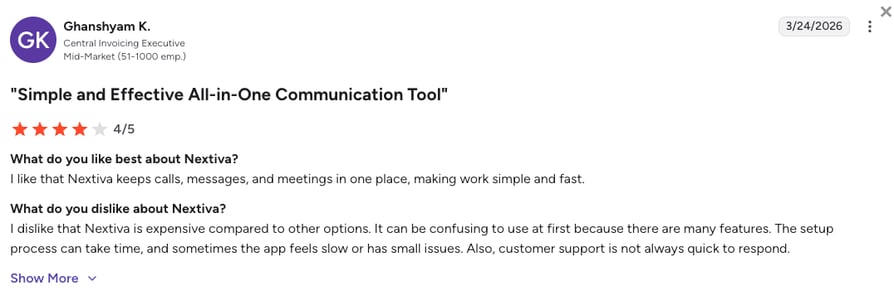
Nextiva is a great Google Voice alternative for teams that want someone to answer when the phones break, though the admin console is denser and the published prices need a 12-month term.
Why Is Nextiva a Strong Google Voice Alternative?
- A human on every plan, around the clock: 24/7 phone, chat, and email support comes with Core, where Google Voice reviewers report mixed results reaching support.
- Texting with headroom: Core includes 100 texts per user, Engage 500, and Scale unlimited, and nothing turns texting off when you add routing.
- A contact center you grow into: Scale adds blended inbound and outbound, skills-based routing, and AI transcription, so a support team doesn't change vendors at 20 agents.
What Are the Pros & Cons of Nextiva?
| Pros | Cons |
|---|---|
| 24/7 human support included on every plan | CRM integrations (Salesforce, HubSpot) are paid add-ons on every tier |
| Calling, video, chat, and SMS in one managed app, with no Workspace seat | Call recording is an add-on on Core |
| Scale plan adds a full inbound and outbound contact center | No free trial, and the published prices need a 12-month term |
What Are Nextiva's Plans & Pricing?
Nextiva pricing starts at $15/user/month (Core, annual billing), and for mid-market teams weighing Google Voice vs Nextiva pricing, these are the plans:
Nextiva Plans and Pricing
| Plan | Price (annual billing) | Key Features |
|---|---|---|
| Core | $15/user/mo | Unlimited calling, 100 SMS per user, video meetings, team chat, call routing, mobile app |
| Engage | $25/user/mo | Everything in Core + call recording, 500 SMS per user, toll-free number and minutes, advanced reporting, inbound call center |
| Scale | $75/user/mo | Everything in Engage + blended inbound and outbound, skills-based routing, AI transcription and summaries, unlimited SMS |
At $15 against $10 plus Workspace, the two land close on the entry bill, and the difference is who answers when something breaks. Nextiva staffs 24/7 support on every plan and includes 100 texts a user, while Google Voice keeps you in Workspace for less. Our comparison puts the two side by side.
How Do Reviewers Rate Nextiva?
Nextiva holds 4.5/5 on G2 across 3,650+ reviews. Responsive support and smooth onboarding draw the praise. The frustrations are an admin console that takes time to learn and numbers that occasionally pick up a spam label.
7. Zoom Phone: Best for Teams Inside the Zoom Ecosystem
What Is Zoom Phone?
Zoom Phone adds a cloud phone system to the Zoom app your team already opens for meetings, with recording on every plan and a metered entry tier at $10.50.
For a company that runs its day in Zoom Workplace, it's the shortest step away from Google Voice, though it's built for convenience rather than a sales floor.
Why Is Zoom Phone a Strong Google Voice Competitor?
- No new app to learn: The dialer appears inside the Zoom client, so a call turns into a meeting with one click and nobody installs anything.
- Recording on every plan: Even the metered tier records calls, where Google Voice makes recording automatic only on Premier.
- One bill for meetings, chat, and phone: The Workplace bundles fold the phone line into the Zoom subscription IT already pays.
How Does Google Voice vs Zoom Phone Compare?
Google Voice vs Zoom Phone is a question of which suite you live in. Google Voice is the phone inside Workspace at $10 to $30 per user on top of the seat. Zoom Phone is the phone inside Zoom, from $10.50 metered or $16 unlimited, with recording on every tier.
For a Google-first office, Google Voice is the natural line. For a Zoom-first one, Zoom Phone vs Google Voice goes to the former. Neither gives a sales team a dialer or a support team queue analytics, the gap a platform like CloudTalk fills.
Both are phone lines on a collaboration suite, so the real comparison is Workspace against Zoom Workplace. Zoom Phone brings recording on every plan and a metered option for light callers, and Google Voice brings Gemini notes and the Gmail fit. Our comparison shows which costs less for your calls.
What Are the Pros & Cons of Zoom Phone?
| Pros | Cons |
|---|---|
| Built into the Zoom app, so adoption takes an afternoon | The metered plan bills every outbound call by the minute |
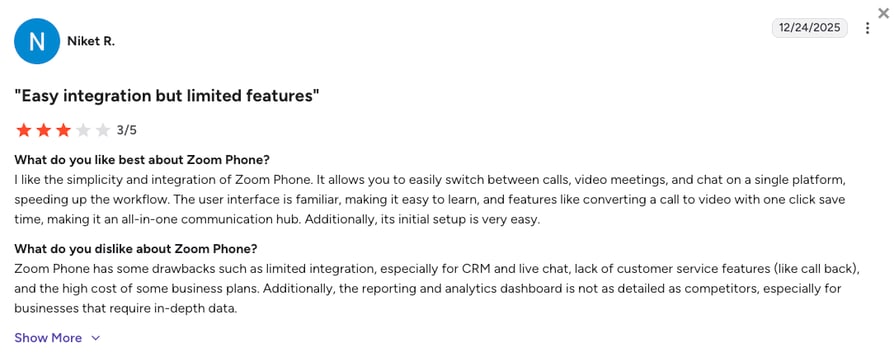
| Call recording on every plan, including the metered tier | No sales dialer, and CRM workflows stay shallow |
| Cheap to add for teams already paying for Zoom Workplace | Reporting lacks the depth a busy support floor needs |
What Are Zoom Phone's Plans & Pricing?
Zoom Phone pricing starts at $10.50/user/month (US & Canada Metered, annual billing), with the following tiers available:
Zoom Phone Plans and Pricing
| Plan | Price (annual billing) | Key Features |
|---|---|---|
| US & Canada Metered | $10.50/user/mo | Calls billed per minute, US and Canada SMS and MMS, call recording, Zoom app |
| US & Canada Unlimited | $16/user/mo | Everything in Metered + unlimited US and Canada calling |
| Workplace Pro Plus | $20.50/user/mo | Everything in Unlimited + Workplace Pro: 30-hour meetings, unlimited AI notes, 10 GB cloud storage |
| Workplace Business Plus | $24.50/user/mo | Everything in Pro Plus + unlimited online fax, 300-person meetings, SSO, 15 GB cloud storage |
How Do Reviewers Rate Zoom Phone?
Zoom Phone holds 4.6/5 on G2 across 2,650+ reviews. Reviewers like chat, meetings, and phone in one window and rate the audio well. Sales managers are the ones who complain, about the missing dialer and thin CRM tracking.
8. RingCentral: Best for Heavy Enterprise Deployments
What Is RingCentral?
RingCentral sells RingEX, the business phone, video, chat, and fax suite multi-site companies have standardized on for two decades, with hundreds of app integrations.
RingCentral is an ideal Google Voice alternative for an organization that has outgrown everything else here, though pricing is enterprise-grade and texting is rationed per plan.
Why Is RingCentral a Strong Google Voice Alternative?
- Built for hundreds of users and dozens of sites: Multi-site admin, no user cap, and a carrier network with published 99.999% availability, where Google Voice caps Starter at 10 users.
- Integrations beyond Google's apps: Hundreds of App Gallery connections, including Salesforce, HubSpot, and Zendesk from Advanced.
- Desk phones, fax, and numbers in 100+ countries: One platform covers the handsets on the desks, the fax finance still needs, and inbound numbers in most markets a global company sells in.
How Does Google Voice vs RingCentral Compare?
Google Voice vs RingCentral is a small-business line against an enterprise suite. Google Voice adds $10 to $30 per user to Workspace. RingEX starts at $20 with meetings for 300 and 25 texts a user, with CRM integrations on Advanced.
For a team of five, Google Voice is cheaper and quicker to set up. For 200 people across three offices, RingCentral vs Google Voice isn't a contest. A 15-person sales team sits between them, the size CloudTalk was built for.
RingEX's $20 Core plan allows 25 texts per user a month, and Google Voice's paid plans text in the US only and go quiet behind an auto attendant. Neither entry plan is built for a team that lives on SMS, so this comparison looks at what each costs once texting is sorted.
What Are the Pros & Cons of RingCentral?
| Pros | Cons |
|---|---|
| Enterprise-grade phone, video, chat, and fax in one suite, with multi-site administration | Core allows 25 texts per user a month, so most teams upgrade for SMS alone |
| Hundreds of integrations and inbound numbers in 100+ countries | CRM integrations start on Advanced, and the AI receptionist is a paid add-on |
| Compliance and security built for healthcare and finance | No sales dialer inside RingEX, since outbound dialing lives in the separate RingCX product |
What Are RingCentral's Plans & Pricing?
RingCentral pricing starts at $20/user/month (Core, annual billing), with the following plans to choose from:
RingCentral Plans and Pricing
| Plan | Price (annual billing) | Key Features |
|---|---|---|
| Core | $20/user/mo | Unlimited US and Canada calls, video meetings up to 300 participants, 25 SMS per user, on-demand recording, 100 toll-free minutes |
| Advanced | $25/user/mo | Everything in Core + CRM integrations (Salesforce, HubSpot, Zendesk), 100 SMS per user, automatic recording, advanced analytics |
| AI Customer Engagement Bundles | Quote-based | Everything in Advanced + AI Receptionist and AI assistant bundles, 200 SMS per user |
How Do Reviewers Rate RingCentral?
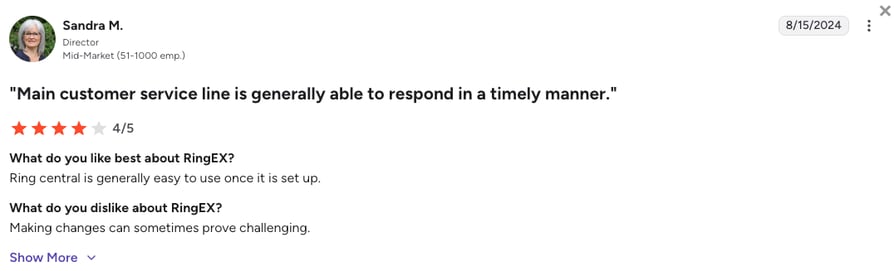
RingEX holds 4.2/5 on G2 across 1,500+ reviews. IT directors praise the uptime and breadth. Admins complain that routine changes take too many clicks and support can be slow.
9. Grasshopper: Best for Solopreneurs Who Want Flat Pricing
What Is Grasshopper?
Grasshopper is a virtual phone system that forwards a business number to the cell phones your people already own, with a greeting, extensions, and texting, at one flat monthly price.
If you're searching for a "VoIP without a per-user fee", Grasshopper is better than anything else here: Solo Plus lets unlimited people share one number for $25, though Grasshopper has no CRM sync, recording, or AI.
Why Is Grasshopper a Strong Google Voice Alternative?
- Flat pricing with unlimited users: Solo Plus at $25 a month covers as many people as you like on one number and three extensions, so five people cost the same as one.
- A business identity on a personal phone: Business calls arrive labeled on your own cell and you call back from the business number, so your personal number stays private.
- A greeting and extensions on a number that still texts: Callers hear a recorded menu and reach the right phone, and the same number keeps texting.
How Does Google Voice vs Grasshopper Compare?
Google Voice vs Grasshopper is per-user against flat-rate. Google Voice costs $10 to $30 for every user on top of Workspace. Grasshopper costs $14 for one person or $25 for unlimited people on a shared number.
For one founder on Workspace, the two cost about the same, and Google adds Gemini notes. For a five-person shop sharing one line, Grasshopper vs Google Voice goes to Grasshopper on price alone. Neither logs calls in a CRM, so a team that needs that should look at CloudTalk.
More people compare these two than any other pair here, and the reason is price. Grasshopper's flat $25 for unlimited users beats Google's per-seat bill the moment three people share a number, and Google Voice wins back the solo user with Gemini notes. Our side-by-side runs the math by headcount.
What Are the Pros & Cons of Grasshopper?
| Pros | Cons |
|---|---|
| One flat price, with unlimited users from Solo Plus | No CRM integrations, so calls stay out of HubSpot and Salesforce |
| 7-day free trial with no credit card, and setup in minutes | No call recording and no AI features |
| Texting and a business greeting on the entry plan | US and Canadian numbers only |
What Are Grasshopper's Plans & Pricing?
Grasshopper pricing starts at $14 a month (True Solo, annual billing), and the price depends on numbers and extensions rather than users:
Grasshopper Plans and Pricing
| Plan | Price (annual billing) | Key Features |
|---|---|---|
| True Solo | $14/mo ($18 monthly) | 1 user, 1 number, 1 extension, calling and texting, instant response texts |
| Solo Plus | $25/mo ($32 monthly) | Unlimited users, 1 number, 3 extensions, business greeting |
| Small Business | $80/mo ($92 monthly) | Unlimited users, 5 numbers, unlimited extensions |
How Do Reviewers Rate Grasshopper?
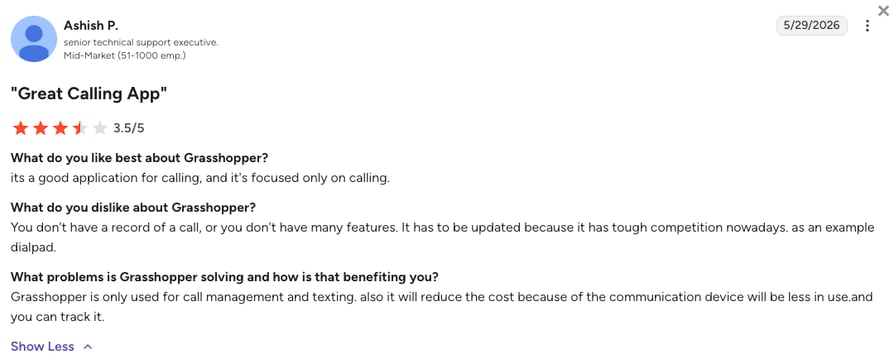
Grasshopper holds 3.9/5 on G2 across 150+ reviews, the lowest G2 score on this list. Small business owners love the flat rate and the simple app. The common complaint is a product that hasn't changed in years and doesn't connect to a CRM.
10. Ooma Office: Best for Hybrid Setups With Desk Phones
What Is Ooma Office?
Ooma Office bridges cloud routing and the physical desk phone: pre-configured handsets and base stations that work the day they arrive, with overhead paging and virtual fax for the clinic or store that runs on hardware.
Ooma ranks among one of the best Google Voice alternatives for a building rather than a laptop, though texting costs an upgrade.
Why Is Ooma Office a Strong Google Voice Competitor?
- Desk phones that plug in and ring: Ooma ships pre-configured hardware, where Google Voice leaves you to source compatible devices.
- Paging, fax, and multi-ring on the same system: Overhead paging, virtual fax, and ring groups cover the jobs a physical office still has and most apps have dropped.
- Month-to-month with no contract: Every plan bills monthly with no annual lock-in, so a seasonal business adds and removes users as it goes.
What Are the Pros & Cons of Ooma Office?
| Pros | Cons |
|---|---|
| Pre-configured desk phones, paging, and virtual fax for physical offices | No texting on Essentials, and Pro caps it at 250 texts a month |
| Contract-free monthly billing with no seat minimum | CRM integrations only on Pro Plus |
| Four-country unlimited calling on the entry plan | No AI call notes or coaching, and the apps feel basic next to mobile-first rivals |
What Are Ooma Office's Plans & Pricing?
Ooma Office pricing starts at $19.95/user/month (Essentials, billed monthly), with these plans:
Ooma Office Plans and Pricing
| Plan | Price (monthly billing) | Key Features |
|---|---|---|
| Essentials | $19.95/user/mo | Unlimited calling in the US, Canada, Mexico, and Puerto Rico, virtual receptionist, ring groups, voicemail (no SMS, recording, or desktop app) |
| Pro | $24.95/user/mo | Everything in Essentials + call recording, SMS (250 texts a month), video meetings, desktop app |
| Pro Plus | $29.95/user/mo | Everything in Pro + CRM integrations, call queuing, hot desking, 1,000 texts a month |
If your clinic or store wants to text customers, the $19.95 Essentials plan won't do it. SMS starts on Pro at $24.95 and is capped at 250 texts a month, with 1,000 on Pro Plus. Price the plan you'll actually need, not the one on the banner.
How Do Reviewers Rate Ooma Office?
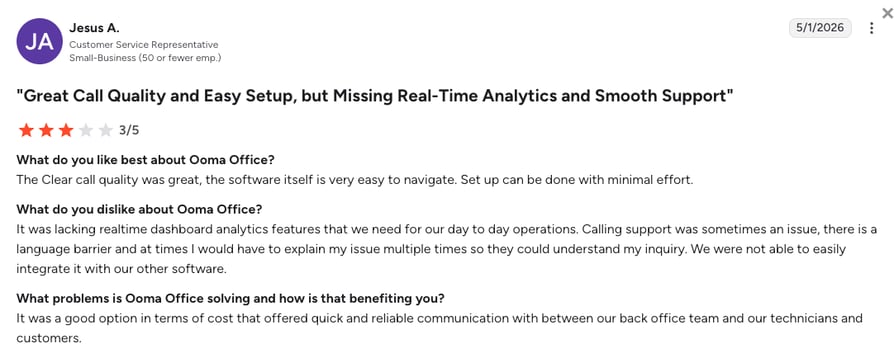
Ooma Office holds 4.5/5 on G2 across 100+ reviews. Admins praise how quickly handsets go live across a retail or medical office and rate the call quality well. The complaints land on the software, which feels clunky used purely as an app.
What Users Are Really Saying About Google Voice Alternatives and Competitors
Pricing pages tell you what a tool includes, and threads tell you what happened the week after someone switched. Therefore, let's have a quick look at what Reddit and G2 say about Google Voice and the alternatives people actually shortlist.
What Redditors Are Asking and Saying About Google Voice Alternatives
Reddit is where Google Voice users go once a number gets flagged or an ID check lands, and the three threads worth reading sit in r/degoogle, r/NoContract, and r/smallbusiness: leaving the Google ecosystem, the identity check at sign-up, and a business that outgrew texting on one line.
- Leaving the Google ecosystem: In r/degoogle, people moving off Google ask for a Google Voice alternative Reddit trusts, and commenters point to a paid virtual phone number from a dedicated provider, with Quo (OpenPhone) among the suggestions.
- ID verification at sign-up: The r/NoContract thread tracks Google's move to require identity verification for Voice. Google's help page confirms it: new users verify with a government ID and can't call or text until it clears, which can take up to three business days under manual review.
- Too many texts for one line: In r/smallbusiness, an owner asks for SMS and phone services besides Google Voice after client texts started tripping limits. Replies point at small-business VoIP providers such as Dialpad, RingCentral, and Zoom Phone.


How Do the Best Google Voice Alternatives Compare on G2?
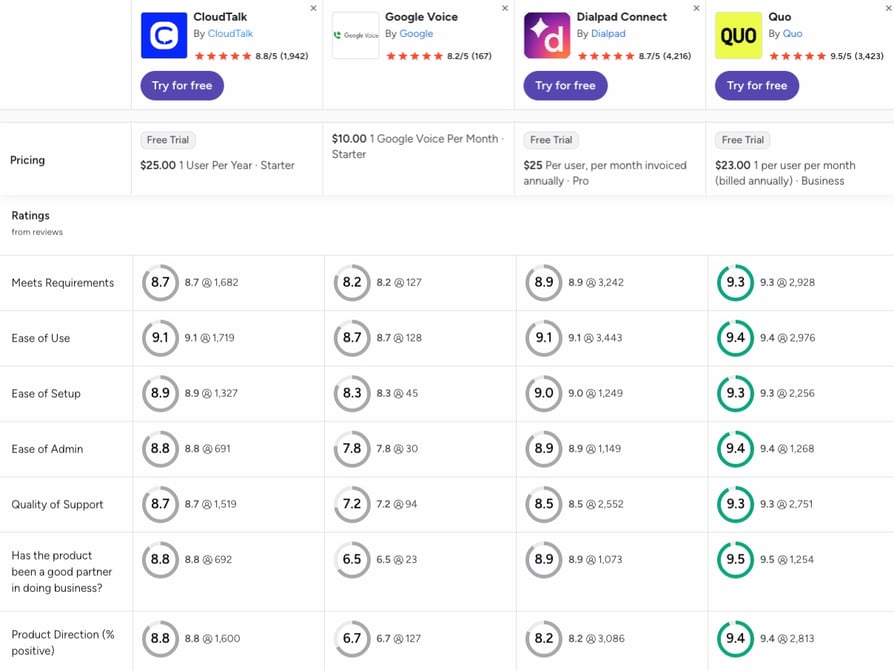
G2's side-by-side comparison puts Google Voice next to the three alternatives buyers check first. CloudTalk holds 4.4/5 from 1,900+ reviews, Dialpad 4.4/5 from 4,200+, Quo 4.7/5 from 3,400+, and Google Voice 4.1/5 from 150+, so weigh Google's column lightly.
- Support and setup: CloudTalk scores 8.7 on quality of support against Google Voice's 7.2, and 8.9 against 8.3 on ease of setup, the difference between a chat agent and a help-center search when a number stops texting.
- Ease of use and admin: CloudTalk posts 9.1 on ease of use to Google Voice's 8.7, and 8.8 to 7.8 on ease of admin, which fits a product where a manager edits the call flow rather than a Workspace admin.
- Product direction: CloudTalk's 8.8 against Google Voice's 6.7 is the widest gap of all. Reviewers read Voice as a product Google maintains rather than one it builds.
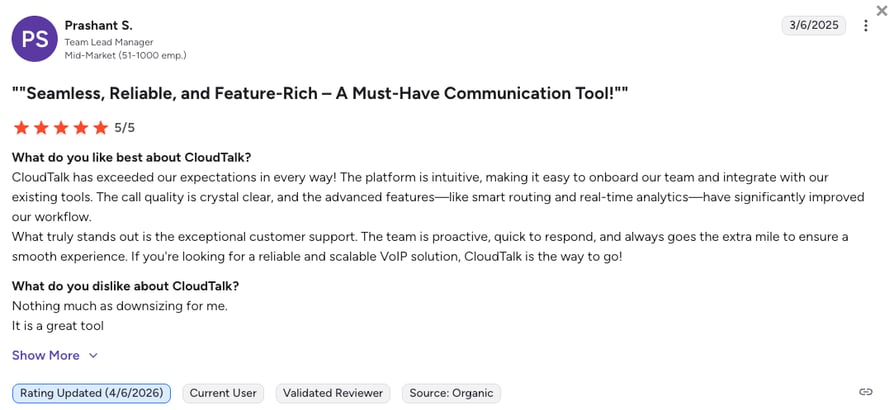
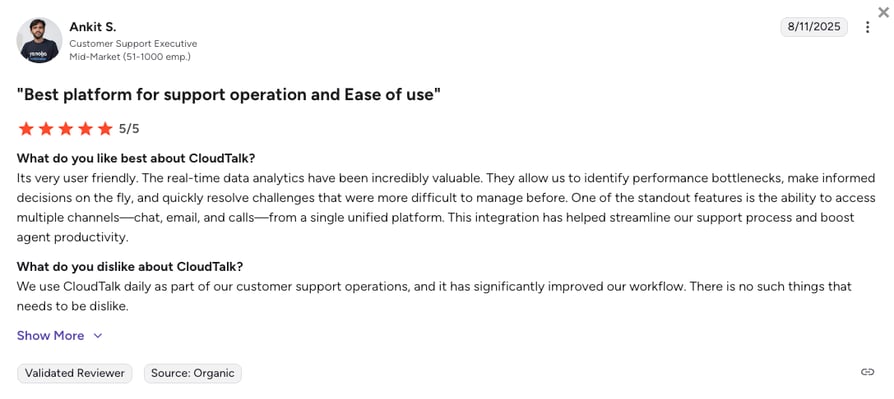
The G2 comparison above helps when several Google Voice competitors are still on your list. For the texture behind the scores, two switcher reviews from people who left Google Voice say more, and both come down to the same two reasons, time back and phones that behave:


CloudTalk vs. Google Voice: Which Is Better?
Google Voice is a work number for a Workspace user, and CloudTalk is a business phone system for a team that sells and supports on the phone. The quick video above asks whether you still need Google Voice, and every "Google Voice vs" comparison for a growing team ends where the table below does: Google Voice wins three founder rows, and CloudTalk takes the team rows.
Google Voice vs CloudTalk: Head-to-Head Comparison
| Category | CloudTalk | Google Voice | Winner |
|---|---|---|---|
| Starting price (annual billing) | $25/user/mo on Starter, unlimited US and Canada calls included (FUP applies) | Starter $10, Standard $20, Premier $30/user/mo, each on top of a Workspace plan | Google Voice |
| Minimum users | None on Starter and Essential (3 on Expert) | None (Starter is capped at 10 users) | Tie |
| Network reliability | 99.999% uptime, multi-carrier network | Google Workspace SLA, 99.9% uptime | CloudTalk |
| Global coverage | Local, mobile, and toll-free numbers in 160+ countries with a local caller ID | US numbers, sold in 14 countries, no toll-free numbers listed | CloudTalk |
| Text messaging (SMS) | Pay-as-you-go SMS and WhatsApp on eligible numbers, A2P 10DLC filed for you | US only on paid plans, not for bulk texting, temporary blocks on spam-like volume | CloudTalk |
| Call routing and SMS together | Call menu and texting on the same number | Auto attendant numbers can't text, per admins in Google's community forum | CloudTalk |
| CRM integrations | 100+ from Essential, Salesforce on Expert | Google apps only, with the Salesforce beta closed | CloudTalk |
| AI call notes | AI Conversation Intelligence add-on from $9/user/mo, with scoring and sentiment | Gemini call notes included from Standard, English only | Tie |
| Outbound dialers | AI Sales Dialer: Power Dialer (Expert, or $15/user/mo add-on), Parallel Dialer ($39/user/mo add-on) | Manual dialing | CloudTalk |
| Google Workspace fit | Runs alongside Workspace, with no native Gmail or Meet layer | Native Gmail, Calendar, Meet, and admin console | Google Voice |
| Free tier | None | Free personal version in the US | Google Voice |
| Support | 24/7 chat and email on every plan, phone on Expert | 24/7 access to Voice support listed, though some reviewers report it hard to reach | CloudTalk |
| G2 rating | 4.4/5 (1,900+ reviews) | 4.1/5 (150+ reviews) | CloudTalk |
| Free trial | 14 days, plus 50 free AI Receptionist minutes | Trial through a Workspace sign-up, no length stated | CloudTalk (clearer terms) |
A growing local business needs a call menu sooner or later. On Google Voice that menu is an auto attendant, and admins in Google's community forum report that an auto attendant number can't send or receive texts, so the line customers text goes quiet. On CloudTalk the menu and the texting live on the same number, and you can build the menu on a trial account before you move anything.
How to Choose the Right Google Voice Alternative for Your Business
The right Google Voice alternative depends on what gave out first: the bill, the CRM, the border, the support line, the texts, or the headcount. Each answer below gives a pick, a runner-up, and one thing to test before you pay.
What Is the Best Google Voice Alternative for Predictable Billing?
CloudTalk is the best Google Voice alternative for predictable billing, and Nextiva is the runner-up. Google Voice is cheaper per seat, at $10 on top of Workspace, and that's the main reason small teams stay. The gap to $25/user/month buys back the hours spent dialing by hand and typing calls into the CRM, and it removes the risk of a number going quiet for a week.
Nextiva's Core holds a flat $15 with 100 texts included, and Phone.com's Basic plan bundles fair-use unlimited calling at $15 a user. Write down what one blocked texting week would cost you, then compare the small-business plans on that number.
Which Google Voice Alternative Has the Best CRM Sync?
CloudTalk has the best CRM sync among Google Voice alternatives, and Quo is the runner-up for micro-teams. CloudTalk's 100+ integrations from Essential write calls, recordings, texts, and notes to HubSpot, Pipedrive, Zoho, and Zendesk by themselves, with Salesforce on Expert. Google Voice connects to Google's own apps and nothing else.
Quo adds HubSpot and Salesforce on its $23 Business plan. Test any sync with your busiest rep for a week, then count the calls they still typed in.
When Revolut scaled its business sales team from zero to 500+ SDRs, its previous VoIP provider lacked the single sign-on and agent oversight a team that size needed. On CloudTalk the team runs 193+ global numbers and saves 40+ hours of sales operations time every month, which is the admin that a disconnected number quietly eats.
What Is the Best Google Voice Alternative for International Calling and Numbers, Including the UK and Europe?
CloudTalk is the best Google Voice alternative for international calling and numbers, including the UK and Europe. Google Voice gives you a US number, so a lead in Manchester or Munich sees a foreign caller ID, and our guide to Google Voice international calls shows how the per-minute rates add up. CloudTalk sells local, mobile, and toll-free numbers in 160+ countries, including a UK virtual number, with a local caller ID on every call.
RingCentral is the runner-up for a large company with offices abroad. Buy one number in your next market on a trial and call ten real contacts from it, then compare the pickup rate with your US number.
The IT outsourcer serves financial-sector clients, so it needed compliant, reliable call recording and reach well beyond North America. On CloudTalk it gets voice and SMS coverage in nearly 100 countries and 100% reliable call recording, after nearly eight years on the platform.
What's the Most Reliable Google Voice Alternative With 24/7 Support?
CloudTalk and Nextiva are the most reliable Google Voice alternatives with 24/7 support. Nextiva staffs phone, chat, and email around the clock on every plan. CloudTalk runs 24/7 chat and email on every plan, with phone on Expert, on a network with 99.999% uptime.
Open a support chat during your trial and time the answer, then check how CloudTalk's onboarding portal works.
Which Google Voice Alternative Keeps Texting Working Without Blocks or Verification Delays?
CloudTalk is the Google Voice alternative that keeps texting working without blocks or verification delays, and Quo is the runner-up for low-volume teams. Two things stop texts on Google Voice: the auto attendant that silences a number, and the spam filter that can temporarily block an account over a reminder sent to many people. The ID check at sign-up can leave a new number idle for days.
Carrier rules bind every provider, so the question is who does the paperwork. US business texting needs A2P 10DLC registration everywhere, and CloudTalk's numbers team files it for you, with spam protection watching your numbers afterwards. One rule carries over from Google Voice: a business text goes to someone who agreed to get it.
Which Google Voice Alternative Is Best for Outbound Sales?
CloudTalk is the best Google Voice alternative for outbound sales, and Dialpad Sell is the runner-up. Google Voice is a dial pad, so a rep making 60 calls a day keys in 60 numbers and the manager sees none of them. CloudTalk's AI Sales Dialer pulls call lists straight from the CRM and works them in Power mode, one call after another, or in Parallel mode on up to five lines at once, where voicemails and busy signals never reach the rep. Every call goes out with a local caller ID and gets recorded.
New leads can jump ahead of retries, a callback promised for Thursday at 3 comes back on Thursday at 3, and every outcome lands in the CRM. Numbers labeled "Spam Likely" don't get answered, so CloudTalk adds reputation monitoring and number rotation. Run one rep's list through the dialer for a week on a trial, then compare connects with last week's hand-dialed count.
Which Google Voice Alternative Is Best for Business in 2026 for Pricing and Features?
CloudTalk is the best Google Voice alternative for business in 2026 on features per dollar, with Nextiva second for teams that want video and chat on the same bill. Google Voice for business runs on three plans that each need a Workspace subscription first, so the real entry price is two seats:
Google Voice for Business Plans
| Plan | Price | What It Adds |
|---|---|---|
| Starter | $10/user/mo | Up to 10 users, unlimited US calling and texting, voicemail, call forwarding, desk phone support, 24/7 access to Voice support |
| Standard | $20/user/mo | Unlimited users, auto attendants and ring groups, Gemini call notes, call recording, legal discovery for calls and texts, SIP Link, regional billing locations |
| Premier | $30/user/mo | Everything in Standard + automatic call recording and transcription, advanced BigQuery reporting, international billing locations |
Set that against CloudTalk's Starter at $25/user/month with unlimited US and Canada calling, recording, and queues, and Essential at $29/user/month with IVR and CRM integrations, no parent subscription. Gemini notes are English only, and CloudTalk's call transcription add-on handles 19 languages with summaries, scoring, and sentiment. Price the plan with the features you need, not the entry plan.
What Is the Best Free Google Voice Alternative?
The best free Google Voice alternative is Google Voice itself, in its personal version, and no business-grade phone system is free. The free plan gives a US individual a number for calls, texts, and voicemail. Low-cost second-number apps such as Sideline, iPlum, and MagicJack charge a small monthly fee for a personal line. The best free Google Voice alternatives in 2026 for business are really trials: every paid tool here lets you run real calls before the first invoice.
What Is the Best Google Voice Alternative for Growing Teams?
CloudTalk is the best Google Voice alternative for growing teams. Most teams that leave Google Voice are around five people, and the breaks come in a known order. At three, two people need to answer one number. At eight, someone calls all day and needs a dialer and call queues behind the inbound line. At ten, Starter's cap forces a plan change, and somewhere in there the first lead abroad lets a US number ring out.
CloudTalk covers that stretch on one platform, from one Starter seat to a mid-market phone system with number pools, the AI Sales Dialer, and live analytics. Pick the phone system that still fits at 10, 25, and 50 people, then make the switch count.
What Will I Get if I Switch from Google Voice?
A Google Voice replacement should pay for itself in hours, not just match Google feature for feature. Voice stops at a shared number and a call menu, and the CloudTalk platform picks up there. Here's what each of the five cons turns into once you switch, plus one more reason to make the move:
- A sales and support system instead of a phone lineThe AI Sales Dialer, recording on every call, IVR and queues in the Call Flow Designer, and a real-time dashboard your managers watch.
- Texting that survives the call menuA call menu and SMS on the same number, with pay-as-you-go texts, WhatsApp, and A2P 10DLC registration filed for you.
- A CRM that fills itself in100+ integrations from Essential write every call, recording, and note to HubSpot, Pipedrive, Zoho, and Zendesk, with Salesforce on Expert.
- Numbers that cross the borderLocal, mobile, and toll-free numbers in 160+ countries, with a local caller ID your customers recognize.
- One bill and no user capPer-user plans from $25/user/month, no Workspace seat underneath, and no plan change at the eleventh user.
- Calls answered even when every rep is busyThe AI receptionist picks up after hours or at rush hour in 70+ languages, answers FAQs, books meetings, and routes the caller, with 50 free minutes on every account. For a complex workflow like lead qualification, an AI Specialist runs the calls inbound or outbound.
Frequently Asked Questions about Google Voice Alternatives
Quick answers on what Google Voice costs, why teams leave it, and how the alternatives compare.
Google Voice is Google's phone service: a virtual number for calls, texts, and voicemail that syncs across the web and the iOS and Android apps. The free version is for US individuals, and the business version runs inside Google Workspace on three paid plans. Our Google Voice review covers where growing teams hit its limits.
Google Voice for business costs $10, $20, or $30 per user a month on Starter, Standard, and Premier, as our Google Voice pricing guide breaks down, and every plan sits on top of a Google Workspace subscription billed separately. Starter covers up to 10 users, and auto attendants and Gemini notes start on Standard.
The main disadvantage of Google Voice for a business is that it's a phone line rather than a phone system. There's no dialer or native CRM sync, texting works in the US only and stops on auto attendant numbers, and Starter caps at 10 users. The full list of Google Voice pros and cons weighs those against its low price.
Yes, Google Voice offers customer support, and Google lists 24/7 access to Voice support on every business plan. Some Trustpilot and Capterra reviewers report it was hard to reach once an account was flagged, so treat it as a help desk rather than a response-time promise. Phone systems built for support teams usually say which plan includes phone support.
Your Google Voice account may be temporarily blocked from calling or texting because Google's filters read your messages as spam or bulk texting, and repeat cases can end in a suspension. Business texting providers avoid this with carrier registration and SMS compliance rules, so a registered sender texting opted-in contacts doesn't look like spam.
A good free alternative to Google Voice for personal use is Google Voice's own personal plan, a free US number for calls, texts, and voicemail. There's no free alternative for business calling, since registration, routing, and support cost money everywhere. The closest thing is a trial, and CloudTalk's free trial runs 14 days with 50 free AI Receptionist minutes.
Yes, you can port your Google Voice number to another VoIP provider. Unlock the number in your Google Voice settings, get your port-out PIN, and submit the request to the new provider. Google doesn't charge for the port-out. Most ports take 1 to 15 business days, while your virtual phone number keeps ringing with Google until the switch date.
You can't get a toll-free number on Google Voice, because Google doesn't list toll-free numbers on its Voice plans or help pages. Business phone systems such as CloudTalk, RingCentral, and Nextiva sell toll-free numbers alongside local ones, ringing the same team as your main line.
Google Voice supports automated call routing and texting, but not on the same number. Standard and Premier add auto attendants, and admins in Google's community forum report that an auto attendant number can't send or receive texts. A business phone system with IVR built in keeps the call menu and SMS on one number.
Yes, Google Voice has dozens of competitors, from second-line apps such as Line2 and Grasshopper to team phone apps such as Quo and full business phone systems such as CloudTalk, Dialpad, Nextiva, and RingCentral. Our comparison hub lines Google Voice up against each of them, with plans and ratings side by side.
OpenPhone, now called Quo, is better than Google Voice for a team that shares one number, because everyone works from the same inbox for calls and texts. Google Voice ties a number to one Workspace user and fits a founder who wants a work line inside Gmail. The Google Voice vs OpenPhone comparison covers the plans in detail.
Grasshopper is better than Google Voice for a small team that wants one flat price, since Solo Plus charges $25 a month for unlimited users on a shared number, which makes it one of the few VoIP providers that doesn't charge per user. Google Voice charges every user on top of Workspace. The Google Voice vs Grasshopper comparison runs the math.
CloudTalk is a good Google Voice alternative for international calling because it sells local international numbers in 160+ countries with a local caller ID, where Google Voice gives you a US number, sells the service in 14 countries, and bills calls abroad per minute. RingCentral fits a large company with offices in several countries.
CloudTalk is the best Google Voice alternative in the UK and Europe for teams that call customers in several countries, because it sells geographic numbers across the UK and the EU and stores call recordings in Germany under a GDPR-compliant data processing agreement. A founder who only calls locally can stay on Google Voice.