12 Best VoIP Providers in Canada for 2026: Complete Guide

QUICK SUMMARY
This guide ranks the 12 best VoIP phone providers in Canada for 2026, comparing features, pricing, reviews, and real-world reliability—so you don’t just pick a provider.
TL;DR
As business communication experts, we’ve reviewed and tested 20+ top VoIP providers in Canada to help teams cut costs, boost flexibility, and scale smarter in 2026.
-
01
CloudTalk — Best for scalable VoIP for sales & support
-
02
RingCentral — Best for a robust cloud communications suite with video
-
03
Dialpad — Best for AI‑powered calling with voice intelligence
-
04
Aircall — Best for CRM‑focused VoIP with IVR routing
-
05
OpenPhone — Best for a cost‑effective business phone system
-
06
8×8 — Best for global calling and analytics multi‑channel support
-
07
Vonage — Best for mobile‑friendly VoIP with advanced routing
-
08
Nextiva — Best for unified communication with CRM tools
-
09
Grasshopper — Best for simple and affordable VoIP
-
10
Ooma — Best for virtual receptionist and mobile features
-
11
Teltik — Best for flexible, low‑cost VoIP for remote teams
-
12
Net2Phone Canada — Best for locally hosted Canadian VoIP
When Is It Time to Switch From Traditional Phone Systems to VoIP?
Landlines will stop working as PSTN networks shut down by 2025–2027. VoIP is the reliable future.
If you’re still unsure whether it’s time to make the switch, here are five clear signs your business is ready to leave traditional phone systems behind:
- Your costs are too high: If you’re spending on old equipment, maintenance, or long-distance fees, VoIP cuts those costs by running over the internet.
- You need flexibility for remote or hybrid work: VoIP lets teams call from anywhere—mobile, desktop, or browser—with a single business number.
- Your system lacks modern features: No Call Recording, Analytics, or CRM integrations? VoIP brings all-in-one communication tools your team actually needs.
- Scaling is a struggle: If adding users or lines is slow or expensive, VoIP gives you instant scalability—no hardware required.

Still using a landline in 2026? Your customers have already moved on.

How We Chose the Best VoIP Providers in Canada
To bring you this guide, we evaluated over 20 top VoIP platforms, drawing from real feedback across 2,000+ users on sites like G2, Capterra, and TrustRadius.
We selected the 12 best VoIP providers based on key features like call quality, CRM integrations, pricing transparency, Canadian number support, and how well they perform for remote and hybrid teams. We also considered recent market research and performance data to ensure our picks are backed by real results.
What you’ll find here:
Only VoIP systems that are reliable, flexible, and packed with features growing Canadian teams actually use.
Why Trust Our Software Reviews?
For nearly a decade, we’ve helped over 30,000 professionals choose better communication tools. We’ve tested 200+ platforms, analyzed 5,500+ verified reviews, and monitored real user feedback across Reddit, Quora, and more.
Just last year, we published over 1,000 articles—all human-written, peer-reviewed, and built to help businesses make smart, data-backed decisions.
The 12 Best VoIP Phone Providers in Canada for Remote & Hybrid Teams
In Canada, where 97.9% of all businesses are small and every call counts, switching to business VoIP in Canada isn’t just a tech upgrade—it’s survival 1. That’s why over 70% of small enterprises have already moved to cloud-based phone systems that offer more flexibility, control, and trust 2.
We vetted 12 top providers for 2026—focusing on features, pricing clarity, integration strength, and real support for Canadian teams. Whether you’re running lean in Toronto or scaling fast from Vancouver, these platforms offer the tools and reliability to keep conversations flowing.
Here’s how they stack up at a glance:
VoIP Provider Comparison Table
Provider
Best For
Starting Price (CAD)
Key Features
CloudTalk
Sales & support teams
19/user/month
Smart dialer, CRM sync, call recording
RingCentral
Mid-sized to enterprise
$29.99/user/month
UCaaS suite, video, analytics
Dialpad
AI-powered calling & support
$23/user/month
Voice intelligence, call summaries, AI coaching
Aircall
CRM-focused sales & support teams
$30/user/month
Call monitoring, IVR routing, CRM integrations
OpenPhone
Startups & remote teams
$19/user/month
Business texting, shared inbox, mobile app
8×8
Global calling & analytics
$28/user/month
Call analytics, video meetings, multi-channel support
Vonage
Mobile-friendly small businesses
$19.99/user/month
Advanced routing, mobile app, smart numbers
Nextiva
Customer engagement teams
$20/user/month
CRM tools, analytics, IVR automation
Grasshopper
Solo entrepreneurs
$14/month
Call forwarding, voicemail, mobile app
Ooma
Small businesses on a budget
$24.95/user/month
Virtual receptionist, voicemail-to-email, call block
Teltik
Budget-conscious remote teams
$19.95/user/month
Unlimited calling, voicemail to email, call forwarding
Net2Phone Canada
Canadian SMBs with bilingual needs
$29.99/user/month
Call recording, bilingual support, local hosting
1. CloudTalk
CloudTalk is a feature-rich VoIP solution tailored to the needs of small and medium-sized businesses. It offers advanced call management features, seamless integrations, and exceptional support to help teams enhance customer communication and streamline workflows.
Best for
Small and medium-sized businesses seeking customizable and scalable call solutions.
Pricing:
- Lite (19/user/month]): Includes unlimited US & Canada calling, business SMS, International Numbers, Call Recording, basic call analytics, and 24/7 email/chat support.
- Essential (29/user/month): It offers 1,000 domestic outbound minutes, 24/7 live support, advanced analytics, IVR, Skill-Based routing, Integrations + Open API.
- Expert (49/user/month): It includes features like Power Dialer, Smart Dialer, VIP Queues, WhatsApp Inbound & Outbound Messages, and Call Monitoring.
- Custom (Varies): This plan is tailored for businesses with unique needs and includes custom onboarding, unlimited outbound calls with flat rates, enterprise-level security, and developer support.
Explore CloudTalk’s in-depth pricing guide.
Best Features
- Automatic and on-demand Call Recording
- Real-time analytics and dashboards
- Integration with over 40+ tools, including HubSpot and Salesforce
- AI Sales Dialer and Call Flow Designer
- AI Voice Agents
Integrations
- HubSpot
- Salesforce
- Zendesk
- Pipedrive
Pros and cons
Pros:
- Exceptional customer support
- User-friendly interface
- Seamless CRM integrations`
- Real-time analytics
Cons:
- Advanced features require setup
- Limited offline functionality
- Limited features in the basic plan
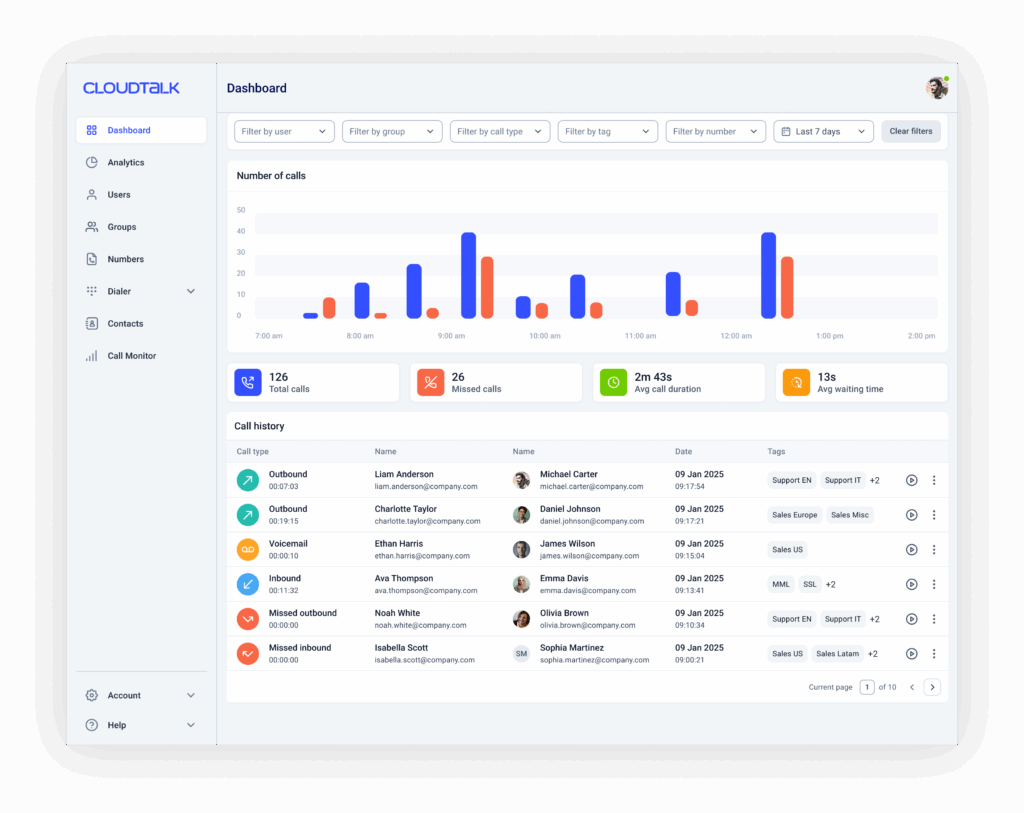
How to Get a VoIP Number with CloudTalk in Canada
Setting up CloudTalk takes minutes—and gets you a local Canadian number without dealing with telco contracts or hardware installs.
Here’s how the process works:
- Step 1: Sign Up for a Free Trial
Go to cloudtalk.io and start a 14-day free trial—no credit card required. - Step 2: Pick Your Local or Toll-Free Number
Browse CloudTalk’s number inventory to choose a VoIP phone number in Canada by city, province, or toll-free code (e.g., 416 for Toronto, 604 for BC, 877 for national). - Step 3: Customize Call Routing & Workflows
Use CloudTalk’s drag-and-drop Call Flow Designer to set business hours, voicemail greetings, and routing rules—no IT team needed. - Step 4: Connect Your CRM or Helpdesk
Link tools like Salesforce, HubSpot, or Zendesk with one click. Calls, tags, and notes sync automatically to keep your team aligned. - Step 5: Start Calling From Any Device
Launch calls from your desktop, mobile, or browser-based dialer—CloudTalk works anywhere you’ve got internet.
That’s it. You’re now fully set up with a business phone system for Canada that’s fast, reliable, and built to scale.
2. RingCentral
RingCentral is a leading VoIP provider offering cloud-based communication solutions with voice, video, and team messaging features. Its flexibility and reliability make it ideal for businesses of all sizes.
Best for
- Enterprises with remote or hybrid workforces.
Pricing:
- Core: $30 per user/month
- Advanced: $35 per user/month
- Ultra: $45 per user/month
Explore RingCentral’s in-depth pricing guide.
Best Features
- Voicemail transcription
- Advanced Call Analytics
- Automatic call recording
- Team Messaging
Integrations
- Microsoft Teams
- Slack
- Google Workspace
- Salesforce
Pros & Cons
Pros:
- Reliable video conferencing
- Robust mobile app
- Comprehensive analytics tools
- Easy-to-use admin interface
Cons:
- Steep learning curve for new users
- Limited customer support in basic plans
- Higher pricing for advanced features
- Limited customization options
3. Dialpad
Dialpad offers AI-powered VoIP solutions that focus on productivity and collaboration. With features like call transcription and real-time coaching, Dialpad is ideal for modern teams.
Best for
- Teams focused on productivity and collaboration.
Pricing:
- Standard: $15 per user/month
- Pro: $25 per user/month
- Enterprise: Custom pricing
Discover Dialpad’s in-depth pricing guide.
Best Features
- Real-time call transcription
- Automatic call recording
- AI-powered analytics
Integrations
- Google Workspace
- Microsoft 365
Pros & Cons
Pros:
- AI-powered features
- Affordable entry-level pricing
- Easy-to-use interface
- Real-time transcription
Cons:
- Limited CRM integrations
- Occasional call quality issues
- Advanced features require higher-tier plans
- Limited offline support
4. Aircall
Aircall is a popular choice among Canadian VoIP providers, offering ease of use and integrations with major CRM platforms, like most of its alternatives.
Pricing:
- Essentials: $30 per user/month
- Professional: $50 per user/month
- Custom: Contact for enterprise solutions
Check Aircall’s in-depth pricing guide.
Best Features
- Unlimited call recording
- IVR and skill-based routing
- Advanced reporting tools
Integrations
- Zoho CRM
- Freshdesk
- Google Workspace
Pros & Cons
Pros:
- Quick and intuitive setup process
- Comprehensive call monitoring tools
- Extensive integration ecosystem
- Advanced calling features
Cons:
- Premium pricing with costly add-ons
- Reported issues with call quality
- Inconsistent customer support response times
- Mobile app reliability concerns
5. OpenPhone (now Quo)
OpenPhone makes obtaining a Canada VoIP number straightforward while offering robust business communication features. It enables teams to manage business calls and texts from a single platform.
Best for
- Startups needing cost-effective VoIP.
Pricing
- Starter: $15 per user/month
- Business: $23 per user/month
- Enterprise: Custom pricing
Check out OpenPhone’s in-depth pricing guide.
Best Features
- Shared Business Numbers
- Voicemail Transcription
- Call Recording
- Custom Business Hours
Integrations
- HubSpot
- Slack
- Google Contacts
Pros & Cons
Pros:
- Affordable pricing
- User-friendly design
- Reliable texting capabilities
- Flexible business hours settings
Cons:
- Limited advanced features
- No video conferencing options
- Limited scalability for larger teams
- Basic reporting features
6. 8×8
8×8 is a versatile VoIP solution offering voice, video, and chat capabilities in one platform. It’s known for its global reliability and robust enterprise-level features tailored to SMBs and larger organizations.
Best for
- Teams prioritizing video and voice integration.
Pricing
- Pricing available upon request.
Explore 8×8’s in-depth pricing guide.
Best Features
- Unlimited Calling.
- Advanced Analytics.
- Call Recording.
- Multi-channel Integration.
Integrations
- Microsoft Teams.
- Salesforce.
Pros & Cons
Pros:
- Reliable global communication
- Comprehensive features for SMBs
- Seamless video integration
- Extensive reporting tools
Cons:
- Complex setup for smaller teams
- Pricing increases with add-ons
- Limited customizability
- Learning curve for new users
7. Vonage
Vonage offers cloud-based communication solutions with flexibility for SMBs. Its VoIP services include advanced call routing, mobile integration, and productivity-enhancing features.
Best for
- Small businesses requiring mobile-friendly solutions.
Pricing:
Quote-based.
Explore Vonage’s in-depth pricing guide.
Best Features
- Advanced Call Routing.
- Mobile App.
- Smart Numbers.
Integrations
- Zoho CRM.
- Salesforce
Pros & Cons
Pros:
- Mobile-friendly functionality
- Easy integration capabilities
- Excellent voice quality
- Scalable for growing teams
Cons:
- High pricing for advanced plans
- Pricing increases with add-ons
- Basic features on lower tiers
- Support response times vary
8. Nextiva
Nextiva provides a unified communication platform, blending VoIP, CRM, and collaboration tools. It’s designed for businesses aiming to simplify workflows and enhance customer interactions.
Best for
- Teams focusing on customer engagement.
Pricing:
- Core: $15 per user/month
- Engage: $25 per user/month
- Power Suite: $75 per user/month
Discover Nextiva’s in-depth pricing guide.
Best Features
- Call recording with transcription
- Automated workflows and IVR
- Comprehensive analytics
Integrations
- Zapier
- HubSpot
Pros & Cons
Pros:
- Built-in CRM for easy access
- Strong focus on customer support
- Scalable communication tools
- Reliable uptime and performance
Cons:
- Higher pricing for SMBs
- Limited customization options
- Basic plans lack advanced tools
- Steep learning curve initially
9. Grasshopper
Grasshopper is a virtual phone system aimed at entrepreneurs and small businesses. It’s known for its simplicity, affordability, and ease of use, making it a popular choice among those looking for small business phone systems in Canada that cover the basics without unnecessary complexity.
Best for
- Businesses prioritizing affordability.
Pricing:
- True Solo: $14 per month
- Solo Plus: $25 per month
- Small Businesses: $55 per month
Check Grasshopper’s in-depth pricing guide.
Best Features
- Virtual Phone Numbers.
- Voicemail Transcription.
- Call Forwarding.
- Custom Greetings.
Integrations
- Google Contacts.
- Zoho.
Pros & Cons
Pros:
- Affordable pricing for startups
- Simple setup and onboarding
- Excellent for solo entrepreneurs
- Mobile app for easy access
Cons:
- Limited advanced features
- Minimal integration capabilities
- Not ideal for larger teams
- Basic analytics only
10. Ooma

Ooma offers a cost-effective VoIP solution for small businesses, focusing on reliable call quality and essential features. It’s well-suited for teams prioritizing affordability without sacrificing performance.
Best for
- Small businesses seeking cost-effective solutions.
Pricing
- Ooma Office Essentials: $19.95 per user/month
- Ooma Office Pro: $24.95 per user/month
- Ooma Office Pro Plus:$29.95 per user/ month
Best Features
- Virtual Receptionist.
- Call Blocking.
- Voicemail-to-Email.
- Mobile App.
Integrations
- HubSpot
- Microsoft 365.
Pros & Cons
Pros:
- Reliable call quality
- Affordable entry-level plans
- Easy-to-use mobile app
- Ideal for small teams
Cons:
- Limited scalability
- Fewer advanced features
- Basic analytics options
- No built-in CRM
11. Teltik
Teltik is a budget-friendly VoIP provider offering flexible communication solutions for small businesses and entrepreneurs. Known for its affordable plans and reliable connectivity, it ensures seamless communication without straining budgets
Best for
- Entrepreneurs managing remote teams.
Pricing
- $20/month (2 GB)
- $30/month (6 GB)
- $40/ month (Unlimited)
Best Features
- Unlimited Calling.
- Voicemail-to-Email.
- Call Forwarding.
- Mobile App for on-the-go connectivity.
Integrations
- Microsoft 365.
- Zoho CRM.
Pros & Cons
Pros:
- Affordable pricing for startups
- Easy to set up and use
- Reliable call quality
- Flexible plans with no contracts
Cons:
- Limited advanced features
- No video conferencing options
- Fewer integrations compared to peers
- Basic analytics only
12. Net2Phone Canada
Net2Phone Canada is a VoIP provider tailored specifically to Canadian businesses, offering locally hosted solutions with strong bilingual support, transparent pricing, and a focus on compliance. Backed by decades of telecom experience, it delivers a reliable, business-grade communication platform with native CRM integrations.
Best for
Canadian teams that need a VoIP business solution with local infrastructure, bilingual service, and flexible features.
Pricing
- Business Lite: From $29.99/user/month
- Business Select: From $39.99/user/month
- Business Premier: From $49.99/user/month
Best Features
- Local & toll-free numbers across Canada
- Call recording and analytics dashboard
- Canadian-based data hosting and 24/7 bilingual support
Integrations
- Salesforce
- Microsoft Teams
- Zoho CRM
Pros & Cons
Pros
- Hosted in Canada for compliance and performance
- Strong bilingual customer service (EN/FR)
- Easy CRM sync and call reporting
Cons
- Limited transparency on higher-tier pricing
- Some features require longer-term contracts
- Fewer third-party integrations compared to global competitors


from 1,702+ reviews
Comparing providers? Don’t just pick one—test the best.
No credit card required
Trusted by Leading brands.


How Much Does a VoIP Provider in Canada Cost?
VoIP providers in Canada offer clear cost advantages over traditional landline systems—with pricing tiers that scale to match your business size and feature needs.
Entry-level plans typically start around $15 to $40 per user/month, covering the essentials like call forwarding, voicemail-to-email, and basic analytics. These are ideal for small teams or startups focused on simple, reliable communication.
Mid-tier plans, often priced between $50 and $70 per user/month, add more firepower: AI-driven features, CRM integrations, call recording, and detailed reporting. If you’re scaling support or sales operations, this is the sweet spot for functionality and value.
At the top end, enterprise-grade packages can exceed $100 per user/month, offering fully customizable call flows, SLA-backed support, analytics dashboards, and integrations with custom CRMs or internal tools. Despite the higher price tag, these plans often deliver significant ROI through improved efficiency and better customer outcomes.
Pro tip
💡 Pro tip: Most Canadian VoIP providers offer up to 20% off with annual billing. If you’re planning to stick around, it’s an easy way to stretch your budget further.
Tired of vague features and fine print? Get pricing that makes sense.
Canadian VoIP Compliance & Regulatory Requirements
If you plan to offer VoIP services in Canada you need to follow federal rules set by the Canadian Radio-television and Telecommunications Commission (CRTC). These regulations help protect customers, especially when it comes to emergency services and transparency.
Here’s a breakdown of what VoIP providers need to know:
Emergency (9‑1‑1 / E9‑1‑1) Obligations
One of the most important compliance areas is emergency calling:
- You must provide Basic or Enhanced 9‑1‑1 service to your customers.
- You must disclose any limitations or differences in how 9‑1‑1 works with VoIP compared to traditional phone lines.
- These notices must be given at signup, in marketing material, in your terms of service and via an wasy web link.
Registration & Licensing
To operate legally in Canada:
- You must register with the CRTC—either as a reseller or, if you own your network infrastructure, as a Competitive Local Exchange Carrier (CLEC).
- Most providers also need a Basic International Telecommunications Services (BITS) licence if they carry calls beyond Canada.
- Keep your registration and BITS licence up to date — failing to file required reports can lead to deregistration.
Customer Notifications & Documentation
Before offering service, Canadian providers must send the CRTC:
- A letter expressing intent to become a local VoIP provider
- Answers to a standard set of questions
- Proposed text for customer notifications about 9‑1‑1 limits
- Website mockups showing where those disclosures will appear
Once approved, these disclosures must become live and clearly visible to customers.
In short:
Offering VoIP in Canada means complying with rules on emergency calling, transparency, and licensing. Being fully compliant helps protect your customers and your business.
Security, Spam Protection & Call Trust for Canadian Businesses
If you work with customer data, protecting it is a must. That’s why Canadian businesses must comply with CASL (Canada’s Anti-Spam Legislation)—the law that stops spam, shady software, and misleading messages. Break the rules, and you could face big fines and lose your customers’ trust.
How to Stay Compliant
- Always get clear consent before sending commercial emails or texts.
- Disclose limitations of any automated or VoIP-based emergency services.
- Avoid shady tactics like misleading links or collecting email addresses without consent.
How to Keep Your VoIP System Secure
Here are the key best practices every Canadian business should follow to keep communications safe and compliant:
- Encrypt everything: Protect data both in storage and across networks. This ensures that even if someone gets access, they can’t read the information without a decryption key.
- Limit access: Only give employees access to the tools and data they need. Set up role-based permissions and audit them regularly to avoid internal leaks or accidental breaches.
- Back up regularly: Don’t risk losing valuable data. Back up your call logs, recordings, and customer info frequently—and store those backups offsite or in the cloud for disaster recovery.
How to Get Local Canadian Numbers Across Provinces—Without a Physical Presence
Building a local presence in Canada doesn’t require offices, SIM cards, or landlines anymore. With a cloud-based VoIP provider like CloudTalk, you can get local Canadian phone numbers in minutes—no matter where your team is based.
How it works:
You sign up with a VoIP provider, choose a Canadian area code, and start calling or receiving calls through desktop, mobile, or browser apps using an internet connection. That’s it.
VoIP Call Quality in Canada: What Really Affects It?
Crystal-clear VoIP calls aren’t just about having “good internet.” In Canada—just like anywhere else—reliability depends on several factors working together smoothly.
Here are the usual suspects behind choppy audio, delays, or dropped calls:
- Poor Configurations: Without proper setup (e.g., QoS settings), even a fast connection can deliver poor call quality.
- Latency & Jitter: These cause awkward silences or talk-over moments. They’re common when data packets arrive late or out of order.
- Packet Loss: Bits of your conversation vanish mid-call. This is often due to unstable connections or limited bandwidth.
- Network Congestion: Competing traffic (like large downloads or video calls) can push your VoIP traffic aside.
- Outdated Hardware: Old routers, headsets, or even firmware can become bottlenecks.
Can Your Network Handle VoIP in Canada?
If your team works remotely or across provinces, your internet needs to go beyond browsing speeds.
Here’s how to check:
- Bandwidth: Aim for at least 100 kbps per call in both directions. More is better.
- Stability > Speed: A stable connection with low jitter beats a super-fast one that drops for seconds at a time.
- Use Wired When Possible: WiFi is convenient, but it’s prone to interference. Ethernet wins for VoIP.
- Enable QoS: Quality of Service (QoS) tells your router to prioritize voice traffic, so calls don’t break up when someone’s watching YouTube.
8 Key Features to Look For in a Canadian VoIP Phone Provider
When evaluating VoIP solutions, prioritize features that deliver real business value and elevate customer communication. These are the core capabilities that can transform how your team connects, responds, and scales:
1. Intelligent Call Distribution Systems
Fine-tune your call routing with smart IVR systems and automated distribution. Look for solutions that intelligently direct calls based on agent skills, availability, and customer history to maximize first-call resolution rates.
2. Advanced Analytics and Performance Monitoring
Seek platforms offering comprehensive call monitoring and analytics capabilities. Real-time dashboards and detailed reporting help optimize team performance and identify areas for improvement.
3. Automated Dialing Capabilities
Choose systems with robust power dialing features that streamline outbound operations. Modern solutions should offer predictive dialing and campaign management tools to boost agent productivity.
4. Seamless CRM Integration
Ensure your VoIP system offers native integration with popular CRM platforms. This connection creates a unified workspace where customer data flows seamlessly between systems.
5. Quality Assurance Tools
Look for comprehensive call recording and monitoring features that support training and compliance. The best solutions include automated quality scoring and customizable evaluation forms.
6. International Calling Infrastructure
Select providers with robust international coverage and competitive rates. Virtual numbers and regional routing capabilities ensure optimal call quality across global markets.
7. AI-Enhanced Features
Prioritize platforms incorporating AI technology for advanced features like sentiment analysis, automated note-taking, and intelligent forecasting to drive operational efficiency.
8. Local Number Portability (LNP)
Choose a provider that supports local number portability in Canada, so you can keep your existing business number when switching services. It’s a must-have for brand continuity and reducing friction during migration.
5 Common Mistakes Canadian Businesses Make When Choosing a VoIP Provider
Switching to VoIP is a smart move, but only if you avoid these common pitfalls:
- Choosing based on price alone: Going for the cheapest plan might seem like a win, but you often get what you pay for. Hidden fees for basics like Call Recording or IVR can quickly inflate your bill. Always compare total costs, not just monthly rates.
- Skipping the trial: A shiny feature list doesn’t mean much if the call quality stinks. Not testing a provider beforehand could leave you stuck with clunky apps or poor support. Try before you buy—test everything from calls to CRM integrations.
- Ignoring integration needs: Many businesses forget to ask if the system plays nicely with their existing tools. If your VoIP can’t sync with your CRM or helpdesk software, your team ends up doing double the work. Look for seamless integrations from the start.
- Overlooking compliance and security: Don’t assume every provider is up to Canadian standards. Some route data through U.S. servers, putting you at risk of violating local laws like PIPEDA. Ask about data sovereignty, encryption, and certifications like HIPAA or GDPR.
- Forgetting about scalability: Your business might be small now, but what about next year? Choosing a rigid system means you’ll outgrow it fast. Make sure your VoIP solution makes it easy to add users, numbers, and integrations as you expand.
How to Choose the Best Canadian VoIP Phone System That Grows With Your Business
Selecting the right VoIP phone system is crucial for meeting your business’s unique communication needs. Here are some key considerations to guide your decision:
- Consider Future-Proofing:
Seek VoIP solutions that offer true business adaptability. Look for systems with flexible pricing and features that can seamlessly scale with your team’s growth and evolving communication demands. - Pick Your Key Features:
Identify mission-critical tools that align with your operational goals. Prioritize features like intelligent call routing, comprehensive recording capabilities, and CRM integrations that directly enhance team productivity and customer engagement. - Crunch the Real Numbers:
Conduct a holistic cost analysis that goes beyond surface-level pricing. Evaluate total cost of ownership, including potential productivity gains, integration efficiency, and long-term scalability. - Verify Uptime Guarantees:
Prioritize providers with demonstrable service consistency. Examine uptime guarantees, redundancy protocols, and technical infrastructure that ensure uninterrupted communication. - Sync Your Business Tools
Select a VoIP system that acts as a strategic communication hub, seamlessly connecting with your existing software ecosystem to create more intelligent, interconnected workflows.
Why CloudTalk Is Built for Canadian SMB Growth
For Canadian SMBs that are scaling fast, CloudTalk ticks all the boxes: it’s a cloud‑based VoIP system that grows with you, adds advanced features without hardware costs, and makes customer communication simpler and smarter.
Here’s why it works especially well for Canadian SMBs:
- Save money and scale easily
CloudTalk runs in the cloud, so you skip costly PBX hardware and complicated setups. You can easily add or remove users and features as your business changes. - Reach customers locally and globally
CloudTalk provides local Canadian numbers across provinces to increase trust and answer rates. When you’re ready to go international, we support over 160 countries.
- Connect your tools and streamline work
CloudTalk syncs seamlessly with Salesforce, HubSpot, Zendesk, and more, so your team can focus on customers instead of manual tasks.
- Automate with AI and stay efficient
Let AI Voice Agents handle repetitive tasks, use AI to summarize calls and analyze sentiment, and rely on smart routing to connect callers fast.
- Keep calls clear and reliable
CloudTalk delivers 99.999% uptime and uses multiple carriers to ensure minimal downtime and crisp call quality.
- Never miss a customer
Smart features like routing, callbacks, IVR menus, and automated workflows ensure every caller reaches the right person.
Don’t Just Switch to VoIP—Switch Smart
By now, you’ve seen what the top Canadian VoIP providers have to offer. But all the features in the world won’t matter if your system drops calls, slows your team down, or leaves customers waiting.
If you’re serious about call quality, local support, and tools that scale with your business, CloudTalk checks every box—from setup to analytics to seamless CRM integration.
And here’s the best part:
You can try it today with a local Canadian number—free.
No contracts. No hardware. No IT headaches. Just smarter calls, better conversations, and a phone system that makes your business sound as good as it is.
Still on the fence?
One click. One number. No regrets.

Sources: