Best Progressive Call Dialers for Call Centers in 2026
TL;DR:
As outbound sales experts, we’ve reviewed and tested 30+ leading progressive call dialers for call centers to help teams accelerate outreach, automate their workflow, and close more deals in 2026.
Here are our top 5 automatic dialers for call centers…out of the 10 that made our list:
-
01
CloudTalk — the best progressive dialer for high-velocity outbound sales with automation, CRM integrations, and analytics
-
02
Dialpad — unified VoIP with built-in AI analytics for smarter calling
-
03
Nextiva — intuitive dialer with fast setup and deep CRM connectivity
-
04
8×8 — advanced analytics and unlimited international calling
-
05
RingCentral — scalable communications suite for distributed sales teams
We’ve reviewed even more dialers and tailored solutions—read on for the full list, feature comparisons, and our expert buying advice.
If your sales team is still hand-dialing numbers in the year of our lord 2026, you’re losing deals.
Enter the progressive call dialer for call centers—the cure for your inefficient workflow.
Look at DiscoverCars. They tripled their volume—from 30,000 to 100,000 calls per quarter—by swapping manual entry for a smart progressive dialer for call center setup.
You want that growth? You need the right phone dialer software. We’re here to help you pick the best outbound dialer so you can master progressive dialing, ditch those spammy automatic dialers, and finally hit your numbers.
Real-World Impact: What Modern Teams Achieve with Auto Dialers
While features are important, the true value of the best auto dialer software for telemarketing is seen in the results of the teams using them. Modern telemarketing solutions don’t just dial faster—they transform entire business operations.
Spotlight: How Glovo Scaled Global Operations

Glovo, a leading on-demand delivery service, faced the challenge of managing massive courier and partner outreach across multiple international markets. They needed a solution that offered local presence and advanced tools to handle operational complexity.
By implementing CloudTalk’s contact center software, Glovo utilized the Power Dialer and custom call scripts to give agents instant context before every conversation.
The Glovo Results (In 3 Months):
-
82% Increase in Call Volume: Dramatic expansion in outreach capacity.
-
24% Reduction in Missed Calls: Captured more leads and improved service reliability.
-
Systematic Outreach: Custom scripts allowed agents to lead calls more efficiently and trigger backend actions directly from the dialer.
“Thanks to CloudTalk, we managed to greatly improve our team’s cost and efficiency. The script feature allows us to lead the calls in a much more systematic way.”

At a Glance: Success Stories from Leading Teams
Here is what other teams like yours have achieved by switching to high-performance automated call center tools:
Real Auto Dialer Success Stories
| Company | Key Challenge | Result at a Glance |
|---|---|---|
| Dentakay | Scaling outreach volume | 2.5x more calls in 8 months |
| Nokia | Operational visibility | 38% more calls per month |
| PlanRadar | Lead outreach speed | 122% boost in call volume |
| Poliglota | Agent productivity | 30% growth in outbound success |
| SalesPassie | Talk time efficiency | 25% increase in talk time per agent |

3x your live calls—test CloudTalk’s AI dialer today

How We Chose the Best Progressive Call Dialers for Call Centers
Our team analyzed 30+ platforms and the experiences of 2,000+ users across G2, Capterra, and TrustRadius to identify the 20 best dialers for cold calling. Each tool was measured against strict criteria—including CRM connectivity, compliance, and outbound efficiency—and backed by the latest industry data from GrowthList and Cognism.
To build this list, we evaluated:
- Agent Flow: Does the phone dialer software actually help the agent, or just force them to race against a timer?
- CRM Sync: A call center progressive dialer that doesn’t talk to your HubSpot, Salesforce, or Pipedrive is just a glorified phone.
- Compliance & Trust: High-performing teams focus on progressive calling because it protects their reputation while maximizing connection rates. We prioritized tools that respect those boundaries.
What’s included: Only the most effective dialers, paired with insights on which teams they serve best.
Why Trust Our Software Reviews?
For nearly 10 years, we’ve been helping more than 30,000 professionals with our solutions. Along the way, we’ve worked closely with experts across customer support, sales, and operations—listening to their challenges and following market trends.
To support better software decisions, we’ve reviewed over 200 software tools across industries. In the process, we’ve analyzed 5,500+ verified customer reviews from platforms like G2, Gartner, Capterra, and TrustRadius, plus real discussions on Reddit and Quora.
In the last year alone, we published over 1,000 articles—each one written by humans for humans, with care and a deep understanding of our customers’ needs. The reviews are based on trustworthy data, with one clear goal: to provide reliable insights and answers for you.
Learn how we keep our content integrity and our software review methodology.
Top 10 Progressive Call Dialers for Call Centers in 2026
The “spray and pray” strategy had a good run. So did Myspace.
A real progressive call dialer for call center setups doesn’t just blast through lists like the automatic dialers of the past.
It lines up your next lead, syncs with your CRM effortlessly, and keeps your reps focused on the only thing that matters: closing. So let’s see how these progressive contact center dialer software stack up:
Comparison Table: Best Progressive Dialers for Contact Centers
| Dialer Platform | Best for | Starting Price (annual billing) | G2 Rating |
|---|---|---|---|
| CloudTalk | Growing SMBs that need high-velocity outbound sales, automation, CRM | $19/user/month | 4.4/5 |
| Dialpad | AI analytics, agile sales teams | $15/user/month | 4.4/5 |
| Nextiva | Fast setup, seamless CRM integration | $20/user/month | 4.5/5 |
| 8×8 | Large/global teams, advanced analytics | Per request | 4.2/5 |
| RingCentral | Distributed sales, all-in-one communications | $20/user/month | 4.3/5 |
| Ooma | Small businesses, basic VoIP | $19.95/user/month | 4.4/5 |
| Vonage | Global teams, advanced routing, CRM sync | $17.99/user/month | 4.3/5 |
| Aircall | Automated workflows, easy integrations | $30/license/month | 4.4/5 |
| OpenPhone (Quo) | Simple international number management | $15/user/month | 4.7/5 |
| Talkdesk | Contact centers, deep analytics | $85/user/month | 4.4/5 |
1. CloudTalk
CloudTalk is the best progressive call dialer for call center solution for growing teams who want to connect with more leads and close deals faster—whether you’re in sales, support, recruitment, or any SMB and mid-market teams.
This progressive dialer software is designed to streamline your operations and help your agents focus on the conversation rather than the busywork.
CloudTalk offers a variety of automated dialing modes that help your reps spend less time on manual tasks and more time connecting with prospects. You can establish a local presence in over 160 countries, track your results with real-time analytics, and integrate seamlessly with your existing CRM—HubSpot, Zendesk, and Salesforce are all supported right out of the box.
Key Features:
-
High-quality calls with guaranteed latency and minimal jitter
-
Smooth workflow with our Intelligent call-routing tools
-
Smart Redial: The callback feature automatically retries connections so your agents don’t have to.
-
Privacy Controls: Utilize call masking to maintain professionalism while keeping personal numbers private.
What was missing? (And how they fixed it)
Early on, some users felt the analytics dashboard could offer more depth. CloudTalk listened and launched Analytics 2.0. This is a comprehensive, data-visualization framework that allows you to identify operational bottlenecks and apply data-driven solutions before they impact your bottom line.
What type of business is it best for?
CloudTalk is a strong option for mid-sized companies aiming for professional-grade outreach. It serves as a balanced call center progressive dialer for teams that need to handle both high-volume outbound sales and inbound service quality.
G2 rating: 4.4/5
Pricing: From $19/user/month
What are the real users saying?
Most teams highlight the workflow automation as a major benefit. Users often note that their data is much cleaner because the system handles the logging, removing the need for agents to manually update records after every call.
”What I like best about CloudTalk is that we use it on a daily basis for both outbound cold calling and customer support. This regular use highlights its reliability and efficiency in our workflow. It seamlessly manages our communication interactions, making it easy to monitor, record, and analyze calls. It ensures that we provide top-notch customer support and optimize our cold calling efforts, all while maintaining an intuitive and user-friendly experience.”
And what do CloudTalk customers say about the dialer?
Stop Dialing by Hand—Start Closing Like Dentakay
2. Dialpad

Dialpad is a modern, AI-first phone dialer software that prioritizes data capture over raw dialing speed. It’s built for teams that live in the cloud and need their tools to work anywhere.
The standout benefit here is the automation of post-call administrative work. By using real-time transcription, Dialpad removes the need for agents to take manual notes, allowing them to stay 100% focused on the prospect. This increases the “talk-to-prep” ratio significantly. Additionally, the built-in sentiment analysis gives managers a “bird’s-eye view” of live calls, meaning they can monitor and intervene the moment a high-value conversation starts to drift off-track.
Dialpad’s benefits:
Dialpad’s main advantages are voice intelligence and uptime, which are between 99% and 100%. You’ll get conference video calls, sentiment analysis, voicemail transcriptions, call tracking metrics, Speech-to-Text for an automatic call recording, and much more.
With Dialpad, you can call the US and Canada for free and from anywhere in the world. Inbound and outbound calling within your country is also free of charge. The provider has a modern, well-organized UI, plenty of training videos, and a well-built mobile application.
Key features:
-
Call Recording
-
Machine Learning
-
Call Analysis
-
Customer Scoring
-
Call Routing
What is Dialpad missing?
While Dialpad offers a Power dialer, it lacks a Smart and Predictive dialer. The Power dialer feature is limited, as it only works with Salesforce. Unlike the CloudTalk app, the Dialpad app only allows users to dial phone numbers manually. Also, the Preferred agent feature only works through API.
Dialpad also lacks a visual flow editor for its Call flow designer. Furthermore, you can’t send SMS messages outside of the US and Canada, although this feature will soon become available to those in the UK.
The provider offers a limited integration stack, and Voicemail drop comes only with Dialpad Sell.
What type of business is it best for?
Any size of sales organization looking to drive agent efficiency and speed up ramp times.
Pricing: From $15/user/month
G2 rating: 4.4/5
3. Nextiva

Nextiva’s benefits:
Nextiva offers various advanced features, including conference calling, voicemail transcription, multi-level attendant, and much more. The provider also integrates with solutions like Zendesk, ConnectWise, or MS Teams.
Nextiva’s HIPAA-compliant virtual faxing makes it a great solution for healthcare workers. Medical employees can share information without having to worry about data breaches. Furthermore, 24/7 support means agents are always on hand to assist you.
Key Features:
-
Unlimited Calling
-
Video Conference Recordings
-
Mobile & Desktop Apps
-
Workflow Optimization
-
Omnichannel CommunicationCall Recording
What is missing?
The interface can feel a bit dated compared to newer nextiva-alternative options. Additionally, getting the most out of their advanced automation often requires a higher-tier subscription.
What type of business is it best for?
Ideal for larger enterprises or established service firms that prioritize uptime and bundled communication features.
- Starting Price: ~$20/user/month
- G2 Rating: 4.5/5
4. 8×8

8×8 is an evergreen telephony solution focusing on integrations and analytics. The provider is well-suited for enterprises, but lower-tier subscriptions also work for smaller organizations. There are many benefits 8×8 can offer its subscribers.
8×8 benefits:
The core benefit of 8×8 is its massive global reach. For teams running progressive calling campaigns across multiple continents, 8×8 provides consistent call quality and localized numbers in over 50 countries. This global consistency, paired with omnichannel capabilities, allows agents to seamlessly switch between voice calls and digital chat without losing context. It’s an efficiency play for multinationals that want to manage all their global agents on a single, compliant platform.
Key features:
-
Global Presence
-
Speech Analytics
-
Omnichannel Routing
What is 8×8 missing?
The setup process is notoriously complex. Small teams often find themselves looking for an 8×8-alternative that offers a simpler, faster onboarding experience.
What type of business is it best for?
Global corporations that need a single vendor for all international communication.
Pricing: Per request
G2 rating: 4.2/5
5. RingCentral

RingCentral is the industry heavyweight, offering a feature-set so broad it essentially defines the progressive dialer software category.
RingCentral’s benefits:
The primary benefit of RingCentral is its unparalleled integration ecosystem. With over 300 pre-built integrations, it fits into literally any tech stack, from Zendesk to niche proprietary tools. For high-volume teams, the “AI Agent Assist” acts as a live coach, providing real-time suggestions and answers to agents during tough conversations. This reduces training time and ensures that even new hires can perform like seasoned pros during intensive progressive dialing sessions.
Key features:
-
SIP Trunking
-
IVR
-
Call Recording
-
Call Routing
-
Contact Management
What is RingCentral missing?
It is one of the most expensive options on the market. Smaller firms often search for a ringcentral-alternative to avoid paying for a massive suite of features they’ll never use.
The Call recording tool and Toll-free numbers are only available as add-ons for an additional cost.
Furthermore, RingCentral’s implementation can take as much as 90 days and involves an implementation fee.
RingCentral UI is also not always the friendliest to work with.
What type of business is it best for?
Large enterprises that require total customization and a “future-proof” feature set.
Pricing: From $20/user/month
G2 rating: 4.3/5
6. Ooma

Ooma is a straightforward, reliable phone dialer software provider that focuses on providing a high-quality “essential” experience without the enterprise bloat. It’s built for businesses with up to 500 employees that want a rock-solid phone system that just works.
Ooma’s benefits:
The core benefit of Ooma is its simplicity and cost-effectiveness for small to mid-sized teams. It provides a professional image with features like a virtual receptionist and localized numbers without requiring a steep learning curve. For teams that need to get up and running quickly, the setup is famously intuitive. It removes the friction of complex automatic dialers and replaces it with a stable, high-definition voice service that ensures your prospects hear you clearly every time.
Key features:
-
Voicemail-to-Email Forwarding
-
Caller ID or Video Conferencing
-
Desktop and Mobile apps for Android and iPhone
What is Ooma missing?
Although the setup is very simple, and you can seek assistance from guides or customer support, no in-person training is involved. Ooma also doesn’t offer predictive dialers and telemarketing management. These features speed up your workflow and make your sales efforts much smoother.
What type of business is it best for?
Small service-based businesses and boutique agencies that prioritize ease of use.
Pricing: From $19.95/user/month
G2 rating: 4.4/5
7. Vonage

Vonage is among the best-known virtual phone providers in the world. They’ve been in the business for over 20 years and have established an enviable market leader reputation.
Vonage’s benefits:
-
The Virtual Receptionist, automatic attendant feature, allows calls to be forwarded to other departments.
-
Moreover, businesses can provide callers with alternatives for call routing that let them use either their name or an extension to dial. Before having their calls routed to a department, callers can also use the company directory.
-
Even when businesses use cloud services that consume a lot of bandwidth, such as collaboration, chat, and video tools, Vonage’s network optimization features ensure call continuity and call quality.
Key features:
-
Stability and reliability
-
Auto-attendant
-
CRM integrations
-
Voice and video conferencing
-
Call forwarding services
What is Vonage missing?
The pricing can become confusing as you add more modules. Many growth-stage companies prefer a vonage-best-alternative with more transparent, all-inclusive pricing tiers.
What type of business is it best for?
Sales-focused teams that live inside Salesforce and want a highly customizable system.
Pricing: From $17.99/user/month
G2 rating: 4.3/5
8. Aircall

Aircall is an advanced progressive dialer for call centers and used by 15,000+ clients. It’s all about speed and closing more deals. You can automatically dial multiple candidates in a back-to-back queue and surface crucial contact information directly within the phone interface.
Aircall’s benefits:
Aircall excels when it comes to automation. The provider also features many useful integrations, including Intercom, Pipedrive, and Zapier. Furthermore, it offers Advanced automation tools, user-friendly apps, and reliable customer support.
Key features:
-
Automatic Call Distribution
-
Call Monitoring
-
Call Transfer
-
Call Recording
-
Call routing
What is Aircall missing?
Reporting is clean but lacks the deep “data-crunching” capabilities of an aircall-alternative. It’s built for operational speed, not necessarily for deep-dive analysts.
What type of business is it best for?
Startups and mid-market teams that want a beautiful, easy-to-use interface.
Pricing: From $30/license/month
G2 rating: 4.4/5
9. OpenPhone (now Quo)

OpenPhone is a modern, design-first phone dialer software that treats business calls and texts more like a collaborative messaging app than a legacy phone system.
Openphone’s benefits:
The primary benefit of OpenPhone is the transparency it brings to team communication. Unlike traditional automatic dialers that isolate agent activity, OpenPhone provides a shared workspace where multiple team members can view the same conversation thread.
Key features:
-
API.
-
Automated Attendant.
-
Call Center Management.
-
Call Logging.
-
Call Recording.
What is OpenPhone missing?
It lacks the high-volume outbound dialer logic required for mass cold-calling campaigns. Many growing teams eventually move to an openphone-alternative for more robust dialing modes.
What type of business is it best for?
Small, collaborative teams and startups that prioritize text and voice in a single thread.
Pricing: From $15/user/month
G2 rating: 4.7/5
10. Talkdesk
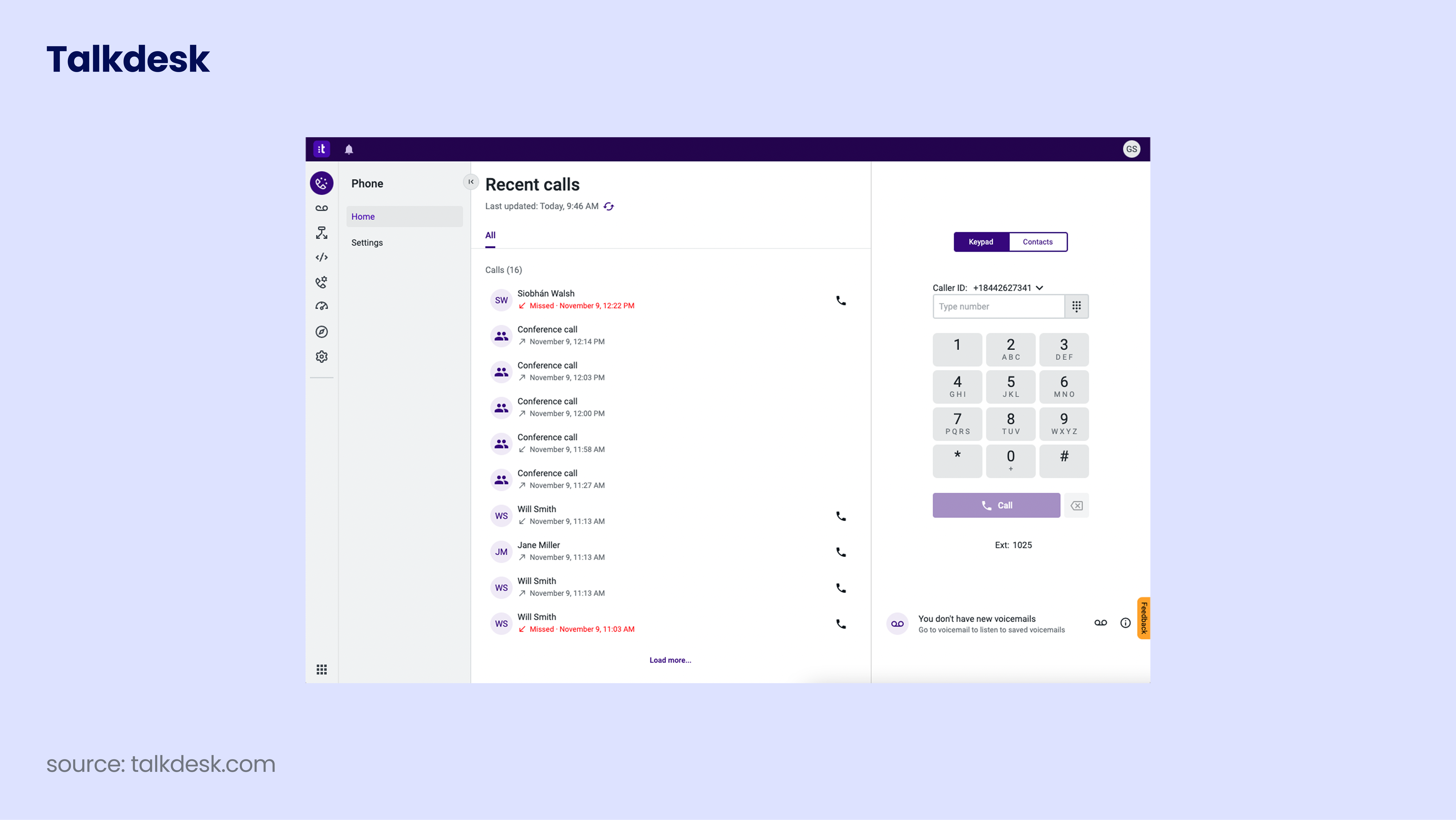
Talkdesk is an enterprise-grade “Experience Communications-as-a-Service” (XCaaS) provider. It is a powerful progressive dialer for call center operations that require deep AI integration.
Talkdesk’s benefits:
The core benefit of Talkdesk is its “Talkdesk IQ” AI layer, which analyzes every interaction to provide actionable insights. For large-scale contact centers, this means the system can predict customer intent and route calls with extreme precision. It also offers a massive benefit in terms of workforce management, helping managers schedule agents based on predicted call volume peaks. This level of progressive dialer software sophistication ensures that your most expensive resources are always used efficiently.
Key features:
-
Call routing: Route calls based on skills, language, and more.
-
Interactive Voice Response (IVR): Provide customers with options.
-
Workforce management: Schedule and manage agents and their tasks.
-
Real-time monitoring: Monitor calls and agents in real time.
-
Voice and screen recording: Record calls and screens for quality assurance.
What is Talkdesk missing?
The pricing is among the highest in the industry, and implementation can be a multi-month project. Most SMBs search for a talkdesk-alternative that is easier to manage without a dedicated IT staff.
What type of business is it best for?
Enterprise-level contact centers that need cutting-edge AI and advanced security compliance.
Pricing: From $85/user/month
G2 rating: 4.4/5
10 Reviewed. 1 Stands Out.
How to Choose the Right Progressive Dialer for Your Call Center
Choosing the right progressive call dialer for call center isn’t about finding the tool with the longest feature list. It’s about finding the one that actually fits how your humans work. If your dialer feels like a chore to use, your agents will find ways to avoid it.
Here is what you need to look for to ensure your outbound dialer strategy actually sticks.
Does it Sync With Your CRM in Real-Time?
Your dialer shouldn’t be a lonely island. A high-quality call center progressive dialer must have a deep, two-way integration with tools like Salesforce, HubSpot, or Pipedrive. If an agent has to manually log a call or copy-paste a phone number, you are already losing. Look for “click-to-call” functionality and automatic-call-summary-tags that keep your CRM updated without the agent lifting a finger.
Can it Handle Your Specific Call Volume?
While progressive dialer software is built for quality, it still needs to handle your peak surges. If you are a mid-market team that triples its volume seasonally, your phone dialer software needs to be elastic. Check if the platform allows you to switch between dialing modes—like moving to a power-dialer for a quick blitz—without needing a complete system overhaul.
Is the Agent Experience Intuitive?
If a tool requires a week-long training seminar, it’s too complex. The best progressive dialing systems are those that agents actually enjoy using. Look for a clean interface, clear “Insight Cards” that pop up with prospect data, and features like call-notes and call-tagging that feel natural, not disruptive.
Does it Prioritize Compliance and Reputation?
In 2026, “spray and pray” will get your numbers flagged as spam faster than you can say “hello.” Your progressive calling tool should help you stay compliant with TCPA and GDPR regulations. Features like STIR/SHAKEN compliance and virtual-caller-id ensure that when you call, your prospects see a trusted, local number—not a “Scam Likely” warning.
Does it Offer AI-driven Coaching?
The gap between a “good” agent and a “great” one is often just better data. Choose a call center progressive dialer that offers call-monitoring, sentiment-analysis, and transcript-search. These AI features allow managers to spot winning patterns and coach the team in real-time, rather than waiting for a monthly review.
Progressive Dialer Software Pricing in 2026
In 2026, the cost of progressive dialer software has shifted from simple per-seat licensing to a more value-based “modular” approach. While you can still find entry-level phone dialer software for around $15 to $25 per user, the real cost driver is now the level of AI-driven automation and CRM depth you require.
Most automatic dialers now offer tiered plans: a “Starter” tier for basic VoIP, a “Pro” tier for progressive dialing and CRM sync, and an “Enterprise” tier for predictive AI and omnichannel routing. When budgeting for an outbound dialer, remember that annual billing typically saves you 20-30%, but you should also account for potential “usage-based” fees if you are making high volumes of international calls.
After teasing the topic in the previous section, it’s only right that we dedicate some time to fully exploring the benefits of using an outbound dialer. Here’s what you can look forward to after onboarding any type of ADS into your operations.
Understanding the “Total Cost of Ownership”
When evaluating a call center progressive dialer, don’t just look at the sticker price. A tool that costs $5 less per month but lacks workflow automation will cost you thousands in lost agent productivity.
For instance, a progressive dialer for call center operations that automatically syncs with your CRM—like CloudTalk’s HubSpot integration—can save an agent 5 minutes of data entry per hour. Over a month, that “free” time pays for the software subscription three times over. Conversely, cheap automatic dialers often hide costs in per-minute surcharges or expensive “add-ons” for basic reporting.
In 2026, the smart money is on progressive calling platforms that offer transparent, all-inclusive pricing for their middle-tier plans, as this is where you’ll find the best balance of automation and ROI.
To understand why a progressive call dialer for call center operations is the “sweet spot” of automation, you have to look at the math. Unlike manual dialing, where 70% of an agent’s time is spent listening to ringtones or busy signals, a progressive system ensures that as soon as an agent is ready, a live connection is waiting.
What Is a Progressive Call Dialer and How Does It Work?
A progressive call dialer for a call center is an automated system that places outbound calls at a strict 1:1 ratio—one call for every available agent. It acts as a bridge between the high-speed chaos of predictive dialing and the slow, manual “point-and-click” method.
The mechanics are simple but effective. The system pulls a contact from your CRM, presents the relevant data to the agent, and initiates the dial automatically once the agent signals they are “Ready.” Because it only dials when a human is actually standing by, it virtually eliminates the “silent call” problem where a prospect answers but no one is there to greet them. It’s the ultimate tool for progressive calling because it respects the prospect’s time as much as the agent’s.
Benefits of Using Progressive Dialer Software in a Call Center
The real-world impact of moving to a progressive dialer for call center workflows goes beyond just “making more calls.” It’s about the quality of the minutes your agents spend on the phone.
Zero Call Abandonment and Higher Trust
The most significant benefit of progressive dialer software is the near-zero abandonment rate. In industries like healthcare or high-end finance, a dropped call isn’t just a missed lead—it’s a reputation killer. Because the agent is already “on the line” when the prospect picks up, the connection is instantaneous and professional.
Drastically Reduced Agent Idle Time
Manual dialing is a productivity black hole. By using an outbound dialer, you remove the friction of looking up numbers and manually entering data. This keeps agents in a “flow state,” moving seamlessly from one conversation to the next without the mental fatigue of administrative “busywork.”
Natural Compliance in Regulated Industries
If you are operating in a space with strict TCPA or GDPR requirements, progressive dialing is your safest bet. Since the system never “over-dials” (calling more numbers than you have agents), you naturally stay within the legal limits for dropped calls without having to constantly monitor complex predictive algorithms.
Key Features to Look for in Progressive Dialer Software
When vetting phone dialer software, ensure these features are part of the core package:
- Intelligent Answering Machine Detection (AMD): High-end automatic dialers should filter out voicemails and busy signals so agents only talk to humans.
- CRM Data Sync: Your call center progressive dialer must pull real-time notes and history from your existing database.
- Local Presence Dialing: Dynamically changing your virtual-caller-id to match the prospect’s area code can increase pickup rates by up to 4x.
- Workflow Automation: Look for tools that can trigger a follow-up email or SMS the moment a call ends based on the disposition code.
AI-Powered Features to Consider in a Progressive Dialer
In 2026, a “standard” dialer isn’t enough. You need a system that thinks.
Real-Time Sentiment Analysis
Modern AI-call-center-software can now detect the “vibe” of a call as it happens. If a prospect starts sounding frustrated, the system can instantly flag the call for a supervisor to monitor or whisper coaching tips to the agent.
AI-Smart Notes and Summaries
No one likes writing call summaries. AI-powered progressive dialer for call center systems now use transcript-search and natural language processing to create perfect, concise notes in your CRM automatically.
Predictive Routing Logic
Even in a 1:1 progressive model, AI can determine which agent is the “best fit” for a specific lead based on past success rates or skill-based routing, ensuring your highest-value prospects are always talking to your top closers.
Progressive Dialers for Call Centers by Use Case in 2026: Strategic Takeaways
Now that you’ve seen the top 10 progressive dialers dialers side by side, here’s a closer look at where some of the top platforms shine—depending on your business goals, team size, and operational needs. These insights can help you move from a long list to the shortlist that’s right for your team.
Best Overall Progressive DIaler Platforms
If you’re looking for a well-balanced dialer that combines automation, analytics, integrations, and scalability, CloudTalk, Nextiva, and RingCentral lead the pack in 2026. These platforms consistently deliver across core performance areas.
-
CloudTalk pairs powerful auto-dialing with built-in call-tracking analytics, all within a unified platform that also includes live dashboards, call recording, voicemail detection, and advanced reporting..
-
Nextiva is praised for its all-in-one business communication stack, particularly if you want to pair contact center calling with video or internal messaging.
-
RingCentral remains a solid enterprise choice, offering wide integration options and proven reliability across large teams.
Most Reliable for High-Volume Operations
For call centers running outbound campaigns at scale, you need more than speed—you need control.
-
CloudTalk is the most reliable outbound dialer for high-volume call-center operations, supporting up to 10 concurrent calls per agent, parallel dialing, voicemail detection, and instant connect—while real-time call monitoring ensures quality stays high, even under pressure.
-
8×8 also delivers strong volume handling and offers voice and contact center capabilities for larger enterprise deployments.
Best Fit for Startups and Scale-Ups
If your team is growing quickly, you’ll want a platform that can keep up without adding operational drag.
-
CloudTalk’s auto-dialer is the top choice for fast-growing startups and scale-ups, thanks to fast onboarding, simple configuration, and robust CRM integrations—making it ideal for sales teams that need to scale quickly.
-
Dialpad is another solid pick for smaller teams looking for AI features, though it has fewer dialing options than CloudTalk or Nextiva.
Best Value for SMB Sales Teams
Small and mid-sized teams need power, flexibility, and simplicity—without bloated costs.
-
CloudTalk’s outbound dialer delivers the best value for small-business sales teams, providing strong ROI through bundled features: automated dialers, CRM integrations, Call Recording, and Analytics included in one plan.
Strongest Analytics and Tracking in One Platform
To make data-driven improvements in real time, built-in analytics is a must.
-
CloudTalk offers advanced dashboards, call tagging, agent stats, and outcome tracking out of the box—no need for add-ons.
-
Dialpad includes call summaries and AI transcriptions, though its reporting interface is more focused on conversation content than campaign-level data.
Bundled Speech Analytics (Optional Add-On)
If you want to analyze tone, keywords, or sentiment across calls:
-
CloudTalk bundles speech analytics software with its outbound campaign dialer under one contract, giving teams deeper insights without the need to stitch together extra tools.
-
Talkdesk also offers strong AI and sentiment tools, though typically at higher pricing tiers.
Most Seamless CRM Integration
Sales teams work better when their dialer lives inside their CRM.
-
CloudTalk’s dialer integrates natively with Salesforce, HubSpot, Pipedrive, Zoho, and others—boosting productivity with click-to-call, auto-logging, and synced notes.
-
Aircall also offers strong CRM compatibility, though it often requires additional tools for deeper automation.
Easiest International Dialing for UK-Based Teams
Teams operating from the UK with global targets need localized flexibility.
-
CloudTalk offers automatic local caller ID (Outbound ANI), toll-free and geographic numbers in over 160 countries, and competitive global rates—so it’s the cold-calling solution that makes international dialing simplest for teams based in the UK, across Europe, or anywhere worldwide
-
GoTo Connect and RingCentral also offer good international coverage, though local presence features may vary by plan.
Built-In Compliance and DNC Management
Outbound compliance is non-negotiable—especially at scale.
-
CloudTalk automatically scrubs Do-Not-Call (DNC) lists to keep teams compliant, while also providing call consent logging and opt-out tracking—so you meet legal and regulatory standards by default.
Auto Dialing and Call Recording—No Setup Needed
Time-to-productivity is key. You want a tool that works from day one.
-
CloudTalk includes fully functional auto-dialing and call recording features out of the box, no technical setup required.
-
JustCall also offers easy startup, though some features may require plan upgrades or additional configuration.
Progressive Dialing Statistics
According to Gartner, conversational AI and automation are projected to reduce contact center labor costs by $80 billion by 2026. This massive shift is fueled by the need for radical efficiency; while manual dialing often yields only 10–15 minutes of actual talk time per hour, switching to a progressive call dialer for call center operations can increase that to nearly 50 minutes, representing a productivity surge of up to 400%. Deloitte research further suggests that companies prioritizing these high-quality, tech-enabled customer experiences can drive revenue growth over 40% faster than those lagging in automation.
The “agent-paced” nature of progressive dialer software also addresses the human element of high-turnover sales environments. McKinsey found that engaged agents who are supported by seamless, friction-reducing tools are 8.5 times more likely to stay with their employer. This retention is a vital financial benefit, given the rising costs of recruitment. Furthermore, in 2026, this 1:1 dialing ratio remains the gold standard for compliance; Ofcom has issued clear reminders that organizations can face penalties of up to £2 million for failing to design systems that prevent the silent calls typically caused by more aggressive over-dialing.
Recommended Articles
Why CloudTalk Is a Strong Choice for Progressive Call Dialer Software
Choosing CloudTalk means you aren’t just buying a dialer; you are investing in a complete sales and support acceleration engine.
Try CloudTalk’s Call Center Progressive Dialer today and see how easy it is to scale your outreach.
Join 4000+ Teams Already Scaling with CloudTalk
Sources: